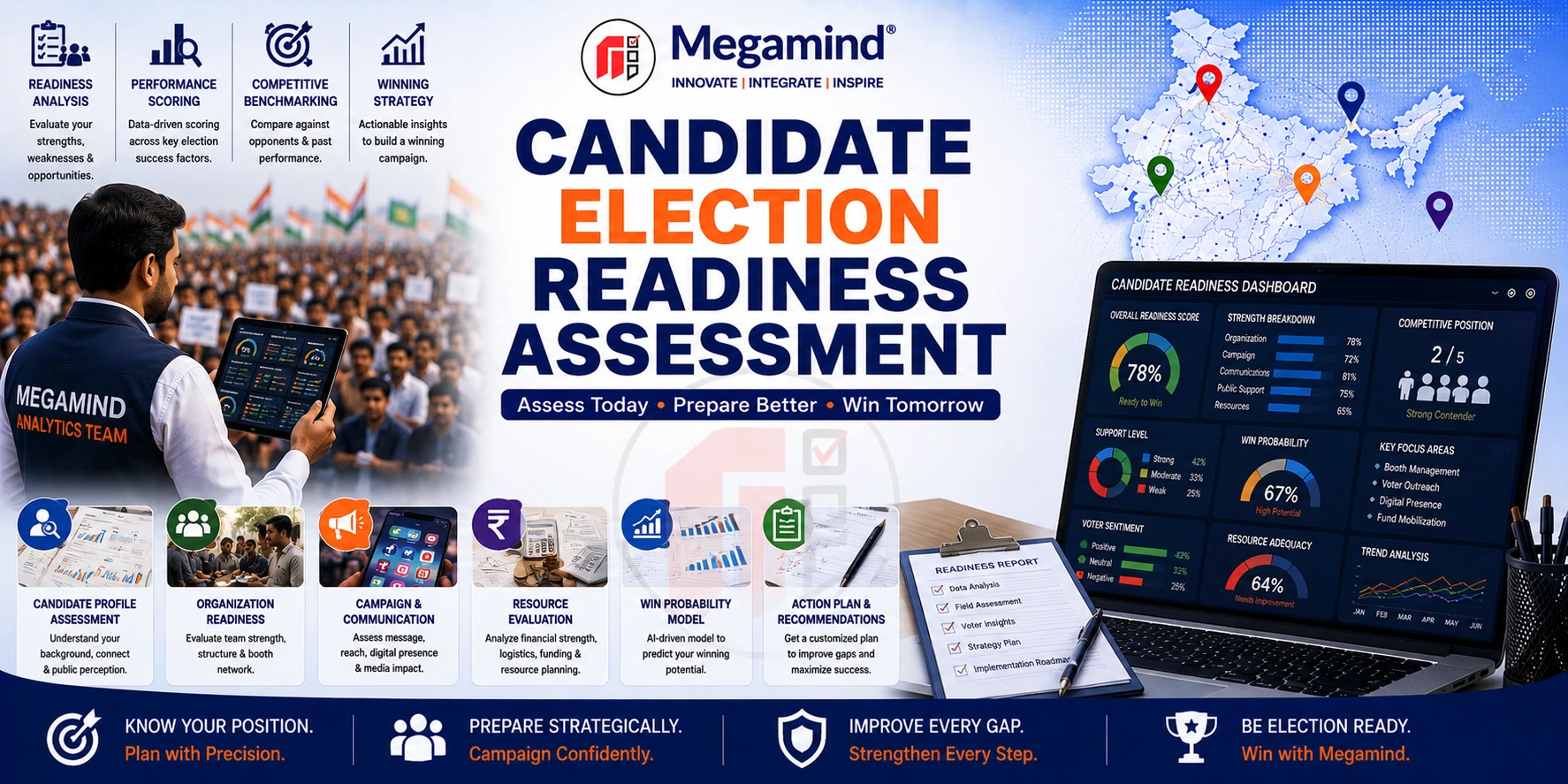
Before an election campaign enters intensive execution, campaign leadership needs a clear understanding of what is already prepared, what remains incomplete and which operational areas require immediate management attention. Megamind's Candidate Assessment & Election Readiness framework connects Candidate Profile → Constituency Context → Political Research → Campaign Organization → Ground Readiness → Communication Readiness → Digital Readiness → Campaign Infrastructure → Monitoring → Gap Analysis → Readiness Report → Management Review into one integrated pre-campaign and campaign-stage assessment system.
What is Candidate Assessment & Election Readiness?
Candidate Assessment & Election Readiness is a structured review of the candidate's current campaign preparedness across the major functions required for an organized election campaign.
The purpose is not simply to evaluate a candidate as an individual. A professional assessment examines the broader campaign system surrounding the candidate.
This can include:
- Candidate public profile assessment
- Constituency context review
- Historical electoral context
- Political research preparedness
- Campaign organization readiness
- Leadership coordination
- Ground campaign readiness
- Outreach operational readiness
- Political communication readiness
- Political branding readiness
- Digital campaign readiness
- Content and creative readiness
- PR and media readiness
- Campaign infrastructure assessment
- Monitoring and reporting readiness
- Election War Room preparedness
A candidate may have strong public visibility but weak campaign organization, or a well-organized field team but insufficient research, communication or reporting systems. Election readiness therefore needs to be evaluated as a complete campaign capability—not from one isolated indicator.
Why Candidate & Election Readiness Assessment Matters
Election campaigns involve many interdependent functions. Research can affect planning, planning can affect field deployment, communication requires verified information, monitoring depends on reporting and campaign leadership needs reliable operational visibility.
If these functions are not prepared at the right stage, campaign teams may spend valuable time solving preventable operational problems during intensive campaigning.
A structured readiness assessment helps leadership:
- Understand current campaign preparedness
- Identify missing campaign capabilities
- Recognize operational dependencies
- Clarify team responsibilities
- Review research requirements
- Evaluate field preparedness
- Review communication systems
- Assess digital campaign operations
- Review campaign infrastructure
- Identify reporting gaps
- Prioritize management attention
- Prepare for campaign scale-up
Our Candidate Assessment & Election Readiness Services
Candidate Profile Assessment
Reviewing documented candidate background, public profile, political experience, public activities and campaign-side preparedness.
Constituency Context Assessment
Reviewing aggregate electoral history, constituency characteristics, public issues and relevant political context.
Research Readiness
Evaluating whether the campaign has sufficient research, data sources, survey inputs and analytical processes for informed management review.
Campaign Organization Assessment
Reviewing campaign structure, team responsibilities, supervision, coordination and management processes.
Ground Campaign Readiness
Evaluating campaign-side field organization, operational planning, supervision and reporting readiness.
Outreach Readiness
Reviewing broad public outreach planning, coordination systems, volunteer organization and legitimate campaign communication processes.
Communication Readiness
Reviewing candidate communication, campaign information, branding consistency and approval workflows.
Digital Campaign Readiness
Evaluating authorized digital channels, content workflow, creative coordination, monitoring and reporting preparedness.
PR & Media Readiness
Reviewing campaign-side press communication, authorized spokesperson coordination, media monitoring and response processes.
Campaign Infrastructure Review
Reviewing offices, systems, workflows, reporting processes, information management and operational campaign infrastructure.
Monitoring & Reporting Readiness
Evaluating whether campaign leadership can receive timely and structured information about campaign operations.
Election Readiness Gap Analysis
Identifying operational gaps, dependencies, management priorities and campaign areas requiring further preparation.
What Does an Election Readiness Assessment Try to Establish?
A readiness assessment should begin with clear operational questions rather than assumptions about election outcome.
Key assessment questions can include:
- What campaign capabilities already exist?
- Which capabilities remain incomplete?
- What research is currently available?
- What research is still required?
- Is the campaign organization clearly structured?
- Are responsibilities documented?
- Is field coordination ready?
- Are reporting systems operational?
- Is candidate communication organized?
- Are digital operations prepared?
- Are content approval systems clear?
- Is campaign monitoring established?
- Can management identify issues quickly?
- Is the campaign ready for higher activity volume?
Structured Candidate & Election Readiness Assessment Methodology
Candidate Profile & Public Position Assessment
Candidate assessment can begin with documented information about the candidate's public and political profile.
Depending on project scope, the review may include:
- Documented candidate background
- Political experience
- Public responsibilities
- Past electoral participation
- Public activities
- Public communication presence
- Documented constituency engagement
- Available public profile material
- Campaign organization status
- Existing communication assets
- Current campaign infrastructure
- Publicly documented campaign activity
The assessment should distinguish documented facts from allegations, speculation, assumptions or unverified information.
Candidate Assessment vs Candidate Image & Reputation Management
Candidate Assessment & Election Readiness
Evaluates overall campaign preparedness, including research, organization, field operations, communication, digital systems, infrastructure, monitoring and management readiness.
Candidate Image & Reputation Management
Focuses on documented public profile, public perception research, candidate positioning, communication consistency and reputation monitoring.
Constituency Context for Candidate Readiness Assessment
Candidate readiness cannot be evaluated without understanding the constituency environment in which the campaign will operate.
Relevant constituency context may include:
- Historical election results
- Aggregate vote-share trends
- Voter-turnout history
- Winning-margin history
- Past candidate performance
- Aggregate area-level electoral patterns
- Aggregate booth-level electoral results
- Documented constituency issues
- Political competition
- Relevant public developments
- Political survey findings where available
- Research limitations and data gaps
Historical electoral information provides context. It does not reveal how an identifiable individual voted and should not be treated as a deterministic prediction of the next election.
Explore: Constituency Analysis
Historical Election Performance Review
Historical election data can help establish the broader electoral environment in which the candidate's campaign will operate.
Historical review may examine:
- Past election results
- Historical vote shares
- Winning and losing margins
- Turnout changes
- Number of candidates
- Past candidate performance
- Multi-election trends
- Aggregate geographic variation
- Election-to-election changes
- Available public electoral records
Historical performance should be used as analytical context rather than presented as proof of future voting behavior.
Political Competition Context in Candidate Assessment
Election readiness can also consider the publicly observable competitive environment in the constituency.
This may include:
- Historical competitor performance
- Public candidate profiles
- Documented political experience
- Public campaign activity
- Public communication activity
- Historical vote-share context
- Publicly documented organizational developments
- Verified election-related developments
Competitor research should rely on lawful and appropriate information sources and should distinguish verified facts from allegations or unverified claims.
Explore: Political Competitor Analysis
Political Research & Election Intelligence Readiness
Campaign planning becomes more difficult when management does not have a structured research base.
Research readiness can review whether the campaign has:
- Defined research questions
- Reliable election data sources
- Constituency research
- Historical electoral analysis
- Public issue research
- Candidate research
- Competitor research
- Survey research where appropriate
- Data validation processes
- Source documentation
- Research reporting
- Research update mechanisms
Political Survey Readiness & Research Requirements
Political surveys may provide useful aggregate research inputs when conducted using an appropriate methodology.
A readiness assessment can review:
- Whether a survey is required
- Research objectives
- Questionnaire requirements
- Geographic coverage
- Sampling methodology
- Fieldwork planning
- Data quality controls
- Analysis requirements
- Reporting requirements
- Methodological limitations
Survey findings should be interpreted at the level supported by the methodology. Respondent confidentiality should be respected, and survey research should not be converted into sensitive individualized political preference profiles.
Explore: Political Survey Services
Political Data & Analytics Readiness
Campaign leadership may receive information from multiple sources. Election readiness therefore includes evaluating whether those data sources can be organized into useful management-level analysis.
Data readiness can include:
- Historical election data availability
- Data-source documentation
- Data cleaning processes
- Aggregate constituency analysis
- Aggregate booth-result analysis
- Vote-share analysis
- Turnout analysis
- Winning-margin analysis
- Survey-data integration
- Dashboard requirements
- Reporting requirements
- Data-access controls
Campaign Organization & Management Readiness
Even a well-developed campaign plan can face execution problems when responsibilities and reporting structures are unclear.
Organizational readiness can review:
- Campaign leadership structure
- Functional responsibilities
- Field team structure
- Supervisor hierarchy
- Communication responsibilities
- Digital team responsibilities
- Research responsibilities
- Reporting responsibilities
- Escalation structure
- Decision-making workflow
- Meeting and review structure
- Cross-team coordination
Campaign Team Responsibility & Accountability Assessment
Campaign teams can lose operational efficiency when the same responsibility is assigned informally to multiple people or when important functions have no clear owner.
Assessment can identify whether key campaign functions have:
- Defined responsibility
- Named operational ownership
- Clear reporting line
- Defined review authority
- Issue escalation process
- Documented coordination mechanism
- Backup responsibility where appropriate
- Management visibility
Ground Campaign Readiness Assessment
Ground campaign readiness evaluates whether campaign-side field operations are sufficiently organized for the expected scale of legitimate campaign activity.
The assessment can review:
- Constituency field planning
- Campaign team deployment
- Supervisor structure
- Volunteer coordination
- Candidate program coordination
- Public meeting coordination
- Campaign activity calendar
- Field logistics
- Field reporting
- Issue escalation
- Field verification
- Management review
Explore: Ground Campaign Management
Booth Management Readiness Assessment
Where relevant to lawful campaign-side organization, the readiness assessment can review whether booth-level operational structures, responsibilities and reporting mechanisms are prepared.
Review areas can include:
- Booth-level organizational structure
- Campaign-side responsibility mapping
- Supervisor coordination
- Aggregate historical booth-result availability
- Campaign activity reporting
- Issue escalation
- Information consolidation
- Management reporting
Aggregate booth election results are historical geographic data. They should not be interpreted as revealing the vote or political preference of an identifiable individual.
Explore: Booth Management
Voter Outreach & Mobilization Operational Readiness
Campaign-side outreach readiness evaluates whether broad, lawful and respectful public outreach operations have the planning, coordination and reporting systems required for execution.
Review areas can include:
- Outreach planning
- Field coordination
- Volunteer organization
- Public program coordination
- Approved voter-information communication
- Activity reporting
- Supervisor review
- Issue escalation
- Operational monitoring
- Management reporting
Outreach readiness should not depend on sensitive individualized political profiles based on religion, caste, ethnicity, health, sexuality or inferred private political preferences.
Explore: Voter Outreach & Mobilization
Political Branding & Communication Readiness
Communication readiness evaluates whether the campaign has a consistent and operational framework for authorized candidate and campaign communication.
The assessment can review:
- Candidate public information
- Campaign identity consistency
- Communication responsibilities
- Approved information sources
- Content planning
- Creative coordination
- Fact verification
- Approval workflow
- Regional-language requirements
- Communication archive
- Public statement process
- Monitoring workflow
Explore: Political Branding & Communication
Political Campaign Content & Creative Readiness
Intensive campaigns can require a large volume of communication assets. Readiness assessment can examine whether the campaign has a structured content-production system.
Assessment areas may include:
- Content strategy
- Content calendar
- Creative requirements
- Content team structure
- Creative production workflow
- Candidate activity content
- Video content workflow
- Fact verification
- Approval process
- Publishing coordination
- Asset management
- Content reporting
Digital Election Campaign Readiness Assessment
Digital readiness focuses on whether authorized campaign digital operations have the necessary workflow, responsibilities, content coordination and monitoring systems.
It can review:
- Authorized campaign digital channels
- Digital team structure
- Content calendar
- Creative workflow
- Publishing responsibilities
- Content approval process
- Public digital reputation monitoring
- Platform policy awareness
- Digital activity reporting
- Operational analytics
- Issue escalation
- War Room coordination
Digital engagement indicators should not automatically be interpreted as representative voter opinion or election results.
Explore: Digital Election Campaign Management
Political PR & Media Readiness Assessment
Political campaigns may require organized processes for factual press communication, candidate media activity, public statements and media monitoring.
PR readiness can review:
- PR responsibility structure
- Authorized spokesperson process
- Press communication workflow
- Candidate media coordination
- Press conference coordination
- Media asset availability
- Fact verification
- Approval process
- Media monitoring
- Issue escalation
- Public clarification process
- War Room integration
Explore: Political PR & Media Management
Election Campaign Infrastructure Readiness
Campaign infrastructure is the operational foundation that allows research, field activity, communication, monitoring and management teams to work together.
Depending on project scope, readiness can review:
- Campaign office preparedness
- Team coordination mechanisms
- Reporting channels
- Information management systems
- Campaign documentation
- Content workflow
- Research access
- Issue tracking
- Management review process
- Data access controls
- Operational communication systems
- Campaign archive processes
Election Monitoring & Campaign Performance Readiness
Campaign leadership needs timely information about whether planned activities are being completed and where operational problems require attention.
Monitoring readiness can review:
- Campaign activity tracking
- Field reporting
- Operational KPI framework
- Issue tracking
- Pending action tracking
- Campaign calendar review
- Digital activity reporting
- Management dashboards
- Daily review process
- Weekly performance review
- Escalation system
- Management reporting
Election War Room Readiness Assessment
An Election War Room becomes useful when it receives structured information and has clear coordination, monitoring and escalation responsibilities.
War Room readiness can review:
- War Room responsibility structure
- Information flow
- Field reporting integration
- Digital monitoring integration
- Media monitoring integration
- Issue tracking
- Escalation procedures
- Campaign dashboards
- Daily management review
- Action tracking
- Reporting cadence
- Campaign leadership communication
Explore: Election War Room Management
Election Readiness Gap Analysis
One of the most important outputs of the assessment is a structured understanding of the difference between the campaign's current capability and its required operational capability.
Existing Capability
Functions, teams, systems and processes already available and operational.
Partial Capability
Functions that exist but require stronger structure, resources, ownership or coordination.
Missing Capability
Important campaign functions that are not yet sufficiently established.
Dependency
Functions whose readiness depends on another campaign system or decision.
Management Priority
Areas requiring campaign leadership review because of operational importance.
Follow-Up Review
Areas that should be reassessed after corrective actions or campaign development.
Campaign Readiness Status Framework
Assessment findings can be organized using a transparent readiness classification rather than making unsupported claims about election outcome.
These classifications describe operational preparedness. They do not represent candidate popularity, voting intention, probability of victory or predicted election outcome.
Candidate Election Readiness Matrix
A candidate's campaign can be reviewed across multiple readiness dimensions so that one strong area does not hide weaknesses elsewhere.
Research Readiness
Availability and quality of political research, constituency context and analytical inputs.
Organization Readiness
Team structure, responsibilities, supervision and campaign coordination.
Ground Readiness
Field planning, campaign-side team coordination, activity management and reporting.
Communication Readiness
Candidate communication, branding, content, approvals and factual information processes.
Digital Readiness
Digital operations, content workflow, monitoring and reporting preparedness.
Management Readiness
Monitoring, issue escalation, dashboards, review and decision-support processes.
Election Readiness Is Not the Same as Election Winnability
Election readiness evaluates whether campaign-side systems, teams and processes are prepared for execution.
It should not be confused with a claim that a candidate will win an election.
Election Readiness
Evaluates campaign preparedness, organization, research, communication, digital operations, field systems, monitoring and management capability.
Election Outcome
Depends on many uncertain factors including public opinion, voter participation, political competition, events and decisions made by voters.
For this reason, a readiness classification should not be represented as a probability of victory.
Pre-Campaign Election Readiness Assessment
One of the most useful stages for conducting a readiness assessment is before intensive campaign operations begin.
A pre-campaign review can help identify:
- Missing research
- Incomplete team structure
- Unclear responsibilities
- Field organization gaps
- Communication preparation gaps
- Digital setup requirements
- Content-production requirements
- PR and media requirements
- Reporting-system requirements
- Campaign infrastructure gaps
- War Room requirements
- Management priorities
Election Readiness Assessment During an Ongoing Campaign
Readiness assessment is also useful when a campaign has already started but leadership needs a structured review of current operations.
An ongoing campaign review can examine:
- What is functioning as planned
- What is delayed
- Where coordination is weak
- Which teams require stronger supervision
- Where reporting is incomplete
- Which campaign systems are overloaded
- Where approvals are slowing operations
- Which issues require escalation
- What management information is missing
- Which operational gaps require corrective action
Candidate Assessment & Election Strategy Integration
Election readiness findings can provide useful operational inputs for Election Strategy & Planning.
The relationship can be understood as:
Assessment → Identify Current Capability → Identify Gaps → Establish Requirements → Develop Campaign Plan → Execute → Monitor → Review
Candidate Assessment identifies the current campaign position. Election Strategy & Planning determines how campaign resources and activities should be organized within the approved campaign framework.
Explore: Election Strategy & Planning
Candidate Readiness & Election Campaign Management
Once assessment and planning are complete, identified campaign requirements can be integrated into a broader Election Campaign Management framework.
This may connect:
- Political research
- Election strategy
- Campaign organization
- Ground operations
- Booth management
- Public outreach
- Candidate communication
- Political branding
- Political PR
- Digital campaign management
- Campaign monitoring
- Election War Room
Explore: Election Campaign Management
Election Readiness Priority & Dependency Review
Not every identified gap has the same operational importance. A readiness assessment should help management understand which requirements need earlier attention and which depend on other campaign decisions.
Immediate Requirement
Important campaign capability requiring early management attention.
Near-Term Requirement
Capability that should be prepared before campaign activity increases.
Scheduled Requirement
Capability linked to a later campaign stage or planned operational milestone.
Dependent Requirement
Requirement whose implementation depends on another campaign decision, resource or system.
Monitoring Requirement
Existing capability that should remain under periodic management review.
Follow-Up Assessment
Area that should be reassessed after changes have been implemented.
Candidate Assessment & Election Readiness Report
Depending on project scope, assessment findings can be consolidated into a structured Election Readiness Report for campaign leadership.
The report can include:
- Assessment scope
- Candidate profile overview
- Constituency context summary
- Research readiness
- Organization readiness
- Ground campaign readiness
- Outreach readiness
- Communication readiness
- Digital readiness
- PR and media readiness
- Campaign infrastructure review
- Monitoring readiness
- War Room readiness
- Readiness gaps
- Dependencies
- Management priorities
- Limitations
- Follow-up review areas
Election Readiness Dashboard
For larger projects, assessment findings can be organized into a management dashboard that provides a consolidated view of campaign preparedness.
Assessment Status
Shows which campaign functions have been assessed and which remain pending.
Readiness Status
Displays operational readiness classification for assessed campaign functions.
Gap Register
Consolidates identified operational gaps requiring campaign attention.
Dependency Register
Tracks important dependencies between campaign systems and decisions.
Priority Review
Helps management organize readiness requirements by operational importance.
Follow-Up Status
Tracks areas requiring subsequent reassessment or management review.
Evidence, Assumptions & Assessment Confidence
Election readiness findings should clearly distinguish between verified information, operational observation, analytical interpretation and areas where evidence is incomplete.
Information can be classified as:
- Verified public information
- Authorized campaign information
- Documented operational status
- Aggregate research finding
- Field observation
- Analytical interpretation
- Management-provided information
- Information requiring verification
- Data limitation
- Assessment assumption
Where evidence is insufficient, the assessment should say so rather than presenting uncertainty as fact.
Field Feedback Is Not Automatically Representative Public Opinion
Campaign teams may receive observations from field workers, volunteers, meetings, campaign offices or public interactions.
These observations can be useful for identifying operational issues and possible research questions, but informal field feedback should not automatically be represented as scientifically representative public opinion.
When representative opinion estimates are required, appropriately designed survey research should be considered with transparent methodology and limitations.
Online Engagement Is Not an Election Readiness Outcome
Digital metrics can help assess whether campaign digital operations are active and whether content is being distributed as planned.
Views, reactions, comments, shares and similar indicators should not automatically be treated as representative public opinion, vote share or election outcome.
Digital readiness therefore evaluates operational capability rather than claiming that online activity proves electoral support.
Candidate Assessment Data Privacy & Information Governance
Candidate assessment projects may involve research documents, campaign information, operational reports, candidate materials and other project information.
Appropriate information governance can include:
- Defined project purpose
- Data minimization
- Appropriate source collection
- Access controls
- Secure information storage
- Controlled sharing
- Purpose limitation
- Version management
- Appropriate retention
- Responsible disposal where applicable
- Aggregate reporting where appropriate
- Consent and lawful basis where required
Candidate Assessment Without Sensitive Individual Voter Profiling
Candidate Assessment & Election Readiness can use aggregate electoral information, constituency-level research, properly designed surveys and documented public information.
The assessment does not require creating individualized political preference or persuadability profiles based on sensitive characteristics such as religion, caste, ethnicity, health, sexuality or other sensitive personal attributes.
Aggregate geographic election results should not be used to infer how an identifiable individual voted.
Election Compliance & Responsible Campaign Readiness
Campaign readiness should include awareness of applicable election regulations, official directions, permissions, privacy obligations, advertising requirements, platform policies and campaign-period restrictions relevant to the project.
Professional campaign readiness does not include or authorize:
- Voter intimidation
- Coercion
- Vote buying
- Unlawful inducements
- Impersonation
- Fabricated election information
- Interference with election officials
- Interference with polling operations
- Unauthorized handling of ballots or EVMs
- Interference with vote counting
- Misrepresentation of official election information
- Other unlawful campaign activity
Campaign Readiness vs Official Election Administration
Candidate Assessment & Election Readiness concerns the candidate's or campaign organization's own lawful campaign systems and operational preparedness.
Campaign-Side Readiness
Research, campaign planning, team organization, lawful field activity, communication, digital operations, monitoring, reporting and campaign-side coordination.
Official Election Administration
Electoral rolls, polling-station administration, ballots, EVM administration, official polling procedures and vote counting remain the responsibility of authorized election authorities.
Candidate Assessment Across the Election Campaign Lifecycle
Candidate Assessment for Assembly Constituencies
Candidate Assessment & Election Readiness can be customized for a single Assembly constituency.
An Assembly-level project can combine:
- Candidate assessment
- Constituency analysis
- Historical election research
- Political survey research
- Campaign organization review
- Ground campaign readiness
- Booth organization readiness
- Communication readiness
- Digital readiness
- Campaign monitoring readiness
- War Room readiness
- Election Readiness Report
Candidate Assessment for Parliamentary Campaigns
Parliamentary campaigns can involve a larger geographic area, multiple Assembly segments, more campaign teams and a greater volume of reporting and coordination.
Readiness assessment can therefore consider:
- Multi-area campaign organization
- Assembly-segment reporting
- Research integration
- Field coordination hierarchy
- Campaign communication structure
- Digital coordination
- Media coordination
- Central reporting
- Issue escalation
- War Room integration
Election Readiness Assessment for Prospective Candidates
A prospective candidate may want to understand the practical campaign requirements before building a full campaign organization.
An early-stage assessment can identify:
- Available candidate information
- Required constituency research
- Research gaps
- Campaign organization requirements
- Field infrastructure requirements
- Communication requirements
- Digital setup requirements
- Content requirements
- Monitoring requirements
- Management-system requirements
This type of assessment evaluates campaign preparedness and planning requirements; it does not guarantee nomination, public support or election outcome.
Who Can Use Candidate Assessment & Election Readiness Services?
- Prospective political candidates
- Confirmed election candidates
- Political leaders
- Political parties
- Candidate campaign offices
- Election campaign organizations
- Campaign management teams
- Political research teams
- Election War Room teams
- Multi-constituency campaign organizations
Benefits of Candidate Assessment & Election Readiness
- Clear view of campaign preparedness
- Early identification of operational gaps
- Better understanding of campaign dependencies
- Clearer organizational responsibilities
- Improved research planning
- Better ground campaign preparation
- Improved communication preparedness
- Better digital campaign preparation
- Improved reporting structure
- Better management visibility
- Structured campaign priorities
- Improved integration between campaign functions
Common Gaps Found in Election Campaign Readiness
- Insufficient constituency research
- Unclear campaign structure
- Undefined team responsibilities
- Weak field reporting
- Incomplete supervisor structure
- Unorganized campaign data
- Disconnected research and planning
- Unstructured content workflow
- Slow communication approvals
- Weak digital coordination
- Insufficient campaign monitoring
- No clear issue escalation system
- Disconnected field and War Room operations
- Weak management reporting
Candidate Assessment & Election Readiness Deliverables
Deliverables can be customized according to candidate, constituency, election type, campaign stage, available information and agreed project scope.
- Candidate Assessment Framework
- Candidate Profile Review
- Constituency Context Summary
- Historical Election Context Review
- Research Readiness Assessment
- Campaign Organization Assessment
- Ground Campaign Readiness Review
- Booth Organization Readiness Review
- Outreach Readiness Assessment
- Communication Readiness Assessment
- Digital Campaign Readiness Assessment
- PR & Media Readiness Assessment
- Content & Creative Readiness Assessment
- Campaign Infrastructure Review
- Monitoring & Reporting Readiness Review
- War Room Readiness Assessment
- Election Readiness Gap Register
- Campaign Dependency Register
- Management Priority Summary
- Election Readiness Report
Customized Candidate & Election Readiness Projects
Every political campaign begins from a different level of preparedness. Some candidates may already have established campaign teams and research, while others may still be developing the basic campaign structure.
Assessment scope can therefore be customized according to:
- Candidate status
- Election type
- Constituency
- Campaign stage
- Existing organization
- Available research
- Field team structure
- Digital operations
- Communication structure
- Campaign infrastructure
- Assessment timeline
- Management requirements
Assess → Research → Evaluate → Identify Gaps → Prioritize → Prepare → Review
Megamind integrates Candidate Assessment + Constituency Analysis + Political Research + Political Data Analytics + Political Survey + Campaign Organization + Ground Readiness + Communication Readiness + Digital Readiness + Monitoring + Election War Room into one structured Election Readiness framework.
Our assessment cycle can follow:
Define Scope → Collect Information → Assess Current Capability → Verify Operational Status → Identify Gaps → Review Dependencies → Establish Priorities → Prepare Readiness Report → Management Review → Follow-Up Assessment
The purpose is to give campaign leadership a clearer, evidence-based understanding of operational preparedness before important campaign decisions and execution stages.
Discuss Candidate Assessment Requirements →Why Megamind for Candidate Assessment & Election Readiness?
Megamind approaches candidate readiness as an integrated campaign-management question rather than evaluating one isolated campaign function.
This allows the assessment to connect research, constituency context, campaign organization, field operations, communication, digital operations, monitoring and management systems within one framework.
- Integrated candidate and campaign assessment
- Constituency research integration
- Historical election context
- Political research integration
- Campaign organization assessment
- Ground readiness review
- Communication readiness review
- Digital readiness assessment
- Campaign infrastructure assessment
- Monitoring readiness
- War Room readiness
- Structured gap analysis
- Management-level readiness reporting
- Responsible research and data practices
FAQs About Candidate Assessment & Election Readiness
1. What is Candidate Assessment & Election Readiness?
Candidate Assessment & Election Readiness is a structured review of a candidate's campaign preparedness, including public profile, constituency context, organization, research, communication, digital operations, ground operations, campaign infrastructure and management systems.
2. Who can use Candidate Assessment & Election Readiness services?
The service can be used by political candidates, prospective candidates, political leaders, political parties and campaign organizations seeking a structured assessment of campaign preparedness.
3. Does Megamind provide Candidate Assessment services across India?
Yes. Megamind provides Candidate Assessment & Election Readiness services in India according to election type, constituency, project scope and available research requirements.
4. What is an Election Readiness Assessment?
An Election Readiness Assessment evaluates whether important campaign functions such as research, organization, field operations, communication, digital operations, monitoring and management systems are sufficiently prepared for the planned campaign.
5. What areas can be included in a candidate assessment?
Assessment areas can include candidate public profile, constituency context, historical election information, campaign organization, field structure, research readiness, communication, digital presence, campaign infrastructure, monitoring and reporting.
6. Can constituency analysis be included in election readiness assessment?
Yes. Aggregate constituency research and historical electoral information can provide important context for evaluating campaign readiness.
7. Can political surveys support candidate assessment?
Yes. Properly designed aggregate political surveys can provide research inputs about selected public issues, awareness and opinion within their stated methodology and limitations.
8. Does candidate assessment include campaign organization review?
Yes. Campaign organization review can examine team structure, responsibilities, coordination, reporting, supervision and operational preparedness.
9. What is Ground Campaign Readiness?
Ground Campaign Readiness evaluates whether campaign-side field teams, coordination processes, activity planning, supervision, reporting and legitimate outreach operations are operationally prepared.
10. What is Digital Campaign Readiness?
Digital Campaign Readiness reviews the operational preparedness of authorized digital channels, content workflow, creative coordination, publishing processes, monitoring and reporting.
11. What is Political Communication Readiness?
Political Communication Readiness reviews whether candidate information, approved communication framework, content systems, media coordination and communication workflows are sufficiently organized.
12. Can candidate public image be assessed?
Publicly available candidate information and appropriately designed aggregate research can be reviewed as part of candidate assessment, while detailed image and reputation management can be handled through a dedicated Candidate Image & Reputation Management service.
13. Can campaign infrastructure be assessed?
Yes. Campaign offices, team coordination systems, reporting mechanisms, content workflows, data processes, communication channels and other relevant campaign-side infrastructure can be reviewed according to project scope.
14. What is an Election Readiness Gap Analysis?
Election Readiness Gap Analysis identifies differences between the campaign's current operational capability and the capabilities required for the planned campaign.
15. Can election readiness be assessed before a campaign starts?
Yes. A pre-campaign assessment can help identify research, organization, communication, digital, field and management requirements before intensive campaigning begins.
16. Can an ongoing election campaign be assessed?
Yes. An ongoing campaign can be reviewed to identify operational gaps, coordination issues, reporting weaknesses and areas requiring management attention.
17. Can Election War Room readiness be assessed?
Yes. The assessment can review whether campaign reporting, issue tracking, monitoring, coordination and management review systems are prepared for Election War Room operations.
18. What is included in an Election Readiness Report?
Depending on project scope, an Election Readiness Report can summarize assessment areas, existing capabilities, operational gaps, dependencies, readiness observations and recommended management priorities.
19. Can Candidate Assessment support Election Strategy & Planning?
Yes. Candidate and campaign readiness findings can provide useful inputs for broader Election Strategy & Planning.
20. Can Candidate Assessment integrate with Political Research & Election Intelligence?
Yes. Political research can provide evidence and context for candidate and campaign readiness assessment.
21. Can Candidate Assessment be customized for an Assembly constituency?
Yes. The scope can be customized for an Assembly constituency according to candidate requirements, available information, campaign stage and agreed project objectives.
22. Can Candidate Assessment support Parliamentary elections?
Yes. Candidate and campaign readiness assessments can be structured for Parliamentary and larger multi-area campaign requirements.
23. Does Candidate Assessment create sensitive individual voter profiles?
No. Responsible Candidate Assessment can use aggregate constituency information, properly designed research and documented public information without creating sensitive individualized political preference or persuadability profiles.
24. Does an Election Readiness score predict the election result?
No. A readiness assessment evaluates campaign preparedness. It should not be presented as a deterministic prediction of voting behavior or election outcome.
25. Does Candidate Assessment & Election Readiness guarantee election victory?
No. Candidate Assessment & Election Readiness can identify campaign capabilities, gaps and operational priorities, but it cannot guarantee public opinion, voting behavior or an election result.
Building Election Readiness Before Campaign Pressure Increases
A political campaign is a combination of research, organization, people, communication, technology, field operations, monitoring and management processes.
Candidate Assessment & Election Readiness provides a structured way to evaluate whether these campaign-side capabilities are sufficiently prepared and where important operational gaps remain.
Megamind's framework connects Candidate Assessment, Constituency Analysis, Political Research, Political Data Analytics, Political Survey, Campaign Organization, Ground Operations, Political Communication, Digital Campaign Management, Campaign Monitoring and Election War Room Management within one integrated readiness review.
The objective is not to claim certainty about election results. The objective is to provide campaign leadership with a clearer understanding of current preparedness, operational gaps, dependencies and management priorities.
Assess Your Campaign's Election Readiness
Discuss your candidate assessment, constituency research, campaign organization, ground readiness, communication readiness, digital preparedness, monitoring systems, Election War Room requirements and Election Readiness Report with Megamind.
Discuss Candidate Assessment Project