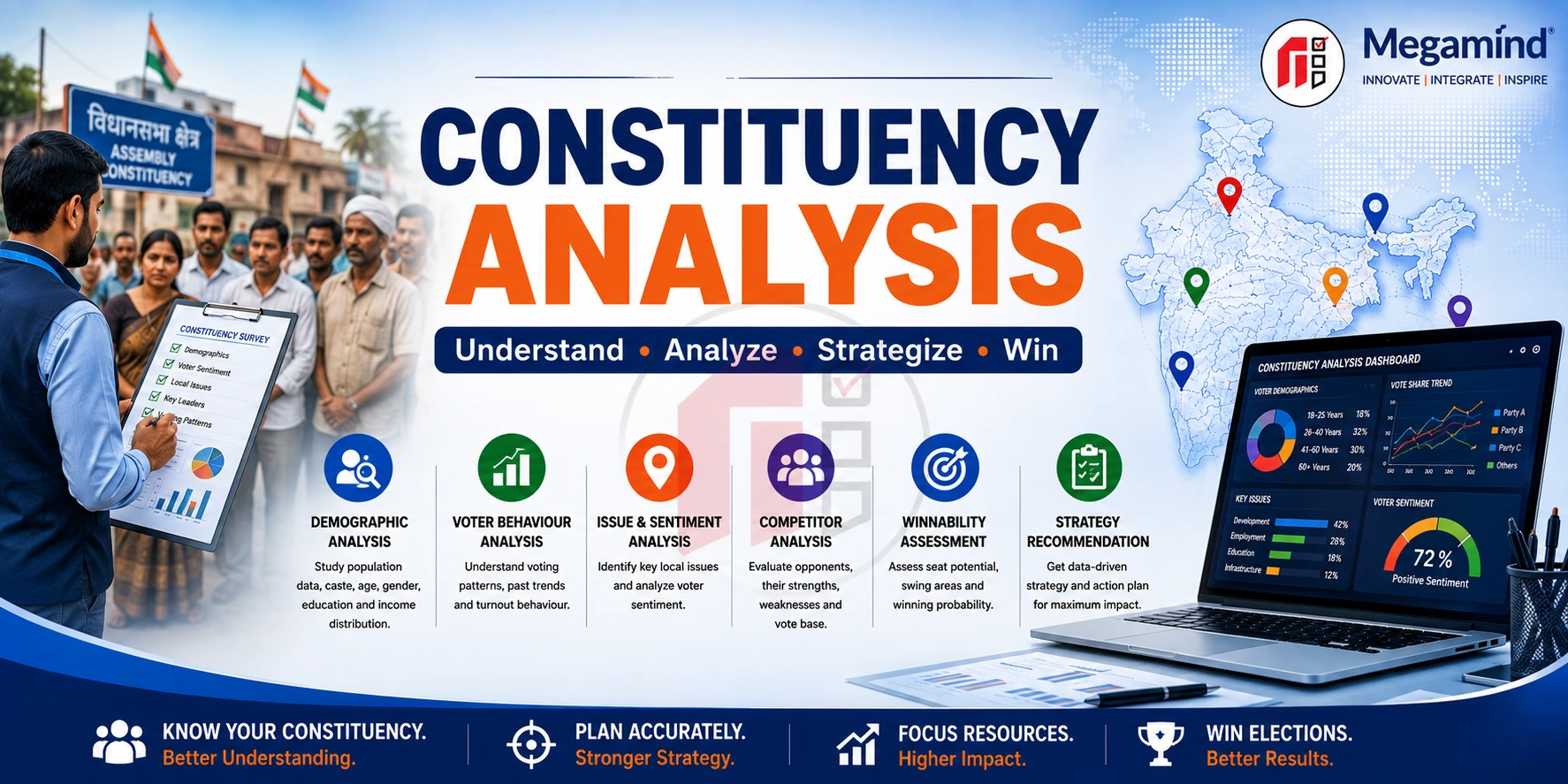
Every constituency has its own electoral history, geography, political competition, turnout patterns, public issues and campaign environment. Megamind Constituency Analysis brings these different information streams together through a structured process: Collect → Organize → Compare → Analyze → Interpret → Report .
What is Constituency Analysis?
Constituency Analysis is the systematic study of an electoral constituency using historical election results, aggregate electoral statistics, political research, candidate information, public issues, field research and other appropriate information.
It helps transform scattered election information into a structured understanding of the constituency.
Rather than relying only on the latest election result, professional constituency analysis examines multiple elections, vote-share movement, turnout, margins, candidate performance, aggregate geographic patterns and current research.
A constituency should be understood as a changing electoral environment rather than a single election result. Historical data provides context, while surveys, field research and current political information can provide additional evidence about present conditions.
Why Constituency Analysis is Important
Campaign planning becomes more structured when leadership has an organized understanding of the constituency before major operational decisions are made.
- Understand historical election performance
- Compare party and candidate vote share
- Analyze turnout trends
- Study winning and losing margins
- Understand geographic electoral patterns
- Review candidate performance
- Integrate political survey findings
- Understand important public issues
- Review competitive landscape
- Organize field research
- Identify material electoral changes
- Support evidence-based campaign planning
What We Analyze in a Constituency
Historical Election Analysis
Multi-election analysis of aggregate constituency results and electoral changes over time.
Vote Share Analysis
Candidate and party vote-share comparison across available election periods.
Turnout Analysis
Analysis of aggregate participation and turnout changes across elections and geographic areas.
Winning Margin Analysis
Comparison of victory and defeat margins to understand historical competitiveness.
Candidate Performance
Structured comparison of historical candidate performance and relevant current research.
Booth-Level Aggregate Analysis
Geographic review of appropriate aggregate polling-area results and electoral patterns.
Election Trend Analysis
Identification of material changes across multiple election periods and relevant current research.
Political Survey Integration
Integration of appropriately designed aggregate survey findings into constituency assessment.
Issue Analysis
Structured research into relevant constituency and public issues.
Competitor Analysis
Assessment of the wider political competitive environment using appropriate evidence.
Ground Research Integration
Organization of appropriate field reports and research into the wider constituency picture.
Constituency Intelligence Report
Structured presentation of key findings for leadership review and campaign planning.
How Our Constituency Analysis Process Works
Historical Election Result Analysis
Historical election results provide the factual foundation for understanding how political competition has developed within a constituency.
Depending on available records, we can organize and analyze:
- Previous election results
- Candidate-wise aggregate votes
- Party-wise aggregate votes
- Total valid votes
- Vote share
- Turnout
- Winning and losing margins
- Candidate ranking
- Party performance changes
- Multi-election trends
Historical analysis provides context. It should not be treated as proof that a future election will produce the same result.
Multi-Election Constituency Comparison
A single election can be influenced by candidate changes, alliances, turnout, political circumstances and other factors. Comparing multiple elections provides a broader view of how the constituency has changed.
| Indicator | Comparison | Analytical Purpose |
|---|---|---|
| Vote Share | Across elections | Understand aggregate electoral movement |
| Turnout | Across election periods | Review participation changes |
| Winning Margin | Election-to-election | Understand historical competitiveness |
| Candidate Performance | Candidate/party comparison | Review changes in electoral performance |
| Geographic Pattern | Aggregate polling areas | Understand geographic result variation |
| Political Context | Election period | Interpret changes within wider context |
Constituency Vote Share Analysis
Vote share provides a standardized way to compare aggregate electoral performance even when the total number of votes cast changes between elections.
Analysis can examine:
- Candidate vote share
- Party vote share
- Vote-share change between elections
- Leading competitor comparison
- Multi-party vote distribution
- Long-term aggregate trend
Related reading: What is Vote Share Analysis?
Voter Turnout Analysis
Turnout analysis examines aggregate electoral participation and how it changes across elections or geographic areas.
Depending on available data, analysis may include:
- Total electors
- Total votes polled
- Turnout percentage
- Turnout change across elections
- Aggregate polling-area turnout
- Comparison with wider election patterns
Turnout should be interpreted alongside the broader electoral context rather than being treated as an isolated indicator.
Winning Margin & Competitiveness Analysis
Winning margin shows the difference between leading candidates and helps describe how competitive a previous election was.
We may compare:
- Absolute winning margin
- Margin as a share of votes
- Margin changes across elections
- First vs second candidate gap
- Multi-election competitiveness
- Relationship with turnout and vote share
Booth-Level Aggregate Constituency Analysis
Where appropriate aggregate polling-area results are available, constituency analysis can move beyond the overall result and examine how historical electoral outcomes varied geographically.
Analysis may include:
- Aggregate polling-area results
- Polling-area turnout
- Candidate performance comparison
- Party performance comparison
- Winning-margin patterns
- Multi-election geographic change
- Areas with changing aggregate results
- Geographic result visualization
Booth or polling-area election results are aggregate geographic outcomes. They should not be interpreted as proof of how a specific individual voted or of an individual's political preference.
Geographic & Area-Level Constituency Analysis
Electoral data becomes easier to interpret when it is organized geographically. Depending on available information, constituency analysis may compare relevant administrative or electoral areas.
Constituency Level
Overall electoral performance, turnout, candidates and multi-election trends.
Polling-Area Level
Aggregate geographic analysis where appropriate data are available.
Administrative Areas
Relevant geographic organization where boundaries and comparable data permit analysis.
Urban / Rural Context
Broad geographic context where reliable classification is available and relevant.
Electoral Change
Geographic comparison of aggregate changes across election periods.
Map-Based Reporting
Visualization of appropriate aggregate electoral indicators for easier interpretation.
Candidate Performance Analysis
Candidate performance is an important component of constituency analysis because electoral competition can change when candidates, alliances or political circumstances change.
Depending on available information, candidate analysis may include:
- Previous election performance
- Aggregate votes received
- Vote share
- Winning or losing margin
- Candidate ranking
- Previous contests
- Public campaign positioning
- Appropriate survey research
Political Competitor Analysis
Constituency analysis should also consider the wider competitive environment surrounding major candidates and political parties.
Competitor analysis may examine:
- Historical electoral performance
- Aggregate vote-share trends
- Candidate performance
- Public campaign activity
- Public communication themes
- Media visibility
- Public digital activity
- Material political developments
Explore our Political Competitor Analysis Services .
Political Survey Integration
Historical results explain what happened in previous elections. Properly designed political surveys can add research about current public opinion and defined constituency questions.
Depending on research objectives, aggregate survey research may examine:
- Candidate awareness
- Candidate perception
- Public issue importance
- Leadership perception
- Campaign awareness
- Public satisfaction research
- Other defined constituency research questions
Survey findings should always be interpreted together with the sampling method, sample size, questionnaire, field dates, geographic coverage and research limitations.
Explore: Political Survey Services and Opinion Poll Services .
Constituency Issue Analysis
Electoral statistics alone cannot describe every aspect of the current constituency environment. Research into public issues can provide additional context for campaign planning.
Issue research can be developed through appropriate methods such as:
- Structured political surveys
- Field research
- Publicly available information
- Constituency-level reports
- Public issue tracking
- Repeated research where required
Findings should distinguish between measured research results, public information and analytical interpretation.
Field Research & Ground Intelligence Integration
Constituency analysis can combine quantitative electoral data with appropriately collected field research to create a broader understanding of current conditions.
Depending on project scope, field information may include:
- Structured field observations
- Public issue reports
- Campaign activity reports
- Organizational readiness reports
- Public event information
- Verified local developments
Field information should be documented and evaluated rather than automatically treating every informal report as verified fact.
Constituency Election Trend Analysis
Election Trend Analysis compares electoral indicators across time to understand how the constituency has changed.
Vote Share Trend
Compare aggregate party and candidate vote-share movement across elections.
Turnout Trend
Understand changes in aggregate electoral participation.
Margin Trend
Review whether historical contests became closer or wider.
Candidate Trend
Compare candidate and party performance across election periods.
Geographic Trend
Compare appropriate aggregate geographic results over time.
Current Research
Add appropriately designed current research without treating it as equivalent to official results.
Related reading: What is Election Trend Analysis?
Constituency Profile vs Constituency Analysis
A constituency profile organizes descriptive information. Constituency analysis goes further by comparing electoral data, research and changes across time to produce analytical findings.
| Area | Constituency Profile | Constituency Analysis |
|---|---|---|
| Basic Information | Organizes constituency facts | Uses relevant facts as analytical context |
| Election Results | May list previous results | Compares results across elections |
| Vote Share | May present figures | Examines changes and patterns |
| Turnout | May show turnout | Compares turnout over time |
| Political Research | May provide background | Integrates structured current research |
| Output | Descriptive profile | Structured analytical intelligence |
You can also read: What is Constituency Profiling?
From Election Data to Constituency Intelligence
Megamind combines multiple evidence streams so that constituency assessment is not dependent on a single indicator.
Historical Results → Vote Share → Turnout → Margins → Geographic Analysis → Candidate Assessment → Political Research → Competitive Analysis → Intelligence Report
The exact framework depends on the election type, constituency, available data, research requirements and project scope.
Constituency Intelligence Reports & Dashboards
Large amounts of electoral information become more useful when they are converted into structured reports and visual summaries.
Constituency Summary
Executive overview of important electoral and research findings.
Election Comparison
Multi-election tables for vote share, turnout, margins and candidate performance.
Geographic Analysis
Appropriate aggregate area-level analysis and visualization.
Political Research
Structured presentation of relevant aggregate survey and field findings.
Competitive Assessment
Summary of relevant political and candidate competition.
Leadership Dashboard
Concise display of defined indicators where dashboard reporting forms part of the assignment.
Constituency Analysis Deliverables
The final deliverables depend on project objectives, available information and research scope.
- Constituency intelligence report
- Historical election analysis
- Multi-election comparison
- Vote-share analysis
- Turnout analysis
- Winning-margin analysis
- Candidate performance analysis
- Aggregate geographic analysis
- Political survey findings
- Public issue analysis
- Competitor assessment
- Executive summary / dashboard
Electoral Data Verification & Research Quality
Constituency analysis may combine information from different election periods and research sources. Data quality and methodological consistency are therefore important.
- Use appropriate electoral data sources
- Review important result information
- Maintain election-year consistency
- Check candidate and party naming consistency
- Document survey methodology
- Identify missing or unavailable information
- Separate official results from research estimates
- Document analytical limitations
Privacy, Aggregate Data & Responsible Interpretation
Election and constituency analysis should distinguish between aggregate geographic data and information about individuals.
Megamind's analytical framework can use appropriate aggregate election results, political research and public information while maintaining responsible interpretation and project confidentiality.
- Use appropriate and lawful data sources
- Protect confidential project information
- Use aggregate election results appropriately
- Do not infer an individual's vote from area results
- Document research methodology
- Recognize uncertainty and limitations
- Separate evidence from analytical interpretation
- Follow applicable election and data requirements
Constituency Analysis for Political Campaigns
Political Parties
Constituency research and electoral analysis for defined election projects.
Election Candidates
Detailed constituency intelligence for campaign planning and leadership review.
Prospective Candidates
Early-stage constituency assessment before major campaign planning.
Political Leaders
Electoral research and constituency intelligence according to defined requirements.
Campaign Teams
Structured research inputs for campaign planning and monitoring.
Political Organizations
Constituency-level analytical support for defined political projects.
Integrated Electoral Data, Political Research & Intelligence
Megamind combines constituency analysis with political survey, voter data analysis, election trend analysis, competitor intelligence and campaign strategy capabilities.
- Historical election analysis
- Vote-share analysis
- Turnout analysis
- Winning-margin analysis
- Aggregate booth-level analysis
- Political survey capability
- Election trend analysis
- Competitor analysis
- Structured reporting
- Election strategy integration
The purpose of constituency analysis is to improve the quality and organization of information available for political research and campaign planning. It does not guarantee an election result.
Constituency Analysis FAQs
What is constituency analysis?
Constituency analysis is the structured study of an electoral constituency using historical results, aggregate electoral data, political research and other appropriate information.
What information is included?
Depending on scope, it may include election results, vote share, turnout, margins, candidate performance, aggregate booth trends, surveys, public issues and competitor analysis.
Why is constituency analysis important?
It provides an organized evidence base for understanding the constituency before developing campaign plans.
Can previous elections be compared?
Yes. Multi-election comparison can examine vote share, turnout, margins, candidates and other comparable aggregate indicators.
Can booth-level results be analyzed?
Where appropriate aggregate polling-area data are available, historical results can be organized geographically for analytical purposes.
Can political surveys be included?
Yes. Properly designed aggregate survey research can be integrated while considering methodology, field dates and research limitations.
Can competitor analysis be included?
Yes. Historical performance, appropriate research and publicly observable campaign information can contribute to the competitive assessment.
Does constituency analysis predict election results?
No. It provides structured research and analytical context. Election outcomes depend on voters and many changing factors.
Are your services available across India?
Megamind undertakes constituency analysis projects across India according to research scope, data availability and operational feasibility.
How can we start a constituency analysis project?
Share the election type, state, constituency and broad research requirement with Megamind to discuss an appropriate analytical framework.
Understand Your Constituency Through Data, Research & Election Intelligence
Discuss your election and constituency requirements with Megamind for a customized constituency analysis combining electoral data, political research and structured intelligence.
Discuss Constituency Analysis