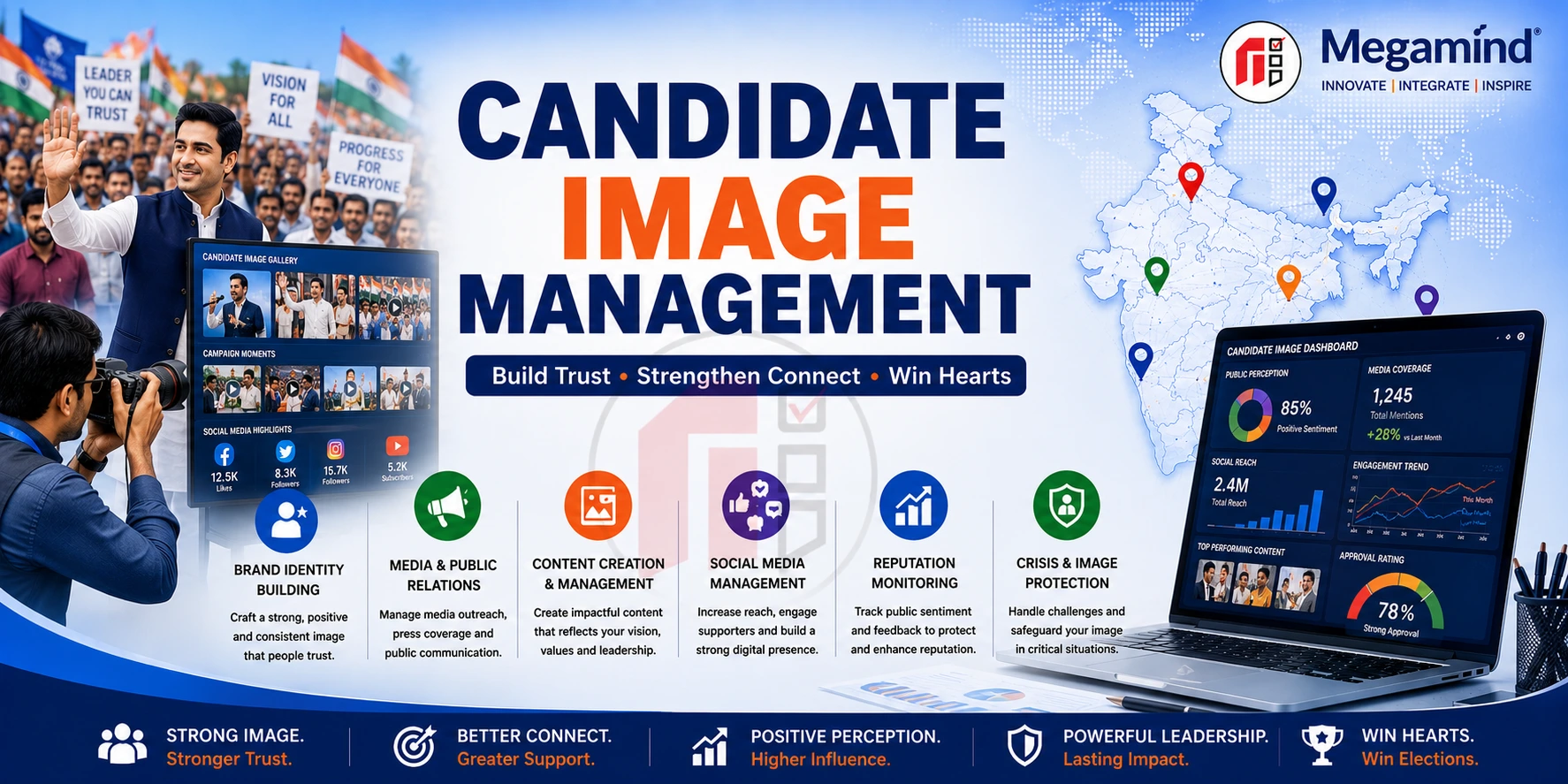
A political candidate's public image develops through many factors: leadership record, accessibility, communication, constituency work, public expectations, media coverage, campaign activity and public discussion. Candidate Image & Reputation Management creates a structured framework to Research → Understand → Position → Communicate → Monitor → Review the candidate's public profile in an authentic and responsible manner.
What is Candidate Image & Reputation Management?
Candidate Image & Reputation Management is the structured process of understanding how a political candidate or leader is publicly perceived and developing an appropriate framework for public positioning, communication and reputation monitoring.
It can combine political research, aggregate public perception studies, candidate profile assessment, communication review, public media monitoring, digital reputation monitoring and campaign coordination.
The objective is not to manufacture an artificial personality. Effective political image management should communicate the candidate's genuine experience, public work, priorities, leadership qualities and responsibilities clearly and consistently.
A sustainable political reputation should be based on credibility, consistency and verifiable public work. Communication can improve awareness and clarity, but it should not substitute for authentic leadership, public engagement and responsible conduct.
Why Candidate Image & Reputation Management is Important
Voters and the wider public may form impressions of political candidates through personal interaction, constituency work, speeches, public meetings, media coverage, digital platforms and discussions around local issues.
Structured research helps campaign teams understand where the candidate's actual public profile may differ from the profile the campaign assumes.
- Understand aggregate public perception
- Measure candidate awareness
- Study leadership attributes
- Identify recognized public strengths
- Identify reputation concerns
- Review communication consistency
- Understand important public issues
- Improve leadership profile clarity
- Coordinate campaign communication
- Monitor relevant public media coverage
- Monitor public digital reputation
- Support periodic reputation review
Our Candidate Image & Reputation Management Services
Candidate Image Assessment
Structured assessment of the candidate's existing public profile, visibility and recognized leadership attributes.
Public Perception Research
Appropriate aggregate research to understand public awareness, satisfaction, expectations and defined candidate attributes.
Reputation Assessment
Structured review of relevant reputation indicators, public issues and communication considerations.
Candidate Positioning
Development of a clear and authentic leadership positioning framework based on appropriate research.
Leadership Profile Development
Structured presentation of relevant experience, priorities, public work and leadership responsibilities.
Political Communication Planning
Development of consistent communication themes around legitimate campaign priorities and public information.
Media Communication Support
Coordination of defined public media communication, interviews, briefings and campaign information.
Public Digital Reputation Monitoring
Structured review of relevant publicly available digital content and public campaign communication.
Public Issue Monitoring
Identification and organization of relevant public issues connected with the candidate or campaign.
Reputation Risk Monitoring
Structured monitoring of significant public reputation developments requiring review.
Crisis Communication Coordination
Responsible coordination of verified information, approved communication and appropriate public response.
Image & Reputation Monitoring
Periodic review of defined public image, communication and reputation indicators.
Candidate Image Management Process
Candidate Image Assessment
Candidate image assessment establishes a baseline before communication or reputation initiatives are planned.
Depending on the project, the assessment can review:
- Current public visibility
- Candidate awareness
- Leadership recognition
- Political experience
- Constituency work visibility
- Public accessibility perception
- Communication profile
- Relevant public reputation issues
- Media visibility
- Public digital presence
Public Perception Research
Political surveys and other appropriate research methods can help understand aggregate public perception instead of relying only on assumptions or isolated feedback.
Awareness
Measure how widely the candidate is recognized within the defined research population.
Leadership Attributes
Study defined aggregate perceptions relating to leadership characteristics.
Public Work Awareness
Understand awareness of relevant public or constituency work.
Accessibility
Study aggregate perception of candidate accessibility where appropriate.
Issue Association
Understand which public issues respondents associate with the candidate.
Public Expectations
Identify important aggregate expectations emerging from appropriately designed research.
Explore our Political Survey Services for structured election and public opinion research.
Strength, Concern & Communication Gap Analysis
Research findings can be organized into a practical assessment of the candidate's recognized strengths, public concerns and communication gaps.
- Recognized leadership strengths
- Experience and public record
- Constituency visibility
- Recognized public work
- Communication strengths
- Awareness gaps
- Reputation concerns
- Information gaps
- Public expectation gaps
- Issues requiring further research
Findings should be interpreted within the methodology and limitations of the underlying research.
Candidate Positioning & Leadership Profile
Candidate positioning defines how legitimate leadership qualities, public work, experience and campaign priorities can be communicated clearly.
A positioning framework may organize:
- Leadership profile
- Relevant political experience
- Public service record
- Constituency involvement
- Policy and development priorities
- Public accessibility
- Relevant achievements
- Campaign priorities
Candidate positioning should be based on authentic, supportable information. Reputation can be damaged when campaign communication creates claims or expectations that cannot be supported by facts.
Candidate Communication Planning
Candidate reputation is influenced not only by what is communicated but also by whether communication remains clear, consistent and aligned with actual public responsibilities.
Communication Framework
Organize key legitimate themes, public information and communication priorities.
Speech Coordination
Support consistency between defined campaign priorities and public communication.
Public Meeting Communication
Structure relevant information for appropriate campaign and public events.
Media Communication
Coordinate accurate and consistent public information for relevant media interactions.
Digital Communication
Maintain consistency across appropriate public digital campaign communication.
Campaign Coordination
Align authorized campaign communication around approved public information and priorities.
Candidate Media Image Management
Public media coverage can contribute to candidate visibility and reputation. Where included in scope, communication can be coordinated around accurate and relevant public information.
- Media communication planning
- Public information coordination
- Interview preparation support
- Press briefing coordination
- Public statement consistency
- Relevant media monitoring
- Issue-response coordination
- Coverage review
See our Public Relations Services for broader political PR support.
Public Digital Reputation Management
Public digital channels are an important part of a candidate's visible communication environment. A structured approach can help maintain consistency and identify relevant public reputation developments.
- Public profile consistency
- Public campaign communication review
- Public content monitoring
- Public issue monitoring
- Relevant media content review
- Communication consistency review
- Material public reputation developments
- Periodic digital reputation reporting
Public digital monitoring should focus on legitimate, publicly available information and responsible campaign communication.
Public Issue & Reputation Risk Monitoring
Reputation management should identify relevant developments early enough for the campaign to verify information and decide whether an appropriate response is required.
A structured monitoring cycle can follow:
Monitor → Identify → Verify → Assess → Prioritize → Coordinate → Communicate → Review
Not every criticism or public discussion requires a campaign response. Research, verification and proportionality are important before communication decisions are made.
Reputation Risk & Crisis Communication Coordination
Significant public issues may require faster coordination between campaign leadership, communication teams, research teams and other appropriate advisers.
A responsible process can include:
- Identify the issue
- Verify available facts
- Assess relevance and seriousness
- Identify authorized decision-makers
- Coordinate accurate information
- Determine whether response is appropriate
- Monitor subsequent public developments
- Review communication outcome
Integrating Ground Feedback with Candidate Image Research
Structured field research can complement broader political surveys by helping campaign teams understand local issues and candidate-related observations within the defined project scope.
Research inputs may include appropriate:
- Political survey findings
- Structured field research
- Constituency-level research
- Public issue research
- Campaign feedback systems
- Relevant public information
Individual anecdotes should not automatically be treated as representative of the wider electorate. Research methodology and sample quality remain important.
Integrating Candidate Reputation with Election Strategy
Candidate image should not operate separately from the wider election campaign. Research findings can inform campaign planning, public communication and reputation monitoring.
Candidate image management can be coordinated with:
- Election Strategy & Planning
- Political Survey
- Constituency Analysis
- Competitor Analysis
- Election Campaign Management
- Public Relations
- Election War Room Management
- Campaign monitoring and reporting
Research-Led Candidate Image & Reputation Management
Megamind approaches political image management as a continuous research, communication and monitoring process rather than a one-time publicity exercise.
Research → Candidate Assessment → Public Perception → Positioning → Communication → Campaign Integration → Reputation Monitoring → Review
The framework is customized according to the candidate, constituency, election type, campaign stage and defined project requirements.
Accuracy, Transparency & Responsible Political Communication
Candidate reputation management should be based on responsible research and communication practices.
- Use appropriate research methodology
- Maintain clear research limitations
- Use supportable public information
- Avoid fabricated achievements or claims
- Distinguish research findings from official results
- Use public monitoring responsibly
- Respect applicable data obligations
- Follow applicable election and communication requirements
Reputation management should not be interpreted as suppressing lawful criticism or manipulating factual public records.
Candidate Image & Reputation Management Deliverables
Deliverables depend on research scope, campaign stage and project requirements.
- Candidate image assessment
- Public perception research summary
- Candidate awareness assessment
- Strength and concern analysis
- Leadership profile framework
- Candidate positioning framework
- Communication planning framework
- Public issue monitoring summary
- Media reputation monitoring
- Public digital reputation monitoring
- Reputation risk reporting
- Periodic image and reputation review
Candidate Reputation Solutions for Political Leadership
Election Candidates
Research-led candidate image, positioning and communication support.
Political Leaders
Structured public profile and reputation monitoring projects.
Political Parties
Candidate research and communication support for defined campaigns.
Campaign Teams
Candidate communication coordination and reputation reporting.
First-Time Candidates
Structured research and leadership profile development for emerging candidates.
Incumbent Representatives
Research into public awareness, reputation and communication of relevant public work.
Political Research, Strategy & Reputation in One Framework
Candidate reputation is connected with the wider political environment. Megamind can combine defined candidate image requirements with political research, constituency intelligence, campaign planning and monitoring.
- Research-led approach
- Political survey capabilities
- Constituency intelligence
- Candidate assessment
- Competitor analysis integration
- Political communication support
- Public reputation monitoring
- Election War Room integration
- Structured reporting
- Campaign strategy coordination
Candidate Image & Reputation Management can improve research, communication consistency and reputation monitoring, but it does not guarantee an election outcome.
Building a Complete Candidate Image Intelligence Framework
A premium Candidate Image & Reputation Management programme requires more than a general review of publicity. It should create a structured intelligence framework that connects research, public visibility, leadership perception, communication, constituency work, media presence and reputation monitoring into one decision-ready system.
Megamind can organize these inputs into a candidate image intelligence framework so that campaign leadership can understand what is known, what is assumed, what requires verification and which areas require deeper research or communication attention.
- Baseline candidate image audit
- Awareness and recognition indicators
- Leadership perception indicators
- Public work visibility review
- Accessibility perception review
- Communication consistency assessment
- Media visibility assessment
- Public digital reputation review
- Issue association analysis
- Reputation concern mapping
- Positioning clarity assessment
- Periodic image tracking framework
Detailed Candidate Image & Public Profile Audit
A detailed image audit creates the starting reference point for the project. The purpose is to document the candidate's existing public profile before recommending positioning, communication or reputation-management actions.
Political Profile
Review relevant political experience, responsibilities, public roles, campaign history and publicly supportable leadership credentials.
Constituency Profile
Review visibility of constituency engagement, local presence, public accessibility and relevant public-service activity.
Communication Profile
Assess consistency of speeches, statements, campaign themes, public information and authorized communication.
Media Profile
Organize relevant public media visibility, recurring coverage themes, interview patterns and significant reputation developments.
Digital Profile
Review public-facing digital profiles, content consistency, public campaign information and relevant online reputation signals.
Research Profile
Bring together appropriate survey findings, field research and other defined aggregate indicators for a consolidated assessment.
Candidate Awareness, Recognition & Recall Analysis
High visibility and positive reputation are not the same thing. A candidate may be widely recognized but poorly understood, or may have strong constituency work that is not sufficiently known. Research can separate awareness from deeper leadership perception.
- Basic candidate recognition
- Unaided and aided awareness where methodologically appropriate
- Awareness of political role
- Awareness of constituency work
- Recognition of major public initiatives
- Leadership attribute recall
- Issue association
- Communication recall
Leadership Perception & Public Confidence Assessment
Where appropriate to the research design, aggregate studies can examine how the candidate is perceived across defined leadership dimensions. These indicators help identify where public understanding is strong, unclear or requires further investigation.
Leadership
Assess defined aggregate perceptions relating to leadership capability and public responsibility.
Credibility
Study whether publicly communicated priorities and the candidate's visible record appear consistent.
Accessibility
Understand aggregate perceptions about approachability, constituency presence and public interaction.
Performance
Review perceptions of relevant public work or responsibilities within the limits of the research design.
Communication
Assess clarity, consistency and public understanding of the candidate's major legitimate priorities.
Issue Ownership
Identify which public issues are most strongly associated with the candidate at an aggregate level.
Actual Profile vs Public Perception Gap Analysis
One of the most useful outputs of candidate image research is identifying the gap between the candidate's documented profile and what the wider public currently understands. This can prevent campaigns from overestimating awareness or assuming that important work is already visible.
Documented Profile → Public Awareness → Public Interpretation → Communication Gap → Research Priority → Review
- Achievements known internally but not publicly recognized
- Public expectations not reflected in communication
- Leadership strengths with low awareness
- High awareness but unclear positioning
- Public concerns requiring verification
- Issues requiring clearer factual information
- Inconsistent campaign communication
- Areas requiring additional research
Constituency Work & Public Contribution Visibility Analysis
For candidates with an established public record, image management can include a structured review of whether relevant and verifiable constituency work is actually recognized. The objective is accurate public communication, not inflated claims.
- Public-service record organization
- Constituency activity documentation
- Development-work visibility review
- Public meeting and accessibility record
- Issue follow-up visibility
- Supportable achievement communication
- Information consistency checks
- Research-based awareness review
Developing an Authentic Candidate Positioning Architecture
A premium positioning framework should convert verified candidate information and research findings into a clear leadership architecture. It should remain factual, coherent and adaptable across public meetings, media, campaign literature and digital communication.
Core Leadership Identity
Define the candidate's authentic public role using supportable experience, responsibilities and priorities.
Proof Points
Organize verifiable examples of public work, experience and relevant contributions supporting the profile.
Priority Themes
Structure legitimate public priorities so communication remains focused and understandable.
Consistency Rules
Establish guidance so authorized campaign communication does not create contradictory public positioning.
Issue Alignment
Connect candidate communication with relevant public issues identified through appropriate research.
Review Mechanism
Periodically review positioning against new research, public developments and campaign-stage requirements.
Integrated Candidate Communication Architecture
Candidate reputation can weaken when different campaign channels communicate conflicting priorities. A structured communication architecture helps authorized teams maintain factual consistency while adapting information to the context of each public channel.
- Core communication framework
- Leadership profile brief
- Public issue information framework
- Speech and event briefing support
- Media talking-point coordination
- Public statement consistency
- Digital content alignment
- Campaign team communication guidance
- Fact-verification workflow
- Periodic communication review
Media Visibility, Narrative & Reputation Intelligence
Media monitoring becomes more useful when coverage is organized into meaningful themes rather than treated as a simple count of mentions. Depending on scope, Megamind can structure relevant public coverage for review by campaign leadership.
- Relevant media mention tracking
- Coverage theme classification
- Candidate visibility review
- Public issue association
- Statement consistency review
- Significant reputation development alerts
- Interview and briefing preparation inputs
- Periodic media reputation summaries
Digital Reputation Intelligence & Public Content Review
Digital reputation management should distinguish between meaningful public developments and ordinary online noise. The focus should remain on legitimate public information, authorized campaign communication and relevant reputation indicators.
Profile Consistency
Review whether official public-facing profiles communicate consistent and accurate candidate information.
Content Review
Organize relevant public campaign content by theme, issue and communication purpose.
Issue Monitoring
Identify material public issues requiring verification or internal campaign review.
Reputation Signals
Track defined public reputation developments without treating every online reaction as representative.
Consistency Check
Compare digital communication with approved public information and broader campaign priorities.
Reporting
Provide periodic summaries of relevant developments, observations and recommended research questions.
Candidate Reputation Early Warning & Escalation Framework
A structured early-warning framework helps teams identify material reputation developments, verify facts and route issues to authorized decision-makers. It is designed to improve internal readiness rather than encourage unnecessary responses to every criticism.
Detect → Verify → Classify → Escalate → Decide → Coordinate → Monitor → Review
- Issue detection criteria
- Source verification
- Relevance assessment
- Severity classification
- Authorized escalation path
- Fact and document coordination
- Response decision support
- Post-response monitoring
Area-Level Candidate Image Research & Constituency Comparison
Where supported by an appropriate research design and sufficient sample quality, aggregate findings can be compared across broad geographic units to understand where candidate awareness, public-work visibility or reputation indicators differ.
Such analysis should remain aggregate and methodologically supportable. It should not be used to infer the political preference of identifiable individuals or to build sensitive-trait political targeting profiles.
- Broad area awareness comparison
- Public-work visibility comparison
- Leadership perception comparison
- Issue prominence comparison
- Accessibility perception comparison
- Communication awareness comparison
- Research uncertainty identification
- Follow-up fieldwork priorities
Candidate Profile & Competitor Benchmarking
Candidate image becomes easier to interpret when relevant aggregate indicators are viewed in the wider competitive environment. Benchmarking can compare publicly supportable attributes and research indicators without relying on personal or sensitive voter profiling.
- Awareness comparison
- Leadership attribute comparison
- Public-work recognition comparison
- Issue association comparison
- Accessibility perception comparison
- Communication visibility comparison
- Public reputation theme comparison
- Research-based positioning gaps
Candidate Image Management Across the Election Lifecycle
Periodic Candidate Image & Reputation Tracking
A single assessment provides a baseline; repeated measurement can show whether defined aggregate indicators are stable, improving, weakening or simply changing within normal research uncertainty.
- Baseline vs current awareness
- Leadership perception movement
- Public-work awareness movement
- Issue association changes
- Accessibility perception changes
- Communication awareness changes
- Material reputation developments
- Research limitations and uncertainty notes
Candidate Image Intelligence Reports & Management Dashboards
Project outputs can be structured for senior campaign leadership so that large volumes of research and monitoring information are converted into concise, reviewable intelligence.
Executive Summary
Key findings, major changes, research limitations and priority observations for leadership review.
Image Dashboard
Defined aggregate awareness, perception, visibility and reputation indicators presented in a consistent format.
Issue Dashboard
Organized view of relevant public issues, their research significance and monitoring status.
Media Review
Summary of material public coverage, recurring themes and relevant communication observations.
Digital Review
Summary of significant public digital developments and official communication consistency.
Action Register
Internal list of research, verification, communication and follow-up items assigned for review.
Detailed Candidate Image & Reputation Management Deliverables
Depending on project scope, geography, research methodology and campaign stage, a customized engagement may include a combination of the following outputs.
- Candidate profile audit report
- Public perception baseline report
- Candidate awareness analysis
- Leadership perception assessment
- Public-work visibility analysis
- Strength, concern and image-gap analysis
- Candidate positioning architecture
- Leadership profile framework
- Communication architecture
- Media communication framework
- Public digital reputation review
- Issue and reputation risk register
- Early-warning escalation framework
- Area-level aggregate research summary
- Competitor benchmarking summary
- Periodic tracking reports
- Executive reputation dashboard
- Campaign coordination briefs
- Research methodology and limitation notes
- Final project review and recommendations
Customized Candidate Image Management Project Design
No two candidates have the same political background, constituency environment, public record or campaign stage. Megamind therefore structures Candidate Image & Reputation Management according to the actual project requirement rather than applying a fixed publicity template.
Project design may vary according to election type, geography, research objectives, candidate profile, available baseline information, campaign timeline, reporting frequency and the level of integration required with political survey, constituency analysis, public relations or election war room operations.
Research first, verify information, define the candidate profile clearly, coordinate communication responsibly and measure changes over time. This creates a more durable reputation-management framework than isolated publicity activity.
Candidate Image & Reputation Management FAQs
1. What is Candidate Image & Reputation Management?
Candidate Image & Reputation Management is a structured process of researching, understanding, developing, communicating and monitoring the public profile and reputation of a political candidate or leader.
2. Why is candidate image important in an election?
Candidate image can influence how people understand a leader's experience, priorities, accessibility, credibility, communication and public role. Research helps campaign teams understand how the candidate is currently perceived.
3. How is a candidate's public image analyzed?
Depending on project scope, candidate image can be studied through appropriate political surveys, field research, public information, communication review, media analysis and other research methods.
4. What is candidate positioning?
Candidate positioning is the process of defining a clear, authentic and evidence-based public profile around relevant leadership attributes, experience, priorities and public responsibilities.
5. Does candidate reputation management include media communication?
Where included in project scope, it can include media communication planning, public message coordination, interview preparation, press coordination and monitoring of relevant public media coverage.
6. Can digital reputation be monitored?
Yes. Relevant publicly available digital content, public communication themes and public online campaign developments can be monitored and organized for review.
7. Can political surveys help understand candidate reputation?
Yes. Appropriately designed political surveys can help measure aggregate public awareness, satisfaction, leadership attributes, issue perceptions and other defined research indicators.
8. Does reputation management mean removing criticism?
No. Professional reputation management focuses on legitimate research, accurate communication, public information, issue response, monitoring and responsible campaign communication rather than suppressing lawful criticism.
9. Does Megamind provide Candidate Image Management across India?
Megamind undertakes Candidate Image & Reputation Management projects across India depending on geography, project requirements, campaign scope and feasibility.
10. Does Candidate Image Management guarantee election success?
No. Candidate Image Management can improve research, communication consistency, reputation monitoring and campaign planning, but election outcomes depend on voters and many changing political factors.
11. What is a candidate image audit?
A candidate image audit is a structured baseline review of the candidate's public profile, awareness, visible work, communication, media presence and relevant reputation indicators.
12. What is candidate image gap analysis?
Image gap analysis compares the candidate's documented profile with aggregate public awareness and perception to identify areas that are well understood, unclear or require further research.
13. Can candidate image be tracked over time?
Yes. Where the methodology supports comparison, periodic research can track defined aggregate indicators such as awareness, leadership perception, public-work visibility and issue association.
14. Can constituency-level differences be studied?
Where sample design and data quality are appropriate, aggregate findings can be compared across broad geographic units to understand differences in awareness, issues and defined public perception indicators.
15. What is reputation early-warning monitoring?
It is a structured process for identifying material public reputation developments, verifying available facts, assessing significance and routing relevant issues to authorized campaign decision-makers.
16. Can Candidate Image Management integrate with an Election War Room?
Yes. Depending on scope, research findings, issue monitoring, media review and reputation reporting can be coordinated with an Election War Room for structured campaign review.
17. Does Megamind provide candidate image reports and dashboards?
Depending on project requirements, outputs can include executive summaries, research reports, image dashboards, issue reviews, media monitoring summaries and periodic reputation tracking reports.
18. Is candidate positioning the same for every election?
No. Positioning should reflect the candidate's authentic profile, election type, constituency environment, public record, campaign stage and findings from appropriate research.
19. Can public work visibility be assessed?
Yes. Research can examine aggregate awareness of relevant and verifiable public or constituency work and identify where important information may not be widely recognized.
20. Can the service be customized for a specific candidate or constituency?
Yes. Megamind can structure the engagement according to the candidate profile, geography, research objectives, campaign timeline, reporting requirements and project feasibility.
Understand, Position & Manage Your Political Reputation with Research
Discuss your election, constituency, candidate profile and campaign requirements with Megamind for a customized Candidate Image & Reputation Management framework.
Discuss Candidate Image Management