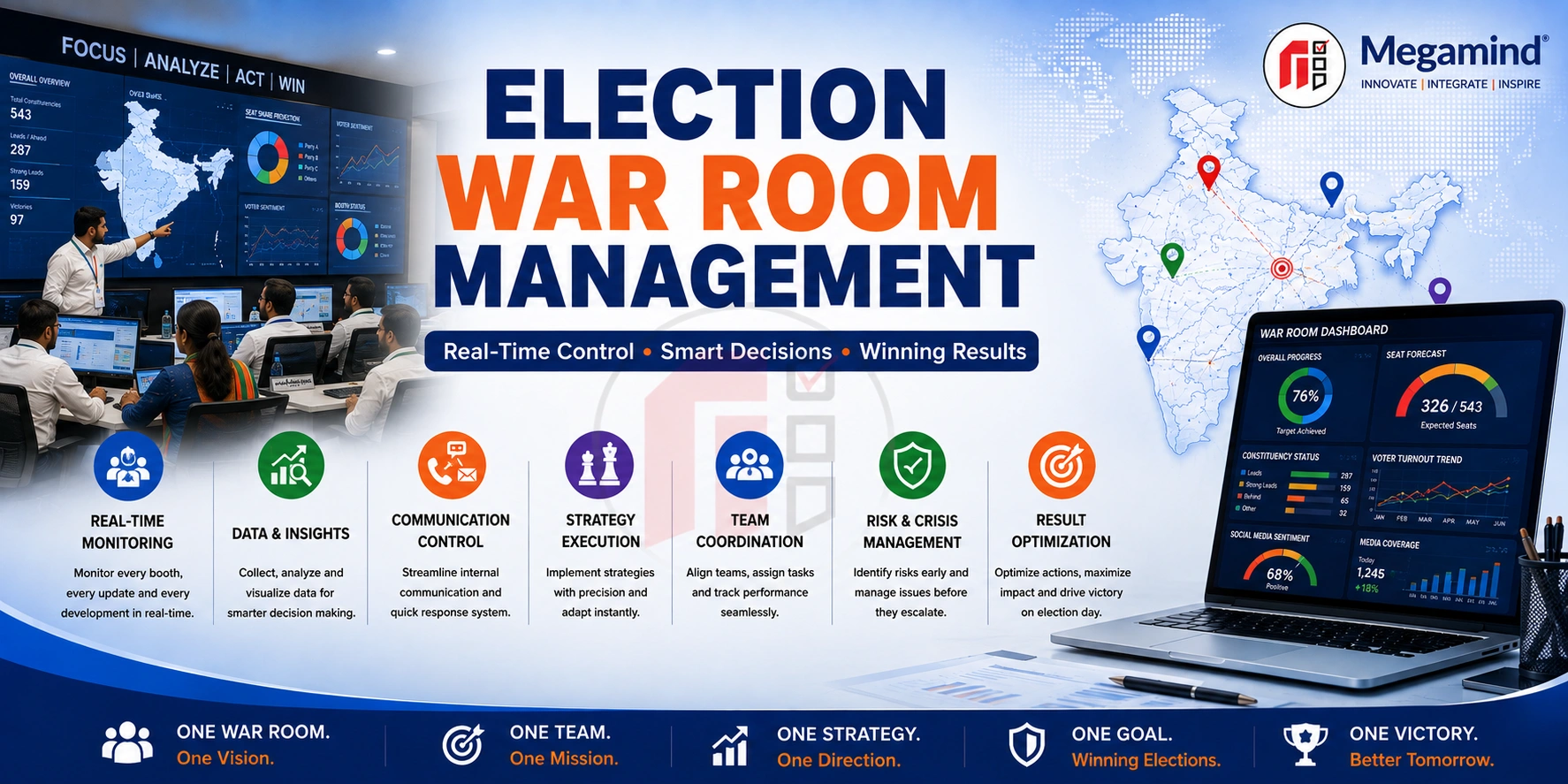
Election campaigns generate information from multiple sources: field teams, constituency coordinators, surveys, campaign events, communication teams, public media, digital channels and campaign leadership. Megamind Election War Room Management brings defined information streams into one structured operational cycle: Collect → Verify → Organize → Monitor → Analyze → Escalate → Report → Review .
What is an Election War Room?
An Election War Room is a structured campaign coordination, monitoring and reporting system designed to help campaign leadership maintain an organized view of defined campaign activities and important developments.
It can bring together field reports, constituency updates, political research, campaign schedules, issue tracking, communication monitoring, public media and digital activity, task status and performance information.
A professional war room is therefore more than a physical room with screens. Its real value comes from the processes, reporting systems, responsibilities and review mechanisms operating behind it.
Information without a defined reporting and review process can create noise instead of intelligence. An effective war room identifies what should be monitored, who reports it, how it is verified, where it is escalated and how leadership receives the final information.
Why Election War Room Management is Important
As campaign activity increases, information can become fragmented across different teams. A structured war room helps organize that flow and creates a common operational picture.
- Centralize defined campaign information
- Improve coordination between campaign teams
- Track constituency-level reporting
- Monitor campaign activity
- Organize political research findings
- Track important public issues
- Review publicly available media developments
- Monitor relevant public digital activity
- Track defined campaign tasks
- Escalate important operational issues
- Provide structured leadership reports
- Support periodic campaign performance review
What We Manage Through an Election War Room
Campaign Coordination
Structured coordination of defined campaign workstreams, reporting channels and review processes.
Field Reporting
Collection and organization of structured reports from authorized campaign and field teams.
Constituency Monitoring
Defined constituency-level reporting for political, campaign and operational developments.
Political Research Integration
Structured incorporation of appropriate surveys, electoral analysis and research findings.
Issue Tracking
Organization of relevant public and campaign issues for monitoring and leadership review.
Competitor Monitoring
Structured review of appropriate public information and publicly observable competitor activity.
Public Media Monitoring
Review and organization of relevant publicly available media coverage and campaign developments.
Public Digital Monitoring
Monitoring of relevant public campaign content, communication themes and digital developments.
Task & Activity Tracking
Tracking of defined campaign tasks, responsibilities, status and operational follow-up.
Information Analysis
Conversion of defined data and reports into structured summaries for campaign review.
Leadership Reporting
Clear executive summaries and defined reports for authorized campaign leadership.
Campaign Review
Periodic review of defined activities, research and operational indicators.
How Our Election War Room Process Works
Election War Room Functional Structure
War room structure should be designed around the actual campaign rather than using the same setup for every election. Depending on project size, functions may be combined or operated as separate workstreams.
| Function | Primary Role | Typical Output |
|---|---|---|
| Coordination Desk | Campaign information flow | Status & coordination updates |
| Field Desk | Structured field reporting | Field activity reports |
| Research Desk | Survey and electoral research | Research summaries |
| Monitoring Desk | Defined campaign monitoring | Monitoring reports |
| Media / Digital Desk | Relevant public communication monitoring | Media & digital summaries |
| Reporting Desk | Leadership information | Executive briefings |
Field Reporting & Ground Coordination
Field teams often generate large volumes of information. Without standard reporting formats, it can become difficult to compare updates or identify which matters require attention.
A war room can establish structured reporting for:
- Campaign activity status
- Public meeting updates
- Program and event status
- Authorized field-team reports
- Organizational readiness updates
- Public issue reports
- Operational issues
- Follow-up status
Reports can then be categorized, reviewed and escalated according to predefined campaign procedures.
Constituency Monitoring & Reporting
For campaigns operating across one or more constituencies, standardized reporting helps leadership compare activity and identify significant developments.
Campaign Status
Structured updates on defined campaign activities and operational progress.
Field Updates
Organized reports from authorized field and constituency teams.
Issue Updates
Relevant public and operational issues requiring tracking or review.
Research Updates
Appropriate survey and electoral research summaries.
Campaign Developments
Material political or campaign developments relevant to the defined scope.
Leadership Summary
Consolidated constituency information for authorized decision-makers.
Explore our Constituency Analysis Services .
Political Survey & Electoral Data Integration
War room reporting can integrate appropriate research so that leadership can review campaign operations alongside structured electoral and political information.
Depending on project scope, this may include:
- Political survey summaries
- Opinion poll research
- Historical election results
- Aggregate vote-share trends
- Turnout analysis
- Winning-margin analysis
- Constituency analysis
- Election trend analysis
Research outputs should retain clear methodology, dates and limitations so that estimates are not confused with official election results.
Campaign Issue Tracking & Escalation
Campaigns may encounter political, operational, communication and public issues that require different levels of attention. A structured war room can maintain a defined issue-management process.
A practical issue flow can follow:
Report → Verify → Categorize → Assign → Escalate → Follow Up → Update → Close
- Record defined issue
- Identify source and time
- Review available information
- Assign responsible team
- Set appropriate priority
- Escalate where required
- Track follow-up status
- Maintain closure/update record
Competitor Monitoring in the War Room
Where included in project scope, relevant publicly observable competitor activity can be organized as part of the wider campaign monitoring system.
This may include:
- Public campaign events
- Public meetings and announcements
- Relevant public statements
- Public communication themes
- Relevant public media coverage
- Public digital campaign activity
- Verified political developments
- Material changes requiring review
For deeper research, see Political Competitor Analysis Services .
Public Media Monitoring
Relevant public media information can be organized so campaign leadership has a structured overview of significant coverage and developments.
News Monitoring
Review of relevant publicly available election and campaign coverage.
Public Statements
Tracking of relevant publicly communicated political statements.
Press Activity
Relevant press conferences, interviews and campaign announcements.
Issue Coverage
Organization of public coverage around relevant campaign and constituency issues.
Campaign Coverage
Public reporting around major campaign activities and events.
Daily Summary
Concise summary of important monitored public media developments where required.
Public Digital Campaign Monitoring
Digital channels generate continuous public campaign communication. Where included in scope, relevant public digital activity can be organized for campaign review.
- Public campaign content
- Public announcements
- Communication themes
- Public event promotion
- Observable publishing activity
- Public video and creative activity
- Relevant public engagement indicators
- Material changes in digital communication
Monitoring should focus on legitimate publicly available information and defined campaign objectives.
Campaign Task & Activity Tracking
A war room can maintain visibility over defined campaign tasks without replacing the responsibility of the teams executing those tasks.
| Tracking Field | Purpose | Possible Status |
|---|---|---|
| Activity | Define the campaign task | Planned |
| Responsibility | Identify responsible team | Assigned |
| Timeline | Track expected schedule | Due / Ongoing |
| Progress | Review execution status | In Progress |
| Issue | Record operational obstacle | Escalated |
| Closure | Confirm completion | Completed |
Election War Room Dashboard & Reporting
The purpose of a war room dashboard is to organize selected indicators into a format that can be reviewed efficiently. Dashboard design should follow campaign requirements rather than displaying unnecessary information.
Campaign Overview
Summary of defined campaign activity and operational status.
Constituency Updates
Consolidated reporting across defined campaign geographies.
Issue Tracker
Status of relevant issues, assignments and follow-up.
Research Summary
Appropriate survey and electoral intelligence in concise reporting format.
Monitoring Summary
Relevant public media, digital and campaign monitoring information.
Executive Briefing
Prioritized summary for authorized campaign leadership.
Daily Campaign Reporting Cycle
Reporting frequency depends on campaign stage and project scope. During active periods, a structured cycle can help prevent information from remaining isolated within individual teams.
A typical reporting framework can follow:
Field & Campaign Inputs → Verification → Categorization → Analysis → Priority Review → Leadership Briefing → Follow-Up → Status Update
High-priority matters can follow a separate escalation process rather than waiting for the next scheduled report.
Campaign Monitoring & Performance Review
War room management can support periodic review of defined campaign activities and reporting indicators.
Depending on the campaign, review may consider:
- Activity completion status
- Reporting consistency
- Campaign schedule status
- Field coordination status
- Research updates
- Issue-resolution status
- Public communication developments
- Material changes requiring strategic review
Operational indicators should be treated as decision-support information rather than as a guarantee of electoral performance.
Executive Reporting for Campaign Leadership
Senior campaign leadership generally requires concise, prioritized information rather than every raw field report. War room reporting can therefore operate at multiple levels.
Operational Report
Detailed status for campaign and coordination teams.
Research Report
Relevant political research and electoral intelligence.
Issue Report
Prioritized issues requiring follow-up or leadership attention.
Monitoring Report
Relevant public campaign, media and digital developments.
Constituency Report
Defined constituency-level campaign and research updates.
Executive Brief
Condensed overview of high-priority developments for authorized leadership.
From Campaign Information to Coordinated Decision Support
Megamind's war room framework is designed to connect campaign information, research, monitoring and reporting through a disciplined operational process.
Field Inputs → Campaign Monitoring → Research Intelligence → Issue Tracking → Verification → Analysis → Leadership Reporting → Coordination → Review
The exact war room structure is customized according to the election, campaign geography, organizational structure, reporting requirements and project scope.
Election-Day War Room Coordination
Where included in the project, the war room can support lawful election-day coordination and reporting within applicable election rules and official directions.
The operational framework may include:
- Authorized team communication
- Polling-status reporting
- Operational issue reporting
- Defined escalation channels
- Team-status coordination
- Consolidated campaign updates
- Incident documentation where appropriate
- Leadership status summaries
Polling-day activities, communication and campaign operations should follow applicable election law, Election Commission directions and other relevant regulatory requirements.
Physical, Digital & Hybrid War Room Models
The operational model can be adapted to campaign geography, team size, reporting requirements and available infrastructure.
Physical War Room
Central campaign location with defined teams, coordination processes and reporting systems.
Digital War Room
Structured remote coordination and reporting using appropriate digital systems.
Hybrid War Room
Central coordination combined with distributed field and constituency reporting.
Election War Room Management Deliverables
Deliverables are customized according to campaign scale, operational requirements and project scope.
- War room structure and workflow
- Reporting formats and protocols
- Campaign activity tracker
- Constituency reporting system
- Field reporting framework
- Issue tracking system
- Research intelligence summaries
- Public media monitoring summaries
- Public digital monitoring summaries
- Campaign status reports
- Executive leadership briefings
- Polling-day coordination framework where applicable
Verification, Reporting Discipline & Information Quality
Speed is important in active campaigns, but speed without information discipline can create confusion. War room processes should therefore distinguish between verified information, pending information and analytical interpretation.
- Define reporting sources
- Timestamp important updates
- Maintain consistent reporting formats
- Separate verified and unverified information
- Identify responsible reporting teams
- Maintain issue-status records
- Document research methodology
- Record significant updates and corrections
Confidentiality, Access Control & Data Responsibility
Election war rooms can handle confidential campaign information. Access to project information should therefore be appropriate to role, project requirements and applicable data obligations.
- Role-based information access where appropriate
- Confidential campaign information handling
- Defined reporting authorization
- Responsible use of aggregate electoral data
- Appropriate handling of research information
- Secure operational practices
- Defined escalation channels
- Compliance with applicable requirements
Election War Room Solutions for Political Campaigns
Political Parties
Structured coordination and reporting for defined election campaigns.
Election Candidates
Constituency-focused campaign monitoring and coordination.
Campaign Leadership
Structured reporting and decision-support information.
Campaign Teams
Operational coordination, task tracking and information flow.
Political Organizations
Customized war room systems for defined political projects.
Multi-Constituency Campaigns
Consolidated reporting across multiple defined campaign geographies.
Integrated Campaign Management, Research & Election Intelligence
A war room becomes more useful when operational reporting can be connected with broader political research and campaign management capabilities.
Megamind can integrate defined war room requirements with:
- Election Strategy & Planning
- Election Campaign Management
- Political Survey
- Opinion Poll Research
- Voter Data Analysis
- Constituency Analysis
- Competitor Analysis
- Booth Management
- Public Relations
- Structured campaign reporting
War room management improves organization, coordination and access to structured information. It does not guarantee an election outcome.
Election War Room Management FAQs
1. What is an Election War Room?
An Election War Room is a structured campaign coordination and monitoring system that brings together defined campaign information, field reporting, research, issue tracking, monitoring and leadership reporting.
2. What does Election War Room Management include?
Depending on project scope, it may include campaign coordination, field reporting, constituency monitoring, issue tracking, research integration, public media and digital monitoring, task tracking and leadership reporting.
3. Why is a war room important during an election?
It helps organize campaign information, improve coordination, track defined activities and provide leadership with structured decision-support information.
4. Can a war room manage multiple constituencies?
Yes. Depending on campaign scale and operational capacity, reporting can be structured for one constituency, multiple constituencies or a wider campaign geography.
5. Can political surveys and electoral data be integrated?
Yes. Appropriate aggregate survey findings, electoral data and constituency analysis can be incorporated while keeping methodology, dates and data distinctions clear.
6. Does the war room monitor media and digital campaigns?
Where included in scope, relevant publicly available media coverage and public digital campaign activity can be monitored and organized for campaign review.
7. What reports can the Election War Room provide?
Reports may include campaign status summaries, field reports, constituency updates, issue reports, research summaries, monitoring reports, task-status reports and executive leadership briefings.
8. Can the war room support election-day coordination?
Where included in scope, it can support lawful status reporting, authorized communication, operational issue escalation and coordination in accordance with applicable election requirements.
9. Does Megamind provide Election War Room Management across India?
Megamind undertakes Election War Room Management projects across India according to campaign scope, geography, operational requirements and feasibility.
10. How can we set up an Election War Room with Megamind?
Share the election type, state or campaign geography, campaign structure and broad monitoring requirements with Megamind to discuss an appropriate war room framework.
Coordinate, Monitor & Manage Your Election Campaign Through a Structured War Room
Discuss your election, campaign geography, reporting structure and operational requirements with Megamind for a customized Election War Room Management framework.
Discuss Election War Room Management