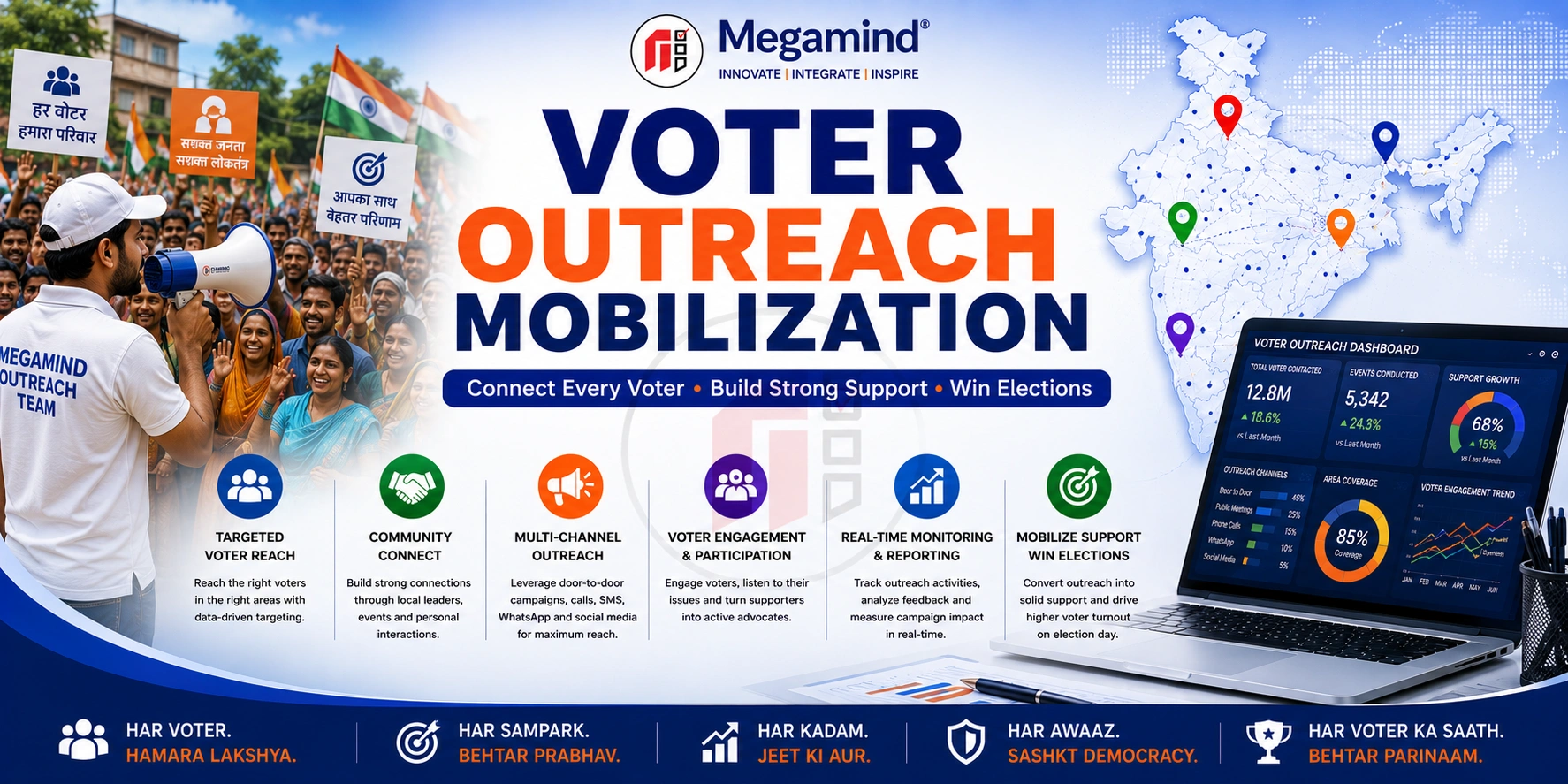
Voter Outreach & Mobilization is the structured organization of lawful public campaign outreach, field-team activity, campaign communication, volunteer coordination, public meetings, geographic coverage, monitoring and management reporting. Megamind connects Constituency Understanding → Outreach Planning → Field Organization → Public Communication → Activity Monitoring → Reporting → Continuous Review within one integrated voter outreach framework.
What is Voter Outreach & Mobilization?
Voter Outreach & Mobilization is the systematic planning, organization, coordination and monitoring of lawful campaign activities designed to establish broad public contact across an election geography.
Political campaigns can involve large numbers of field workers, volunteers, local campaign offices, public meetings, candidate programs, campaign materials, area visits and public information activities.
Without a common operating framework, these activities can become fragmented and difficult to monitor.
Professional outreach management creates a structured system connecting campaign planning with actual field execution.
Depending on project scope, the framework can include:
- Constituency outreach assessment
- Geographic outreach planning
- Area-level campaign organization
- Door-to-door campaign coordination
- Volunteer coordination
- Field-team deployment
- Candidate program coordination
- Public meeting outreach
- Campaign material coordination
- Public information communication
- Field activity monitoring
- Area coverage reporting
- Field feedback management
- Supervisory review
- Election War Room integration
- Executive campaign reporting
Effective voter outreach is not simply the number of people deployed in the field. Geography, team structure, public communication, candidate programs, campaign materials, reporting and management review need to work together. Structured outreach management helps convert campaign plans into organized and measurable field operations.
Why Structured Voter Outreach Matters in Election Campaigns
Election campaigns operate across large and diverse geographic areas. Even within a single constituency, campaign teams may need to coordinate many locations, field workers, volunteers, public programs and daily campaign activities.
Campaign leadership therefore needs a system that answers basic operational questions clearly:
- Which areas are included in the outreach plan?
- Which team is responsible for each area?
- What campaign activity is planned?
- What activity has been completed?
- Which public programs are scheduled?
- What campaign material is required?
- Which activities remain pending?
- What field observations require review?
- What operational problems have been reported?
- Which issues require management escalation?
A structured outreach system improves visibility across these campaign functions and supports more disciplined field management.
Our Voter Outreach & Mobilization Services
Outreach Readiness Assessment
Review of campaign geography, existing field organization, teams, public programs, reporting processes and operational readiness.
Constituency Outreach Planning
Development of an organized geographic framework for campaign outreach and field coordination.
Field Team Coordination
Definition of field responsibilities, geographic allocation, reporting structure and supervisory coordination.
Door-to-Door Coordination
Structured coordination of lawful door-to-door campaign activity, team routes, public information material and field reporting.
Volunteer Coordination
Organization of volunteer roles, orientation, area assignments, activity plans and reporting processes.
Public Meeting Outreach
Coordination of lawful public campaign information, field preparation and operational support around public meetings and candidate programs.
Candidate Program Coordination
Geographic and operational coordination supporting authorized candidate public programs and campaign visits.
Campaign Material Coordination
Planning and tracking of approved public campaign material required by field teams and campaign programs.
Outreach Monitoring
Structured review of field activity, geographic coverage, campaign programs, pending tasks and operational issues.
Field Feedback Management
Collection, classification and escalation of relevant field observations for campaign management review.
Outreach Reporting
Daily or periodic reporting of field deployment, campaign activities, public programs, issues and management actions.
War Room Integration
Integration of outreach activity, field reporting, campaign tasks and operational issues into a central Election War Room framework.
Voter Outreach Readiness Assessment
Before expanding field activity, a campaign should understand its existing outreach capacity.
Megamind can review the current operating environment and identify where additional structure may be required.
A readiness assessment can review:
- Campaign geography
- Existing field organization
- Campaign offices
- Field coordinators
- Available volunteers
- Existing area assignments
- Candidate program calendar
- Public meeting schedule
- Campaign material availability
- Field communication systems
- Reporting mechanisms
- Supervisory structure
- Existing monitoring
- War Room connectivity
- Operational gaps
- Campaign readiness
Constituency-Wide Outreach Planning
Constituency outreach requires a clear geographic operating structure.
The constituency can be organized into practical campaign management areas according to geography, administrative structure, travel requirements, campaign organization and operational feasibility.
The objective is to ensure that campaign leadership has a clear view of where teams are operating and where work remains pending.
- Constituency overview
- Geographic campaign zones
- Locality-level organization
- Field-team allocation
- Route coordination
- Campaign office linkage
- Candidate program mapping
- Public meeting planning
- Area activity calendar
- Supervisory responsibility
- Reporting hierarchy
- Coverage review
Area-Level Outreach Management
Large campaign plans become manageable when responsibilities are converted into clearly defined area-level operations.
Each campaign area can have an assigned coordinator, operating team, activity plan, reporting process and supervisory review.
Area Responsibility
Clear identification of the campaign coordinator or team responsible for an assigned geography.
Activity Plan
Defined public campaign activities and operational tasks for the assigned area.
Daily Reporting
Structured reporting of completed work, pending activities and relevant field observations.
Supervisory Review
Review of field activity by the appropriate campaign coordinator or management team.
Issue Escalation
Routing of significant operational or public issues to authorized campaign leadership.
Progress Review
Periodic assessment of planned activities against actual field execution.
Voter Outreach Field Team Structure
A field campaign requires clear responsibilities from campaign management to local operational teams.
The exact hierarchy depends on election scale and existing campaign organization, but a structured model can establish clear accountability for geographic areas and campaign activities.
Door-to-Door Election Campaign Coordination
Door-to-door activity can be an important form of lawful public campaign outreach when it is properly organized.
Professional coordination focuses on geographic planning, team allocation, approved public information, field supervision and activity reporting.
A structured door-to-door operation can include:
- Area allocation
- Field-team assignment
- Route planning
- Daily activity schedule
- Approved campaign information
- Campaign material allocation
- Team orientation
- Supervisor coordination
- Activity reporting
- Field observation reporting
- Pending-area tracking
- Management review
Respectful & Responsible Voter Contact
Public campaign outreach should be respectful, lawful and based on appropriate public campaign communication.
Field teams should be trained to communicate approved information accurately and to avoid presenting unverified claims as facts.
Outreach programs should also respect applicable privacy, election and campaign requirements.
Political Campaign Volunteer Coordination
Volunteers can support many legitimate campaign activities, but a large volunteer network requires organization.
Volunteers should understand their role, geographic responsibility, reporting structure, campaign information and escalation process.
- Volunteer registration
- Role definition
- Geographic assignment
- Orientation
- Campaign information briefing
- Activity scheduling
- Event support allocation
- Field coordination
- Reporting responsibility
- Supervisor linkage
- Issue escalation
- Performance review
Field Worker & Volunteer Orientation
Field teams should understand how the campaign expects public outreach to be conducted before deployment begins.
Orientation can cover approved campaign information, responsibilities, reporting methods, appropriate conduct, escalation processes and campaign material handling.
Campaign Briefing
Overview of the campaign's authorized public information and current outreach objectives.
Operational Briefing
Explanation of assigned geography, activity plan, reporting and supervisory structure.
Conduct & Escalation
Guidance on appropriate field conduct and how to escalate significant questions or issues.
Candidate Public Program & Constituency Visit Coordination
Candidate programs should connect with the broader outreach calendar rather than operate as isolated events.
Field teams can coordinate appropriate operational preparation around authorized candidate visits and public campaign programs.
Coordination can include:
- Program calendar
- Geographic coordination
- Local field-team briefing
- Public information coordination
- Campaign material preparation
- Event operations
- Post-program reporting
- Follow-up action tracking
Public Meeting & Campaign Event Outreach
Public meetings and campaign events require coordination across field teams, communication teams and campaign management.
Outreach management can organize approved public information, geographic preparation, field-team responsibilities and post-event reporting.
Pre-Event Planning
Coordinate area responsibilities, field teams, campaign information and operational requirements.
Event-Day Coordination
Maintain field communication and activity reporting during the authorized public campaign program.
Post-Event Review
Record activity completion, significant observations and required follow-up.
Campaign Information & Material Coordination
Field teams require approved campaign information and appropriate campaign material to conduct organized public outreach.
A material-management process can help the campaign understand what is available, where it is required and what has already been allocated.
- Approved material list
- Material availability
- Area requirement
- Team allocation
- Distribution record
- Replenishment requirement
- Campaign-event requirement
- Material status reporting
Public Voter Information Communication
Outreach teams may support lawful dissemination of approved public campaign information and other appropriate voter information.
Information should be clear, accurate and consistent with applicable campaign and election requirements.
Operational teams should distinguish between verified information and unconfirmed field observations.
Voter Outreach Activity Calendar
A central outreach calendar can connect campaign geography, field teams, candidate programs, public meetings and recurring campaign activities.
The calendar can record:
- Date
- Campaign area
- Assigned team
- Planned activity
- Candidate program
- Public meeting
- Material requirement
- Responsible coordinator
- Activity status
- Field report
- Follow-up action
- Management review
Daily Voter Outreach & Field Deployment Plan
Daily field planning translates the larger campaign calendar into clear operational assignments.
Each team should know its area, activity, timing, reporting requirement and responsible supervisor.
Structured Voter Outreach Field Reporting
Field reporting provides campaign leadership with visibility into what is actually happening across campaign areas.
Reports should focus on useful operational information rather than producing unnecessary paperwork for field teams.
Depending on scope, reports can include:
- Area name
- Team responsible
- Activity completed
- Candidate program status
- Public meeting status
- Campaign material status
- Significant field observations
- Operational problem
- Required follow-up
- Supervisor review
Field Feedback Collection & Campaign Review
Field teams can observe recurring public questions, local campaign issues, event-related concerns and operational problems.
These observations can be useful when collected in a structured format and reviewed appropriately.
However, informal field feedback should not automatically be interpreted as representative voter opinion.
When statistically meaningful public opinion measurement is required, campaign leadership should rely on appropriately designed research.
Field Observation Classification & Escalation
Not every field observation requires the same level of campaign attention.
A classification process can help distinguish ordinary operational updates from issues that require management review.
Operational Update
Routine information relating to campaign activity, teams, materials or scheduling.
Public Issue
A recurring or significant public matter that may require verification or campaign review.
Management Escalation
A significant issue requiring attention from authorized campaign leadership.
Outreach Activity Verification & Quality Review
Campaign management should not rely only on unverified field claims when assessing operational progress.
Important activities and reports can be reviewed through supervisory checks, structured reporting and other appropriate verification methods.
- Supervisor review
- Activity-status checks
- Area-report consistency
- Event confirmation
- Material-use review
- Follow-up verification
- Reporting completeness
- Escalation review
Continuous Voter Outreach Monitoring
Continuous monitoring helps campaign leadership understand whether planned outreach activity is being implemented.
Monitoring can focus on geographic coverage, team deployment, public programs, field reporting, operational issues and pending campaign tasks.
Area Activity
Review of planned and completed public campaign activity by geographic area.
Team Deployment
Visibility into assigned field teams and operational responsibilities.
Public Programs
Tracking of relevant candidate programs and campaign events.
Pending Tasks
Identification of planned campaign activities that remain incomplete.
Field Issues
Review of significant verified operational or public issues.
Management Actions
Tracking of follow-up actions assigned by campaign leadership.
Voter Outreach Management Dashboard
Senior campaign leadership needs a consolidated operational view rather than disconnected messages from multiple field teams.
A Voter Outreach Management Dashboard can organize key campaign information into a structured review format.
- Geographic campaign areas
- Assigned coordinators
- Field-team deployment
- Planned activities
- Completed activities
- Pending activities
- Candidate programs
- Public meetings
- Material status
- Significant field observations
- Escalated issues
- Management actions
Daily, Weekly & Phase-Wise Outreach Reporting
Different campaign stages require different reporting frequencies.
Daily Review
Operational view of current activities, field deployment, public programs, issues and pending tasks.
Weekly Review
Broader review of geographic progress, recurring issues, operational gaps and campaign priorities.
Phase Review
Assessment of outreach systems and campaign operations before moving into the next election phase.
Voter Outreach & Election War Room Integration
Outreach operations can generate large volumes of field information. A central Election War Room can organize this information for management review.
Outreach-War Room integration can bring together:
- Area activity reports
- Field-team deployment
- Candidate program status
- Public meeting status
- Campaign material status
- Field observations
- Operational issues
- Escalated public issues
- Management tasks
- Daily executive reporting
Explore: Election War Room Management
Ground Outreach & Digital Campaign Integration
Ground campaign activity and digital campaign communication should operate as coordinated parts of the broader election campaign.
Ground → Digital
Verified public campaign activity, candidate programs, public meetings and appropriate field material can be shared with the authorized digital campaign team.
Digital → Ground
Approved campaign information, public program updates and appropriate campaign communication can be coordinated with field teams.
Explore: Digital Election Campaign Management
Political Survey & Outreach Planning Integration
Appropriately designed political research can provide aggregate context about constituency conditions, public issues and candidate awareness.
Such findings can support broad campaign planning when interpreted according to research methodology and limitations.
Research findings should remain aggregate and should not be converted into sensitive political profiles of identifiable individuals.
Explore: Political Survey Services
Constituency Analysis & Outreach Operations
Constituency analysis provides the geographic and electoral context within which outreach operations take place.
Relevant aggregate information can help campaign management understand the scale, geography, operational complexity and broader public-issue environment of the constituency.
Explore: Constituency Analysis
Voter Outreach & Booth Management Integration
Where included within a campaign's lawful organizational framework, outreach operations can be coordinated with booth-level campaign management.
The objective is to create clear responsibilities, geographic reporting and operational visibility across the campaign organization.
Outreach and booth-management coordination can include:
- Geographic organization
- Field-team responsibility
- Campaign activity reporting
- Volunteer coordination
- Public program coordination
- Operational monitoring
- Issue escalation
- War Room reporting
Explore: Booth Management
Voter Outreach Across the Election Campaign Lifecycle
Outreach requirements change as an election campaign progresses.
Early stages may focus on organization and readiness, while active campaign periods can require greater field deployment, more frequent public programs and faster reporting.
Pre-Campaign Outreach Preparation
Early outreach preparation can establish the operational foundation required for later campaign activity.
- Constituency assessment
- Geographic organization
- Field-team mapping
- Volunteer organization
- Outreach calendar
- Reporting system
- Campaign material planning
- Supervisor structure
- War Room integration
- Baseline operational review
Active Campaign Outreach Operations
During the active campaign, field operations can increase in frequency and geographic coverage.
Candidate programs, public meetings, volunteer activity, door-to-door outreach, campaign material requirements and field reporting may all need closer coordination.
The outreach management system should therefore provide campaign leadership with timely operational visibility.
Intensive Election-Period Outreach Coordination
High-activity election periods can require faster field reporting and closer campaign supervision.
Campaign teams should continue to follow applicable election requirements and maintain appropriate standards for public communication, privacy, field conduct and campaign information.
Lawful Election-Day Field Coordination
Election-day activities are subject to applicable election laws, official directions and restrictions.
Any campaign field coordination undertaken during this period should therefore remain within the activities lawfully permitted in the relevant election.
Operational management can focus on lawful team communication, permitted campaign administration, information flow and issue escalation according to applicable requirements.
Responsible Voter Outreach & Mobilization
Megamind's approach focuses on legitimate campaign organization, broad public outreach, geographic field coordination, accurate public information and aggregate campaign research.
Responsible outreach should not depend on creating sensitive political profiles of identifiable individuals based on characteristics such as religion, caste, ethnicity, health information or other sensitive personal attributes.
- Lawful public outreach
- Accurate campaign information
- Appropriate field conduct
- Responsible research use
- Geographic campaign planning
- Aggregate campaign analysis
- Appropriate privacy practices
- Controlled information access
- Structured field reporting
- Supervisory verification
- Applicable election requirements
- Responsible management review
Outreach Data Privacy & Information Governance
Outreach projects can generate operational information, field reports, campaign schedules and other project records.
Information should be managed according to project purpose, appropriate access controls and applicable requirements.
- Purpose-based information collection
- Data minimization where appropriate
- Controlled project access
- Secure information handling
- Appropriate retention practices
- Field-report governance
- Research confidentiality
- Responsible aggregate reporting
Field Feedback vs Political Survey Research
Field Feedback
Field observations can provide useful operational information about recurring questions, campaign activity and local issues, but they are usually anecdotal and should not automatically be treated as representative public opinion.
Political Survey Research
Properly designed surveys use a defined methodology, sampling framework, field controls and analysis to estimate aggregate public opinion within stated limitations.
Voter Outreach Operational Performance Framework
Outreach performance should be evaluated using indicators that reflect campaign operations rather than unsupported assumptions about individual voting behaviour.
Appropriate operational indicators can include:
- Planned activity completion
- Geographic activity coverage
- Team deployment completion
- Candidate program completion
- Public meeting activity
- Field report completion
- Material availability
- Supervisor review completion
- Pending task status
- Issue escalation status
Voter Outreach for Different Election Scales
Constituency Project
Structured field coordination and outreach management for a defined constituency campaign.
Multi-Constituency Project
Standardized field reporting, campaign monitoring and management coordination across multiple constituencies.
Large Election Project
Scalable outreach organization with centralized reporting and campaign management systems.
Common Challenges in Voter Outreach & Mobilization
Unclear Area Responsibility
Campaign areas can remain without clear operational ownership when responsibilities are not formally assigned.
Fragmented Field Teams
Multiple field groups can work independently without common reporting or supervisory systems.
Weak Activity Reporting
Leadership may lack reliable visibility into completed and pending field activity.
Campaign Material Gaps
Field operations can be disrupted when approved material requirements are not coordinated.
Unverified Field Feedback
Anecdotal observations can be overinterpreted when verification and research distinctions are unclear.
Slow Issue Escalation
Significant operational issues may not reach campaign leadership quickly without an escalation framework.
Megamind Voter Outreach Management Framework
Megamind's operating framework connects planning, field organization, communication, monitoring and reporting.
Megamind's Integrated Voter Outreach & Mobilization Approach
Megamind combines Constituency Understanding + Outreach Planning + Field Organization + Public Communication + Volunteer Coordination + Monitoring + Reporting + Election War Room Management within an integrated campaign framework.
Our broad working process can follow:
Campaign Requirement → Constituency Assessment → Geographic Planning → Field Structure → Team Allocation → Outreach Calendar → Public Campaign Activity → Candidate Programs → Volunteer Coordination → Field Reporting → Activity Verification → Issue Escalation → War Room Review → Executive Reporting → Continuous Refinement
The exact operating model is customized according to the election, constituency geography, campaign stage, existing organization, available field resources, project duration and agreed scope.
Explore Complete Election Campaign Management →Benefits of Structured Voter Outreach Management
- Clear geographic organization
- Defined field responsibilities
- Better volunteer coordination
- Structured campaign calendar
- Organized public outreach
- Better candidate program coordination
- Improved field information flow
- Structured activity reporting
- Supervisory visibility
- Faster issue escalation
- Centralized management reporting
- Continuous operational review
Voter Outreach & Mobilization Deliverables
The final deliverable set depends on election type, constituency geography, project duration, existing campaign organization, field-team availability and agreed scope.
A comprehensive engagement can include:
- Outreach readiness assessment
- Constituency outreach framework
- Geographic campaign structure
- Area responsibility framework
- Field-team organization
- Volunteer coordination framework
- Field orientation framework
- Outreach activity calendar
- Daily deployment framework
- Door-to-door coordination framework
- Candidate program coordination
- Public meeting coordination
- Campaign material tracking
- Field reporting format
- Field observation framework
- Verification process
- Issue escalation framework
- Outreach monitoring system
- Daily campaign report
- Weekly management review
- Outreach dashboard
- War Room integration
- Operational progress review
- Final campaign outreach report
Customized Voter Outreach & Mobilization Projects
Every constituency has a different geography, campaign organization, election timeline, field capacity and operational requirement.
Megamind therefore structures outreach projects according to actual campaign requirements rather than applying one fixed field campaign model.
Project design can vary according to:
- Election type
- Constituency geography
- Campaign stage
- Existing field organization
- Available campaign offices
- Field-team availability
- Volunteer availability
- Candidate program schedule
- Public meeting requirements
- Reporting requirements
- Project duration
- War Room integration
Who Can Use Voter Outreach & Mobilization Services?
- Political parties
- Election candidates
- Prospective candidates
- Political leaders
- Constituency campaign teams
- Election campaign organizations
- Field campaign teams
- Political organizations
Why Megamind for Voter Outreach & Mobilization?
Megamind's broader election consulting capabilities allow voter outreach operations to be coordinated with political research, constituency analysis, booth management, digital election campaign management, public relations and Election War Room management where included in the engagement.
- Political campaign understanding
- Constituency research capability
- Structured outreach planning
- Field-team coordination
- Volunteer management framework
- Campaign monitoring
- Digital campaign integration
- Booth-management integration
- Election War Room integration
- Management reporting
- Customized project structure
- Responsible outreach framework
Voter Outreach & Mobilization can improve campaign organization, communication, field coordination and management visibility, but it cannot guarantee an election outcome.
FAQs About Voter Outreach & Mobilization
1. What is Voter Outreach & Mobilization?
Voter Outreach & Mobilization is the structured planning and coordination of lawful public campaign outreach, field activities, volunteer operations, voter information communication, public meetings, campaign contact programs, monitoring and reporting.
2. What services are included in Voter Outreach & Mobilization?
Depending on project scope, services can include constituency outreach planning, area-level campaign coordination, door-to-door campaign coordination, volunteer management, public meeting outreach, voter information communication, field monitoring, reporting and Election War Room integration.
3. Does Megamind provide Voter Outreach & Mobilization across India?
Megamind undertakes Voter Outreach & Mobilization projects across India according to election type, geography, campaign requirements, project scope and operational feasibility.
4. Can voter outreach be planned at constituency level?
Yes. Outreach operations can be organized geographically at constituency, zone, sector, locality or other practical campaign-management levels according to project requirements.
5. Does the service include door-to-door campaign coordination?
Depending on project scope, Megamind can help structure lawful door-to-door campaign operations including route planning, field-team allocation, campaign information distribution, activity reporting and supervisory review.
6. Can volunteer teams be coordinated?
Yes. Volunteer operations can include role definition, area allocation, orientation, daily activity planning, reporting structures and coordination with campaign management.
7. Can public meetings be integrated with voter outreach?
Yes. Public meetings, candidate programs and lawful campaign events can be incorporated into the broader outreach calendar and field coordination framework.
8. How is voter outreach monitored?
Outreach can be monitored through area activity reports, team reporting, event status, campaign material status, field observations, supervisory review and management dashboards according to project scope.
9. Can voter outreach be integrated with political surveys?
Yes. Properly designed aggregate political survey and constituency research can provide broader campaign context for outreach planning, subject to methodology, privacy and applicable requirements.
10. Can digital and ground outreach be coordinated?
Yes. Verified ground campaign information can support authorized digital communication, while digital campaign schedules and public information can be coordinated with field operations.
11. What is an outreach activity dashboard?
An outreach activity dashboard is a management view that can summarize campaign areas, assigned teams, completed activities, pending work, public meetings, significant field observations and operational follow-up.
12. Can outreach teams report field feedback?
Yes. Structured field observations can be recorded and escalated for campaign review. Anecdotal field feedback should be distinguished from representative political survey findings.
13. Can Voter Outreach & Mobilization integrate with Booth Management?
Yes. Where included in scope, outreach operations can be coordinated with lawful booth-level campaign organization, field-team management, reporting and Election War Room operations.
14. Can Voter Outreach & Mobilization integrate with an Election War Room?
Yes. Area activity, field reports, public meetings, campaign tasks, significant issues and management actions can be consolidated within an Election War Room reporting framework.
15. Can outreach operations be customized for an Assembly constituency?
Yes. The operating structure can be customized according to constituency geography, campaign stage, available teams, project duration, public programs and agreed scope.
16. Can outreach operations be used for Parliamentary elections?
Yes. Outreach operations can be structured for Parliamentary, Assembly and local election projects according to campaign requirements and operational scale.
17. What is responsible voter outreach?
Responsible voter outreach emphasizes lawful public communication, accurate campaign information, appropriate privacy practices, transparent field operations and compliance with applicable election requirements.
18. Does voter outreach involve sensitive political profiling?
Megamind's responsible outreach framework focuses on broad campaign operations, geographic planning, public communication and aggregate research rather than creating sensitive-trait political profiles of identifiable individuals.
19. When should voter outreach planning begin?
Outreach planning can begin before intensive campaign activity so that geography, teams, responsibilities, communication material, monitoring and reporting systems are prepared.
20. Can Megamind provide daily outreach reports?
Depending on project scope, daily or periodic reports can summarize area activity, team deployment, campaign programs, field observations, pending tasks and management actions.
21. How is field information verified?
Important field information can be reviewed through supervisory checks, source verification, structured reporting and comparison with other available campaign information before major decisions are based on it.
22. Can outreach operations support public voter information?
Yes. Lawful public campaign and voter information can be communicated through approved outreach activities according to applicable election requirements.
23. Can Voter Outreach & Mobilization integrate with full Election Campaign Management?
Yes. Outreach operations can be coordinated with campaign strategy, political research, digital campaign management, public relations, field operations and Election War Room management where included in scope.
24. Does Voter Outreach & Mobilization guarantee election victory?
No. Professional outreach can improve campaign organization, communication, field coordination and monitoring, but election outcomes depend on voters and many changing political factors.
25. How can a campaign start a Voter Outreach & Mobilization project with Megamind?
A project can begin with discussion of the election, constituency, campaign stage, geography, available field organization, public outreach requirements, reporting needs and proposed project scope.
Building a Structured Voter Outreach Operation
Voter Outreach & Mobilization connects constituency planning, geographic field organization, campaign teams, volunteers, candidate programs, public meetings, public communication, monitoring and management reporting within one coordinated campaign framework.
The objective is not simply to increase field activity. The objective is to make campaign outreach more organized, accountable, measurable and connected with the broader election campaign.
Megamind's approach combines campaign understanding, constituency intelligence, field organization, responsible public outreach, monitoring, reporting and Election War Room coordination according to the requirements of each project.
Build a Structured Voter Outreach & Mobilization Campaign with Megamind
Discuss your election, constituency, campaign stage, field organization and Voter Outreach & Mobilization requirements with Megamind.
Discuss Voter Outreach & Mobilization