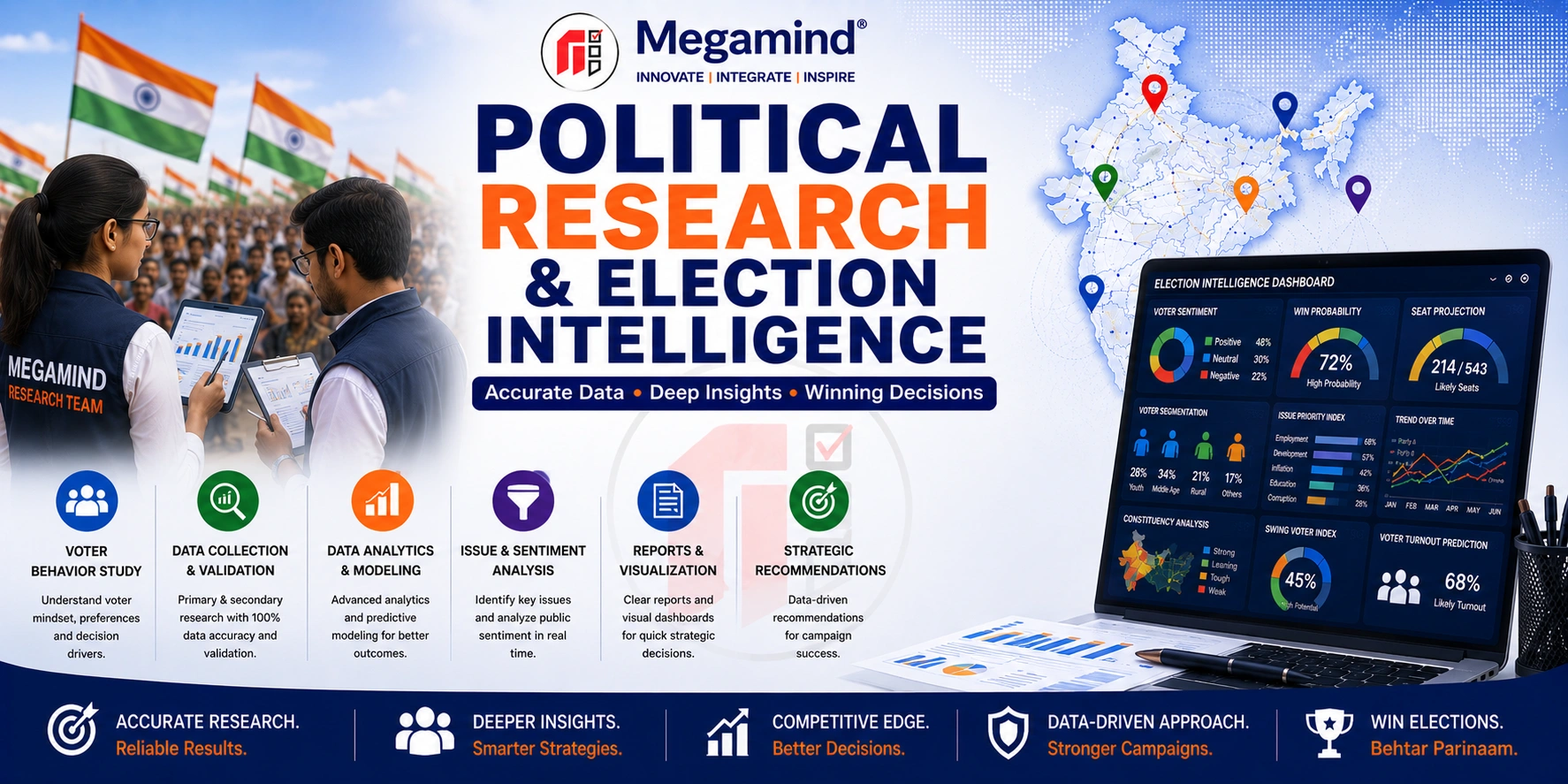
Political Research & Election Intelligence transforms fragmented electoral information into structured research and decision-support intelligence. Megamind connects Research Questions → Source Collection → Electoral Data → Constituency Research → Political Surveys → Public Issues → Candidate & Competitor Research → Validation → Analysis → Intelligence Reporting → Strategic Review within one integrated political research framework.
What is Political Research & Election Intelligence?
Political Research & Election Intelligence is the systematic process of collecting, organizing, validating, analyzing and interpreting relevant political and electoral information for campaign understanding and strategic decision support.
Election environments contain multiple forms of information—historical results, vote share, turnout, candidate performance, constituency characteristics, political surveys, public issues, campaign developments and publicly observable political activity.
Political research brings these information streams together within a structured methodology.
Election intelligence goes one step further by synthesizing research findings into concise, decision-relevant insights while preserving the distinction between verified facts, research findings, estimates, observations and analytical interpretation.
- Historical election research
- Constituency research
- Electoral performance analysis
- Vote share research
- Turnout research
- Winning margin analysis
- Candidate performance research
- Political competitor research
- Public issue research
- Political survey integration
- Election trend research
- Aggregate geographic analysis
- Research validation
- Political intelligence reporting
- Strategic research briefs
- Election War Room integration
More information does not automatically create better election intelligence. The real value comes from asking the right research questions, using appropriate sources, separating evidence from assumption, understanding limitations and converting verified findings into clear strategic context.
Why Political Research Matters in Election Campaigns
Election campaigns operate in complex and changing environments. Decisions based only on assumptions, informal impressions or isolated observations can miss important context.
Structured political research helps campaign leadership examine the constituency and electoral environment through documented evidence and clearly defined research methods.
Research can help answer questions such as:
- How has the constituency performed historically?
- How has vote share changed across elections?
- How has turnout changed?
- How have winning margins changed?
- Which candidates have contested historically?
- How has candidate performance changed?
- What broad public issues are being measured?
- What does a properly designed survey indicate?
- What are the major political competition patterns?
- Which findings are verified and which remain uncertain?
- What historical comparisons are actually valid?
- What information requires further research?
Our Political Research & Election Intelligence Services
Electoral Research
Structured study of elections, electoral history, performance indicators and relevant political context.
Constituency Research
Integrated research covering electoral history, geography, aggregate context, public issues and political competition.
Historical Election Analysis
Comparison of previous election results, vote share, turnout, margins and candidate performance.
Election Trend Research
Study of aggregate changes and patterns across comparable elections and electoral periods.
Candidate Research
Research based on legitimate, relevant and properly sourced information about candidate electoral and public activity.
Competitor Research
Research into publicly observable competitor performance, communication, campaign activity and electoral context.
Public Issue Research
Structured study of public and constituency issues through appropriate research sources and methods.
Political Survey Integration
Integration of properly designed aggregate survey findings with wider electoral research.
Political Data Research
Structured review of aggregate electoral datasets and relevant research indicators.
Research Validation
Source checks, methodology review, consistency checks and documentation of limitations.
Election Intelligence Reporting
Structured research reports presenting findings, trends, context, limitations and analytical interpretation.
Strategic Research Integration
Connecting approved research outputs with campaign strategy, management review and Election War Room reporting.
Political Research Objectives & Research Questions
Good political research begins with clearly defined questions.
Collecting large quantities of information without a research objective can produce noise rather than useful intelligence.
A Political Research & Election Intelligence project can therefore begin by defining:
- Research objective
- Election context
- Geographic scope
- Time period
- Research questions
- Required datasets
- Required survey research
- Public information sources
- Comparison framework
- Validation requirements
- Reporting requirements
- Research limitations
Structured Political Research Methodology
Political intelligence should be built through a repeatable research process rather than informal information accumulation.
Political Research Source Framework
The strength of election intelligence depends heavily on source quality.
Research projects may use different sources according to the research objective and lawful availability.
Official Electoral Data
Officially published election results and related electoral information where available.
Political Surveys
Properly designed survey research with documented methodology and aggregate reporting.
Public Records
Relevant publicly accessible records used within appropriate legal and research boundaries.
Public Communication
Publicly observable political statements, campaign communication and documented public activity.
Field Research
Structured field research and observations collected through defined research processes.
Internal Campaign Records
Appropriate campaign operational information used within the agreed research scope and governance framework.
Historical Election Research & Electoral Performance Analysis
Historical election results provide an important baseline for understanding a constituency.
Research can compare previous elections while recognizing that electoral boundaries, alliances, candidates, turnout and political conditions may change.
- Previous election results
- Party performance
- Candidate performance
- Vote share
- Turnout
- Winning margin
- Runner-up performance
- Candidate changes
- Party changes
- Alliance changes
- Election-to-election comparison
- Aggregate geographic trends
Historical performance should be treated as context—not as a guarantee of future electoral behavior.
Vote Share Research & Historical Comparison
Vote share research examines how the proportion of valid votes received by parties or candidates changes across elections.
This can provide a more useful comparative measure than raw vote totals alone because turnout and electorate size may vary.
Research can examine:
- Candidate vote share
- Party vote share
- Election-to-election change
- Winner vote share
- Runner-up vote share
- Competitive gap
- Multi-cornered contests
- Alliance context
- Aggregate area patterns
- Historical volatility
Voter Turnout Research & Electoral Participation Analysis
Aggregate turnout is another important election research indicator.
Historical turnout can be compared across elections and available geographic units to understand participation patterns.
Turnout analysis should be interpreted carefully. A change in turnout does not by itself establish why voters participated or how particular individuals voted.
- Historical turnout
- Election-to-election turnout change
- Aggregate geographic variation
- Urban-rural context where relevant
- Turnout and margin comparison
- Election type comparison
- Available official turnout records
- Contextual interpretation
Winning Margin & Electoral Competitiveness Research
Winning margin research helps describe how close or one-sided previous electoral contests were.
A constituency may show different levels of competitiveness across different elections.
Research can compare:
- Absolute winning margin
- Margin as a percentage
- Winner-runner-up gap
- Historical margin changes
- Competitive election cycles
- Candidate-specific context
- Alliance context
- Turnout relationship
Comprehensive Constituency Research
Constituency research brings multiple evidence streams into one structured electoral profile.
Depending on the project and available information, research can cover:
- Constituency electoral history
- Previous winners and runners-up
- Vote share history
- Turnout history
- Winning margins
- Aggregate geographic context
- Broad demographic context
- Public issue research
- Political survey findings
- Candidate landscape
- Competitor landscape
- Public campaign environment
- Research gaps
- Key analytical observations
Explore: Constituency Analysis
Aggregate Area-Level & Booth-Level Electoral Research
Where reliable aggregate election information is available, political research can examine geographic variation across constituency areas or polling-area aggregates.
Such research can help describe historical electoral patterns at an aggregate level.
It is important to maintain the distinction between aggregate election results and individual voter behavior.
- Aggregate area performance
- Historical area comparison
- Aggregate turnout patterns
- Aggregate vote share patterns
- Area-level electoral change
- Data completeness review
- Boundary comparability review
- Research limitations
Aggregate booth or area results do not reveal how an identifiable individual voted and should not be used to infer an individual's political preference.
Public Issue & Constituency Concern Research
Election campaigns often need a structured understanding of issues being discussed within a constituency.
Public issue research can draw on appropriate sources such as properly designed surveys, field research, public records, documented public communication and other legitimate research material.
The objective is to organize issues by evidence and relevance rather than relying on isolated anecdotes.
Issue Identification
Identify recurring public issues through defined research sources.
Issue Classification
Organize findings into relevant research categories for easier review.
Evidence Review
Examine the source and strength of evidence behind reported issues.
Geographic Context
Where supported by valid evidence, examine broad geographic variation in issue findings.
Survey Context
Compare qualitative issue information with properly designed aggregate survey findings.
Research Reporting
Present issue findings with source, methodology and limitation notes.
Political Survey Integration with Election Intelligence
Historical results describe what happened in previous elections. Properly designed political surveys can help measure selected aspects of current public opinion at the time research is conducted.
Survey findings can be integrated with wider election research while maintaining important methodological distinctions.
- Research objective
- Survey questionnaire
- Sampling methodology
- Fieldwork process
- Data quality review
- Aggregate response analysis
- Public issue findings
- Awareness measurements
- Methodology notes
- Research limitations
- Fieldwork dates
- Aggregate reporting
Survey results represent measurements subject to sampling, fieldwork, questionnaire, timing and other methodological limitations.
Explore: Political Survey Services
Field Intelligence vs Representative Political Survey Research
Field Observations
Can provide qualitative context, recurring themes, operational observations and areas requiring further research, but may be selective or anecdotal.
Political Survey
Uses a defined research methodology to measure selected public opinion indicators within known methodological limitations.
Field observations should therefore not automatically be presented as representative public opinion.
Candidate Research & Electoral Performance Review
Candidate research can help campaign leadership understand the documented electoral and public context surrounding candidates.
Research should rely on legitimate, relevant and properly sourced information.
- Previous electoral contests
- Historical vote performance
- Public political roles
- Public campaign activity
- Documented public communication
- Candidate changes across elections
- Party association where relevant
- Publicly documented campaign context
- Source verification
- Research limitations
Candidate research should distinguish documented facts from allegations, speculation and unverified claims.
Political Competitor Research & Election Intelligence
Political competition can be studied through publicly observable and properly sourced electoral information.
Competitor research can include:
- Historical electoral performance
- Previous vote share
- Previous winning margins
- Candidate history
- Public campaign activity
- Public communication
- Public political positioning
- Visible campaign developments
- Historical constituency performance
- Source-backed research observations
Explore: Political Competitor Analysis
Election Trend Research & Multi-Election Comparison
Election trend research examines how relevant aggregate indicators change across electoral cycles.
Depending on available comparable information, trend research can study:
- Vote share changes
- Turnout changes
- Winning margin changes
- Candidate changes
- Party performance changes
- Competitive structure
- Aggregate geographic changes
- Alliance context
- Election type differences
- Long-term electoral patterns
Comparisons should account for important changes in boundaries, alliances, candidates and electoral context.
Political Research & Political Data Analytics Integration
Political Research and Political Data Analytics are closely connected but they are not identical services.
Political Research
Defines research questions, examines political and electoral context, combines quantitative and qualitative evidence, validates sources and develops structured research findings.
Political Data Analytics
Focuses more deeply on structured quantitative datasets, calculations, comparisons, indicators, dashboards and analytical visualization.
When integrated, research provides context while analytics provides structured quantitative evidence.
Electoral Data Validation & Research Quality Control
Political research can become misleading when information from different elections, boundaries, dates or sources is combined without validation.
Research quality checks can include:
- Source identification
- Election year verification
- Constituency verification
- Candidate name review
- Party name review
- Vote total checks
- Vote share consistency
- Turnout consistency
- Boundary comparability
- Duplicate record checks
- Missing information review
- Methodology documentation
Source Confidence & Evidence Classification
Not all information used in political research has the same evidentiary strength.
A useful research framework can distinguish between different evidence categories.
Verified Fact
Information supported by reliable documented evidence appropriate to the claim.
Survey Finding
A measurement produced through a defined survey methodology and subject to its limitations.
Field Observation
Qualitative information that may identify themes but should not automatically be generalized.
Analytical Interpretation
A reasoned interpretation derived from available evidence rather than a direct factual observation.
Estimate
A calculated or research-based estimate that should be labeled and accompanied by assumptions.
Unverified Information
Information requiring further verification and not suitable for presentation as established fact.
Political Research Bias, Assumptions & Limitations
Election research can be affected by source limitations, incomplete data, survey error, changing electoral conditions, interpretation bias and other uncertainties.
Professional reporting should therefore document relevant limitations rather than presenting every analytical conclusion as certainty.
- Source limitations
- Missing data
- Boundary changes
- Alliance changes
- Candidate changes
- Survey sampling limitations
- Fieldwork timing
- Questionnaire effects
- Qualitative research limitations
- Interpretation uncertainty
- Changing campaign environment
- Unexpected political developments
Political Research Reports & Election Intelligence Briefs
Research becomes more useful when findings are organized according to the decisions campaign leadership needs to review.
Depending on project scope, Megamind can structure research outputs such as:
- Constituency Research Report
- Historical Election Report
- Electoral Performance Report
- Vote Share Trend Report
- Turnout Research Report
- Winning Margin Analysis
- Candidate Research Brief
- Competitor Research Brief
- Public Issue Research Report
- Political Survey Research Report
- Election Trend Report
- Research Validation Note
- Election Intelligence Brief
- Executive Research Summary
Election Intelligence Dashboard & Research Monitoring
Larger research projects may involve multiple information streams and regular updates.
A structured dashboard can help campaign management review approved aggregate research indicators without confusing research data with official election administration.
Electoral History
Consolidated historical results and comparative election indicators.
Survey Research
Aggregate survey findings with fieldwork and methodology references.
Public Issues
Structured issue research with source and evidence context.
Candidate Research
Relevant documented candidate and electoral research indicators.
Competitor Research
Publicly observable competitive electoral and campaign information.
Research Updates
Track new verified information, revised findings and research gaps.
Political Research & Election War Room Integration
Election War Room Management can provide a central review environment for approved campaign research and operational information.
Research integration can provide leadership with structured access to:
- Historical election context
- Constituency research
- Survey findings
- Public issue research
- Candidate research
- Competitor research
- Election trend analysis
- Research updates
- Research limitations
- Executive intelligence briefs
Explore: Election War Room Management
Political Research & Election Strategy Integration
Research can support election strategy by providing structured evidence and context for leadership review.
A useful relationship is:
Explore: Election Strategy & Planning
Research Integration with Election Campaign Management
Election Campaign Management requires coordination between research, planning, communication, field operations and monitoring.
Political Research & Election Intelligence can provide an evidence layer that supports broader campaign management review.
Research may connect with:
- Election Strategy & Planning
- Constituency Analysis
- Political Survey
- Ground Campaign Management
- Voter Outreach & Mobilization
- Political Branding & Communication
- Digital Election Campaign Management
- Election War Room Management
Explore: Election Campaign Management
Political Research Across the Election Campaign Lifecycle
Research requirements can change as an election campaign develops.
Responsible Political Research & Election Intelligence
Political research should be conducted with appropriate standards for accuracy, privacy, transparency and responsible data use.
Megamind's research framework emphasizes aggregate electoral research and legitimate political intelligence rather than individualized political profiling based on sensitive personal attributes.
- Documented research objectives
- Legitimate research sources
- Source verification
- Methodology documentation
- Aggregate reporting
- Survey respondent confidentiality
- Data minimization
- Purpose limitation
- Appropriate access controls
- Clear research limitations
- No fabrication of findings
- No presentation of estimates as official results
- No unnecessary sensitive political profiling
- No inference of identifiable individuals' votes from aggregate results
Political Research Data Privacy & Information Governance
Research projects can involve electoral datasets, survey information, public records and internal research material.
Appropriate information governance can include:
- Defined research purpose
- Data minimization
- Appropriate collection practices
- Survey confidentiality
- Role-based access
- Secure storage
- Controlled sharing
- Retention practices
- Aggregate reporting where appropriate
- Documented source handling
- Quality controls
- Responsible disposal where applicable
Historical Results Are Context — Not Future Election Predictions
Historical election data is valuable because it shows what happened previously.
However, an upcoming election can involve different candidates, alliances, turnout, public issues, campaign environments and political developments.
Historical results should therefore support context and comparison rather than be presented as deterministic predictions.
Past election performance is evidence about the past. Current survey research is a measurement at a particular time. Field observations provide qualitative context. None of these, individually or together, can guarantee a future election result.
Election Intelligence vs Political Rumour
Research-Based Intelligence
Uses identified sources, defined methods, verification, evidence classification, documented assumptions and clear limitations.
Unverified Political Rumour
May lack reliable sourcing, verification, methodology or evidence and should not be presented as established fact.
A professional political research process should clearly separate the two.
Political Research Update & Intelligence Review System
Election environments can change. A research report created months earlier may need updates as new verified information becomes available.
A structured update system can track:
- New official election information
- Updated survey research
- New candidate developments
- Publicly announced alliance changes
- New public issue research
- Verified campaign developments
- Revised analytical assumptions
- New research gaps
- Updated limitations
- Research report version
Political Research for Different Election Projects
Assembly Constituency
Detailed constituency research integrating historical elections, public issues, surveys and electoral context.
Parliamentary Constituency
Larger research framework covering multiple Assembly segments and wider electoral context.
Multi-Constituency Research
Standardized research methodology for comparison across multiple electoral areas.
State-Level Research
Broader electoral research using appropriately aggregated constituency and election information.
Candidate Research Project
Focused research for relevant candidate electoral and public political context.
Continuous Intelligence Project
Periodic research updates and structured intelligence reporting across a defined campaign period.
Benefits of Structured Political Research & Election Intelligence
- Better understanding of electoral history
- Structured constituency knowledge
- Evidence-based campaign review
- Clearer public issue research
- Better historical comparison
- Integrated survey interpretation
- Structured competitor research
- Improved research documentation
- Better source verification
- Clearer research limitations
- Centralized intelligence reporting
- Improved strategic context
Common Challenges in Political Research & Election Intelligence
Election research often involves incomplete, inconsistent or rapidly changing information.
- Incomplete historical records
- Inconsistent source formats
- Boundary changes
- Candidate name inconsistencies
- Party and alliance changes
- Missing turnout information
- Survey methodology differences
- Field observation bias
- Unverified political claims
- Outdated information
- Incorrect cross-election comparisons
- Overconfidence in limited evidence
A structured research methodology helps identify these problems rather than hiding them.
Political Research & Election Intelligence Deliverables
Deliverables can be customized according to election type, constituency, research objectives, available information, project duration and agreed scope.
- Political Research Framework
- Research Question Matrix
- Source & Data Inventory
- Constituency Research Report
- Historical Election Analysis
- Vote Share Analysis
- Turnout Analysis
- Winning Margin Analysis
- Election Trend Report
- Candidate Research Brief
- Competitor Research Brief
- Public Issue Research Report
- Political Survey Integration Report
- Aggregate Geographic Analysis
- Research Validation Report
- Source Confidence Matrix
- Research Limitation Notes
- Election Intelligence Dashboard
- Executive Intelligence Brief
- Periodic Research Updates
- War Room Research Integration
- Final Election Research Report
Customized Political Research Projects
Political research requirements differ according to the election, constituency, candidate, campaign stage and available evidence.
Megamind can structure research projects around defined questions rather than applying one identical research model everywhere.
Project design can vary according to:
- Election type
- Research geography
- Constituency size
- Available electoral data
- Historical period
- Survey requirement
- Public issue research requirement
- Candidate research scope
- Competitor research scope
- Reporting frequency
- War Room integration
- Agreed project scope
Who Can Use Political Research & Election Intelligence Services?
- Political candidates
- Prospective candidates
- Political leaders
- Political parties
- Election campaign organizations
- Campaign strategy teams
- Political research teams
- Election management teams
Research → Validate → Analyze → Interpret → Report → Review
Megamind integrates Political Research + Historical Election Data + Constituency Analysis + Political Surveys + Public Issue Research + Candidate Research + Competitor Analysis + Political Data Analytics + Election Strategy + Election War Room into one structured Election Intelligence framework.
Our broad research process can follow:
Define → Collect → Organize → Validate → Compare → Analyze → Interpret → Report → Review → Update
The purpose is not to replace political judgment with a single number. The purpose is to give decision-makers a clearer evidence base, documented context and a transparent understanding of uncertainty.
Discuss Political Research Requirements →Why Megamind for Political Research & Election Intelligence?
Megamind approaches political research as part of a wider election intelligence and campaign management system.
This allows research to connect with constituency analysis, political surveys, data analytics, competitor analysis, election strategy, campaign management and War Room reporting while preserving the methodological differences between each information source.
- Election-focused research framework
- Historical election research
- Constituency intelligence
- Political survey integration
- Public issue research
- Candidate research
- Competitor research
- Political data analytics integration
- Research validation
- Structured intelligence reporting
- War Room integration
- Responsible research practices
Political research and election intelligence can improve understanding and decision support, but they cannot guarantee a future election outcome.
FAQs About Political Research & Election Intelligence
1. What is Political Research & Election Intelligence?
Political Research & Election Intelligence is the systematic study of electoral history, constituencies, public issues, political competition, survey findings and other relevant information to create structured research insights for campaign planning and decision-making.
2. What services are included in Political Research & Election Intelligence?
Services can include constituency research, historical election analysis, vote share and turnout research, candidate research, competitor research, public issue research, political surveys, election trend analysis, research synthesis, reporting and strategic election intelligence.
3. Does Megamind provide political research services across India?
Yes. Megamind can structure Political Research & Election Intelligence projects across India according to election type, constituency, research objectives, available information and agreed project scope.
4. What is electoral research?
Electoral research studies elections using historical results, turnout, vote share, margins, candidate performance, constituency context, political surveys and other relevant information.
5. Can historical election results be analyzed?
Yes. Historical election research can examine previous results, vote share, turnout, winning margins, candidate performance and aggregate geographic trends where reliable data is available.
6. Does the service include constituency research?
Yes. Constituency research can combine electoral history, geography, aggregate demographic context, public issues, political competition, survey findings and other relevant constituency-level information.
7. Can political surveys be integrated with election intelligence?
Yes. Properly designed political surveys can provide aggregate measurements of public opinion, awareness and issues that can be integrated with other research while preserving methodology and respondent confidentiality.
8. What is public issue research?
Public issue research studies recurring constituency and public concerns through appropriate research sources such as surveys, field research, public records and documented public information.
9. Can candidate research be included?
Yes. Candidate research can examine relevant publicly available and properly sourced information such as electoral history, public roles, campaign activity, public communication and other legitimate research indicators.
10. Can competitor research be included?
Yes. Competitor research can study publicly observable electoral performance, candidates, campaign activities, communication, historical results and other legitimate political research indicators.
11. What is election trend analysis?
Election trend analysis studies changes across elections using historical vote share, turnout, margins, candidate performance, aggregate geographic patterns and other comparable electoral indicators.
12. Can vote share trends be researched?
Yes. Vote share can be compared across available elections to identify aggregate patterns and changes, subject to boundary, candidate, alliance and election-context differences.
13. Can voter turnout be studied?
Yes. Aggregate turnout information can be studied across elections and geographic units where reliable official or properly sourced information is available.
14. What is election intelligence reporting?
Election intelligence reporting organizes verified research findings, trends, issues, uncertainties and relevant campaign context into structured reports for management review.
15. Can Political Research & Election Intelligence support Election Strategy & Planning?
Yes. Research can provide evidence and context that campaign leadership can consider while developing broader election strategy and planning.
16. Can Political Research & Election Intelligence integrate with Political Data Analytics?
Yes. Political research provides broader research questions, context and qualitative or documentary evidence, while political data analytics can provide quantitative analysis of structured aggregate datasets.
17. Can election intelligence integrate with an Election War Room?
Yes. Approved research findings and intelligence reports can be incorporated into Election War Room reporting for centralized campaign review.
18. How is political research verified?
Research quality can be strengthened through source documentation, cross-checking, methodology notes, data validation, date references and clear separation between verified facts, research findings and interpretation.
19. Does field feedback equal representative public opinion?
No. Field observations can provide useful qualitative context but should not automatically be treated as representative public opinion. Representative measurement requires an appropriate research methodology.
20. Does historical election performance predict the next election?
No. Historical results provide context but future elections can change because of candidates, alliances, turnout, public issues, campaign conditions and other factors.
21. Can research be customized for one Assembly constituency?
Yes. Research can be customized for a specific Assembly constituency according to available data, research objectives and agreed scope.
22. Can research be conducted for Parliamentary elections?
Yes. Political Research & Election Intelligence projects can be structured for Parliamentary, Assembly and appropriate local election contexts.
23. Does political research create sensitive individual political profiles?
Megamind's responsible research framework emphasizes aggregate electoral and constituency research rather than creating individualized political profiles based on sensitive traits or inferred political preferences.
24. How should research uncertainty be communicated?
Research reports should distinguish facts, estimates, survey findings, assumptions, limitations and analytical interpretation so decision-makers understand the strength and uncertainty of the evidence.
25. Does Political Research & Election Intelligence guarantee election victory?
No. Research and election intelligence can improve understanding and support decision-making, but election outcomes are determined by voters and many changing political and electoral factors.
Turning Political Information into Structured Election Intelligence
Modern election campaigns generate large amounts of information, but information alone is not intelligence.
Professional political research requires clear questions, reliable sources, appropriate methodology, validation, contextual interpretation and transparent reporting.
Megamind's Political Research & Election Intelligence framework connects Electoral Research, Historical Election Analysis, Constituency Research, Political Surveys, Public Issue Research, Candidate Research, Competitor Research, Political Data Analytics and Election Intelligence Reporting within one integrated research system.
The objective is to help campaign leadership understand the electoral environment through better organized evidence, clearly stated limitations and structured research intelligence.
Build a Stronger Political Research & Election Intelligence Framework
Discuss your constituency research, historical election analysis, political survey, candidate research, competitor research, public issue research, data analytics and Election War Room intelligence requirements with Megamind.
Discuss Political Research Project