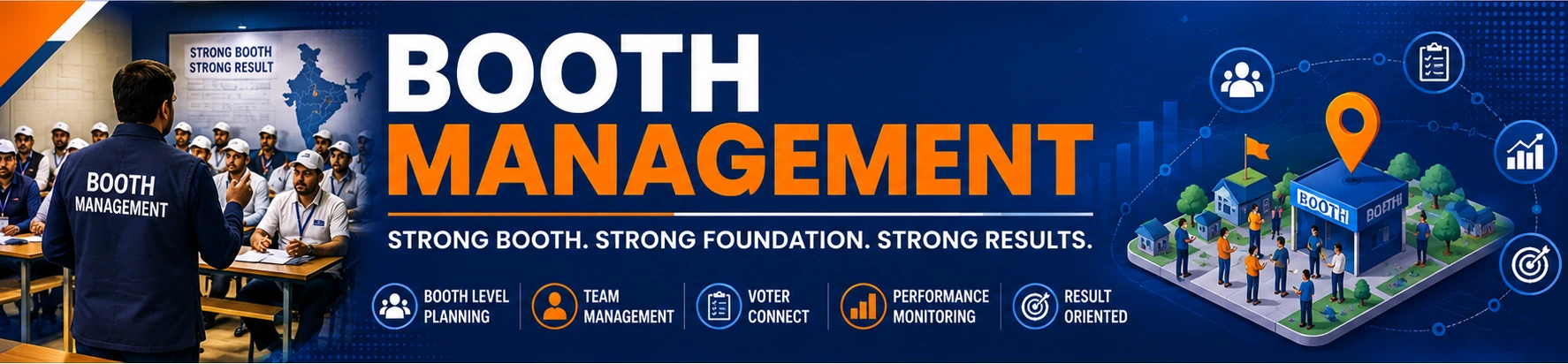
Booth Management is an important part of organized election campaign operations. It brings together booth-level research, historical electoral data, field intelligence, campaign organization, team coordination, public communication, monitoring and reporting within a structured operational framework. Megamind provides professional booth management and booth-level election intelligence services for political parties, candidates, prospective candidates, leaders, political organizations and campaign teams across India.
What is Booth Management in Elections?
In campaign operations, booth management refers to organizing research, data, field teams, communication and campaign activities around polling-station or polling-area geography.
Instead of treating a constituency as one large operational unit, booth-level organization allows campaign teams to maintain a more structured understanding of different local areas, field activities and operational requirements.
Professional booth management can bring together:
- Polling-area and booth mapping
- Historical election-result analysis
- Aggregate booth-level electoral analysis
- Electorate and geographic data organization
- Local issue and field intelligence reporting
- Field team structure and responsibility allocation
- Volunteer and worker coordination
- Campaign activity planning
- Public communication support
- Field reporting and documentation
- Dashboard-based monitoring
- Constituency-level coordination
Campaign-side booth management is different from official polling-station administration. Political campaign teams may organize their own lawful research, communication, field teams and campaign operations. Official electoral rolls, polling personnel, polling-station administration, voting procedures, security and the conduct of polling are handled by the relevant election authorities.
Why Booth-Level Organization Matters
Large constituencies may contain hundreds or even thousands of polling areas. Managing field information only at constituency level can make operational reporting difficult.
Booth-level organization creates smaller geographic units for research, coordination and reporting.
This can help campaign teams:
- Organize geographic election information
- Understand historical electoral patterns
- Maintain structured field reporting
- Document local public issues
- Coordinate field teams systematically
- Track authorized campaign activities
- Improve communication between field and central teams
- Maintain operational dashboards
- Identify incomplete field reporting
- Review constituency-wide campaign operations
Our Booth Management Services
Booth Mapping
Structured organization of polling areas, booth identifiers, geographic references and relevant constituency information.
Historical Election Analysis
Review of historical booth-level results, turnout, vote share, margins and electoral patterns where comparable data is available.
Electoral Data Management
Organization, verification and structured management of appropriate booth and constituency-level electoral data.
Field Team Organization
Team hierarchy, role allocation, area responsibility, communication structure and field reporting processes.
Local Issue Reporting
Structured field collection and reporting of local public issues, infrastructure concerns and constituency observations.
Field Activity Coordination
Planning and reporting systems for authorized campaign activities conducted by field teams.
Public Communication Support
Support for consistent campaign information, public issue communication and structured feedback reporting.
Monitoring & Dashboards
Centralized monitoring of field reports, activity status, pending tasks and operational updates.
Constituency Coordination
Integration of booth-level reporting into constituency-level operational review and campaign coordination.
Booth-Level Election Data Analysis
Booth-level election analysis examines aggregate electoral results and geographic patterns associated with polling areas.
Depending on data availability and comparability, analysis can include:
- Historical booth-wise election results
- Candidate-wise aggregate vote totals
- Party-wise vote share
- Historical voter turnout
- Winning and runner-up margins
- Election-to-election vote-share movement
- Electorate-size changes
- Polling-area geographic patterns
- Boundary or booth-number changes
- Comparison with constituency-level trends
This research can be integrated with Voter Data Analysis and Political Survey to provide broader election intelligence.
What Booth-Level Election Results Can — and Cannot — Tell Us
What Aggregate Results Can Show
Historical vote totals, vote share, turnout, margins, election-to-election movement and geographic electoral patterns at an aggregate polling-area level.
What They Cannot Show
Aggregate booth results do not reveal how an individual elector voted and should not be treated as proof of an individual's political preference.
Changes in booth boundaries, polling-station numbers or electorate allocation should also be checked before historical results are compared.
Information Used in Booth-Level Research
A professional booth-management project may combine multiple appropriate information sources depending on the project objective.
Historical Results
Previous election results, turnout, vote share and margins.
Polling Geography
Polling areas, booth references, constituency geography and relevant boundary information.
Electorate Statistics
Appropriate aggregate electorate totals and related geographic statistics.
Political Surveys
Properly designed aggregate survey research for current political and public-issue understanding.
Field Research
Structured observations, public issues and operational information reported by field teams.
Campaign Reporting
Authorized activity status, field-team reports and operational updates.
Local Issues & Ground Intelligence
Booth-level field operations are not only about historical election numbers. Local observations can provide important context for understanding constituency conditions.
Field teams can systematically report information such as:
- Local civic issues
- Road and transport concerns
- Water and sanitation issues
- Electricity-related concerns
- Public service observations
- Local development concerns
- Public meeting feedback
- Area-specific campaign observations
- Field activity status
- Issues requiring further research
Such information should be documented systematically rather than relying only on informal or anecdotal reports.
Booth-Level Field Team & Volunteer Coordination
A clear team structure helps ensure that field responsibilities, communication and reporting remain organized.
Depending on campaign requirements, coordination may include:
- Area responsibility allocation
- Team hierarchy and reporting structure
- Field-worker onboarding
- Operational briefings
- Communication protocols
- Activity scheduling
- Daily field reporting
- Issue escalation
- Attendance and activity records
- Training on campaign procedures
Door-to-Door & Public Contact Operations
Where included in the campaign plan, booth management can support structured door-to-door and public-contact operations.
The operational framework may include:
- Area mapping
- Field-team deployment
- Daily route and activity planning
- Distribution of authorized campaign information
- Respectful public communication
- Collection of public issues and feedback
- Activity reporting
- Team safety procedures
- Supervisor coordination
- Daily review and documentation
Learn more: What is Door-to-Door Campaigning?
How Professional Booth Management Works
Booth Monitoring, Dashboards & Daily Reporting
Large field operations require a reliable reporting system so that information from multiple areas can be consolidated and reviewed.
A booth-management dashboard may track:
- Field-team reporting status
- Assigned and completed activities
- Pending operational tasks
- Local issue reports
- Field observations
- Survey progress where applicable
- Area coverage status
- Data-quality checks
- Escalated operational issues
- Constituency-level summary reporting
Integration with Election War Room Operations
Booth-level reporting becomes more useful when field information can be consolidated at constituency or central campaign level.
A campaign war room can use structured booth reports to coordinate:
- Field-team communication
- Operational task tracking
- Issue escalation
- Research updates
- Campaign-event coordination
- Public communication updates
- Daily management reporting
- Data-quality review
Related insight: What is Election War Room Management?
Technology in Modern Booth Management
Digital systems can make booth-level campaign operations easier to organize, monitor and report when they are implemented with suitable access controls and data-governance practices.
Central Database
Structured storage of appropriate geographic, electoral and operational information.
Field Reporting
Digital reporting systems for authorized field activities, observations and issues.
Dashboards
Consolidated views for monitoring campaign-side operational progress.
GIS & Mapping
Geographic visualization of polling areas and constituency information where appropriate.
Data Validation
Checks for incomplete, inconsistent or duplicate operational records.
Management Reports
Structured summaries for campaign coordinators and project management teams.
Data Privacy, Security & Governance
Election projects can involve large volumes of electoral, survey, geographic and operational information. Data governance should therefore be built into the project from the beginning.
- Use appropriate and lawful data sources
- Collect only information needed for the project
- Prefer aggregate analysis where appropriate
- Restrict system access according to roles
- Protect survey confidentiality
- Maintain secure data storage
- Verify data before analysis
- Maintain reporting and access controls
- Avoid unnecessary sensitive personal profiling
- Document data-processing procedures
Election Rules, Permissions & Operational Compliance
Campaign-side booth activities should be conducted in accordance with applicable election rules, lawful permissions, platform requirements where digital systems are used, and directions issued by the relevant election authorities.
Field teams should also receive clear operational guidance regarding authorized campaign activity, respectful public interaction, data handling, safety, reporting and escalation procedures.
Booth Management During the Polling Period
During the polling period, campaign-side teams should clearly distinguish their lawful organizational and reporting functions from the official conduct of the election.
Campaign-Side Functions
Internal team coordination, authorized campaign records, operational communication, issue escalation and lawful campaign-side reporting.
Official Election Functions
Electoral-roll administration, polling personnel, voting procedures, polling-station control, security and official election administration remain with the relevant authorities.
What Makes a Booth Management System Effective?
A professional booth-management system depends less on the volume of data collected and more on whether the information is reliable, organized and useful for campaign operations.
- Clear booth and geographic structure
- Verified historical data
- Defined field-team responsibilities
- Consistent reporting formats
- Reliable communication channels
- Regular data-quality checks
- Structured issue escalation
- Secure information access
- Central monitoring
- Documented operational procedures
Megamind's Booth Management Approach
Megamind approaches booth management as an integrated Research + Data + Field Operations + Technology + Monitoring system rather than treating it only as a polling-period activity.
Our framework can follow:
Constituency Understanding → Booth Mapping → Historical Election Analysis → Electoral Data Organization → Political Survey & Field Research → Local Issue Reporting → Team Organization → Ground Operations → Monitoring → Data Verification → Dashboards → Continuous Reporting
The exact structure depends on the election, constituency, geographic coverage, project duration and agreed scope of work.
Explore Complete Election Services →Who Can Use Booth Management Services?
Professional booth-level research and campaign operations can support different types of political projects.
- Political parties
- Election candidates
- Prospective candidates
- Political leaders
- Campaign teams
- Political organizations
- Constituency-level campaign units
- Election research and coordination teams
Booth Management for Different Project Scales
Booth-management requirements can differ significantly depending on election type and project scale.
Constituency Project
Booth mapping, electoral research, field organization, reporting and campaign operations within a specific constituency.
Multi-Constituency Project
Standardized booth systems, reporting structures and centralized coordination across multiple constituencies.
Large Election Project
Scalable data, technology, field coordination and monitoring frameworks across larger geographic operations.
Benefits of Professional Booth Management
- Better organization of booth-level information
- Structured historical election analysis
- Improved field-team coordination
- Clear operational responsibilities
- Consistent field reporting
- Better visibility of local public issues
- Centralized campaign monitoring
- Improved data quality and documentation
- Faster operational issue escalation
- Integration of research and field operations
- Technology-supported reporting
- More structured constituency management
Common Challenges in Booth Management
Incomplete Data
Missing or inconsistent booth records can reduce analytical reliability.
Boundary Changes
Polling-area or booth changes can complicate historical comparisons.
Field Reporting
Unstructured reporting can make large ground operations difficult to review.
Team Coordination
Large field teams require clear roles and communication structures.
Data Quality
Duplicate, outdated or unverified information can affect reporting.
Operational Scale
Processes that work in one constituency may need different systems for larger projects.
FAQs About Booth Management Services
1. What is booth management in an election campaign?
Campaign-side booth management is the structured organization of booth-level electoral research, aggregate election data, field teams, local issue reporting, campaign activities, coordination, monitoring and reporting around polling areas.
2. Is booth management the same as managing an official polling station?
No. Campaign booth management relates to a political campaign's research and operations. Official polling-station administration and the conduct of voting are responsibilities of the relevant election authorities.
3. What services can be included in booth management?
Services can include booth mapping, historical electoral analysis, aggregate booth-level data analysis, field-team organization, issue reporting, campaign activity coordination, monitoring, dashboards and reporting.
4. Does Megamind provide booth-level election data analysis?
Yes. Where reliable data is available, Megamind can analyze aggregate historical results, turnout, vote share, margins and other relevant booth-level electoral trends.
5. Can booth results identify an individual's vote?
No. Booth-level election results are aggregate geographic totals and do not reveal how an individual elector voted.
6. Do you coordinate field workers and volunteers?
Project scope can include campaign-side team organization, responsibility allocation, operational briefing, communication, activity reporting and field coordination.
7. Can booth management include door-to-door operations?
Yes. Where appropriate, campaign field operations can include area mapping, team deployment, respectful public communication, issue collection and structured activity reporting.
8. What information is useful for booth-level research?
Useful inputs can include polling-area geography, historical election results, vote share, turnout, margins, electorate totals, field observations, local issues and appropriately designed survey research.
9. Do you provide booth monitoring dashboards?
Depending on project scope, Megamind can provide structured field reporting, monitoring systems, dashboards and constituency-level management reports.
10. Can booth management be integrated with political surveys?
Yes. Aggregate political survey findings can provide a current research layer alongside historical election data and field intelligence.
11. Is booth management available for different election types?
The framework can be adapted for different election and geographic contexts according to data availability, project scope and applicable requirements.
12. Are Megamind's booth management services available across India?
Megamind undertakes political research and election-service projects across India, subject to project scope, operational requirements and applicable rules.
13. Who can use professional booth management services?
Political parties, candidates, prospective candidates, leaders, campaign teams and political organizations can discuss booth-management requirements with Megamind.
14. When should booth-level planning begin?
The appropriate timeline depends on project scope, but research, data organization and field-team structures generally benefit from being established before intensive campaign operations begin.
15. How can I discuss a booth management project with Megamind?
Contact Megamind with the relevant election, constituency or project geography, expected services and approximate scope so the requirement can be reviewed.
Booth Management Connects Research with Ground Operations
Effective booth management is not simply a list of polling stations or a polling-period activity. It is a structured system connecting electoral research, aggregate booth-level data, field intelligence, team organization, campaign operations, technology, monitoring and reporting .
Historical election results can provide context, political surveys can add current research, field teams can document local conditions, and technology can consolidate operational information into structured dashboards and reports.
When these elements are integrated responsibly, booth-level organization becomes an important operational component of a broader election campaign management system.