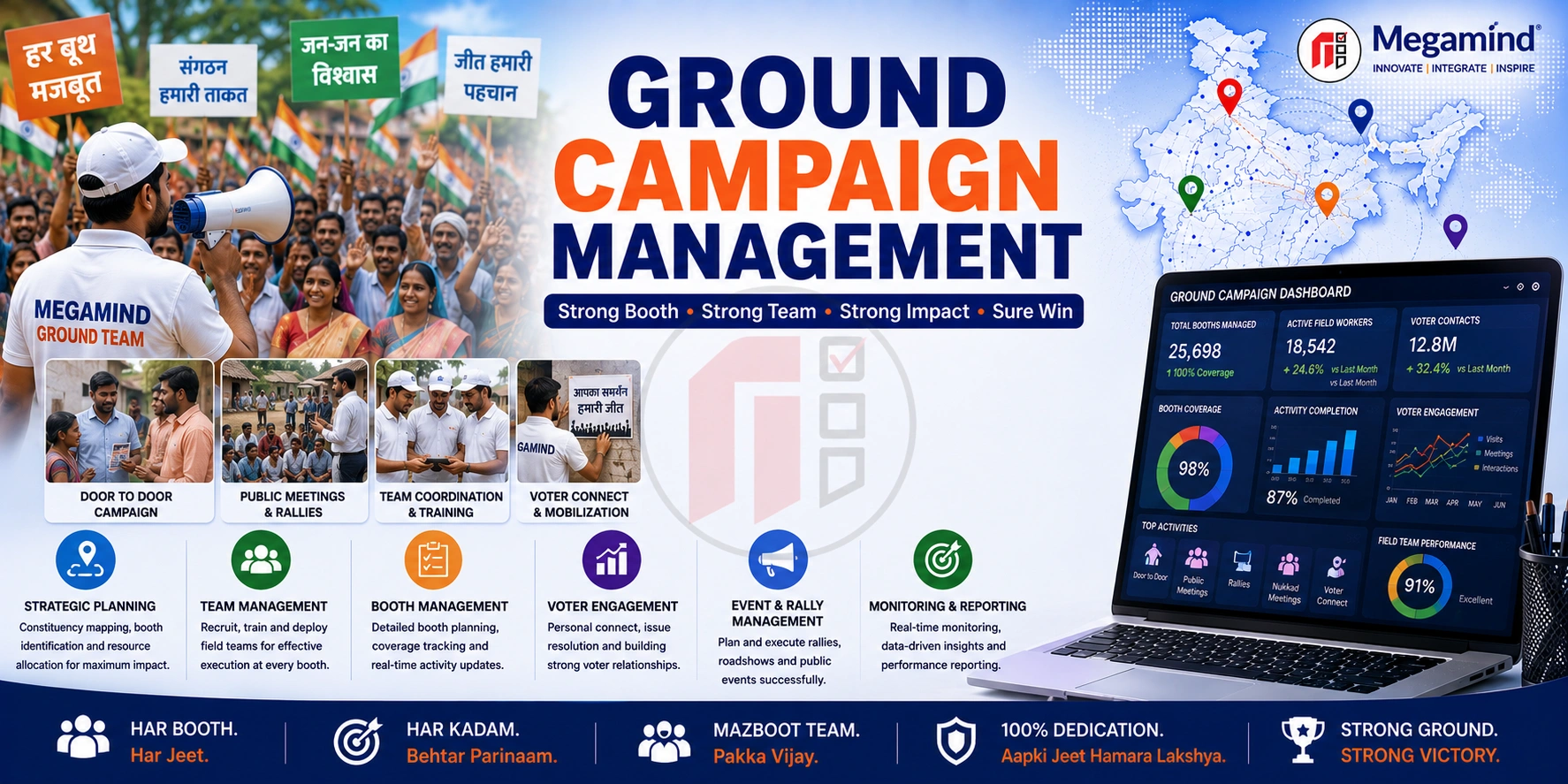
Ground Campaign Management converts election strategy into organized field execution. Megamind connects Strategy → Constituency Planning → Team Structure → Field Deployment → Campaign Activities → Supervision → Monitoring → Reporting → Election War Room → Management Review so that ground campaign operations can be managed through a defined and accountable system rather than disconnected activities.
What is Ground Campaign Management?
Ground Campaign Management is the structured planning, organization, execution, supervision and monitoring of political campaign activities taking place physically within a constituency or electoral area.
While election strategy establishes broader campaign direction, ground campaign management focuses on converting approved plans into coordinated field activity.
This can include constituency field planning, team organization, campaign scheduling, public programs, outreach coordination, volunteer operations, logistics, reporting and management review.
A professional ground campaign structure helps create a clear operational chain between campaign leadership and teams working across the constituency.
- Constituency field planning
- Campaign team organization
- Field responsibility allocation
- Supervisor hierarchy
- Volunteer coordination
- Campaign activity scheduling
- Candidate program coordination
- Public meeting coordination
- Outreach execution
- Field logistics
- Daily campaign monitoring
- Activity verification
- Field feedback reporting
- Issue escalation
- Management dashboards
- Election War Room integration
A campaign plan creates value only when it can be translated into disciplined execution. Ground Campaign Management provides the operational structure connecting campaign leadership with field managers, supervisors, volunteers, public activities and daily reporting.
Why Professional Ground Campaign Management Matters
Political campaigns involve multiple teams, locations, activities and deadlines operating simultaneously.
Without a structured management system, field activities can become fragmented. Teams may receive inconsistent instructions, activities may overlap, reporting may be incomplete and campaign leadership may not have a reliable picture of what is actually happening on the ground.
Professional Ground Campaign Management establishes processes for planning, responsibility, supervision, reporting and review.
- Clear campaign responsibilities
- Structured field hierarchy
- Better activity coordination
- Consistent daily planning
- Improved team communication
- Better volunteer coordination
- Structured candidate programs
- Improved event coordination
- Faster operational escalation
- Consistent field reporting
- Better management visibility
- Improved War Room coordination
Our Ground Campaign Management Services
Constituency Field Planning
Structured planning of campaign areas, teams, schedules, responsibilities and reporting processes across the constituency.
Field Team Management
Organization of field managers, supervisors, coordinators and authorized campaign teams through defined operational roles.
Volunteer Coordination
Volunteer onboarding, activity allocation, attendance coordination, supervision and operational reporting.
Campaign Activity Planning
Daily and periodic scheduling of approved public campaign activities according to campaign priorities and operational capacity.
Candidate Program Coordination
Operational coordination of lawful candidate visits, meetings, public programs and constituency activities.
Public Meeting Coordination
Planning support for lawful public meetings, campaign events, team deployment, logistics and activity reporting.
Outreach Operations
Coordination of broad, lawful and respectful public outreach activities within the overall ground campaign framework.
Field Logistics Coordination
Operational planning for campaign materials, schedules, teams, approved venues and other field requirements.
Field Monitoring
Structured monitoring of campaign activity completion, team reporting and operational issues.
Field Feedback Management
Collection and classification of operational observations and public issues reported by campaign teams.
Campaign Reporting
Daily and periodic reports covering approved campaign activities, team status, issues and management actions.
War Room Integration
Integration of field operations with centralized campaign monitoring, escalation and management review.
Ground Campaign Audit & Field Readiness Assessment
Before intensive field execution begins, the existing campaign structure should be reviewed.
A readiness assessment helps identify operational gaps, unclear responsibilities, reporting weaknesses and coordination requirements.
- Existing campaign structure
- Field team availability
- Supervisor structure
- Volunteer capacity
- Area coverage structure
- Activity planning process
- Candidate schedule coordination
- Field reporting process
- Communication channels
- Escalation hierarchy
- Campaign material readiness
- War Room connectivity
Constituency-Wide Ground Campaign Planning
A constituency is easier to manage when field operations are organized into clearly defined operational areas and responsibilities.
Megamind can help structure a constituency campaign around manageable geographic and operational units using lawful aggregate information and campaign requirements.
Planning can consider:
- Constituency geography
- Operational areas
- Campaign team availability
- Public activity calendar
- Candidate movement schedule
- Volunteer availability
- Field logistics
- Reporting hierarchy
- Supervisor workload
- Campaign stage
- Aggregate research context
- Operational priorities
Constituency planning is operational in nature and should not be confused with individualized political profiling.
Ground Campaign Team Structure & Responsibility Matrix
Field execution requires a clear chain of responsibility.
Every campaign can use a different structure depending on its size, but responsibilities should be clearly defined so that teams know who assigns work, who supervises activities, who verifies reports and who handles escalations.
Campaign Leadership
Provides approved campaign direction, priorities and management decisions.
Ground Campaign Manager
Coordinates constituency-wide field execution and connects operational teams with campaign leadership.
Area Coordinators
Coordinate campaign activities across assigned geographic or operational areas.
Field Supervisors
Supervise authorized field teams, activity completion and operational reporting.
Field Teams
Execute approved campaign activities and submit required operational reports.
War Room Team
Consolidates reporting, tracks issues and supports management review and escalation.
Supervisor Hierarchy & Accountability System
A campaign can have a large number of field participants, but management becomes difficult if everyone reports directly to one central team.
A defined supervisor hierarchy creates manageable reporting channels and accountability.
Campaign Volunteer Management & Coordination
Volunteers can support many lawful campaign activities, but their effectiveness depends on clear responsibilities, guidance and coordination.
Volunteer management can include:
- Volunteer registration
- Availability tracking
- Basic onboarding
- Role allocation
- Activity assignment
- Team grouping
- Supervisor assignment
- Attendance coordination
- Campaign guidelines
- Activity reporting
- Issue escalation
- Performance review
Daily Ground Campaign Planning & Execution
Ground campaigns operate through daily activity.
A structured daily campaign plan helps field managers understand what needs to happen, where activities will take place, which team is responsible and how completion will be reported.
Ground Campaign Calendar & Activity Scheduling
A campaign calendar connects strategic priorities with practical field execution.
It can help coordinate candidate programs, public meetings, outreach activities, team deployment, campaign events and reporting requirements.
- Daily activity calendar
- Weekly campaign plan
- Candidate program calendar
- Public meeting schedule
- Field team deployment schedule
- Volunteer schedule
- Campaign material schedule
- Reporting deadlines
- Review meetings
- Special campaign activities
Candidate Program & Constituency Visit Coordination
Candidate time is a limited campaign resource. Public programs and constituency visits therefore require organized operational coordination.
Ground Campaign Management can coordinate approved candidate activities with relevant field teams, public communication teams and campaign management.
- Program scheduling
- Area coordination
- Field team readiness
- Venue coordination
- Volunteer coordination
- Campaign material readiness
- Public information coordination
- Operational reporting
Public Meetings, Campaign Programs & Event Coordination
Public campaign activities involve multiple operational requirements that should be coordinated through a defined process.
Depending on project scope and applicable permissions, coordination can cover:
- Activity scheduling
- Venue coordination
- Team deployment
- Volunteer coordination
- Campaign material readiness
- Candidate schedule integration
- Public information coordination
- Media team coordination
- Digital team coordination
- Post-event reporting
Required permissions and applicable election, public-order and local rules remain important for physical campaign activities.
Ground Campaign & Voter Outreach Integration
Ground Campaign Management and Voter Outreach & Mobilization are closely connected but perform different functions.
Ground Campaign Management
Manages the wider field campaign structure, including teams, activities, candidate programs, logistics, supervision, monitoring and reporting.
Voter Outreach & Mobilization
Focuses more specifically on broad public outreach, field contact coordination, volunteer-supported communication and lawful mobilization operations.
Both services can operate within one integrated campaign management framework.
Explore: Voter Outreach & Mobilization
Respectful, Lawful & Transparent Public Outreach
Field campaign activity should respect citizens, applicable law and the integrity of the electoral process.
General campaign outreach should be voluntary and transparent. People should not be subjected to intimidation, coercion, harassment, vote buying or unlawful inducements.
Ground campaign planning should also avoid individualized political targeting based on sensitive personal traits or inferred political preferences.
- Respectful public interaction
- Transparent campaign identity
- Lawful campaign activity
- Appropriate permissions
- No intimidation or coercion
- No vote buying
- No unlawful inducements
- No impersonation
- No interference with official election processes
- No sensitive-trait political profiling
Campaign Material Planning & Field Distribution Coordination
Physical campaign materials require planning so that approved materials are available where and when campaign teams require them.
Operational coordination can include:
- Material requirement planning
- Approved material inventory
- Area-wise allocation
- Team-wise allocation
- Distribution records
- Stock monitoring
- Replenishment requests
- Activity-wise material planning
- Public meeting requirements
- Basic utilization reporting
Campaign materials should comply with applicable election, advertising and local regulatory requirements.
Ground Campaign Logistics Coordination
Field campaigns depend on practical coordination between people, schedules, materials and approved activities.
Logistics management can support campaign execution by tracking operational requirements and ensuring that responsible teams receive timely information.
Team Logistics
Coordinate approved team deployment and activity schedules.
Material Logistics
Organize campaign material requirements and distribution records.
Event Logistics
Coordinate operational requirements for lawful campaign meetings and programs.
Schedule Coordination
Align candidate, field team and campaign activity calendars.
Reporting Logistics
Ensure operational reports move through the defined management hierarchy.
Escalation Support
Route operational issues to the responsible campaign management level.
Field Feedback Collection & Management Reporting
Campaign teams working across a constituency may observe operational problems, public issues, event requirements and other developments.
A structured feedback process helps convert these observations into organized management information.
- Operational feedback
- Public issue categories
- Campaign activity observations
- Material requirements
- Team coordination issues
- Event-related observations
- Verification status
- Escalation status
- Management action
- Closure status
Field observations are not automatically representative public opinion. A valid opinion poll or political survey requires a defined research methodology.
Ground Campaign Issue Escalation System
Not every field issue requires campaign leadership attention. At the same time, important issues should not remain buried within local communication channels.
A structured escalation system can classify and route operational issues according to responsibility and urgency.
Daily Ground Campaign Monitoring
Monitoring provides campaign leadership with visibility into operational execution.
The objective is not simply to count activities but to understand whether planned work was completed, whether reports were submitted and whether important operational issues require attention.
- Planned activities
- Completed activities
- Pending activities
- Team deployment status
- Volunteer participation
- Candidate program status
- Public meeting status
- Material distribution status
- Field reporting status
- Operational issues
- Escalated matters
- Pending management actions
Ground Campaign KPI & Operational Monitoring Framework
Ground campaign KPIs should measure operational execution rather than claim to measure an individual's political preference.
Activity Completion
Percentage or count of approved field activities completed against the operational plan.
Team Reporting
Reporting completion and timeliness across campaign teams and supervisors.
Volunteer Attendance
Operational attendance information for authorized campaign activities.
Event Completion
Status of scheduled lawful meetings, programs and campaign activities.
Issue Closure
Tracking of reported operational issues from escalation through closure.
Data Completeness
Completeness and consistency of approved field reporting.
Daily, Weekly & Management-Level Ground Campaign Reports
Reporting should convert field activity into concise management information.
Depending on campaign requirements, reporting can include:
- Daily activity report
- Area-wise campaign report
- Team deployment report
- Volunteer activity report
- Candidate program report
- Public meeting report
- Campaign material report
- Operational issue report
- Escalation report
- Weekly campaign summary
- Management dashboard
- Executive campaign summary
Field Verification & Campaign Quality Assurance
Campaign reporting becomes less useful when activity completion is inconsistent or reporting standards vary widely between teams.
Quality assurance can establish basic verification and reporting standards.
- Defined reporting format
- Supervisor verification
- Activity status review
- Data completeness checks
- Duplicate reporting checks
- Operational consistency review
- Issue classification standards
- Management review
Ground Campaign & Digital Campaign Integration
Ground and digital campaign teams should not operate as completely disconnected units.
Approved public campaign activities can be coordinated with digital communication teams so that public information, campaign schedules and authorized content remain operationally aligned.
- Candidate activity coordination
- Public event communication
- Approved campaign content coordination
- Field photo and video workflow
- Digital team notification
- Campaign calendar alignment
- Media coordination
- Post-event reporting
Explore: Digital Election Campaign Management
Ground Campaign & Political Communication Coordination
Public-facing field activities should remain aligned with approved campaign identity and communication.
Coordination between field operations and communication teams can help maintain consistency across public meetings, candidate programs, printed campaign materials and digital communication.
Explore: Political Branding & Communication
Ground Campaign & Political Survey Integration
Properly designed political research can provide aggregate constituency-level context for campaign planning.
Survey findings may help leadership understand broad public issues, awareness and other measured indicators while remaining subject to methodology and sampling limitations.
Survey respondent information should be handled confidentially, and aggregate research should not be converted into individualized sensitive political preference profiles.
Explore: Political Survey Services
Ground Campaign & Political Data Analytics Integration
Aggregate historical election data, constituency analysis and political research can provide contextual information for campaign management.
Ground campaign operational reports can also contribute to management dashboards when they are clearly distinguished from public opinion research and official election results.
Ground Campaign & Election War Room Integration
The Election War Room can provide the centralized management layer connecting constituency field operations with campaign leadership.
Ground campaign information can be consolidated for management review through standardized reports and dashboards.
- Daily field plan
- Activity completion
- Team deployment
- Volunteer activity
- Candidate program status
- Public meeting status
- Field issue reporting
- Escalation tracking
- Pending management actions
- Campaign reporting
Explore: Election War Room Management
Converting Election Strategy into Ground Execution
Strategy defines priorities. Ground Campaign Management creates the operational system required to execute approved priorities.
The connection can be represented as:
Explore: Election Strategy & Planning
Ground Campaign Management Across the Election Lifecycle
Ground campaign requirements change as an election progresses.
A flexible operational framework can adapt team structures, reporting frequency and campaign activities according to the campaign stage.
Ground Campaign Readiness Before Intensive Campaigning
Early preparation can reduce operational confusion later in the election cycle.
The pre-campaign stage can focus on:
- Campaign structure
- Team identification
- Supervisor allocation
- Volunteer onboarding
- Reporting formats
- Communication channels
- Campaign calendar
- Material planning
- Public program workflow
- War Room reporting structure
Managing High-Volume Ground Campaign Activity
As campaign activity increases, coordination becomes more important.
Field management should maintain visibility across activities without creating unnecessary reporting burden for teams.
- Daily field planning
- Team deployment
- Candidate program coordination
- Public meetings
- Volunteer operations
- Material coordination
- Activity monitoring
- Issue escalation
- Daily reporting
- War Room review
Election-Day Campaign-Side Field Coordination
Election-day operations require particular care because official election administration is the responsibility of authorized election authorities and officials.
Campaign-side teams should operate only within activities permitted by applicable election laws, regulatory directions and local requirements.
Where lawful and within project scope, operational coordination may include:
- Authorized volunteer coordination
- Permitted public information support
- Campaign-side team communication
- Operational attendance reporting
- Lawful logistical coordination
- Issue escalation to campaign management
- Compliance reminders
- Management reporting
Ground Campaign Management does not include administering polling stations, controlling official voter rolls, handling ballots or EVMs, counting votes, interfering with election officials, intimidating voters, buying votes or providing unlawful inducements.
Ground Campaign Operations vs Official Election Administration
Campaign-Side Operations
Includes lawful campaign planning, team management, public programs, volunteer coordination, permitted outreach, operational reporting and campaign management activities.
Official Election Administration
Includes official electoral rolls, polling station administration, ballots or voting equipment, polling procedures, official counting and declaration of results by authorized election authorities.
Campaign organizations and campaign consultants must remain separate from official election administration.
Ground Campaign Data Privacy & Responsible Information Management
Ground campaign operations can generate team information, activity reports, operational records and other project data.
Information should be collected only where appropriate for a legitimate campaign-management purpose and handled according to applicable requirements.
- Purpose limitation
- Data minimization
- Appropriate access controls
- Secure storage
- Defined user permissions
- Operational data classification
- Appropriate retention rules
- Responsible sharing
- Aggregate reporting where appropriate
- Consent where legally required
- Survey respondent confidentiality
- No unnecessary sensitive political profiling
Election Compliance & Operational Governance
Ground campaign activities should be planned with applicable election laws, Election Commission directions, local permissions, public-order requirements, privacy rules and other relevant regulations in mind.
Depending on the campaign activity, compliance considerations can include:
- Applicable election regulations
- Campaign-period restrictions
- Public meeting permissions
- Local authority requirements
- Campaign material requirements
- Advertising rules where applicable
- Privacy and data handling
- Silence-period restrictions where applicable
- Election-day restrictions
- Documented campaign approvals
Strategy → Organization → Execution → Monitoring → Improvement
Megamind integrates Election Strategy + Constituency Planning + Field Team Management + Voter Outreach + Candidate Programs + Campaign Communication + Political Research + Data Analytics + Daily Reporting + Election War Room within one coordinated Ground Campaign Management framework.
Our broad operational process can follow:
Assess → Plan → Organize → Assign → Coordinate → Execute → Monitor → Verify → Report → Review → Improve
The exact campaign structure depends on constituency, election type, campaign stage, available teams, project duration and agreed scope.
Discuss Ground Campaign Requirements →Who Can Use Ground Campaign Management Services?
- Political candidates
- Prospective candidates
- Political leaders
- Political parties
- Campaign organizations
- Election campaign teams
- Constituency campaign teams
- Political field organizations
Ground Campaign Management for Different Election Projects
Assembly Constituency
Constituency-wide field structure, campaign activity coordination, supervision and reporting.
Parliamentary Campaign
Larger multi-area campaign structure with decentralized coordination and centralized management reporting.
Multi-Constituency Campaign
Standardized campaign processes and reporting across multiple electoral areas.
Local Election Campaign
Appropriately scaled ground campaign management according to election type and project requirements.
Short-Duration Campaign
Focused field management for a defined campaign period and selected operational activities.
Integrated Campaign
Ground operations integrated with strategy, survey, digital campaign, communication and War Room management.
Benefits of Professional Ground Campaign Management
- Clear field organization
- Defined responsibilities
- Better campaign coordination
- Improved daily execution
- Structured volunteer management
- Better candidate program coordination
- Consistent campaign reporting
- Faster operational escalation
- Improved field visibility
- Better War Room integration
- Stronger management accountability
- Continuous operational improvement
Common Challenges in Ground Election Campaigns
Many ground campaign problems are operational rather than strategic.
Common challenges can include:
- Unclear team responsibilities
- Weak supervisor structure
- Uncoordinated campaign activities
- Incomplete field reporting
- Duplicate or conflicting instructions
- Poor volunteer coordination
- Last-minute event planning
- Campaign material shortages
- Slow issue escalation
- Disconnected digital and ground teams
- Weak War Room reporting
- Lack of operational review
Ground Campaign Management Deliverables
Deliverables can be customized according to constituency, election type, campaign stage, team structure and agreed project scope.
A comprehensive Ground Campaign Management engagement can include:
- Ground Campaign Readiness Assessment
- Constituency Field Operations Plan
- Campaign Team Structure
- Responsibility Matrix
- Supervisor Hierarchy
- Volunteer Coordination Framework
- Campaign Activity Calendar
- Daily Field Plan Format
- Candidate Program Coordination Framework
- Public Meeting Coordination Process
- Campaign Material Tracking Framework
- Field Reporting Format
- Field Feedback Classification
- Issue Escalation Matrix
- Daily Monitoring Dashboard
- Operational KPI Framework
- Weekly Campaign Review
- Management Reporting System
- War Room Integration Framework
- Campaign Compliance Checklist
- Data Governance Guidelines
- Final Campaign Operations Review
Customized Ground Campaign Management Projects
Every constituency has different geography, campaign organization, resources and operational requirements.
Megamind can structure the engagement according to the actual campaign environment rather than applying one fixed model to every project.
Project design can vary according to:
- Election type
- Constituency size
- Campaign duration
- Campaign stage
- Existing team structure
- Volunteer availability
- Candidate schedule
- Public activity volume
- Reporting requirements
- Digital campaign integration
- War Room requirements
- Agreed project scope
Why Megamind for Ground Campaign Management?
Megamind approaches ground campaigning as part of an integrated election-management system rather than as a collection of disconnected field activities.
Ground operations can connect with our broader capabilities in election strategy, political research, constituency analysis, voter outreach, political communication, digital campaign management, data analytics and Election War Room Management.
- Integrated election campaign approach
- Constituency planning
- Field operations management
- Team coordination
- Campaign monitoring
- Structured reporting
- Political research integration
- Election analytics integration
- Digital campaign coordination
- War Room integration
- Responsible campaign framework
- Customized project structure
Ground Campaign Management can improve campaign organization, coordination and operational visibility, but no campaign-management service can guarantee an election result.
FAQs About Ground Campaign Management
1. What is Ground Campaign Management?
Ground Campaign Management is the structured planning, coordination, execution, monitoring and reporting of on-ground political campaign activities across a constituency or wider electoral area.
2. What services are included in Ground Campaign Management?
Services can include constituency field planning, campaign team coordination, volunteer management, campaign activity scheduling, public meeting coordination, outreach execution, field supervision, reporting and Election War Room integration.
3. Does Megamind provide Ground Campaign Management services across India?
Yes. Megamind can structure Ground Campaign Management projects across India according to constituency, election type, campaign duration, field requirements and agreed project scope.
4. What is constituency field planning?
Constituency field planning organizes campaign areas, teams, schedules, public activities, reporting responsibilities and operational requirements into a coordinated field execution framework.
5. Can Megamind coordinate political field teams?
Yes. Field coordination can include team structure, responsibility allocation, supervisor hierarchy, activity scheduling, reporting workflows and management review.
6. Does Ground Campaign Management include volunteer coordination?
Yes. Depending on project scope, volunteer operations can include onboarding, activity allocation, attendance coordination, field guidance, supervision and reporting.
7. Can public meetings and campaign events be coordinated?
Yes. Ground campaign operations can support lawful public meetings, campaign programs and events through scheduling, team coordination, logistics, communication and post-activity reporting.
8. Does Ground Campaign Management include door-to-door outreach?
Ground Campaign Management can coordinate lawful and respectful door-to-door public outreach as part of the wider field campaign, while detailed outreach planning can also be integrated with Voter Outreach & Mobilization services.
9. How are daily campaign activities planned?
Daily activities can be organized through area-wise plans, team assignments, activity calendars, supervisor responsibilities, logistical requirements and structured reporting schedules.
10. How are field campaign activities monitored?
Monitoring can use activity reports, attendance information, supervisor verification, event reports, approved operational indicators, issue escalation and management dashboards.
11. What reports can campaign leadership receive?
Reports can include activity completion, team deployment, public programs, volunteer participation, field observations, operational issues, pending actions and other approved campaign management indicators.
12. Can Ground Campaign Management integrate with an Election War Room?
Yes. Field reports, campaign activities, operational issues and approved management indicators can be integrated with an Election War Room for centralized review and coordination.
13. Can Ground Campaign Management integrate with Election Strategy & Planning?
Yes. Election Strategy & Planning establishes broader campaign priorities while Ground Campaign Management converts approved plans into coordinated field execution.
14. Can political surveys support ground campaign planning?
Yes. Properly designed aggregate political research can provide constituency-level context and public issue information that can support general campaign planning without creating sensitive individual political profiles.
15. Can constituency analysis be integrated with ground operations?
Yes. Aggregate constituency analysis can provide historical, geographic and research context for operational planning and management review.
16. Can digital and ground campaign activities be coordinated together?
Yes. Public campaign events, candidate activities and approved campaign communication can be coordinated between field and digital teams to improve operational consistency.
17. What is field feedback management?
Field feedback management is the structured collection, classification, verification and reporting of operational observations and public issues reported by authorized campaign teams.
18. How are field issues escalated?
Projects can use a defined escalation hierarchy so operational issues are recorded, assigned, reviewed and escalated to the appropriate campaign manager or War Room team.
19. Can Ground Campaign Management be customized for an Assembly constituency?
Yes. Ground campaign structures can be customized for Assembly constituencies according to geography, campaign duration, team strength, activities and project requirements.
20. Can Ground Campaign Management support Parliamentary elections?
Yes. Ground campaign operations can be scaled for Parliamentary, Assembly and appropriate local election projects according to project requirements and lawful campaign activities.
21. When should ground campaign planning begin?
Planning should ideally begin early enough to establish team structure, responsibilities, field processes, reporting systems and campaign calendars before intensive campaign activity begins.
22. Does Megamind use sensitive personal traits for political targeting?
Megamind's responsible framework emphasizes aggregate area-level and operational planning rather than individualized political targeting based on sensitive traits or inferred political preferences.
23. How is field and campaign data handled responsibly?
Responsible data practices can include purpose limitation, data minimization, appropriate access controls, secure storage, defined retention practices and aggregate reporting where appropriate.
24. Can Ground Campaign Management support election-day coordination?
Where lawful and within project scope, campaign teams can be coordinated for permitted information, volunteer deployment, reporting and logistical activities while remaining separate from official election administration.
25. Does Ground Campaign Management guarantee election victory?
No. Professional ground campaign management can improve organization, coordination, execution and reporting, but election outcomes are determined by voters and many changing electoral factors.
Building an Organized, Accountable & Integrated Ground Campaign
Ground campaigning is where election strategy meets day-to-day field execution.
A strong campaign therefore requires more than field presence. It requires an operational structure connecting campaign leadership, managers, supervisors, volunteers, candidate programs, public activities, logistics, reporting and management review.
Megamind's Ground Campaign Management framework brings these components together through Planning, Organization, Coordination, Execution, Monitoring, Reporting and Election War Room Integration .
The objective is to create a campaign operation that is organized, measurable, responsive and professionally managed while respecting applicable election requirements and responsible data practices.
Build a Structured Ground Election Campaign with Megamind
Discuss your constituency, campaign stage, field team, volunteer coordination, public campaign activities, monitoring, reporting and Election War Room requirements with Megamind.
Discuss Ground Campaign Management