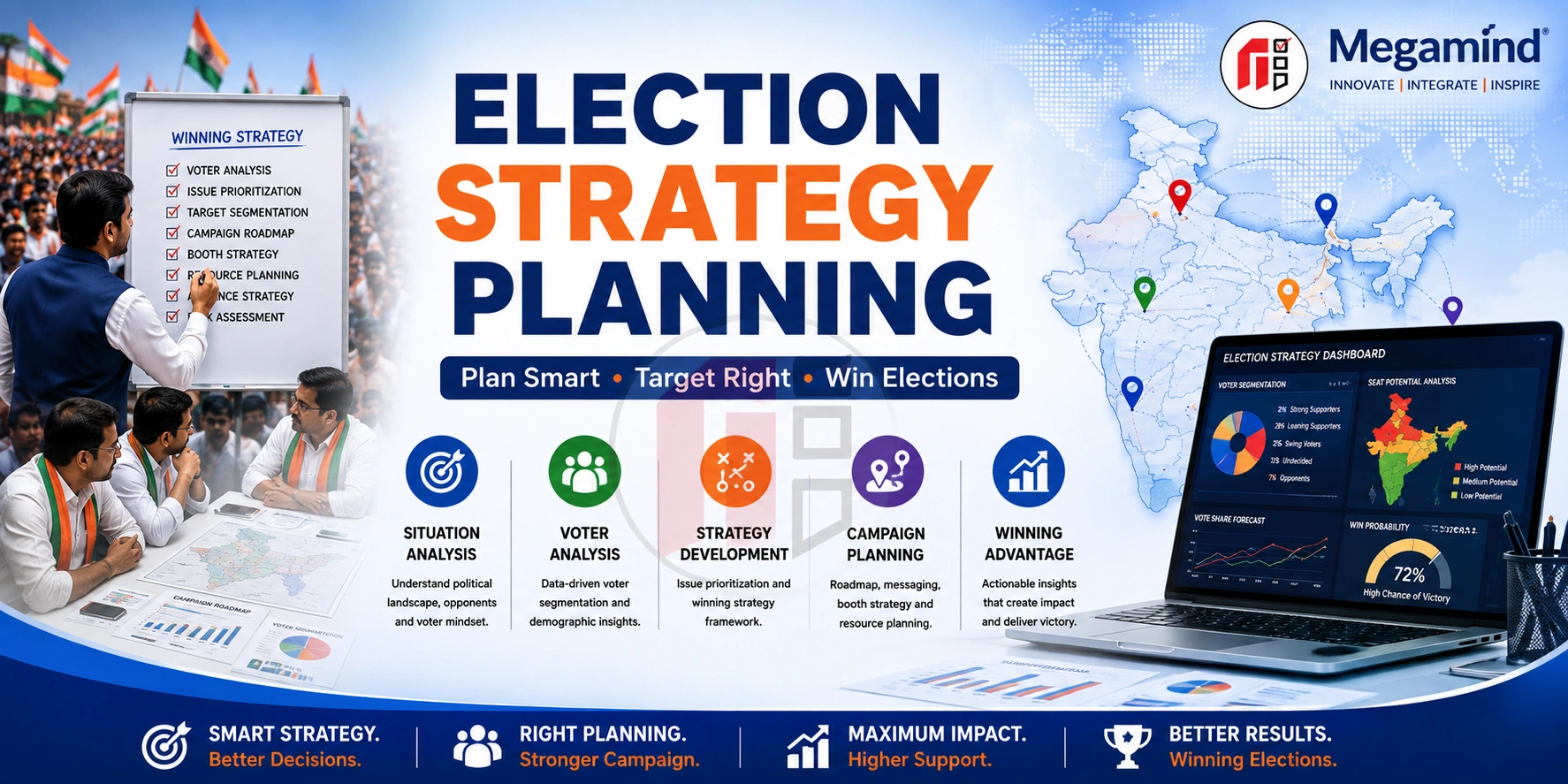
Elections involve research, organization, communication, field operations, digital activity, public relations, candidate schedules, booth teams and continuous decision-making. Megamind Election Strategy & Planning brings these components into one structured framework: Research → Analysis → Strategy → Planning → Execution → Monitoring → Review .
What is Election Strategy & Planning?
Election Strategy & Planning is the systematic process of understanding the electoral environment, defining campaign objectives, organizing available resources and developing a coordinated plan for political communication, field operations, research, campaign management and monitoring.
A professional strategy does not begin with slogans or advertisements. It begins with understanding the constituency, historical election results, current political conditions, public issues, candidate position, organizational capacity and available research.
The purpose is to establish a clear campaign direction and create an operational framework that allows different teams to work toward defined objectives while campaign leadership continuously reviews new information and changing conditions.
Effective election strategy is a continuous process rather than a one-time document. Research, field information, public issues, campaign activity and operational performance can change during an election. Strategy should therefore be monitored and reviewed throughout the campaign.
Why Election Strategy & Planning is Important
Election campaigns involve many teams and limited resources. Without structured planning, research, field operations, communication and campaign activity can become disconnected.
- Creates clear campaign objectives
- Organizes political research
- Improves constituency understanding
- Supports evidence-based decisions
- Coordinates campaign teams
- Improves operational planning
- Creates communication consistency
- Supports booth-level organization
- Improves resource allocation
- Enables campaign monitoring
- Supports rapid review of changing conditions
- Creates structured leadership reporting
Our Election Strategy & Planning Services
Political Research
Structured collection and interpretation of appropriate political, electoral and constituency information.
Historical Election Analysis
Study of previous aggregate results, turnout, vote share, margins and electoral changes.
Constituency Analysis
Structured assessment of electoral history, geography, issues, surveys and current constituency conditions.
Political Surveys
Survey research designed around defined political and constituency research objectives.
Candidate Assessment
Research-based assessment of candidate awareness, public perception, positioning and campaign context.
Competitor Analysis
Structured analysis of political competitors using appropriate public, electoral and research information.
Campaign Planning
Development of campaign priorities, phases, activities, responsibilities, timelines and review mechanisms.
Booth Strategy
Geographic organization of booth-level campaign operations, teams, reporting and readiness.
Communication Planning
Coordinating campaign themes, public communication, speeches, media and campaign information.
Digital Campaign Planning
Structured planning of digital communication, content, publishing and performance review.
War Room Planning
Creating campaign coordination, reporting and monitoring structures for leadership decision support.
Performance Monitoring
Tracking campaign activities, research signals, operational progress and reporting requirements.
How Our Election Strategy Process Works
Political Research Before Strategy
Strategy should be developed from evidence rather than assumptions. The research phase establishes a factual and analytical foundation for campaign planning.
- Historical election results
- Aggregate vote-share trends
- Turnout trends
- Winning-margin analysis
- Constituency geography
- Political survey findings
- Public issue research
- Candidate research
- Competitor research
- Field reports
- Organizational assessment
- Campaign activity information
Explore our Political Survey Services and Voter Data Analysis Services.
Constituency Situation Analysis
Every constituency has a different electoral history, organizational environment, geography, public issue profile and campaign context. Strategy should therefore be developed around the constituency rather than copied from another election.
Electoral History
Previous results, vote share, margins, turnout and changes across elections.
Geographic Structure
Constituency, ward and polling-area organization where relevant information is available.
Public Issues
Structured understanding of locally reported public and constituency concerns.
Survey Findings
Aggregate research findings from appropriately designed political surveys.
Field Situation
Structured field reports and operational observations.
Campaign Environment
Candidate activity, competition, communication and broader political developments.
Learn more: What is Constituency Profiling?
Candidate Assessment & Positioning
Candidate strategy should consider research about public awareness, perception, accessibility, local association, communication and broader campaign context.
Depending on the research design, candidate assessment may examine:
- Candidate awareness
- Aggregate favourability research
- Public perception
- Leadership perception
- Accessibility perception
- Issue association
- Communication visibility
- Campaign positioning
Related reading: What is Candidate Image Management?
Competitor Analysis
Election planning also requires a structured understanding of the broader competitive environment. Competitor analysis can use public information, historical election results, research and observable campaign activity to understand how the political contest is developing.
Analysis may include:
- Historical electoral performance
- Aggregate vote-share movement
- Previous winning and losing margins
- Candidate positioning
- Public campaign activity
- Communication themes
- Media visibility
- Digital campaign activity
- Organizational presence
- Publicly observable campaign developments
Competitor analysis should rely on appropriate public, aggregate or properly collected research information. Aggregate geographic election results should not be treated as evidence of an individual person's political preference.
Political Surveys in Election Strategy
Historical election data explains previous results, while political surveys can provide additional research about current public opinion, issues, candidate awareness and other defined research questions.
Survey findings should be interpreted with attention to:
- Research objective
- Sampling methodology
- Sample size
- Field dates
- Questionnaire design
- Geographic coverage
- Quality control
- Weighting where applicable
- Uncertainty
- Research limitations
Explore: Political Survey Services, Opinion Poll Services and Exit Poll Services.
Building the Election Campaign Plan
After research and strategic assessment, the campaign requires an operational roadmap that translates objectives into coordinated activities.
- Campaign objectives
- Campaign phases
- Priority activities
- Leadership responsibilities
- Team responsibilities
- Field activity calendar
- Candidate schedule coordination
- Communication calendar
- Digital activity calendar
- Review meetings
- Reporting structure
- Operational contingency planning
Booth-Level Campaign Planning
Booth-level organization helps convert constituency-level campaign plans into manageable geographic operations.
Depending on project requirements, booth planning may include:
- Polling-area organization
- Aggregate historical result review
- Turnout analysis
- Booth team structure
- Volunteer coordination
- Field activity reporting
- Operational readiness tracking
- Polling-day preparation
Explore: Booth Management Services .
Political Communication Planning
Campaign communication should remain coordinated across public meetings, speeches, media interactions, campaign materials, digital channels and public relations activities.
Campaign Narrative
Establishing clear and consistent high-level campaign themes.
Speech Planning
Organizing public communication around verified issues, campaign priorities and event context.
Media Coordination
Planning interviews, press interactions, statements and communication schedules.
Public Relations
Coordinating reputation, media relations and public communication activities.
Digital Communication
Organizing social content and digital publishing around the wider campaign plan.
Issue Communication
Preparing accurate communication around researched public and constituency issues.
Related reading: What is Political Communication?
Digital Campaign Strategy
Digital communication should operate as part of the wider campaign rather than as a disconnected activity.
- Digital campaign objectives
- Content planning
- Publishing calendar
- Candidate digital presence
- Public information communication
- Creative coordination
- Campaign event coverage
- Digital performance reporting
Learn more: What is Digital Promotion in Elections?
Public Relations in Election Strategy
Public relations helps coordinate the candidate's public communication, media interaction, reputation and response to campaign developments.
- Media relations planning
- Press communication
- Candidate public positioning
- Event communication
- Reputation monitoring
- Issue response coordination
- Communication consistency
- Crisis communication planning
Explore: Political Public Relations Services .
Election War Room & Campaign Monitoring
As campaign activity increases, leadership requires organized information from different teams. A campaign war room can provide a central structure for coordination, monitoring and reporting.
- Daily campaign reports
- Field activity status
- Research updates
- Candidate schedule status
- Communication activity
- Digital activity reporting
- Booth organization status
- Issue tracking
- Task follow-up
- Leadership review information
Related reading: What is Election War Room Management?
Campaign Monitoring & Strategy Review
Election strategy should be reviewed as reliable new information becomes available. Monitoring helps leadership understand whether planned activities are being completed and whether campaign conditions require operational adjustments.
Research Review
Review new survey, field and electoral information.
Field Review
Track planned field activity and organizational status.
Communication Review
Review campaign communication and public developments.
Digital Review
Examine content activity and relevant performance data.
Operational Review
Identify delays, coordination gaps and pending tasks.
Strategy Review
Reassess priorities when reliable evidence or conditions materially change.
Polling-Day Planning & Readiness
Polling day requires advance operational preparation, clear responsibilities and reliable communication between campaign teams.
Planning may include:
- Team readiness review
- Booth-level responsibility mapping
- Communication channels
- Reporting schedules
- Volunteer coordination
- Operational support arrangements
- Turnout information monitoring where lawful and appropriate
- Escalation and issue-reporting process
All election-day activities should comply with applicable election laws, Election Commission directions and other regulatory requirements.
From Political Research to Coordinated Campaign Planning
Megamind's approach connects different election functions rather than treating them as isolated services.
Research → Electoral Analysis → Constituency Understanding → Strategy → Campaign Planning → Field Coordination → Communication → Monitoring → Review
The exact strategy depends on the election, constituency, candidate, available research, organizational structure, campaign stage and project scope.
Data Responsibility, Research Quality & Compliance
Political research and election planning should be supported by appropriate data governance, methodological discipline and responsible use of information.
- Use appropriate and lawful data sources
- Verify important research inputs
- Document survey methodology
- Protect confidential project information
- Use aggregate election results appropriately
- Avoid treating geographic results as individual preferences
- Maintain research limitations and uncertainty
- Follow applicable election and campaign regulations
Election Strategy & Planning Deliverables
Deliverables depend on project scope and may include a combination of research, planning and monitoring outputs.
- Constituency assessment report
- Historical election analysis
- Political research report
- Survey findings report
- Candidate assessment
- Competitor analysis
- Campaign strategy document
- Campaign activity roadmap
- Booth organization plan
- Communication plan
- Digital campaign plan
- Monitoring and review reports
Election Strategy Services for Political Organizations
Project scope can be designed according to the campaign stage, constituency, organization and research requirements.
Political Parties
Research, campaign planning and organizational coordination for defined election projects.
Election Candidates
Constituency-specific research and structured campaign planning.
Prospective Candidates
Early constituency assessment and political research before campaign planning.
Political Leaders
Research, communication and political planning support according to project requirements.
Campaign Teams
Strategy coordination, reporting structures and operational planning.
Political Organizations
Structured research and campaign management support for defined political projects.
Integrated Election Research, Strategy & Execution Support
Megamind combines multiple election capabilities within a coordinated framework, allowing research and campaign operations to be connected rather than managed as unrelated activities.
- Political survey capability
- Opinion poll research
- Election data analysis
- Constituency research
- Booth management support
- Campaign management
- Political public relations
- Digital campaign coordination
- Structured reporting
- Election intelligence integration
Professional strategy improves the quality of information, planning and coordination available to campaign leadership. Election outcomes, however, remain dependent on voters and many changing political and social factors.
Election Strategy & Planning FAQs
What is Election Strategy and Planning?
It is the structured process of combining political research, electoral analysis, campaign objectives, organizational planning and monitoring into a coordinated election plan.
What is included in election strategy services?
Depending on scope, services may include research, constituency assessment, surveys, candidate assessment, competitor analysis, campaign planning, booth planning, communication, digital coordination, monitoring and reporting.
Why is constituency analysis important?
It helps campaign teams understand historical electoral performance, geography, public issues, surveys and current constituency conditions before developing a plan.
How are political surveys used in strategy?
Surveys can provide research about current public opinion, issues and other defined questions when they are designed and interpreted using appropriate methodology.
What is competitor analysis?
It is structured analysis of the political competitive environment using appropriate public, electoral and research information.
What is booth-level planning?
It organizes campaign operations geographically and may include aggregate electoral analysis, team structure, reporting and operational readiness.
What is an election war room?
It is a coordination and monitoring structure used to organize campaign reports, schedules, operational information and decision-support inputs.
Can election strategy guarantee victory?
No. Strategy can improve research, planning, coordination and decision-making, but no responsible service can guarantee an election result.
Are your services available across India?
Megamind undertakes projects across India according to project scope, research requirements and operational feasibility.
How can we discuss an election strategy project?
Contact Megamind with the election type, state, constituency and broad project requirement so the appropriate research and campaign planning scope can be discussed.
Build Your Election Strategy with Research & Structured Planning
Discuss your election, constituency and campaign requirements with Megamind for a customized political research, election strategy and campaign planning framework.
Discuss Election Strategy