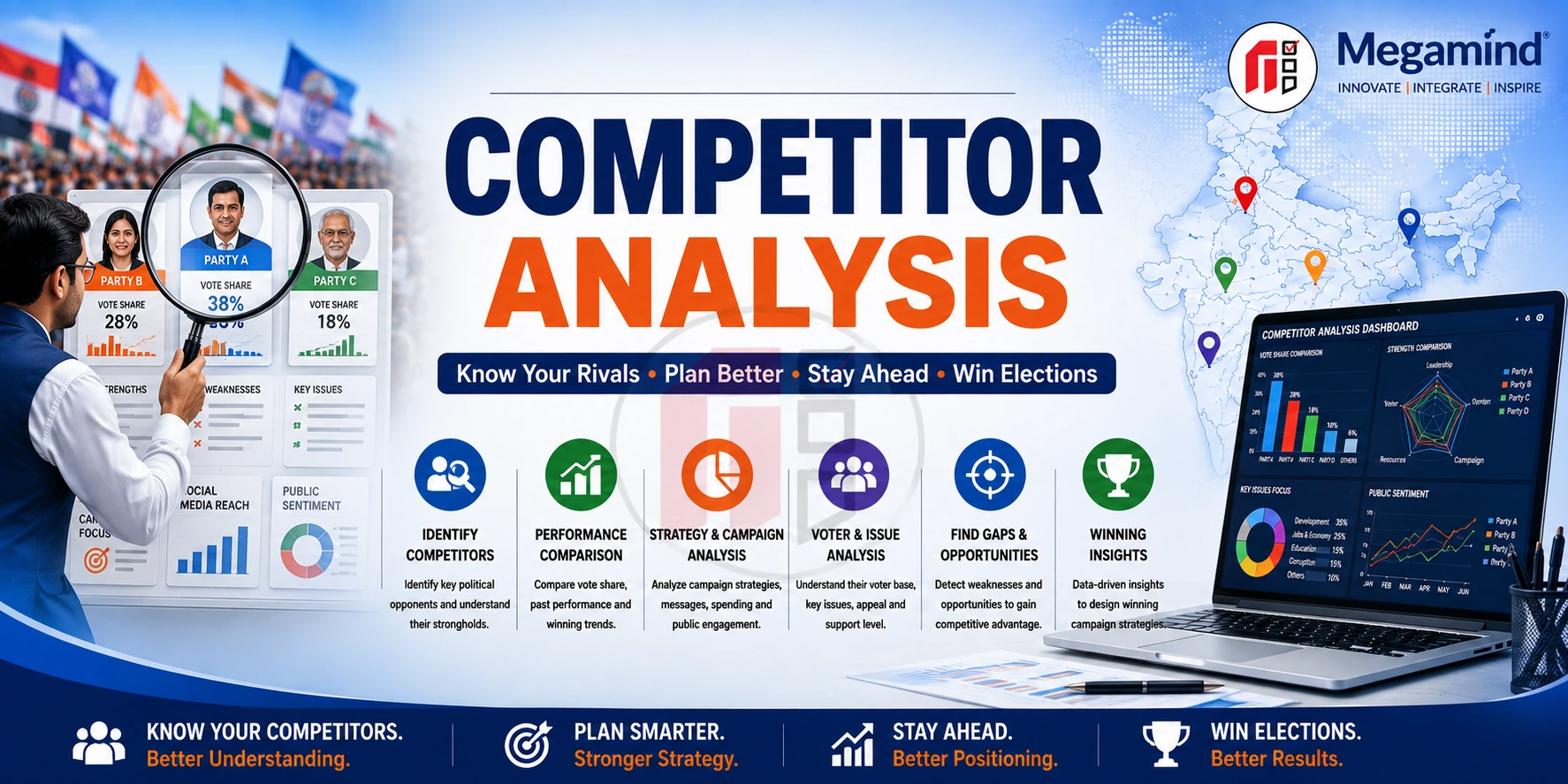
An election campaign does not operate in isolation. Political competitors, changing public issues, campaign activities, communication, electoral history and constituency conditions collectively shape the competitive environment. Megamind Political Competitor Analysis organizes relevant information into a structured framework: Identify → Research → Compare → Analyze → Monitor → Review .
What is Political Competitor Analysis?
Political Competitor Analysis is the systematic study of the electoral and campaign environment surrounding competing candidates and political parties.
It may combine historical election results, aggregate vote-share information, turnout, winning margins, candidate research, political surveys, constituency research and publicly observable campaign activity.
The purpose is not simply to create a list of opponents. Professional competitor analysis helps campaign leadership understand how the political contest has developed, what has changed and which developments require further research or strategic attention.
Competitor analysis should separate verified information, research findings and analytical interpretation. Political assumptions, rumours and unverified claims should not be treated as established intelligence.
Why Competitor Analysis is Important in Elections
Campaign strategy requires an understanding of both internal campaign capabilities and the external competitive environment. Competitor analysis provides a structured way to examine that environment.
- Understand historical competitor performance
- Compare aggregate vote-share trends
- Analyze winning and losing margins
- Review candidate positioning
- Understand constituency competition
- Track publicly observable campaign activity
- Review communication themes
- Monitor public media visibility
- Review public digital campaign activity
- Identify important changes over time
- Improve leadership situational awareness
- Support evidence-based strategy review
What We Analyze in Political Competition
Historical Performance
Comparison of previous aggregate election results, electoral performance and changes across elections.
Vote Share Analysis
Comparative analysis of aggregate vote share and its movement across available election periods.
Winning Margin Analysis
Study of victory and defeat margins to understand the historical competitiveness of an election.
Candidate Assessment
Structured assessment using appropriate public information and research findings.
Competitive Landscape
Understanding how candidates, parties and electoral factors interact within the constituency.
Survey Integration
Integration of appropriately designed aggregate survey findings into wider competitor assessment.
Public Campaign Monitoring
Structured review of publicly observable rallies, meetings, events and campaign developments.
Campaign Communication Analysis
Analysis of publicly communicated themes, issues and positioning used in political campaigning.
Public Digital Presence
Review of public digital content, campaign communication and observable publishing activity.
Media Visibility
Structured review of relevant publicly available media coverage and candidate visibility.
Public Issue Positioning
Comparison of publicly communicated positions and campaign emphasis around relevant issues.
Competitive Change Tracking
Periodic review of material changes in the competitive environment during the campaign.
How Our Competitor Analysis Process Works
Historical Election Performance Analysis
Previous election results provide a factual starting point for understanding political competition. They show what happened in earlier elections, although they should not be treated as a guarantee of future performance.
Depending on data availability, analysis may include:
- Previous election results
- Candidate-wise aggregate votes
- Party-wise aggregate votes
- Vote share
- Winning and losing margins
- Turnout
- Rank changes across elections
- Changes in party performance
- Candidate changes
- Multi-election trend comparison
Explore our Voter Data Analysis Services for broader electoral analytics.
Competitor Vote Share & Margin Analysis
Vote share and winning margin provide two different perspectives on historical electoral competition.
Vote share indicates the proportion of valid votes received in an election, while margin measures the difference between competing candidates.
| Indicator | What It Shows | Analytical Use |
|---|---|---|
| Vote Share | Share of aggregate valid votes | Compare electoral performance |
| Winning Margin | Difference between leading candidates | Understand historical competitiveness |
| Turnout | Aggregate participation level | Compare participation across elections |
| Rank | Candidate position in election result | Track changes in competitive position |
| Trend | Change across multiple elections | Identify longer-term movement |
Related reading: What is Vote Share Analysis? and What is Election Trend Analysis?
Competitor Candidate Assessment
Candidate assessment organizes appropriate research and public information to understand how a candidate is positioned within the wider election environment.
Electoral History
Previous contests, aggregate electoral performance and available result history.
Public Awareness
Aggregate awareness research where appropriately measured through political surveys.
Public Perception
Aggregate research findings concerning defined candidate-perception questions.
Public Positioning
Publicly communicated political and campaign positioning.
Campaign Visibility
Observable public meetings, events, media and campaign communication.
Current Developments
Verified material developments relevant to the defined competitive assessment.
Constituency-Level Competitor Analysis
Political competition should be interpreted in the context of the constituency. The same political party or candidate can face very different conditions across different electoral areas.
Constituency-level analysis may bring together:
- Historical election performance
- Aggregate constituency vote share
- Turnout history
- Winning margins
- Candidate history
- Current political research
- Public issues
- Campaign activity
- Field research
- Political developments
Learn more: What is Constituency Profiling?
Booth-Level Aggregate Competitor Performance
Where official or otherwise appropriate aggregate polling-area results are available, historical performance can be organized geographically to understand how electoral competition varied across polling areas.
Analysis can include:
- Aggregate booth or polling-area results
- Historical turnout
- Candidate performance comparison
- Party performance comparison
- Winning-margin patterns
- Multi-election geographic comparison
Polling-area results describe aggregate election outcomes. They should not be used to infer the political preference, belief or voting behavior of a specific individual.
Political Survey Integration
Historical data describes previous elections. Properly designed political surveys can add research about defined questions in the current election environment.
Depending on methodology and project objectives, survey research may examine aggregate measures such as:
- Candidate awareness
- Candidate perception
- Public issue importance
- Leadership perception
- Campaign awareness
- Other defined research questions
Survey findings should always be interpreted with the sample design, field dates, questionnaire, geographic coverage and methodological limitations.
Explore: Political Survey Services and Opinion Poll Services .
Competitor Campaign Activity Analysis
Campaign activity can change rapidly during an election. Structured monitoring of publicly observable developments helps maintain an updated picture of the competitive environment.
Public Meetings
Relevant publicly announced or observable campaign meetings and events.
Campaign Events
Major campaign programs and publicly visible campaign activities.
Leadership Activity
Relevant public campaign appearances and political activities.
Public Announcements
Important publicly communicated campaign statements and announcements.
Campaign Themes
Recurring themes and issues appearing in public campaign communication.
Material Changes
Verified developments that may alter the competitive context and require analytical review.
Competitor Communication & Narrative Analysis
Political campaigns communicate through speeches, public meetings, press statements, interviews, campaign material, digital channels and other public communication.
Analysis can organize these public communications to understand:
- Major campaign themes
- Frequently discussed public issues
- Public candidate positioning
- Changes in communication emphasis
- Public campaign announcements
- Media communication patterns
Related reading: What is Political Communication?
Competitor Digital Campaign Analysis
Public digital communication can provide additional context about campaign activity, content themes and communication priorities.
Where included in project scope, analysis may review publicly available information such as:
- Public campaign content
- Publishing frequency
- Major communication themes
- Public event promotion
- Public video and creative formats
- Public campaign announcements
- Observable engagement indicators
- Changes in digital activity
Learn more: What is Digital Promotion in Elections?
Media Visibility & Public Coverage Analysis
Public media coverage can be organized to understand the issues, events and developments receiving attention around political competitors.
Depending on scope, monitoring may examine:
- Relevant public news coverage
- Candidate media visibility
- Major public interviews
- Press conferences
- Public statements
- Issue-related coverage
- Campaign-event coverage
- Material changes in media attention
Competitor Issue Positioning Analysis
Campaigns often emphasize different public issues over the course of an election. Competitor analysis can organize publicly communicated positions and compare how campaign emphasis changes.
Issue analysis may consider:
- Frequently discussed constituency issues
- Public campaign priorities
- Candidate issue positioning
- Public policy themes
- Changes in campaign emphasis
- Survey-based aggregate issue research
Competitor Comparison Framework
Different information sources can be organized into a common framework so campaign leadership can review competitors using consistent analytical dimensions.
| Dimension | Possible Evidence | Purpose |
|---|---|---|
| Electoral Performance | Historical official/appropriate aggregate results | Understand previous performance |
| Candidate Position | Research and public information | Understand current candidate context |
| Campaign Activity | Public events and announcements | Track campaign developments |
| Communication | Public speeches, statements and content | Understand public themes |
| Public Opinion Research | Methodologically appropriate aggregate surveys | Add current research context |
| Trend | Multi-period comparison | Identify material changes |
Ongoing Competitor Monitoring
A one-time assessment provides a baseline. During active campaigns, however, new events, communication, research and political developments can change the competitive environment.
Where ongoing monitoring is part of the assignment, reporting can be structured around:
- Important new campaign developments
- Public campaign activity changes
- Major communication changes
- Relevant media developments
- Public digital activity changes
- New aggregate research findings
- Verified political developments
- Changes requiring strategy review
From Raw Information to Structured Political Intelligence
Megamind combines different evidence streams into a structured analytical process rather than relying on isolated observations.
Electoral Data → Political Research → Candidate Assessment → Campaign Intelligence → Communication Analysis → Competitive Assessment → Monitoring → Strategic Review
The exact analytical framework depends on the election, constituency, project objective, available information and research scope.
Competitor Intelligence Reports & Dashboards
Analysis becomes more useful when findings are organized into clear reporting formats that campaign leadership can review efficiently.
Competitor Profile
Structured summary of relevant electoral, candidate and campaign information.
Election Comparison
Tables comparing historical results, vote share, margins and turnout.
Trend Report
Periodic summary of material changes in relevant indicators.
Campaign Activity Report
Organized summary of important publicly observable campaign developments.
Executive Summary
Concise decision-support briefing for campaign leadership.
Monitoring Dashboard
Structured presentation of defined indicators where ongoing monitoring is included.
Political Competitor Analysis Deliverables
Deliverables are customized according to the election, project scope, available data and monitoring requirements.
- Competitor profile report
- Historical electoral comparison
- Vote-share comparison
- Winning-margin analysis
- Candidate assessment report
- Constituency competition analysis
- Survey research integration
- Campaign activity report
- Communication analysis
- Public digital activity analysis
- Periodic competitor monitoring report
- Executive intelligence summary
Data Verification & Analytical Quality
Political intelligence can contain information from different sources and with different levels of reliability. A professional analytical process should therefore document and review the evidence used.
- Define data sources
- Review important factual inputs
- Separate fact from interpretation
- Document survey methodology
- Identify research limitations
- Use comparable indicators consistently
- Maintain reporting dates and periods
- Update analysis when material evidence changes
Privacy, Data Responsibility & Compliance
Competitor analysis should be based on appropriate electoral data, properly conducted research and legitimate public information. Confidential project information should also be handled responsibly.
- Use lawful and appropriate information sources
- Protect confidential project information
- Use aggregate electoral results appropriately
- Respect applicable privacy and data requirements
- Avoid unsupported political claims
- Document research methodology where applicable
- Recognize uncertainty and analytical limitations
- Follow applicable election and campaign regulations
Aggregate constituency, ward or polling-area results describe geographic election outcomes. They should not be treated as proof of an individual voter's political preference or political belief.
Competitor Analysis for Political Campaigns
Political Parties
Structured competitive assessment for defined election and constituency projects.
Election Candidates
Constituency-specific electoral and competitor research.
Prospective Candidates
Early competitive landscape research before campaign planning.
Political Leaders
Election intelligence and research according to defined project requirements.
Campaign Teams
Structured competitor monitoring and leadership reporting.
Political Organizations
Research-based competitive intelligence for defined political projects.
Integrated Political Research & Election Intelligence
Competitor analysis becomes stronger when it is connected with broader election research. Megamind combines political survey, electoral data analysis, constituency research and campaign planning capabilities within one structured framework.
- Political survey capability
- Opinion poll research
- Historical election analysis
- Vote-share analysis
- Constituency research
- Booth-level aggregate analysis
- Election trend analysis
- Campaign strategy integration
- Structured reporting
- Ongoing monitoring capability
Competitor analysis supports better-informed campaign planning, but no analytical service can guarantee an election result.
Political Competitor Analysis FAQs
What is political competitor analysis?
It is the structured analysis of competing candidates, political parties and the electoral environment using appropriate electoral data, political research and public information.
What information can be analyzed?
Depending on scope, analysis may include historical election results, aggregate vote share, turnout, margins, candidate research, surveys, public campaign activity, communication and public digital activity.
Why is competitor analysis useful?
It provides a structured understanding of the competitive environment and helps leadership incorporate verified information into campaign planning.
Can historical election results be analyzed?
Yes. Historical aggregate results can be used to compare previous performance, vote share, turnout and margins.
Can political surveys be integrated?
Yes. Appropriately designed aggregate political survey research can be integrated while clearly considering methodology and limitations.
Can you monitor competitor campaign activity?
Where included in project scope, publicly observable campaign activity and relevant developments can be organized into periodic monitoring reports.
Does analysis include public digital activity?
It can include review of publicly available campaign content, communication themes and observable digital activity when relevant to the project.
Does competitor analysis predict who will win?
No. It provides evidence and analytical context. Election outcomes depend on voters and many changing factors.
Are competitor analysis services available across India?
Megamind undertakes assignments across India according to project scope, research requirements, data availability and operational feasibility.
How can we start a competitor analysis project?
Share the election type, state, constituency or geographic scope and broad research requirement with Megamind to discuss the appropriate project framework.
Understand the Competitive Landscape with Structured Election Intelligence
Discuss your election, constituency and competitor analysis requirements with Megamind for a customized political research and competitive intelligence framework.
Discuss Competitor Analysis