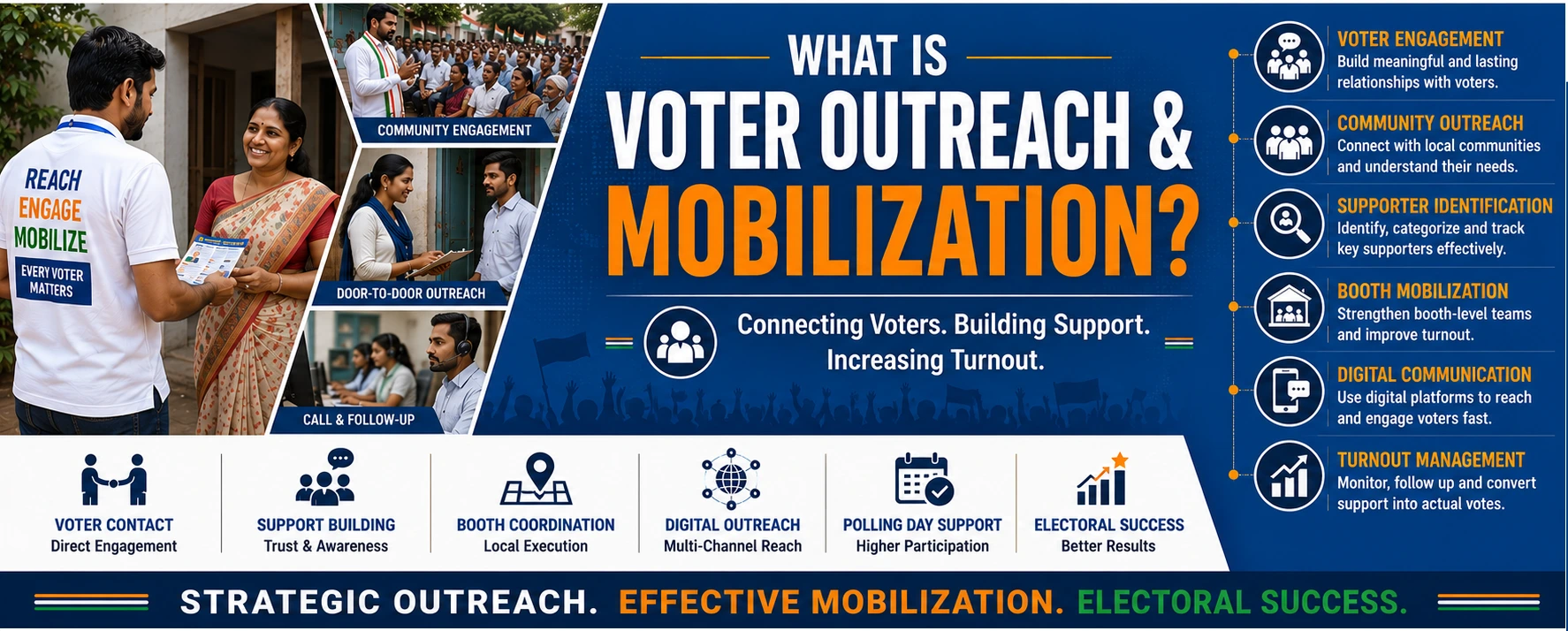
Election campaigns require continuous communication and organized field operations across constituencies, wards, villages, localities and booth areas. Voter outreach refers broadly to campaign activities through which political parties, candidates and campaign teams communicate public information, meet citizens, listen to local concerns and maintain a visible presence during an election campaign. Campaign mobilization, in this guide, refers to the organization and coordination of campaign teams, volunteers, field activities, meetings, communication channels, logistics and reporting required to conduct these campaign operations efficiently.
What is Voter Outreach?
Voter outreach is the process through which a political campaign communicates with the public and creates opportunities for two-way interaction.
Outreach can take place through:
- Door-to-door public interaction
- Public meetings
- Local campaign offices
- Public events
- Telephone communication
- Campaign websites
- Official social-media channels
- WhatsApp and digital communication
- Printed public-information material
- Local field teams
Good outreach is not only about delivering information. It also provides a structured way to hear public concerns, document local issues and improve the quality of campaign communication.
What is Campaign Mobilization?
In campaign-management terms, mobilization can be understood as the process of organizing people and resources required to carry out campaign activities across a constituency.
It can include:
- Field-team organization
- Volunteer coordination
- Area allocation
- Campaign-event coordination
- Public-information distribution
- Digital-team coordination
- Campaign-office management
- Logistics planning
- Activity reporting
- Management monitoring
This organizational meaning is different from official election administration. Campaign teams do not administer polling stations, voting procedures or official electoral processes.
Why Voter Outreach is Important in Election Campaigns
Election campaigns operate in complex environments where citizens may receive information from speeches, news media, social media, public meetings, local conversations and many other sources.
Structured outreach can help a campaign:
- Provide clear public information
- Explain campaign positions and public proposals
- Listen to citizen concerns
- Document local public issues
- Maintain consistent public communication
- Coordinate field activities
- Improve campaign accessibility
- Connect field and management teams
- Improve operational reporting
- Maintain organized campaign records
Effective outreach is not simply about increasing the number of contacts. A professional campaign needs clear information, trained teams, respectful public interaction, reliable field reporting, issue documentation and continuous coordination . Quality of engagement and organization matters more than raw contact numbers alone.
Main Objectives of a Voter Outreach Program
Public Information
Provide clear information about the candidate, campaign, public record, issues and stated proposals.
Citizen Feedback
Create channels for citizens to raise local issues, questions and concerns.
Field Presence
Maintain organized campaign activity across different geographic parts of the constituency.
Team Coordination
Coordinate volunteers, field workers, area coordinators and campaign-management teams.
Issue Documentation
Organize recurring public concerns into useful field and research reports.
Campaign Reporting
Provide management with structured information about activities, coverage and operational requirements.
Voter Outreach vs Campaign Mobilization
Voter Outreach
Primarily concerns public communication, field interaction, citizen feedback, public meetings, information distribution and campaign accessibility.
Campaign Mobilization
Primarily concerns organizing campaign teams, volunteers, events, logistics, geographic assignments, communication systems and internal reporting.
The two functions work together. Outreach concerns public-facing campaign activity, while campaign mobilization provides the organizational structure required to manage that activity.
Key Components of Election Outreach
Door-to-Door
Organized geographic field visits for respectful public interaction and issue collection.
Public Meetings
Open campaign events where public information can be shared and local concerns can be heard.
Local Campaign Teams
Area-based campaign workers who coordinate campaign activities and report field information.
Digital Communication
Official websites, social media, messaging channels and other approved digital communication.
Telephone Communication
Appropriate campaign calling operations for public information and campaign-related communication.
Public Information Material
Printed or digital material containing verified campaign information and public statements.
Public Events
Campaign programs, discussions and permitted public gatherings.
Citizen Feedback
Structured collection of general public issues and constituency concerns.
Campaign Reporting
Daily or periodic reporting of field activities, observations and operational requirements.
Step-by-Step Voter Outreach Workflow
Constituency Mapping for Field Outreach
Large constituencies can contain many villages, wards, colonies, polling areas and geographically separated localities.
Mapping helps campaign management divide field operations into manageable geographic units.
- Constituency boundaries
- Ward boundaries
- Village and locality mapping
- Polling-area geography
- Road and access information
- Public meeting locations
- Campaign-office locations
- Field-team areas
Learn more: What is Constituency Profiling?
Door-to-Door Campaigning and Public Outreach
Door-to-door campaigning is one of the most direct forms of public campaign interaction.
A professional door-to-door operation can focus on:
- Geographic route planning
- Field-team allocation
- Approved public-information material
- Respectful citizen interaction
- General issue collection
- Activity completion reporting
- Field-team safety
- Supervisor coordination
Citizens should remain free to decline interaction. Field teams should avoid intrusive questioning or unnecessary collection of personal information.
Grassroots Campaigning and Local Field Networks
Grassroots campaign operations create an organizational connection between central campaign management and different geographic areas of a constituency.
Local teams can support:
- Local campaign coordination
- Public meeting organization
- Area-level activity reporting
- Local issue reporting
- Volunteer coordination
- Campaign material management
- Public-information distribution
- Communication with campaign management
Role of Local Leadership in Campaign Outreach
Local campaign coordinators can provide practical knowledge about geography, public facilities, campaign logistics and recurring local issues.
Their campaign role may include:
- Area coordination
- Campaign-event support
- Volunteer coordination
- Issue reporting
- Field-team guidance
- Public communication support
- Activity reporting
No individual should automatically be treated as representing the views of an entire social, religious or other community.
Volunteer Management in Voter Outreach
Volunteers may support a wide range of campaign activities when responsibilities are clearly defined.
Volunteer operations can include:
- Campaign-event support
- Field-team assistance
- Public-information distribution
- Campaign-office operations
- Digital content support
- Activity reporting
- Logistics support
- Internal team coordination
Volunteers should receive clear instructions about privacy, respectful public interaction, safety and campaign compliance.
Role of Booth-Area Teams in Campaign Outreach
Campaigns often organize field teams around polling-area geography because it provides a practical geographic structure for managing large constituencies.
Campaign-side booth-area teams may help with:
- Area-level campaign coordination
- Volunteer organization
- Campaign material management
- Public meeting coordination
- General issue reporting
- Campaign activity reporting
- Field-team communication
- Operational issue escalation
Explore: Booth Management Services
Campaign Booth Teams vs Official Polling Administration
Campaign-Side Teams
Can coordinate permitted campaign activities, volunteers, internal communication, field reporting, logistics and campaign-office operations.
Election Authorities
Official electoral rolls, polling-station administration, voting procedures, polling personnel, official turnout reporting, election security and formal counting are handled by the relevant election authorities.
Collecting Local Issues Through Outreach
Field outreach creates an opportunity for campaign teams to hear public concerns directly.
Commonly reported local issues may relate to:
- Roads
- Water supply
- Electricity
- Employment
- Education
- Healthcare
- Agriculture
- Public transport
- Civic services
- Local infrastructure
Reports should summarize recurring issues rather than creating unnecessary individual political profiles.
Field Feedback is Not the Same as a Political Survey
Outreach teams may collect useful public observations, but these observations should not automatically be treated as representative public-opinion research.
Field Feedback
Comes from ordinary campaign interactions and may be useful for identifying recurring issues and operational concerns.
Political Survey
Uses a defined research objective, questionnaire, sampling methodology, field protocol, validation and statistical analysis.
Explore: Political Survey Services
Role of Data in Voter Outreach
Data can improve the operational organization of field outreach without requiring campaigns to classify individuals according to political preference.
Useful aggregate information may include:
- Constituency geography
- Ward and locality structure
- Polling-area geography
- Electorate totals
- Historical turnout
- Historical election trends
- Political survey findings
- Public issue summaries
- Field-research coverage
- Campaign activity coverage
Explore: Voter Data Analysis Services
Digital Tools for Election Outreach
Digital tools can help campaigns distribute official information, coordinate teams and organize public-facing campaign communication.
These tools may include:
- Campaign websites
- Official social-media accounts
- WhatsApp communication channels
- Campaign email systems
- Digital content calendars
- Field-reporting applications
- Volunteer coordination systems
- Campaign dashboards
Digital communication should follow applicable platform rules, privacy requirements and election-related compliance requirements.
Explore: Digital Promotion Services
Political Communication in Outreach Programs
Field teams should receive clear, verified and consistent public information before beginning campaign outreach.
Communication preparation can include:
- Candidate profile information
- Public record documentation
- Issue information
- Campaign proposals
- Frequently asked questions
- Event information
- Approved campaign materials
- Public statement guidance
Local Language and Accessible Communication
Public information is more useful when citizens can understand it easily.
Outreach teams can improve accessibility through:
- Clear language
- Locally understood languages
- Readable printed material
- Accessible digital formats
- Subtitles for important videos
- Consistent terminology
- Clear contact information
Field Reporting and Outreach Monitoring
Campaign management needs reliable information about what field teams have completed and what operational requirements remain.
Daily or periodic reporting may include:
- Areas covered
- Activities completed
- Meetings conducted
- General public issues reported
- Material requirements
- Volunteer attendance
- Operational problems
- Pending activities
- Supervisor comments
Monitoring should focus on campaign operations and legitimate research requirements rather than intrusive tracking of individual citizens.
Outreach Dashboards and Management Systems
Large campaigns can use dashboards to summarize field activity across multiple areas.
A dashboard may show:
- Area coverage
- Team assignments
- Activities completed
- Pending tasks
- Public issue categories
- Meeting schedules
- Volunteer operations
- Campaign material status
- Field incidents
- Management review items
Privacy and Responsible Data Use
Outreach programs can create privacy risks if campaign teams collect more personal information than is genuinely necessary.
Responsible practices include:
- Define the purpose of data collection
- Collect only necessary information
- Avoid unnecessary sensitive personal profiling
- Use aggregate issue reporting where appropriate
- Restrict database access
- Secure digital devices
- Protect login credentials
- Use secure data transfer
- Maintain appropriate retention controls
- Respect a citizen's decision not to engage
Safety and Conduct During Public Outreach
Campaign teams interact directly with the public and therefore need clear standards of conduct.
- Use trained field teams
- Maintain respectful communication
- Avoid confrontation
- Respect private property
- Respect requests not to engage
- Follow local event and public-space rules
- Maintain supervisor contact
- Report significant field incidents
Campaign Coordination During the Polling Period
Campaign organizations may continue permitted internal coordination and administrative activities during the polling period, subject to applicable rules.
Depending on the applicable requirements, internal operations may include:
- Campaign-office coordination
- Internal team communication
- Permitted logistics
- Coordinator status updates
- Operational incident reporting
- Compliance reminders
- Management reporting
Activities around polling stations and during restricted campaign periods must comply with applicable election laws, Election Commission directions and local administrative requirements.
Polling Information Should Come from Authoritative Sources
Information about polling stations, voting procedures, electoral rolls and other official election processes should be checked against authoritative election sources.
Campaign teams should avoid presenting unofficial information as an official election instruction.
Voter Outreach Across India
Campaign outreach is used in Lok Sabha, Vidhan Sabha, municipal, panchayat and other election campaigns across India.
The exact campaign structure varies according to constituency size, geography, urban or rural conditions, campaign resources, applicable election rules and local operational requirements.
In large and diverse states such as Uttar Pradesh, Punjab, Bihar, Rajasthan, Madhya Pradesh, Maharashtra, Gujarat, Haryana and others, structured geographic planning and reliable field reporting can be especially important for managing large campaign operations.
Benefits of Structured Voter Outreach
- Better public accessibility
- Clearer campaign information
- Improved local issue documentation
- Better geographic campaign coverage
- Improved volunteer coordination
- Better field-team management
- More structured campaign reporting
- Better integration of field and digital operations
- Improved management visibility
- More organized campaign operations
Challenges in Managing Large Outreach Programs
Large Geography
Constituencies may contain many villages, wards and geographically separated localities.
Team Coordination
Large volunteer and field teams require clear roles, supervision and reporting.
Information Consistency
Different teams can create confusion when they use inconsistent or unverified information.
Data Quality
Incomplete or poorly organized field reports can reduce the value of campaign monitoring.
Privacy & Security
Unnecessary personal-data collection can create privacy and security risks.
Compliance
Campaign activities must adapt to applicable election rules, restricted periods and local requirements.
Best Practices for Election Outreach
- Plan outreach geographically
- Define clear team responsibilities
- Train field workers and volunteers
- Use verified public information
- Keep communication clear and respectful
- Document recurring local issues
- Use structured field reporting
- Respect citizens who decline interaction
- Protect campaign data
- Avoid unnecessary personal profiling
- Monitor operational performance
- Follow applicable election requirements
How Professional Campaign Outreach Management Helps
Managing outreach across a large constituency can require constituency mapping, team recruitment, training, field coordination, digital systems, issue reporting and continuous monitoring.
Professional campaign-management support can help organize:
- Constituency mapping
- Field-team planning
- Volunteer management
- Door-to-door operations
- Public meeting coordination
- Issue reporting
- Campaign communication
- Digital operations
- Field dashboards
- Management reporting
- Data governance
- Campaign monitoring
Megamind's Voter Outreach & Field Operations Approach
Megamind integrates political research, constituency intelligence, campaign organization, field operations, volunteer coordination, technology and reporting into a structured campaign-management framework.
Our approach can follow:
Constituency Understanding → Geographic Mapping → Political Research → Issue Documentation → Outreach Planning → Team & Volunteer Training → Area Allocation → Field & Digital Operations → Citizen Feedback → Activity Reporting → Monitoring → Continuous Coordination
The framework is designed to support political parties, candidates, leaders, prospective candidates, aspirants, campaign teams and political organizations with organized public communication and campaign operations.
Explore Election Campaign Management →Integrating Outreach with Complete Election Campaign Management
Outreach works best as part of a coordinated campaign-management system rather than as an isolated activity.
Political Research → Constituency Intelligence → Voter Data Analysis → Issue Research → Campaign Communication → Door-to-Door Operations → Volunteer Management → Booth-Area Coordination → Digital Communication → Field Reporting → Monitoring & Continuous Review
FAQs About Voter Outreach and Campaign Mobilization
1. What is voter outreach in an election campaign?
Voter outreach refers to campaign activities used to provide public information, interact with citizens, hear local issues and maintain campaign accessibility.
2. What does campaign mobilization mean?
In campaign-management terms, it means organizing campaign teams, volunteers, field operations, events, logistics, communication systems and reporting.
3. What are the main voter outreach methods?
Common methods include door-to-door interaction, public meetings, campaign offices, field teams, websites, social media, messaging channels and public-information materials.
4. What is the role of door-to-door campaigning?
It provides direct public interaction and can help campaigns distribute information, hear local concerns and report general field observations.
5. How can volunteers support outreach?
Volunteers can assist with events, field activities, campaign offices, public-information distribution, digital operations, logistics and reporting.
6. What is the role of booth-area campaign teams?
They can help coordinate campaign activities, volunteers, field reporting and permitted campaign logistics within defined geographic areas.
7. Are campaign booth teams the same as polling officials?
No. Official polling administration and voting procedures are handled by relevant election authorities and authorized election personnel.
8. How does voter data analysis support outreach?
Aggregate electoral and geographic information can help organize field coverage, constituency research, historical analysis and campaign reporting.
9. Is ordinary field feedback the same as a political survey?
No. Scientific political surveys use defined sampling, questionnaires, field protocols, validation and statistical analysis.
10. How can digital tools support voter outreach?
Digital tools can support official campaign communication, field reporting, volunteer coordination, content management and campaign dashboards.
11. Why is privacy important in campaign outreach?
Outreach can involve personal information, so campaigns should minimize collection, restrict access and avoid unnecessary sensitive profiling.
12. What should field teams report?
Reports can cover activities completed, areas covered, recurring public issues, operational requirements, meetings, material needs and campaign incidents.
13. What happens to campaign operations during polling periods?
Permitted internal coordination may continue subject to applicable election laws, Election Commission directions and local administrative requirements.
14. Can voter outreach be used in different types of Indian elections?
Campaign outreach is commonly organized in Lok Sabha, Vidhan Sabha, municipal, panchayat and other election campaigns, with structure varying by geography and applicable requirements.
15. Who can use professional election outreach services?
Political parties, candidates, leaders, prospective candidates, aspirants, political organizations and campaign teams may use professional campaign-management support for legitimate public communication and operational requirements.
Voter Outreach Connects Public Communication with Campaign Operations
Voter outreach is an important part of election campaign management because it creates structured channels for public communication, citizen feedback and field-level campaign activity.
Professional outreach requires more than simply increasing the number of public contacts. It depends on constituency understanding, clear information, trained teams, respectful interaction, reliable reporting, privacy, security and continuous coordination .
When integrated with Political Research, Voter Data Analysis, Booth Management, Door-to-Door Campaigning, Volunteer Management, Digital Communication and Campaign Monitoring , outreach can become an organized component of a complete election campaign-management framework.