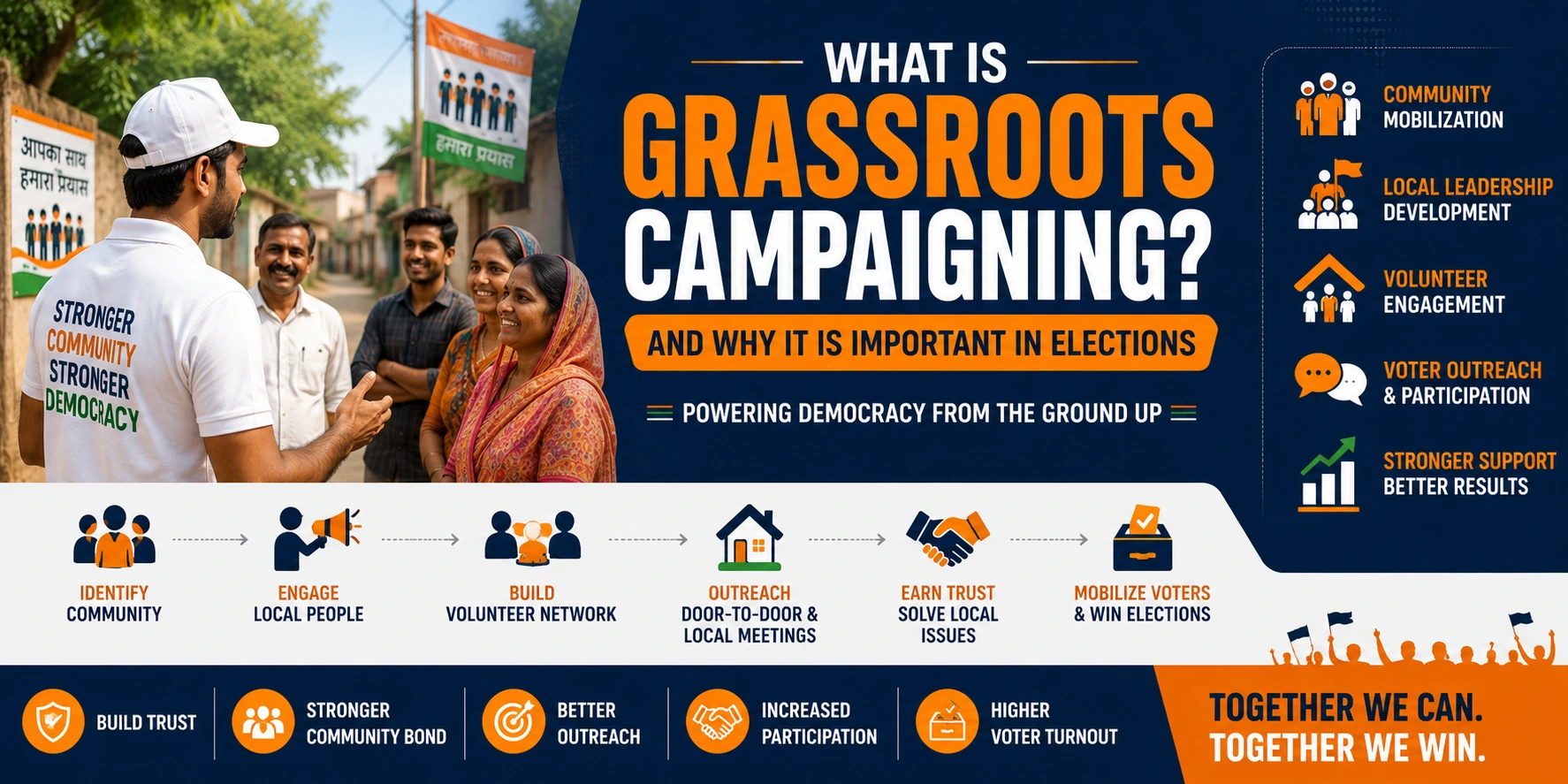
Grassroots Campaigning is a ground-level campaign approach built around local organization, volunteers, area teams, community interaction, public meetings, door-to-door communication, issue feedback and continuous field coordination. Instead of depending only on large rallies, advertising or digital visibility, grassroots campaigning creates an organized local presence through villages, wards, neighbourhoods, polling areas and constituency teams. A professionally managed grassroots campaign connects local understanding, field teams, volunteer management, public communication, booth coordination, reporting and campaign monitoring within one operational system.
What is Grassroots Campaigning?
Grassroots campaigning refers to campaign organization that begins at the local level and is implemented through structured community and field operations.
It can include local campaign teams, volunteers, area coordinators, public meetings, authorized door-to-door communication, citizen feedback, issue reporting and local campaign events.
The main purpose is to create an organized ground structure that connects constituency-level campaign management with activity taking place in individual villages, wards, neighbourhoods and polling areas.
In simple terms, grassroots campaigning brings campaign organization closer to local communities.
Why Grassroots Campaigning is Important
A constituency may contain hundreds of localities, villages, wards and polling areas. Central campaign management alone may not have enough visibility into what is happening in each location.
Grassroots organization creates local structures through which campaign activities, citizen feedback and operational information can move between field teams and campaign leadership.
- Builds organized local campaign presence
- Improves field-team coordination
- Creates regular public interaction
- Helps identify local issues
- Supports booth and area-level organization
- Improves volunteer management
- Creates structured field reporting
- Connects local activity with central planning
Grassroots campaigning is most effective as an organizational system, not simply a collection of local events. Local teams need defined responsibilities, reporting procedures, approved communication and regular coordination with the constituency campaign structure.
Main Objectives of Grassroots Campaigning
Local Organization
Establish campaign structures across villages, wards, neighbourhoods and polling areas.
Volunteer Coordination
Recruit, organize and coordinate volunteers within defined operational roles.
Public Communication
Provide opportunities for respectful local communication and public interaction.
Issue Feedback
Record recurring local concerns and operational issues through structured field reporting.
Area Coordination
Connect booth and locality teams with broader campaign management.
Monitoring
Track field activity, team progress and operational gaps through regular reporting.
Key Components of Grassroots Campaigning
A complete grassroots campaign combines multiple operational functions.
Area Mapping
Organize the constituency into manageable geographic campaign units.
Local Teams
Establish area coordinators and local campaign structures with defined responsibilities.
Volunteer Network
Develop a structured network of campaign volunteers and coordinators.
Community Interaction
Organize local public meetings, discussions and permitted campaign communication.
Door-to-Door Operations
Coordinate respectful household-level campaign communication where appropriate.
Booth Coordination
Connect local campaign teams with the broader campaign-side booth-management structure.
Issue Reporting
Record recurring local concerns and field observations in a structured format.
Communication Coordination
Maintain consistent approved campaign information across local teams.
Monitoring
Track local activities, team deployment and operational reporting.
Grassroots Campaigning vs Door-to-Door Campaigning
Grassroots campaigning and door-to-door campaigning are related but are not the same.
Door-to-Door Campaigning
A specific field activity involving authorized campaign communication at household level.
Grassroots Campaigning
A broader ground-campaign system combining local teams, volunteers, meetings, field communication, issue feedback, booth coordination and reporting.
Therefore, door-to-door campaigning can be one activity within a broader grassroots strategy.
Learn more: What is Door-to-Door Campaigning?
How Grassroots Campaigning Works
Professional grassroots operations can be organized through a structured workflow.
Role of Volunteers in Grassroots Campaigning
Volunteers can provide important support for local campaign operations.
Their responsibilities should be clearly defined so that field activity remains organized, consistent and accountable.
- Support local campaign events
- Assist with authorized public communication
- Help coordinate community meetings
- Assist door-to-door field teams
- Report local operational issues
- Record public feedback
- Coordinate with area teams
- Maintain activity reports
Volunteers should receive basic training in professional conduct, privacy, respectful communication and applicable campaign rules.
Volunteer Recruitment and Management
A large volunteer network requires structure. Simply adding people to campaign groups does not create an effective grassroots organization.
Professional volunteer management can define:
- Role descriptions
- Area assignments
- Reporting hierarchy
- Training requirements
- Activity schedules
- Communication channels
- Issue-escalation procedures
- Daily or periodic reporting
Role of Local Leadership and Community Stakeholders
Local campaign teams often interact with a wide range of community stakeholders, including social workers, resident associations, professional groups, local organizations and other publicly active individuals.
These interactions can help campaign teams understand local conditions, recurring public issues, infrastructure concerns and community-level operational realities.
Stakeholder engagement should not assume that any individual automatically represents the views of an entire community.
Important information should therefore be verified through multiple appropriate sources where possible.
Community Meetings and Local Campaign Events
Smaller local meetings can provide a practical environment for public interaction and campaign communication.
Depending on local conditions and applicable permissions, campaign teams may organize:
- Village-level meetings
- Ward meetings
- Neighbourhood interactions
- Resident association meetings
- Local issue discussions
- Campaign volunteer meetings
- Public information sessions
- Small campaign events
The focus should remain on clear information, respectful discussion, factual communication and listening to local concerns.
Role of Local Issue Mapping
One of the important benefits of organized ground operations is the ability to identify recurring local issues.
Field teams may encounter concerns relating to infrastructure, transport, water, sanitation, public services, roads, local facilities or other constituency matters.
These observations can be reported through structured issue categories so that campaign management receives a more organized view of local conditions.
Field observations should be treated as operational inputs rather than automatically assumed to represent the views of the entire constituency.
Grassroots Feedback and Reporting Systems
Grassroots campaigns can generate large volumes of field information. Without a reporting structure, useful information may remain scattered across individuals or messaging groups.
A structured field reporting system can record:
- Area visited
- Activity completed
- Local issue observed
- Public feedback received
- Campaign material requirement
- Team availability
- Operational issue
- Follow-up requirement
Grassroots Feedback vs Political Survey
Field feedback and political surveys are not the same type of information.
Grassroots Field Feedback
Operational information collected during normal campaign activity. It can highlight recurring observations and local issues but may not represent the wider electorate.
Political Survey
Structured research using a defined questionnaire, sampling methodology, field process and analytical framework.
When scientifically representative information is required, campaign teams should use an appropriately designed Political Survey rather than treating informal field feedback as survey evidence.
Grassroots Campaigning and Booth Management
Campaign-side booth management can provide an organizational structure through which local field activities are coordinated and reported.
Depending on campaign requirements, local teams may support:
- Area mapping
- Local team coordination
- Campaign activity reporting
- Volunteer assignment
- Issue reporting
- Campaign material coordination
- Local event coordination
- Operational communication
Explore Booth Management Services .
Campaign Ground Operations vs Official Polling Administration
Grassroots campaign operations should not be confused with official polling-station administration.
Official electoral rolls, voting procedures, polling personnel, polling-station administration and election security are functions of the relevant election authorities and authorized officials.
Campaign teams should remain separate from official polling administration and follow applicable election requirements.
Membership Drives and Grassroots Organization
Political organizations may use membership drives as an internal organizational activity to build and maintain formal member networks.
A structured membership system can help manage:
- Member registration
- Area-wise organization
- Volunteer opportunities
- Internal communication
- Training schedules
- Event coordination
- Organizational records
- Member activity management
Membership information should be handled according to appropriate privacy and data-management practices.
Integrating Grassroots and Digital Campaign Operations
Ground and digital campaign teams can operate more effectively when information moves through a coordinated workflow.
Field teams can provide verified updates about public events, campaign activities and recurring local issues. Digital teams can prepare approved public communication using appropriate verified information.
Ground Activity → Field Reporting → Verification → Campaign Review → Communication Coordination → Digital/Public Updates → Ground Teams
This helps reduce inconsistencies between local campaign activity and public digital communication.
Role of Technology in Grassroots Campaigning
Technology can help campaign managers coordinate large field teams and consolidate activity reports from multiple areas.
Depending on project requirements, campaign technology may support:
- Area and team mapping
- Volunteer records
- Task assignment
- Daily activity reporting
- Issue-report management
- Field dashboards
- Campaign-event tracking
- Management reporting
Technology should support field organization rather than replace local coordination and human review.
Monitoring Grassroots Campaign Activities
Campaign leadership needs visibility into whether planned ground activities are actually being implemented.
Monitoring can include:
- Areas covered
- Activities completed
- Meetings conducted
- Volunteer participation
- Field reports received
- Operational issues
- Pending tasks
- Follow-up requirements
Monitoring should focus on execution quality and operational accountability rather than unnecessary personal profiling of individual citizens.
Privacy and Data Governance in Grassroots Campaigning
Ground campaigns may collect operational information, volunteer records, public feedback and campaign reports.
Information management should follow appropriate data-minimization and access-control practices.
- Collect only information needed for campaign operations
- Avoid unnecessary sensitive personal profiling
- Define who can access campaign systems
- Secure volunteer and field records
- Use aggregate reporting where appropriate
- Verify important field information
- Maintain data-quality procedures
- Follow applicable privacy requirements
Safety and Respectful Public Communication
Grassroots campaigning involves direct interaction with citizens, so campaign workers should follow clear standards of professional conduct.
- Respect a citizen's choice not to engage
- Avoid intimidation or harassment
- Follow local safety instructions
- Use approved campaign identification where required
- Protect personal information
- Maintain professional language
- Escalate disputes to campaign supervisors
- Follow applicable election rules
Benefits of Professional Grassroots Campaigning
Professionally organized grassroots operations can provide several campaign-management benefits.
- Stronger local campaign organization
- Better field-team coordination
- More structured volunteer management
- Improved local issue visibility
- Better campaign reporting
- Improved booth and area coordination
- Consistent public communication
- Better connection between central and field teams
- Greater operational accountability
- Long-term organizational capacity
Challenges in Grassroots Campaigning
Grassroots campaigns can involve large teams spread across many geographic areas. This creates significant management challenges.
Team Scale
Managing many volunteers and local coordinators can become difficult without a clear structure.
Communication
Campaign information may become inconsistent when it passes through multiple layers of field teams.
Reporting
Field information may be delayed, incomplete or difficult to verify.
Training
Volunteers may require regular orientation on campaign procedures and conduct.
Data Quality
Unstructured field information can be difficult to combine and interpret.
Coordination
Ground, booth, digital and central campaign teams may operate separately without an integrated system.
Best Practices for Grassroots Campaigning
- Start with constituency and area mapping
- Define local campaign structure
- Assign clear team responsibilities
- Train volunteers before deployment
- Maintain approved communication guidelines
- Use structured field-report formats
- Verify important field information
- Monitor campaign activities regularly
- Protect volunteer and public information
- Integrate ground and digital teams
- Respect public choice and privacy
- Review operations continuously
How Professional Grassroots Campaign Services Help
Professional campaign-management teams can help political organizations design and operate large-scale grassroots structures.
Depending on project requirements, professional support may include:
- Constituency mapping
- Ground-team planning
- Volunteer-management systems
- Door-to-door campaign operations
- Booth coordination
- Field reporting
- Campaign technology
- Digital-ground integration
- Monitoring and dashboards
- Campaign management support
These functions can be integrated within Election Campaign Management according to project requirements.
Megamind's Approach to Grassroots Campaigning
Megamind approaches grassroots campaigning as a structured ground campaign-management system connecting research, organization, field execution and monitoring.
Depending on project requirements, our approach can follow:
Constituency Understanding → Area Mapping → Ground Team Structure → Volunteer Coordination → Public Outreach → Field Reporting → Booth Coordination → Digital Integration → Monitoring & Continuous Review
The framework can integrate Political Survey, Voter Data Analysis, Booth Management, Door-to-Door Campaigning, Digital Promotion, Public Relations and Election Campaign Management within one coordinated campaign structure.
Megamind provides ground-campaign and election-management support for political parties, candidates, leaders, prospective candidates, aspirants, campaign teams and political organizations according to project requirements.
Explore Complete Election Services →Grassroots Campaigning Across India
Grassroots campaigning can be applied across Lok Sabha, Vidhan Sabha, municipal and other local electoral contexts in India.
However, ground-campaign structures should reflect the actual geography and operational environment of each constituency.
Rural constituencies may require extensive village-level coordination, while urban constituencies may require ward, locality, apartment, neighbourhood and resident-association level organization.
No single field structure should therefore be assumed to fit every constituency.
Grassroots Campaigning Within a Complete Election Strategy
Grassroots campaigning becomes more useful when it is integrated with research, booth operations, communication and campaign monitoring.
Political Research → Constituency Understanding → Grassroots Planning → Team & Volunteer Organization → Ground Operations → Booth Coordination → Digital Communication → Monitoring → Continuous Feedback & Review
Each function contributes a different capability: research provides evidence, local teams provide field presence, reporting creates visibility and monitoring helps maintain operational coordination.
FAQs About Grassroots Campaigning
What is grassroots campaigning?
Grassroots campaigning is a ground-level campaign approach organized through local teams, volunteers, community interaction, field activities and structured reporting.
Why is grassroots campaigning important?
It helps campaign organizations create local operational structures and maintain better coordination between central campaign management and field teams.
Is grassroots campaigning the same as door-to-door campaigning?
No. Door-to-door campaigning is one specific field activity, while grassroots campaigning is a broader system of local campaign organization.
What is the role of volunteers?
Volunteers may support events, local communication, door-to-door operations, issue reporting and other approved campaign activities.
What is area mapping in grassroots campaigns?
Area mapping organizes a constituency into manageable geographic campaign units for team assignment and operational reporting.
How are local issues identified?
Field teams may record recurring public concerns and local observations through structured issue-reporting systems.
Is grassroots feedback the same as survey research?
No. Informal field feedback is an operational input, while survey research uses a defined sampling and research methodology.
How does booth management support grassroots campaigning?
Campaign-side booth management can provide a local structure for coordinating field teams, reporting and campaign operations.
Can technology support grassroots campaigns?
Yes. Technology can support team mapping, task assignment, field reporting, issue tracking, dashboards and campaign monitoring.
Why is volunteer training important?
Training helps maintain consistent campaign procedures, professional communication, reporting quality and responsible field conduct.
How do digital and grassroots teams work together?
Verified field information can support campaign communication, while central communication teams can provide approved updates and campaign information to local teams.
Why is privacy important in grassroots campaigning?
Ground operations may involve volunteer records and public feedback, so campaigns should minimize unnecessary data collection and use appropriate access controls.
Who can use professional grassroots campaign services?
Political parties, candidates, leaders, prospective candidates, aspirants, campaign teams and political organizations may use professional ground-campaign services according to project requirements.
Grassroots Campaigning Builds Organized Ground-Level Campaign Operations
Grassroots Campaigning is more than door-to-door activity or local meetings. It is an organized ground-campaign system connecting local teams, volunteers, public communication, issue feedback, booth coordination and field reporting.
A professional grassroots structure begins with constituency understanding and area mapping , assigns responsibilities to field teams and creates consistent procedures for outreach, reporting and campaign monitoring.
When integrated with Political Survey, Voter Data Analysis, Booth Management, Digital Promotion, Public Relations and Election Campaign Management, grassroots campaigning can become an important part of a broader election-management framework.
The objective is to create stronger organization, better coordination, reliable field information and disciplined campaign execution across the constituency.