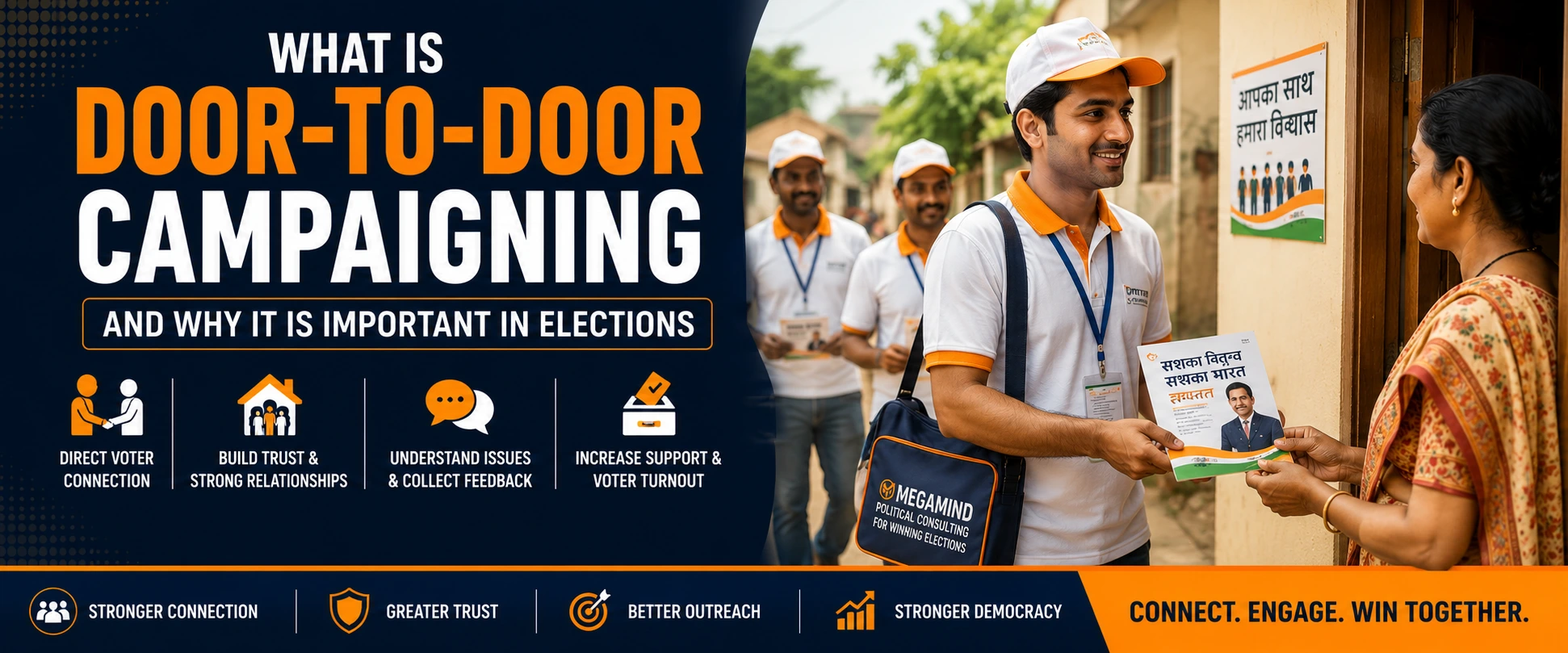
Door-to-door campaigning is a structured ground-level election outreach activity in which authorized campaign representatives, field workers or volunteers visit households within defined areas to communicate campaign information, listen to local concerns and collect field feedback. Even as political communication increasingly uses social media, online advertising, websites, data systems and digital platforms, direct field interaction continues to provide something that digital channels cannot fully replace: local presence, face-to-face communication and direct ground feedback. Professional door-to-door campaigning therefore combines area planning, team organization, communication, field reporting, monitoring and campaign coordination rather than functioning as unplanned household visits.
What is Door-to-Door Campaigning?
Door-to-door campaigning is an election field activity in which campaign representatives systematically visit households across designated villages, wards, localities or other campaign areas.
During these visits, representatives may introduce the candidate or political organization, provide authorized campaign information, communicate public positions, listen to citizens' concerns and record relevant field observations.
Unlike a rally or public meeting, where one message is delivered to a large audience, door-to-door outreach allows direct conversations in smaller settings.
It can therefore function as both a communication channel and a field-feedback mechanism within a broader election campaign.
Why is Door-to-Door Campaigning Important in Elections?
Constituencies can contain many villages, colonies, wards and neighbourhoods with different local concerns. Large campaign events cannot always provide detailed information about these variations.
Door-to-door activity can create a structured mechanism through which campaign organizations maintain local presence and receive information directly from the field.
- Creates direct contact with citizens
- Provides information about local issues
- Strengthens campaign presence at the ground level
- Supports locality-wise field understanding
- Provides structured citizen feedback
- Connects central and local campaign teams
- Supports booth and area-level coordination
- Provides field information for campaign review
Professional door-to-door campaigning should not be treated simply as “visiting as many houses as possible.” A structured system connects Constituency Understanding → Area Mapping → Team Deployment → Household Outreach → Field Feedback → Reporting → Monitoring → Campaign Review . This converts field activity into an organized campaign-management process.
Main Objectives of Door-to-Door Campaigning
The exact objectives depend on the election and campaign, but a professionally managed ground outreach program may serve several operational purposes.
Public Communication
Provide citizens with authorized information about the candidate, political organization and campaign activities.
Issue Understanding
Identify recurring locality-level concerns and public issues reported during field interaction.
Field Feedback
Create a structured channel for collecting relevant observations and citizen feedback from campaign areas.
Ground Presence
Maintain visible and organized campaign activity across villages, wards and localities.
Team Coordination
Connect field workers, booth coordinators, area coordinators and campaign-management teams.
Campaign Reporting
Convert field activity into organized progress, issue and operational reports.
How Door-to-Door Campaigning is Organized
Large constituencies normally require ground activity to be divided into manageable geographic units.
Depending on local administrative and campaign structures, teams may organize activity by constituency, ward, village, locality, polling area or another appropriate geographic unit.
Field workers can then be assigned defined areas and reporting responsibilities so that campaign managers know which locations have been covered, what issues have been reported and where operational attention may be required.
The objective of this structure is coverage management and operational accountability, not profiling individual citizens.
Key Components of Door-to-Door Campaigning
A professional door-to-door operation requires several connected components.
Area Mapping
Organize constituency areas into practical units for field planning and coverage.
Team Structure
Define field workers, coordinators, reporting responsibilities and supervision.
Team Training
Prepare field teams for respectful communication, listening, reporting and campaign procedures.
Communication Material
Prepare approved informational material and clear communication points for field use.
Household Outreach
Conduct planned visits according to assigned areas and campaign schedules.
Feedback Collection
Record relevant local concerns and operational observations in a structured format.
Daily Reporting
Consolidate field coverage, reported issues and team activity into campaign reports.
Monitoring
Review field progress, team activity, reporting quality and operational gaps.
Campaign Integration
Connect relevant field information with broader campaign planning and management.
Step-by-Step Door-to-Door Campaign Process
A structured campaign can organize door-to-door outreach through a defined operational workflow.
Role of Field Workers, Volunteers and Coordinators
The quality of a door-to-door campaign depends heavily on its field organization. Large numbers of volunteers alone do not guarantee an organized operation.
Teams require defined responsibilities, reporting structures, communication protocols and supervision.
- Work within assigned geographic areas
- Follow approved campaign communication
- Listen respectfully to citizen concerns
- Record relevant field observations accurately
- Report recurring locality-level issues
- Coordinate with area and booth teams
- Submit regular activity reports
- Escalate important operational issues
Good Practices for Door-to-Door Interaction
Face-to-face political communication should be respectful and professional. Citizens may have different views, priorities and levels of interest in political discussion.
Field representatives should therefore focus on clear communication, listening and accurate reporting rather than aggressive or intrusive interaction.
- Introduce yourself and the campaign clearly
- Communicate respectfully
- Respect a person's decision not to engage
- Listen carefully to local concerns
- Avoid unnecessary arguments
- Use approved and verified campaign information
- Do not make unauthorized commitments
- Record relevant feedback accurately
Role of Electoral Rolls and Area Information
Publicly available electoral information can assist campaigns in understanding the geographic and polling-area structure of a constituency, subject to applicable rules and permitted use.
For campaign management, such information can support area organization, field coverage planning and coordination between local teams.
Official electoral rolls, voter registration, polling personnel, polling-station administration and the conduct of voting are functions of the relevant election authorities. Campaign-side door-to-door management is separate from those official functions.
Campaign organizations should use electoral information responsibly and avoid unnecessary creation of intrusive individual profiles.
Door-to-Door Campaigning and Booth Management
Door-to-door outreach and campaign-side booth management are closely related because both involve local organization and field coordination.
Booth-level or area-level structures can help campaigns divide field responsibilities, monitor geographic coverage and consolidate local information.
Door-to-door teams can provide ground observations to area coordinators, while coordinators can help organize schedules, team assignments and reporting.
This creates a continuous operational connection between local outreach, field reporting and campaign management.
Role of Field Feedback in Door-to-Door Campaigning
One of the most useful outputs of organized field activity is direct information about recurring public concerns and campaign conditions.
Field teams may encounter issues relating to roads, water, sanitation, public services, infrastructure, employment, agriculture or other local matters depending on the constituency.
Rather than relying on isolated anecdotes, campaign managers can consolidate recurring area-level issues and compare them with other research and field information.
- Local issue reporting
- Area-level recurring concerns
- Campaign activity observations
- Field-team operational problems
- Public questions requiring clarification
- Communication gaps reported from the field
Door-to-Door Campaigning vs Political Survey
Door-to-door campaigning and political surveys can both involve interaction with citizens, but they serve different purposes.
Door-to-Door Campaigning
A campaign outreach and field-operation activity involving communication, local presence, field feedback and campaign coordination.
Political Survey
A research activity designed to collect structured responses using an appropriate research methodology for analysis and reporting.
Informal comments received during campaign outreach should therefore not automatically be treated as scientifically representative survey findings.
Role of Technology in Door-to-Door Campaign Management
Technology can help campaign managers organize field operations, particularly when many teams are working simultaneously across a large constituency.
Digital tools may support area assignments, activity reporting, authorized feedback collection, progress monitoring and campaign dashboards.
- Area and team assignment
- Field activity reporting
- Coverage monitoring
- Issue-report consolidation
- Coordinator dashboards
- Daily progress reporting
- Team communication
- Operational review
Technology should support field organization without encouraging unnecessary collection of personal information.
Monitoring Door-to-Door Campaign Activity
Without monitoring, campaign leadership may know how many teams have been deployed but have limited visibility into actual field progress.
A professional monitoring framework can focus on operational indicators such as geographic coverage, team activity, reporting completion, recurring issues and unresolved field requirements.
- Areas assigned
- Areas covered
- Team activity status
- Field reports received
- Recurring issues reported
- Operational gaps
- Pending campaign actions
- Coordinator review status
Daily Reporting and Ground Campaign Dashboards
Field information becomes more useful when it is organized into consistent reports.
Daily reporting can help campaign managers understand which areas were covered, what operational issues emerged, what recurring public concerns were reported and where coordination is required.
For larger campaigns, dashboards may consolidate information from multiple field teams and coordinators into an easier management view.
Reports should emphasize operational and appropriately aggregated information rather than unnecessary personal profiling.
Door-to-Door Campaigning and Digital Promotion
Ground campaigning and digital promotion can support each other when managed within the same campaign framework.
Ground teams can report campaign events, recurring local issues and field activity. After appropriate verification, relevant information can help communication teams understand what is happening across the constituency.
Digital channels can also distribute public-event information, official statements and approved campaign updates that field teams may reference during their work.
This creates a two-way operational flow:
Ground Activity → Field Reporting → Campaign Review → Communication Coordination → Digital Updates → Ground Teams
Privacy and Data Governance in Ground Campaigning
Door-to-door activity can generate field notes, issue reports, contact information or other campaign records. Campaign organizations should define what information is genuinely necessary before collecting it.
Responsible data practices can include appropriate sourcing, data minimization, access controls, secure storage and clear responsibility for campaign databases.
- Collect only information necessary for legitimate campaign operations
- Avoid unnecessary sensitive personal profiling
- Use appropriately sourced information
- Define who can access campaign data
- Secure digital campaign systems
- Review field-data quality
- Remove unnecessary duplicate records
- Follow applicable privacy and data requirements
Safety and Professional Conduct for Field Teams
Door-to-door campaigning places field representatives in direct contact with the public. Campaign organizations should therefore establish appropriate standards of conduct and field-safety procedures.
- Use clear team identification where appropriate
- Respect private property and personal boundaries
- Do not enter premises without permission
- Avoid confrontational interactions
- Maintain coordinator contact during field activity
- Follow appropriate local safety procedures
- Report incidents through defined channels
- Respect a citizen's choice not to participate in conversation
Election Rules and Door-to-Door Campaigning
Election campaigning operates within applicable election laws, regulatory directions, campaign-period restrictions and local administrative requirements.
The applicable requirements can vary depending on the election, campaign period, location and activity involved.
Campaign organizations should therefore review relevant Election Commission directions, the Model Code of Conduct when applicable, expenditure requirements, campaign restrictions, local permissions and other applicable rules.
Compliance should be treated as an ongoing part of campaign operations rather than a one-time checklist.
Campaign Activity and Official Polling Administration
It is important to distinguish political campaign operations from the official administration of elections.
Official electoral rolls, polling-station management, polling personnel, voting procedures, security arrangements and the conduct of polling are responsibilities of the relevant election authorities and authorized officials.
Political campaign teams must operate within applicable rules and should not interfere with official polling processes.
Benefits of Structured Door-to-Door Campaigning
When properly planned and professionally managed, door-to-door campaigning can provide several operational benefits to an election campaign.
- Direct ground-level communication
- Better understanding of recurring local concerns
- Organized constituency coverage
- Stronger coordination of field teams
- Continuous field feedback
- Improved campaign reporting
- Better integration of ground and digital operations
- More structured campaign management
Common Challenges in Door-to-Door Campaigning
Door-to-door campaigning can be resource-intensive and requires strong field management.
- Large geographic areas
- Limited campaign time
- Household availability differences
- Volunteer and field-worker training
- Maintaining communication consistency
- Incomplete or inconsistent field reporting
- Rural and remote-area logistics
- Coordination between multiple teams
- Data-quality problems
- Monitoring large-scale field operations
Best Practices for Door-to-Door Campaign Management
A professional ground campaign should emphasize organization, respectful communication, reliable reporting and continuous review.
- Map areas before field deployment
- Define team responsibilities clearly
- Train workers before outreach begins
- Use verified and approved campaign information
- Listen carefully to local concerns
- Use structured reporting formats
- Review field progress regularly
- Verify important field information
- Coordinate field and digital teams
- Protect campaign information appropriately
How Professional Door-to-Door Campaign Services Help
Large-scale door-to-door campaigning requires more than field manpower. It can involve area planning, team structures, training, field coordination, reporting systems, monitoring and campaign-management support.
A professional Election Campaign Management Service can coordinate door-to-door outreach with other campaign functions according to project requirements.
This may include integration with Political Survey , Voter Data Analysis , Booth Management , Digital Promotion, Public Relations and campaign monitoring.
Megamind's Approach to Ground Campaign Management
Megamind approaches door-to-door campaigning as part of an integrated election-management system rather than as an isolated field activity.
Depending on project requirements, the process can connect Constituency Understanding → Area Mapping → Field Team Structure → Ground Outreach → Feedback → Reporting → Monitoring → Campaign Review .
Field operations may be coordinated with Political Survey, Voter Data Analysis, Booth Management, Digital Promotion, Public Relations and Election Campaign Management where appropriate.
This approach helps create a structured flow of operational information between field teams, coordinators and campaign management.
Megamind provides election campaign support for political parties, candidates, leaders, prospective candidates, aspirants, campaign teams and political organizations according to project requirements.
Explore Election Campaign Management →Door-to-Door Campaigning Across India
Door-to-door outreach can be used across different types of election campaigns in India, including Lok Sabha, Vidhan Sabha, municipal and other local electoral contexts.
However, the appropriate field structure can differ considerably between constituencies. Population distribution, geography, settlement patterns, campaign organization, language, available field teams and local conditions can all affect implementation.
A densely populated urban constituency may require a different field structure from a geographically dispersed rural constituency.
Professional planning should therefore begin with the actual constituency and campaign environment rather than applying one identical model everywhere.
Door-to-Door Campaigning Within a Complete Election Strategy
Door-to-door outreach is one component of a larger election campaign. Its value increases when information and operations are coordinated across relevant campaign functions.
Political Research → Constituency Understanding → Booth & Area Planning → Door-to-Door Outreach → Field Feedback → Digital Communication → Monitoring → Campaign Review
Each component serves a different function. Research provides structured information, ground outreach provides field interaction, digital communication supports online information distribution, and monitoring helps campaign managers maintain operational visibility.
FAQs About Door-to-Door Campaigning
What is door-to-door campaigning?
Door-to-door campaigning is a ground-level election outreach activity in which authorized campaign representatives visit households within defined areas for direct communication and field feedback.
Why is door-to-door campaigning important?
It provides direct field interaction, supports local issue understanding, strengthens campaign presence and creates a structured channel for ground feedback.
How is a door-to-door campaign organized?
A structured campaign can include area mapping, team formation, training, household outreach, field reporting, monitoring and campaign review.
What is the role of field workers?
Field workers conduct assigned outreach, communicate approved information, listen to citizens, record relevant observations and report to campaign coordinators.
Is door-to-door campaigning the same as a political survey?
No. Door-to-door campaigning is primarily a campaign outreach activity. A political survey is a structured research exercise based on an appropriate methodology.
Can field feedback be treated as survey data?
Not automatically. Informal campaign feedback can provide useful field observations, but it should not be represented as scientifically representative survey findings unless collected through an appropriate research methodology.
How does booth management support door-to-door campaigning?
Campaign-side booth and area structures can help organize geographic responsibilities, field-team coordination, coverage monitoring and reporting.
How can technology support ground campaigning?
Digital tools can assist with area assignment, team reporting, coverage monitoring, issue consolidation and campaign dashboards.
Does door-to-door campaigning replace digital promotion?
No. Ground outreach and digital promotion perform different functions and can be coordinated within a broader election campaign.
Why is monitoring important?
Monitoring gives campaign managers greater visibility into geographic coverage, field-team activity, reported issues and operational requirements.
Is privacy important in door-to-door campaigning?
Yes. Campaigns should avoid unnecessary personal-data collection, use appropriately sourced information, maintain access controls and follow applicable privacy requirements.
Are official polling-station operations part of campaign booth management?
No. Polling-station administration, polling personnel, voting procedures and official election operations are functions of the relevant election authorities.
Who can use professional ground campaign services?
Political parties, candidates, leaders, prospective candidates, aspirants, campaign teams and political organizations may use professional campaign services according to their requirements.
Door-to-Door Campaigning Remains an Important Ground Campaign Function
Door-to-door campaigning remains an important form of direct political communication because it brings campaign teams into direct contact with citizens and local issues.
However, professional door-to-door campaigning is more than household visits. It requires constituency understanding, area mapping, team organization, training, respectful communication, field feedback, reporting, monitoring and responsible data management.
Ground outreach can also be coordinated with political research, booth management, digital communication, public relations and wider election campaign operations.
When these functions operate through a structured system, door-to-door campaigning becomes an organized component of election intelligence and campaign management.