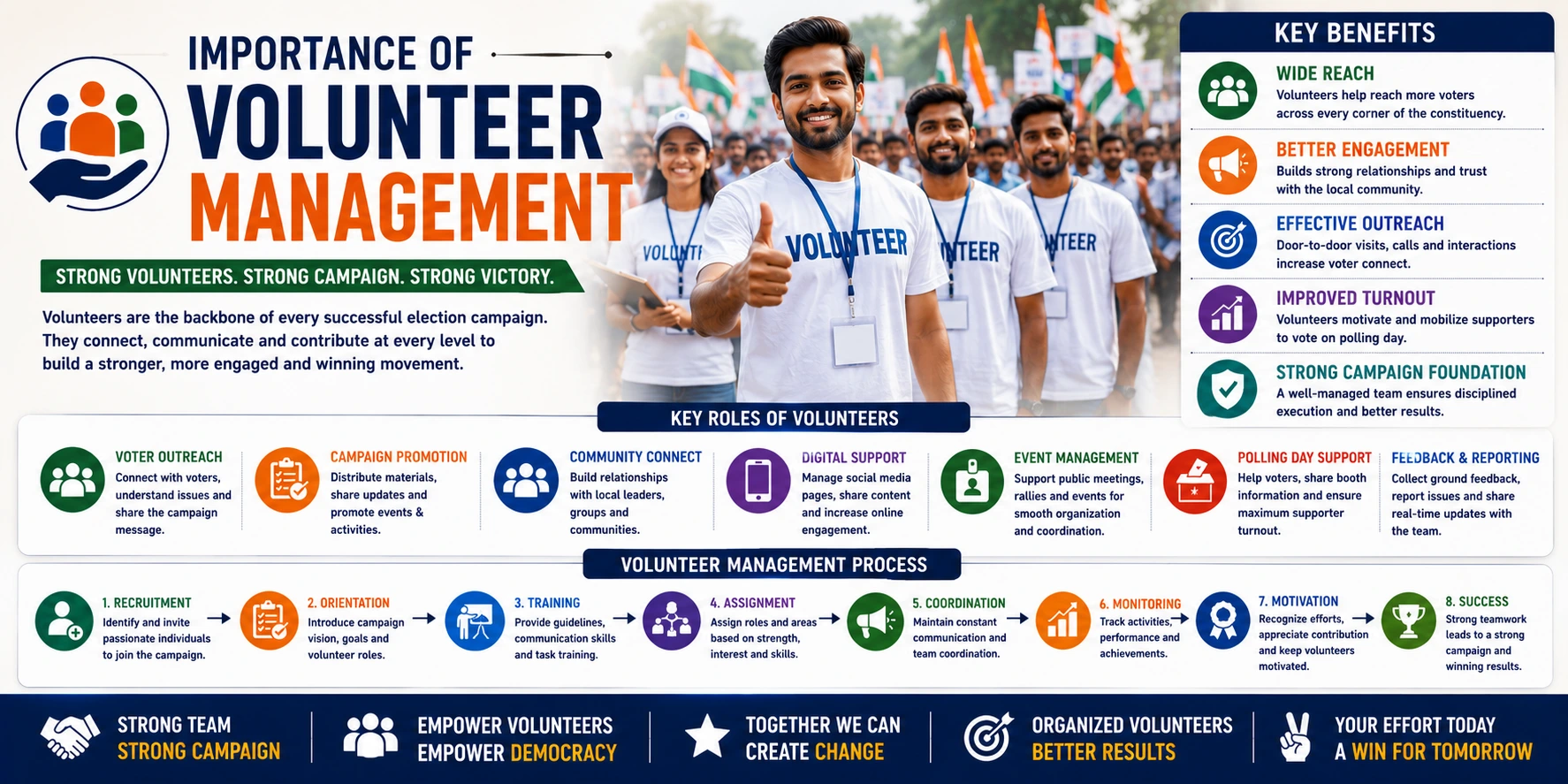
Volunteer management is an important part of large-scale election campaign organization. Political campaigns may involve hundreds or thousands of people working across constituencies, wards, villages, neighbourhoods and booth areas. Volunteers can support public meetings, field operations, door-to-door activities, campaign events, digital communication, campaign material management, research support and local reporting. However, volunteer strength becomes operationally useful only when it is supported by a structured system for recruitment, onboarding, training, responsibility assignment, communication, monitoring, safety and reporting.
What is Volunteer Management in Elections?
Volunteer management in election campaigns is the structured process of recruiting, registering, organizing, training, assigning, coordinating and monitoring people who voluntarily participate in legitimate campaign activities.
Volunteers may work in ground operations, events, research support, office coordination, digital communication, campaign logistics, local issue reporting or other defined campaign functions.
Professional volunteer management ensures that every volunteer knows:
- Who their coordinator is
- Which area or function they are assigned to
- What responsibilities they have
- What information they may communicate
- How activities should be reported
- What conduct is expected
- How issues should be escalated
- What campaign and privacy rules apply
Why Volunteer Management is Important in Elections
The number of volunteers alone does not determine the quality of a campaign operation. Large teams without clear responsibilities can create duplication, inconsistent communication and unreliable reporting.
A structured volunteer-management system can improve:
- Campaign organization
- Area-level field coverage
- Team accountability
- Volunteer communication
- Event coordination
- Field reporting
- Digital-ground coordination
- Campaign discipline
Volunteer management should be treated as an operations-management system, not simply as a list of people willing to help. Clear roles, training, reporting lines, data governance and regular review can turn a large volunteer network into an organized campaign structure.
Main Objectives of Volunteer Management
Recruitment
Build an organized pool of people who voluntarily want to participate in approved campaign activities.
Role Assignment
Assign appropriate responsibilities according to operational requirements, skills and availability.
Training
Provide guidance on campaign processes, public interaction, reporting, safety and responsible conduct.
Coordination
Connect volunteers with local coordinators, campaign managers and relevant operational teams.
Monitoring
Track assigned activities, completion status and operational issues through structured reporting.
Retention
Maintain respectful communication, recognition and meaningful participation throughout the campaign.
Key Components of an Election Volunteer Management System
Volunteer Registration
Maintain necessary volunteer contact, availability and assigned-role information.
Team Structure
Organize volunteers by geography or campaign function with clearly identified coordinators.
Training System
Provide standardized orientation before volunteers begin field or digital activities.
Task Management
Assign specific activities with clear ownership, deadlines and reporting requirements.
Communication
Maintain reliable channels between volunteers, coordinators and campaign management.
Reporting
Capture activity completion, field observations and operational requirements systematically.
Monitoring
Review participation, task completion and operational consistency across teams.
Data Governance
Protect volunteer records and restrict access to authorized campaign personnel.
Recognition
Acknowledge genuine contributions and maintain respectful volunteer relationships.
How Volunteer Management Works – Step by Step
Volunteer Recruitment in Election Campaigns
Volunteer recruitment should begin with a clear understanding of campaign requirements rather than simply collecting a large number of names.
Campaigns may require volunteers for:
- Field operations
- Campaign events
- Office coordination
- Research assistance
- Campaign logistics
- Digital operations
- Local reporting
- Campaign material management
Recruitment should be voluntary, transparent and based on clearly communicated responsibilities.
Creating a Volunteer Management Database
A volunteer database can help campaign managers organize large teams and maintain operational continuity.
Depending on legitimate campaign requirements, records may include:
- Volunteer name
- Necessary contact information
- Assigned geographic area
- Assigned campaign function
- Coordinator details
- Availability
- Training status
- Task status
Campaigns should avoid collecting unnecessary sensitive personal information and should protect volunteer records from unauthorized access.
Building a Clear Volunteer Team Structure
Large volunteer networks work more effectively when reporting lines are clearly defined.
Campaign Management → Constituency Coordinators → Ward / Area Coordinators → Booth-Area Coordinators → Volunteer Teams
The exact structure should depend on constituency geography, campaign size, available resources and operational requirements.
Volunteer Training and Orientation
Volunteers may represent the campaign during field, event and digital activities. Training helps establish consistent professional standards.
Orientation can cover:
- Campaign structure
- Volunteer role and responsibilities
- Approved public information
- Respectful public interaction
- Field reporting procedures
- Privacy and data handling
- Safety procedures
- Issue escalation
- Digital communication guidelines
- Applicable campaign rules
Volunteers should be encouraged to avoid unverified claims and refer questions outside their responsibility to the appropriate campaign coordinator.
Role of Volunteers in Door-to-Door Campaigning
Volunteers can support Door-to-Door Campaigning through organized field-team operations.
Their operational role may include:
- Joining assigned field teams
- Following designated geographic routes
- Providing approved campaign information
- Distributing permitted campaign material
- Recording general field observations
- Reporting recurring public issues
- Reporting activity completion
- Escalating operational problems
Public interaction should remain respectful and citizens should be free to decline engagement.
Role of Volunteers in Grassroots Campaigning
Volunteers are an important operational resource in Grassroots Campaigning .
They can support:
- Local campaign meetings
- Event logistics
- Campaign office support
- Local team communication
- Issue-report collection
- Campaign material coordination
- Area activity reporting
- Public information activities
Volunteer Management at Booth Level
Campaign-side Booth Management may require volunteers to support organizational activities across small geographic campaign units.
Volunteer responsibilities can include:
- Area-team coordination
- Campaign material management
- Volunteer communication
- Activity reporting
- Local logistics
- Meeting support
- Issue escalation
- Coordination with campaign-side booth teams
Campaign-side booth operations are separate from official polling station administration.
Campaign Volunteers vs Official Election Personnel
Campaign volunteers are not official polling personnel.
Electoral rolls, polling-station administration, voting procedures, polling personnel, election security and official polling operations are handled by the relevant election authorities and authorized officials.
Campaign volunteers should remain within the activities permitted for campaign organizations and follow applicable election rules and local administrative requirements.
Digital Volunteer Management
Modern campaigns may also use volunteers for approved digital communication and campaign operations.
Digital volunteers may support:
- Sharing official campaign updates
- Content scheduling support
- Campaign event updates
- Website-content coordination
- Approved social-media operations
- Digital asset organization
- Monitoring public campaign channels
- Flagging suspected misinformation for review
Digital volunteers should use approved content, protect account credentials and follow applicable platform, privacy and campaign requirements.
Digital Security for Volunteer Teams
Large volunteer networks can create security risks if campaign accounts, documents or communication groups are not managed carefully.
- Use role-based account access
- Avoid unnecessary password sharing
- Use strong authentication where available
- Remove access when responsibilities end
- Maintain approved communication groups
- Verify suspicious links and files
- Escalate account-security incidents
- Protect internal campaign information
Volunteer Coordination and Communication
Volunteers need a clear communication system so that instructions and reports move through defined channels.
A structured communication system may include:
- Coordinator-led groups
- Daily task briefings
- Activity schedules
- Standard reporting formats
- Issue escalation channels
- Campaign updates
- Training updates
- Management review meetings
Communication tools such as messaging platforms should be managed with appropriate privacy, access and moderation controls.
Volunteer Activity Reporting
Reporting allows campaign management to understand what activities have actually been completed.
A volunteer report may include:
- Assigned activity
- Area covered
- Activity completion status
- Campaign material requirements
- General field observations
- Recurring local issues
- Operational problems
- Required follow-up
Reports should focus on campaign operations and legitimate field observations rather than unnecessary personal profiling of individual citizens.
Volunteer Feedback vs Political Research
Volunteers may hear useful observations during legitimate field activities, but informal volunteer feedback should not automatically be treated as scientifically representative public opinion.
Volunteer Feedback
Operational observations collected during campaign activity, meetings and field work.
Political Survey
Structured research conducted through a defined questionnaire, sampling methodology, field process and analysis.
Where systematic public-opinion research is required, campaign teams can use professional Political Survey Services .
Volunteer Motivation and Retention
Volunteers contribute their time and effort voluntarily, so respectful management is essential.
Healthy volunteer-management practices can include:
- Clear responsibilities
- Regular communication
- Respectful treatment
- Timely operational guidance
- Recognition of genuine contribution
- Opportunities to provide feedback
- Reasonable workloads
- Safe working conditions
Volunteer participation should remain voluntary and campaign managers should avoid coercive practices.
Volunteer Safety and Professional Conduct
Field campaigning can involve travel, large gatherings, outdoor activity and interaction with the public. Volunteer safety should therefore be part of campaign planning.
- Provide clear field assignments
- Use team-based deployment where appropriate
- Maintain coordinator contact information
- Establish emergency escalation procedures
- Avoid confrontational situations
- Respect private property
- Respect a citizen's decision not to engage
- Follow local administrative requirements
Privacy and Data Governance in Volunteer Management
Volunteer systems may contain names, contact information, assignments and activity records. Campaign organizations should handle such information responsibly.
- Collect only necessary volunteer information
- Explain why information is being collected
- Restrict access to authorized personnel
- Protect stored records
- Avoid unnecessary sensitive personal information
- Maintain accurate records
- Remove unnecessary access when roles change
- Follow applicable privacy requirements
Volunteer Coordination During the Polling Period
As polling approaches, volunteer responsibilities should be clearly reviewed so that campaign-side activities remain organized and compliant with applicable election requirements.
Appropriate campaign-side responsibilities may include:
- Internal team communication
- Campaign office coordination
- Permitted logistics support
- Coordinator updates
- Campaign-side incident reporting
- Volunteer scheduling
- Compliance reminders
- Management reporting
Any activity around polling stations or during restricted campaign periods should follow applicable election laws, election-authority directions and local administrative requirements.
Technology for Volunteer Management
Technology can make large volunteer networks easier to organize and monitor.
Campaign-management systems may support:
- Volunteer registration
- Area and team allocation
- Task assignment
- Training records
- Activity reporting
- Issue tracking
- Coordinator dashboards
- Management summaries
Technology should support human coordination and verified campaign operations rather than replace responsible management.
Volunteer Performance Monitoring
Volunteer monitoring should focus on operational responsibilities and task completion.
Useful management indicators can include:
- Training completion
- Assigned tasks
- Tasks completed
- Reporting consistency
- Attendance where relevant
- Coordinator responsiveness
- Issue-resolution status
- Operational reliability
Monitoring should not become unnecessary surveillance or intrusive profiling.
Benefits of Professional Volunteer Management
- Clearer campaign organization
- Defined responsibilities
- Better team coordination
- More consistent training
- Improved activity reporting
- Better campaign logistics
- Stronger digital-ground coordination
- Improved accountability
- Faster operational communication
- More structured field execution
Common Challenges in Volunteer Management
Unclear Roles
Volunteers may duplicate work when responsibilities are not clearly assigned.
Inconsistent Training
Different instructions can lead to inconsistent field and digital practices.
Communication Gaps
Large teams can become disconnected from campaign management without defined reporting channels.
Volunteer Fatigue
Long campaigns can reduce participation if workloads and expectations are poorly managed.
Data Management
Large volunteer databases require accuracy, access controls and appropriate security.
Reporting Quality
Incomplete or delayed reporting can make campaign operations difficult to evaluate.
Best Practices for Election Volunteer Management
- Define volunteer requirements before recruitment
- Use a structured registration process
- Create clear reporting lines
- Assign specific responsibilities
- Provide standardized training
- Maintain appropriate data security
- Use consistent reporting formats
- Review activities regularly
- Recognize volunteer contributions
- Maintain reasonable workloads
- Establish safety procedures
- Maintain professional conduct standards
How Professional Volunteer Management Services Help
Professional campaign-management teams can help design and operate volunteer-management systems for large election campaigns.
Depending on project requirements, professional support may include:
- Volunteer requirement planning
- Registration systems
- Team structure design
- Training frameworks
- Area and task allocation
- Communication systems
- Activity reporting
- Campaign dashboards
- Field-team coordination
- Monitoring and management reporting
Volunteer operations can be integrated with Election Campaign Management , Booth Management , grassroots campaigning, digital promotion and other campaign functions.
Megamind's Approach to Volunteer Management
Megamind approaches volunteer management as part of a complete campaign-operations system rather than as an isolated activity.
Depending on project requirements, the process can follow:
Campaign Requirement Assessment → Volunteer Planning → Registration → Team Structure → Training → Role & Area Allocation → Field / Digital Operations → Reporting → Monitoring → Continuous Coordination
Volunteer management can be integrated with Election Campaign Management, Political Survey, Constituency Analysis, Booth Management, Grassroots Campaigning, Door-to-Door Operations, Digital Promotion, Public Relations, Data Management and Campaign Monitoring according to campaign requirements.
Megamind provides election research and campaign-management support for political parties, candidates, leaders, prospective candidates, aspirants, campaign teams and political organizations across India.
Explore Complete Election Services →Volunteer Management Across Indian Elections
Volunteer structures can differ substantially across constituencies because campaign geography, population distribution, transport, local organization and available resources are different.
Rural constituencies may require village and area-level team structures, while urban constituencies may require ward, neighbourhood and locality-based coordination.
The appropriate model should therefore be designed around the actual campaign environment rather than applying the same structure to every constituency.
Volunteer Management Within a Complete Election Campaign
Volunteer management becomes more useful when it is connected with research, field operations, booth organization, communication and monitoring.
Political Research → Campaign Planning → Volunteer Structure → Training → Ground & Digital Operations → Booth Coordination → Field Reporting → Monitoring → Continuous Review
This creates a more organized relationship between campaign management and the people carrying out day-to-day campaign activities.
FAQs About Volunteer Management in Elections
What is volunteer management in elections?
It is the structured process of recruiting, organizing, training, assigning, coordinating and monitoring volunteers participating in campaign activities.
Why is volunteer management important?
It helps campaign teams maintain clear responsibilities, coordination, communication, reporting and operational discipline across large volunteer networks.
What activities can election volunteers support?
Depending on campaign requirements, volunteers may support field activities, events, office operations, digital communication, logistics, research assistance and reporting.
Why do election volunteers need training?
Training helps volunteers understand their responsibilities, reporting procedures, professional conduct, safety and campaign communication standards.
Can volunteers support door-to-door campaigning?
Yes. Volunteers can support organized field teams, geographic coverage, permitted campaign-material distribution and activity reporting.
What is the role of volunteers in booth management?
Campaign-side volunteers can support local organization, logistics, team communication and operational reporting, while official polling administration remains the responsibility of election authorities.
What are digital campaign volunteers?
They are volunteers assigned to approved digital operations such as official content support, campaign updates and digital asset coordination.
What information should a volunteer database contain?
It should contain only information reasonably necessary for campaign operations, such as contact details, assigned role, area, coordinator and task status.
How can technology help volunteer management?
Technology can support registration, task assignment, training records, area allocation, reporting, issue tracking and management dashboards.
Is volunteer field feedback the same as survey data?
No. Volunteer observations can be useful field inputs, but scientifically designed surveys use defined sampling and research methodologies.
Why is data privacy important?
Volunteer-management systems contain personal and operational information, so access should be limited and unnecessary data collection should be avoided.
How can campaigns retain volunteers?
Clear responsibilities, respectful treatment, regular communication, recognition, reasonable workloads and good coordination can support volunteer retention.
Who can use professional volunteer management services?
Political parties, candidates, leaders, prospective candidates, aspirants, campaign teams and political organizations may use professional campaign-management support according to project requirements.
Volunteer Management Builds Organized Campaign Operations
Volunteers can provide valuable operational support across election campaigns, but the effectiveness of a volunteer network depends on how professionally it is managed.
A structured system built around recruitment, training, clear responsibilities, communication, field coordination, reporting, safety, privacy and monitoring can help campaign organizations manage volunteer activities more consistently.
Volunteer management can also be integrated with Grassroots Campaigning, Door-to-Door Operations, Booth Management, Digital Promotion, Political Research and Election Campaign Management to create a coordinated campaign operations framework.
The objective is not simply to build a large volunteer network, but to create a responsible, organized and accountable system in which every volunteer understands their role and how it connects with the broader campaign.