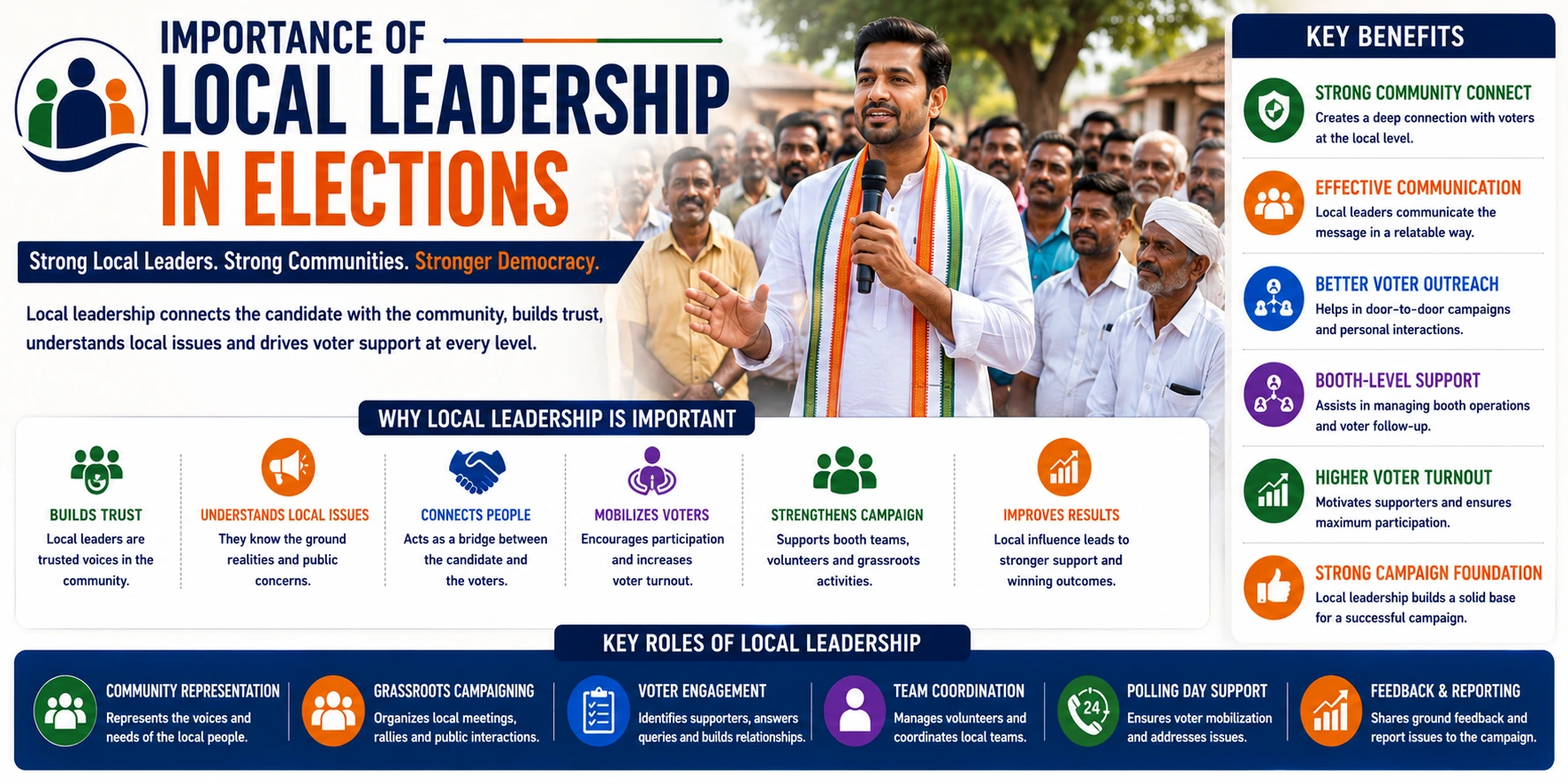
Local leadership is an important part of organized election campaigning because every constituency contains different villages, wards, neighbourhoods, polling areas, public issues and operational conditions. Local leaders, coordinators, social workers, volunteers and other publicly active individuals can help campaign organizations understand these local conditions, coordinate field activities and maintain communication between constituency-level management and ground teams. Professionally managed local leadership is therefore not simply about identifying influential individuals. It is about building a structured local campaign network based on responsibility, information, coordination, accountability and continuous field communication.
What is Local Leadership in Elections?
Local leadership in election campaigns refers to individuals who understand a particular geographic area and can contribute to organized campaign activities within that area.
Depending on the constituency, these individuals may include ward coordinators, village-level organizers, booth-area coordinators, social workers, resident-association representatives, campaign volunteers and other locally active persons.
Their campaign role may include helping coordinate local teams, identifying public issues, organizing meetings, supporting field communication and providing operational feedback to campaign management.
Local leadership should therefore be viewed as part of a structured ground-campaign organization rather than as a substitute for research or verified public opinion.
Why Local Leadership is Important in Elections
Central campaign teams may understand the overall constituency, but local teams often have greater visibility into day-to-day conditions within individual areas.
A well-organized local leadership structure can help connect constituency-level planning with ground-level execution.
- Provides local geographic knowledge
- Helps identify recurring public issues
- Improves communication with field teams
- Supports local campaign organization
- Strengthens volunteer coordination
- Supports community meetings and events
- Improves field reporting
- Connects booth and area teams with campaign management
Effective local leadership is not measured only by an individual's popularity. A professional campaign should also consider reliability, local knowledge, communication ability, organizational capacity, accountability and quality of field reporting.
Main Objectives of Local Leadership in Election Campaigns
Local Understanding
Provide campaign teams with practical knowledge of local geography, infrastructure and recurring public issues.
Field Coordination
Coordinate campaign activities between constituency management and local field teams.
Public Communication
Support respectful and factual communication during approved campaign activities.
Issue Reporting
Identify recurring local concerns and report them through a structured process.
Volunteer Coordination
Help organize local campaign volunteers and maintain defined responsibilities.
Operational Reporting
Provide regular updates on campaign activity, requirements and field-level operational issues.
Types of Local Leadership in Election Campaigns
Local campaign leadership can take different forms depending on the geographic and organizational structure of a constituency.
Booth-Area Coordinators
Campaign-side coordinators responsible for local organization, activity reporting and team communication.
Ward Coordinators
Local organizers responsible for coordinating activities across a ward or urban locality.
Village-Level Organizers
Local campaign organizers familiar with village geography, public facilities and campaign requirements.
Social Workers
Publicly active individuals who may provide useful knowledge about local civic and community issues.
Resident Representatives
Representatives of resident associations or locality-based organizations in urban areas.
Campaign Team Leaders
Individuals responsible for supervising volunteers, campaign activities and reporting within assigned areas.
A campaign should not assume that any individual automatically represents the political views of an entire community. Information obtained through local leadership should be verified through appropriate research and multiple sources where required.
How a Local Leadership Network is Organized
Professional campaign teams can develop local leadership through a structured process.
Role of Local Leadership in Grassroots Campaigning
Local leadership and Grassroots Campaigning are closely connected because grassroots operations require people who understand individual campaign areas.
Local coordinators can support:
- Area-level campaign planning
- Volunteer coordination
- Local campaign meetings
- Door-to-door team coordination
- Field activity reporting
- Local issue identification
- Campaign material coordination
- Communication with central teams
Role of Local Leadership in Booth Management
Campaign-side Booth Management requires coordination across many small geographic areas.
Local leadership can support the campaign's booth-level organizational structure through:
- Local area coordination
- Volunteer assignment
- Campaign activity reporting
- Field-team communication
- Local issue reporting
- Campaign material coordination
- Operational follow-up
- Management reporting
These are campaign-side organizational functions and should remain separate from official election administration.
Local Campaign Leadership vs Official Polling Administration
Local campaign leaders and campaign-side booth coordinators are not official polling administrators.
Official electoral rolls, polling-station administration, voting procedures, polling personnel and election security are handled by the relevant election authorities and authorized officials.
Campaign organizations should maintain this distinction and conduct local activities according to applicable election requirements.
Local Leadership as a Source of Ground Knowledge
Local coordinators may have practical knowledge that is difficult for central teams to obtain through desk research alone.
This can include information about:
- Local geography
- Road and transport conditions
- Public infrastructure
- Recurring civic issues
- Local institutions
- Campaign-event logistics
- Area-level operational challenges
- Recent local developments
However, local observations should be treated as field intelligence, not automatically as representative public opinion.
Local Leadership and Issue Identification
Local leaders and field coordinators can help identify recurring public issues because they operate close to the areas being covered.
Common issue categories may include:
- Roads and transport
- Water supply
- Sanitation
- Electricity
- Education facilities
- Healthcare access
- Agriculture-related infrastructure
- Employment concerns
- Public safety
- Civic services
Structured issue reporting helps campaign management organize recurring observations rather than relying on scattered informal feedback.
Local Leadership Feedback vs Political Survey
Information received from local leaders can be valuable, but it should not automatically be treated as scientifically representative public opinion.
Local Leadership Feedback
Practical field observations based on local activity, conversations, operational experience and recurring issues.
Political Survey
Structured research conducted using a defined questionnaire, sampling approach, field process and analytical methodology.
For broader research requirements, local field intelligence can be combined with a professionally designed Political Survey .
Local Leadership and Community Engagement
Local leaders can help organize appropriate opportunities for public interaction within villages, wards and neighbourhoods.
These activities may include:
- Village meetings
- Ward-level meetings
- Neighbourhood discussions
- Resident-association interactions
- Local issue meetings
- Public information sessions
- Volunteer meetings
- Campaign events
Public interaction should focus on respectful communication, accurate information and opportunities for citizens to raise local concerns.
Local Leadership, Credibility and Public Trust
Local campaign representatives are often visible to the public over long periods of time. Their conduct can therefore affect how the campaign's professionalism is experienced at the local level.
Credibility should be supported through:
- Accurate information
- Respectful communication
- Consistent conduct
- Clear responsibilities
- Transparency where appropriate
- Responsible issue handling
- Professional behaviour
- Reliable follow-up on operational commitments
Campaign communication should not rely on misinformation, intimidation or misleading claims.
Local Leadership and Candidate Public Communication
Local campaign teams can support candidate communication by helping distribute accurate information about public programmes, campaign events, documented work, policy positions and official campaign announcements.
Communication should remain consistent with the candidate's official public position and should avoid exaggerated, misleading or unverified claims.
This approach supports a more consistent public identity across central, digital and ground campaign channels.
Local Leadership and Volunteer Management
Local coordinators can provide an important management layer between constituency campaign leadership and field volunteers.
Their operational responsibilities can include:
- Volunteer onboarding
- Area-wise task assignment
- Activity scheduling
- Team communication
- Field monitoring
- Issue escalation
- Daily reporting
- Campaign material coordination
Volunteers should receive appropriate guidance on campaign procedures, privacy, safety, respectful public interaction and applicable rules.
Local Leadership and Door-to-Door Campaigning
Local coordinators can support Door-to-Door Campaigning by helping organize field teams geographically.
Their role may include route planning, team allocation, activity scheduling, local logistics and field reporting.
Household-level communication should remain respectful, follow applicable campaign rules and recognize a citizen's choice not to engage.
Local Leadership and Field Reporting
One of the most valuable operational roles of local leadership is to provide structured information from the field.
A standardized report may include:
- Area covered
- Campaign activity completed
- Meeting or event conducted
- Volunteer availability
- Recurring local issues
- Operational problems
- Campaign material requirements
- Follow-up actions
Standardized reporting makes it easier for campaign management to compare information from multiple areas.
Combining Local Knowledge with Election Data
Local knowledge becomes more useful when it is reviewed alongside reliable electoral and campaign information.
Campaign teams may combine appropriate field information with:
- Historical election results
- Geographic constituency information
- Polling-area information
- Political survey findings
- Publicly available constituency information
- Field research
- Local issue reports
- Campaign activity reports
Historical or field information should not automatically be treated as a prediction of future electoral behaviour.
Technology for Local Leadership Management
Technology can help campaign managers organize large local networks more systematically.
Campaign systems may support:
- Area mapping
- Team records
- Role assignment
- Task management
- Activity reporting
- Issue tracking
- Campaign dashboards
- Management review
Technology should support verified field operations and human decision-making rather than replace them.
Connecting Local Leadership with Digital Campaign Teams
Ground and digital campaign teams can operate within a coordinated information flow.
Local Field Activity → Structured Reporting → Verification → Campaign Review → Approved Communication → Digital/Public Updates → Ground Team Coordination
This approach can help reduce inconsistencies between what is happening on the ground and what is communicated through official campaign channels.
Monitoring Local Leadership Networks
Large local networks need regular monitoring to ensure that assigned responsibilities are being completed and reports are reaching campaign management.
Monitoring can focus on operational indicators such as:
- Activities completed
- Reports submitted
- Team coordination
- Meeting organization
- Issue-report quality
- Task completion
- Communication responsiveness
- Operational follow-up
Monitoring should evaluate campaign execution rather than create unnecessary personal profiles of individual citizens.
Privacy and Data Governance
Local campaign operations may involve volunteer information, team records, activity reports and public feedback.
Campaign organizations should use appropriate data-governance practices.
- Collect only necessary operational information
- Avoid unnecessary sensitive personal profiling
- Limit access to authorized campaign personnel
- Maintain secure records
- Verify important field information
- Use aggregate reporting where appropriate
- Maintain data-quality procedures
- Follow applicable privacy requirements
Challenges in Local Leadership Management
Conflicting Information
Different local sources may provide different assessments of the same issue.
Local Rivalries
Internal competition or personal disagreements may affect campaign coordination.
Message Consistency
Large networks may unintentionally communicate inconsistent campaign information.
Reporting Quality
Field reports may be incomplete, delayed or difficult to verify.
Role Confusion
Unclear responsibilities can lead to duplicated work and operational gaps.
Large-Scale Coordination
Managing many local coordinators across a constituency requires structured systems and regular review.
Best Practices for Managing Local Leadership
- Start with geographic area mapping
- Define responsibilities clearly
- Use structured reporting formats
- Verify important local information
- Maintain consistent campaign communication
- Provide regular team orientation
- Coordinate with booth and field teams
- Review field reports regularly
- Maintain professional conduct standards
- Protect campaign and personal information
- Use technology for coordination where useful
- Maintain clear escalation procedures
How Professional Campaign Teams Help
Professional campaign-management teams can help organize local leadership networks through structured area planning, role assignment, field coordination, reporting and monitoring.
Depending on project requirements, professional support may include:
- Constituency and area mapping
- Local campaign structure planning
- Ground-team coordination
- Volunteer management
- Booth-management support
- Field reporting systems
- Political research integration
- Campaign technology
- Digital-ground coordination
- Monitoring and management reporting
These functions can be integrated through professional Election Campaign Management Services .
Megamind's Approach to Local Leadership Management
Megamind approaches local leadership as part of a broader election-management and ground-operations framework.
Depending on project requirements, the process can follow:
Constituency Understanding → Area Mapping → Local Structure Assessment → Role Definition → Team & Volunteer Coordination → Field Operations → Issue Reporting → Booth Coordination → Monitoring & Continuous Review
Local leadership can be integrated with Political Survey, Constituency Analysis, Voter Data Analysis, Booth Management, Grassroots Campaigning, Door-to-Door Operations, Digital Promotion, Public Relations and Election Campaign Management within a coordinated election-support framework.
Megamind provides election research and campaign-management support for political parties, candidates, leaders, prospective candidates, aspirants, campaign teams and political organizations according to project requirements.
Explore Complete Election Services →Importance of Local Leadership Across Indian Elections
Local leadership structures can be relevant across Lok Sabha, Vidhan Sabha, municipal and other local electoral contexts in India.
However, campaign structures can differ significantly between constituencies.
Rural areas may require village and locality-based coordination, while urban constituencies may require ward, neighbourhood, apartment and resident-association level organization.
The appropriate local structure should therefore be developed from the actual geography, administrative context, field research and operational requirements of each constituency.
Local Leadership Within a Complete Election Campaign Framework
Local leadership is most useful when connected with broader campaign research, field operations and monitoring systems.
Political Research → Constituency Understanding → Local Leadership Structure → Grassroots Operations → Booth Coordination → Field Reporting → Digital Communication → Monitoring → Continuous Review
This creates a structured flow between constituency management and the local campaign organization.
FAQs About Local Leadership in Elections
What is local leadership in election campaigns?
Local leadership refers to campaign coordinators, organizers and other locally active individuals who help manage ground-level campaign operations within defined areas.
Why is local leadership important?
It helps connect constituency-level campaign management with local field operations, public issues and volunteer teams.
What information can local leaders provide?
They may provide practical information about geography, infrastructure, public issues, campaign logistics and field operations.
Is local leadership feedback the same as a political survey?
No. Local feedback is a field input, while a political survey uses a defined research and sampling methodology.
How does local leadership support grassroots campaigning?
Local coordinators can help organize teams, meetings, field activities, issue reporting and campaign communication.
How does local leadership support booth management?
Campaign-side local coordinators can support area organization, volunteer coordination, reporting and operational communication.
Can local leaders support door-to-door campaigns?
Yes. They can help with geographic planning, field-team allocation, scheduling, logistics and reporting.
How should local leaders be selected?
Campaigns can consider local knowledge, reliability, communication ability, organizational capability and willingness to follow defined responsibilities.
What is the role of local leaders in issue identification?
They can report recurring public and infrastructure concerns observed during legitimate field activities.
Can technology help manage local leadership networks?
Yes. Technology can support area mapping, task assignment, reporting, issue tracking and campaign-management dashboards.
Why is verification important?
Local information may be incomplete or reflect only a limited perspective, so important findings should be checked through appropriate additional sources.
Why is privacy important in local campaign operations?
Campaign systems may contain team records and public feedback, so unnecessary personal data collection should be avoided and access should be appropriately controlled.
Who can use professional local leadership management services?
Political parties, candidates, leaders, prospective candidates, aspirants, campaign teams and political organizations may use professional campaign-management support according to project requirements.
Local Leadership Connects Election Strategy with Ground Operations
Local leadership is an important organizational layer in election campaigns because it connects constituency-level planning with the practical realities of villages, wards, neighbourhoods and polling areas.
Effective local leadership can provide local knowledge, issue reporting, volunteer coordination, field communication and operational support to the broader campaign structure.
Its value increases when local information is structured, verified and integrated with professional Political Survey, Voter Data Analysis, Booth Management, Grassroots Campaigning, Digital Promotion and Election Campaign Management.
A professional approach therefore focuses on organization, responsibility, accurate information, coordination, accountability and continuous monitoring rather than relying only on informal influence.