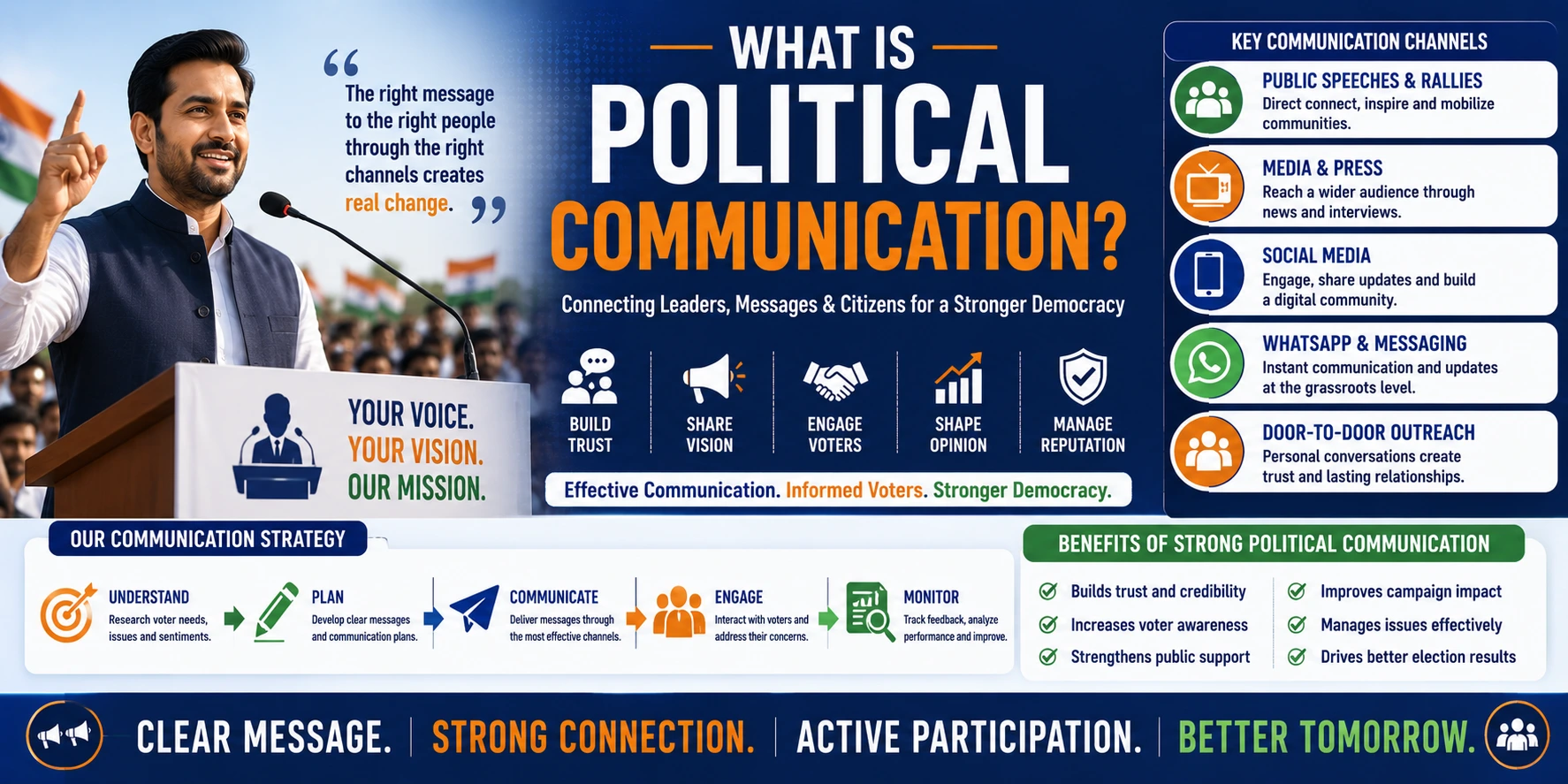
Political Communication is the organized process through which political candidates, leaders, parties and campaign organizations communicate public information, priorities, policies, programmes, statements and campaign activities through ground, media and digital channels. It can include speeches, press releases, interviews, websites, social media, campaign literature, public meetings, official statements, videos, public-service information and responses to emerging issues. Professional political communication is not simply about communicating more frequently. It requires clear information, factual accuracy, consistent language, appropriate channels, responsible public conduct, verification, coordination and communication governance.
What is Political Communication?
Political communication is the planned creation, approval, distribution and management of public-facing political information.
It connects political organizations and public representatives with citizens, journalists, media organizations, volunteers, campaign teams and other stakeholders through defined communication channels.
Political communication can include:
- Public speeches
- Press releases
- Official statements
- Media interviews
- Press conferences
- Websites
- Social-media updates
- Campaign videos
- Printed communication
- Public meetings
- Issue explanations
- Crisis communication
Why Political Communication is Important in Elections
Election campaigns communicate through many channels at the same time. Without a coordinated system, different teams can publish inconsistent information, use outdated facts or respond differently to the same issue.
Structured political communication can help:
- Explain candidate or party priorities clearly
- Maintain consistent public information
- Communicate documented public work
- Improve coordination between campaign teams
- Provide timely official updates
- Support professional media relations
- Respond to public questions
- Correct inaccurate information where necessary
Effective political communication begins with information discipline. A campaign should know what information is verified, who can approve it, which channel should publish it and how outdated or inaccurate communication will be corrected.
Main Objectives of Political Communication
Message Clarity
Present political priorities, public information and official positions in understandable language.
Information Consistency
Maintain the same verified core information across campaign teams and public channels.
Public Accessibility
Make official information easier for citizens and media to find and understand.
Issue Communication
Explain official positions and responses to important public or constituency issues.
Media Readiness
Maintain organized information for interviews, statements, press conferences and media inquiries.
Crisis Response
Provide verified, coordinated and timely responses when significant communication issues arise.
Key Components of Political Communication
Core Information
Verified candidate biography, public positions, programmes and campaign information.
Speech Communication
Structured public-speaking material for rallies, meetings, interviews and public programmes.
Media Communication
Press releases, interviews, media statements and press-conference coordination.
Digital Communication
Website, social-media, video and other official online communication.
Visual Communication
Posters, presentations, graphics and campaign materials using consistent visual standards.
Ground Communication
Public information shared during meetings, events and legitimate field campaign activities.
Issue Communication
Structured explanation of public priorities, problems and official positions.
Crisis Communication
Coordinated response to rapidly developing public or media issues.
Communication Governance
Verification, approval, publishing and archive procedures for official communication.
How Political Communication Works – Step by Step
Political Communication Audit
Before developing new communication, a campaign can review its existing public information.
The audit may include:
- Official website
- Social-media profiles
- Candidate biography
- Public statements
- Press releases
- Campaign literature
- Previous speeches
- Media interviews
- Digital videos
- Outdated or conflicting information
An audit helps identify gaps before they create public confusion.
Developing a Core Political Communication Framework
Campaign teams often need a common reference document that defines the official information used across communication channels.
This framework may include:
- Candidate biography
- Political background
- Public-service record
- Declared priorities
- Official issue positions
- Public programmes
- Frequently asked questions
- Approved terminology
- Verified statistics
- Media contact information
This reduces the likelihood that different teams publish different versions of the same factual information.
What Makes Political Communication Clear?
Clear political communication should allow a reader, listener or viewer to understand the information without unnecessary ambiguity.
Good communication can focus on:
- Plain language
- Clear subject
- Defined context
- Accurate claims
- Logical structure
- Relevant supporting information
- Consistent terminology
- Appropriate length
Communication should explain rather than deliberately obscure important information.
Issue-Based Political Communication
Public issues are often a major part of election communication.
A structured issue-communication format can explain:
- What the issue is
- Why it matters publicly
- Relevant local context
- Available factual information
- Candidate or party position
- Proposed approach where applicable
- Implementation considerations
- Sources or documentation where relevant
Issue communication should be based on verified information and should avoid presenting uncertain claims as established facts.
Role of Political Research in Communication
Research can help communication teams understand which public issues require explanation, what information is missing and where further evidence is needed.
Appropriate research inputs may include:
- Political Survey findings
- Opinion Poll research
- Constituency issue studies
- Publicly available administrative information
- Historical election data
- Field research
- Media monitoring
- Public feedback in aggregate form
Research should support understanding and factual communication, not be used as a substitute for verified public facts.
Using Data Responsibly in Political Communication
Statistics and research findings can make political communication more informative when used accurately.
Before publishing a statistic, campaign teams should consider:
- Source reliability
- Date of the data
- Geographic scope
- Definition of the metric
- Whether the figure is estimated or official
- Whether important context is missing
- Whether updated data exists
- Whether the source can be documented
Aggregate data can inform public communication without requiring unnecessary profiling of individual citizens.
Speech Communication in Election Campaigns
Speeches are one of the most visible forms of political communication and often need to communicate several ideas within a limited time.
A speech framework can include:
- Opening context
- Purpose of the event
- Relevant local or public issues
- Verified public work
- Declared priorities
- Policy or programme explanation
- Acknowledgment of public concerns
- Clear closing summary
Speech content should remain consistent with official information published elsewhere by the campaign.
Preparing Political Speeches Professionally
Professional speech preparation can involve more than writing a script.
The process can include:
- Event context
- Audience size and setting
- Language requirement
- Time available
- Verified issue briefing
- Fact checking
- Pronunciation or name checks
- Supporting documents
- Media considerations
- Final approval
Political Statements and Official Responses
Official statements should clearly indicate the position of the candidate, leader or organization issuing them.
A structured statement may include:
- Subject or issue
- Verified context
- Official position
- Relevant supporting facts
- Next action where appropriate
- Authorized spokesperson or issuer
Statements should avoid attributing claims to other people without adequate verification.
Media Communication in Politics
Professional media communication helps journalists access clear and verified information about candidates, political organizations and campaign developments.
Media operations can include:
- Press releases
- Media advisories
- Official statements
- Press conferences
- Interview coordination
- Candidate background material
- Media photographs
- Fact sheets
- Clarification notes
- Media contact management
Explore Political Public Relations Services for broader media and PR requirements.
What Makes a Good Political Press Release?
A political press release should provide clear, news-relevant and attributable information.
It can contain:
- Clear headline
- Date and location
- Key development
- Supporting facts
- Authorized quotation where appropriate
- Background information
- Media contact
Press material should distinguish factual information from opinion or political commentary.
Preparing Candidates for Media Interviews
Media preparation helps ensure that candidates have accurate information available when responding to public questions.
Preparation can include:
- Interview topic review
- Recent public developments
- Verified statistics
- Candidate background information
- Issue briefing notes
- Potential factual corrections
- Media format and timing
- Public disclosure considerations
Media preparation should help improve clarity and accuracy rather than encourage deceptive answers.
Digital Political Communication
Digital communication allows political organizations to publish official information through websites, social platforms, videos and other online channels.
Digital communication operations may include:
- Official website updates
- Social-media publishing
- Campaign videos
- Public announcements
- Event updates
- Press-release distribution
- Public information graphics
- Clarification posts
- Digital archives
- Performance reporting
Explore Digital Promotion Services for broader political digital operations.
Role of the Campaign Website in Political Communication
A campaign website can serve as a central public reference point for verified political information.
It may contain:
- Candidate biography
- Public priorities
- Official announcements
- Press releases
- Public work
- Videos
- Events
- Policy information
- Media resources
- Contact information
Website information should be reviewed periodically to prevent old or incorrect information remaining publicly available.
Social Media and Political Communication
Social platforms allow campaigns to publish information quickly, but the speed of publication also increases the risk of errors.
Professional social communication can use:
- Approved content calendars
- Official account standards
- Fact-check procedures
- Visual templates
- Video review
- Caption verification
- Account-access controls
- Correction procedures
Visual Communication and Political Branding
Visual communication helps official campaign information remain recognizable across posters, graphics, websites, presentations and public events.
Visual standards may define:
- Campaign colors
- Typography
- Candidate photographs
- Graphic layouts
- Video titles
- Presentation style
- Logo usage where applicable
- Website appearance
Visual identity can be integrated with Political Branding to maintain consistency across communication channels.
Political Communication During Ground Campaigning
Public meetings, campaign events and other legitimate field activities are also political communication channels.
Ground teams may use:
- Approved candidate introductions
- Public-information leaflets
- Issue briefing material
- Event scripts
- Campaign literature
- Frequently asked questions
- Official contact information
- Escalation procedures for questions they cannot answer
Field representatives should avoid improvising factual claims that have not been verified.
Political Communication and Door-to-Door Campaigning
During Door-to-Door Campaigning , field workers may provide approved public information and listen to citizen concerns.
Good field communication should be:
- Respectful
- Accurate
- Non-confrontational
- Relevant to the interaction
- Consistent with official information
- Respectful of a citizen's choice not to engage
Local Language in Political Communication
Political information may need to be available in the languages used within the relevant constituency or region.
Translation should preserve the meaning of the original communication rather than introduce new claims or interpretations.
A professional translation process can include:
- Source-text approval
- Translation
- Language review
- Name and terminology checks
- Fact consistency
- Final approval
Accessibility in Political Communication
Public political information can be made easier to access through thoughtful communication design.
Depending on the communication format, accessibility practices can include:
- Readable typography
- Clear contrast
- Video captions
- Transcripts
- Mobile-friendly webpages
- Plain-language summaries
- Alternative text for meaningful images
- Multiple language versions where appropriate
Crisis Communication in Politics
Campaigns may face sudden controversies, misinformation, public incidents, reporting errors or rapidly developing events.
A disciplined response process can reduce contradictory statements.
Identify Issue → Verify Facts → Assess Significance → Coordinate Internally → Prepare Response → Authorized Approval → Official Publication → Monitor Developments
The objective should be to provide accurate information, not simply to respond as quickly as possible.
Managing Misinformation and False Claims
False or manipulated content can spread rapidly during election periods.
Before responding, communication teams should establish whether the information is actually incorrect.
A responsible process can include:
- Capture the disputed content
- Identify the original source where possible
- Verify relevant facts
- Collect supporting documentation
- Prepare factual clarification
- Obtain approval
- Publish through official channels where appropriate
- Maintain an incident record
Fact Checking Political Communication
Political communication often contains claims about public work, statistics, government programmes, election history and other factual topics.
Important claims should be checked against appropriate sources.
Fact verification can review:
- Candidate biography
- Public achievements
- Government statistics
- Election results
- Public programme details
- Dates and locations
- Quotations
- Legal or administrative statements
Political Communication and Reputation Management
Reputation management is closely connected with political communication because public questions or inaccurate claims often require an official response.
Responsible reputation communication can include:
- Media monitoring
- Digital monitoring
- Fact verification
- Clarification statements
- Correction requests
- Public documentation
- Media coordination
- Issue escalation
Reputation management should not be used to conceal legitimate public information.
Political Communication vs Political Branding
Political Communication
Focuses on creating, approving and distributing public information through speeches, media, digital, ground and other channels.
Political Branding
Focuses on the broader political identity, visual system, candidate profile and cross-channel consistency.
Political branding creates the identity framework, while political communication carries verified information through that framework.
Political Communication vs Public Relations
Political Communication
Covers the complete public communication system across speeches, ground, media, digital, visual and official channels.
Public Relations
Focuses more specifically on media relations, press communication, public statements, reputation and related public-information activities.
Political Communication vs Digital Promotion
Political Communication
Defines the information, language, official position and communication standards.
Digital Promotion
Manages digital publication, content operations, distribution and monitoring through online channels.
Political Content Approval Workflow
Large campaigns often involve many content creators, designers, coordinators and spokespersons.
A defined workflow can help reduce publishing errors.
Requirement → Draft → Fact Verification → Communication Review → Authorized Approval → Production → Final Check → Publication → Archive
Creating a Political Communication Library
A central communication library helps multiple teams use the same approved information.
It can contain:
- Approved candidate biography
- Official photographs
- Press releases
- Public statements
- Speech references
- Verified statistics
- Issue briefs
- Videos
- Campaign presentations
- Brand assets
- FAQs
- Archived material
Version control helps prevent outdated files from being reused.
Monitoring Political Communication
Communication monitoring can help ensure that official information remains accurate and consistent.
Monitoring may include:
- Website review
- Official social-account review
- Press monitoring
- Public-statement tracking
- Outdated-information checks
- Correction requirements
- Media-query tracking
- Content approval compliance
- Digital account integrity
- Communication archive maintenance
Measuring Communication Operations
Communication analytics can help teams understand how efficiently their communication systems are operating.
Useful operational indicators may include:
- Content published
- Channel activity
- Website traffic
- Video views
- Media mentions
- Press inquiries
- Correction requests
- Response time
- Content approval turnaround
- Digital platform performance
Metrics should be interpreted in context rather than assuming that a single engagement number represents public opinion.
AI in Political Communication
AI-assisted tools can support some communication operations such as transcription, translation, summarization, document organization, research assistance and content workflow management.
Important political communication should still receive appropriate human review.
Particular care is appropriate for:
- Official statements
- Candidate quotations
- Statistics
- Public issue claims
- Images and video
- Translations
- Press communication
- Crisis responses
AI-generated or edited material should not be presented in a way that misleadingly represents real events or statements.
Security of Political Communication Channels
Official social accounts, websites, communication databases and campaign documents can require security controls.
- Limit administrator access
- Use strong authentication where available
- Avoid unnecessary password sharing
- Maintain recovery information
- Remove access when roles change
- Protect website administration
- Secure important communication files
- Maintain incident escalation procedures
Privacy and Data Governance
Political communication systems may contain media contact information, campaign-team records, public inquiries and other operational information.
Good data-governance practices can include:
- Collect only necessary information
- Avoid unnecessary sensitive personal profiling
- Use appropriate access controls
- Secure stored information
- Maintain accurate records
- Use aggregate reporting where appropriate
- Remove unnecessary access when roles change
- Follow applicable privacy requirements
Political Communication Across India
Political communication across India may require different language, geographic and operational approaches because constituencies and election contexts vary significantly.
Communication planning may consider:
- Language requirements
- Local public issues
- Constituency geography
- Media environment
- Digital infrastructure
- Public communication channels
- Candidate profile
- Campaign organization
Different communication formats may be required in different areas, but core factual information should remain consistent.
Political Communication and Election Compliance
Political communication should be planned with attention to applicable election laws, Election Commission directions, Model Code requirements when in force, advertising requirements, platform policies, privacy obligations and other rules relevant to the specific election and communication medium.
Requirements can change depending on the election, timing, type of publication and platform.
Campaign organizations should therefore verify the rules applicable at the relevant time rather than relying only on general assumptions.
Benefits of Professional Political Communication
- Improves information clarity
- Maintains communication consistency
- Supports media readiness
- Improves digital-ground coordination
- Reduces contradictory information
- Improves documentation
- Supports factual issue communication
- Creates defined crisis-response procedures
- Supports communication accountability
- Creates long-term public-information continuity
Common Challenges in Political Communication
Inconsistent Information
Different campaign teams may communicate different versions of the same factual information.
Fast Media Cycle
Rapid developments can create pressure to respond before facts are fully verified.
Misinformation
False or manipulated information can create additional verification and response requirements.
Channel Fragmentation
Media, digital and ground teams may publish without a shared information system.
Language Consistency
Translation and local-language communication can introduce unintended differences if not reviewed carefully.
Approval Delays
Poorly designed approval processes can slow important public communication.
Best Practices for Political Communication
- Maintain a verified core-information document
- Use clear and understandable language
- Verify important factual claims
- Define official communication channels
- Maintain consistent candidate information
- Use documented approval procedures
- Coordinate media, digital and ground teams
- Maintain a content and document library
- Correct significant factual errors promptly
- Protect official digital accounts
- Maintain crisis-response procedures
- Review communication regularly
How Professional Political Communication Services Help
Political communication often requires coordination between research, content, media, design, digital, field and campaign management teams.
Professional services may include:
- Communication audit
- Candidate information framework
- Issue briefing development
- Speech-support material
- Press-release development
- Media coordination
- Digital communication planning
- Content verification workflows
- Crisis communication procedures
- Misinformation monitoring
- Communication dashboards
- Content governance
These functions can be integrated with Election Campaign Management , political research, Public Relations and Digital Promotion.
Megamind's Approach to Political Communication
Megamind approaches political communication as an integrated research, information, content, media, digital and communication governance system .
Depending on project requirements, our framework can follow:
Communication Audit → Political Research → Verified Information Framework → Issue & Content Planning → Speech / Media / Digital Preparation → Fact Verification → Authorized Approval → Multi-Channel Publication → Monitoring → Continuous Communication Review
Political communication can be integrated with Political Branding, Candidate Image Management, Public Relations, Digital Promotion, Political Survey, Grassroots Campaigning, Campaign Technology and Election Campaign Management according to project requirements.
Megamind provides political research, public communication and election campaign-management support for political parties, candidates, leaders, prospective candidates, aspirants, campaign teams and political organizations across India.
Explore Complete Election Services →Political Communication Within a Complete Election Campaign
Political communication is most effective operationally when it is connected with research, public documentation, media relations, digital systems and ground campaign management.
Research → Verified Public Information → Political Branding → Communication Planning → Media & Digital Operations → Ground Communication → Monitoring → Crisis Response → Continuous Review
This structure helps maintain the same factual foundation while adapting the presentation format for different legitimate communication channels.
FAQs About Political Communication
1. What is political communication?
Political communication is the structured creation, approval and distribution of public political information through speeches, media, digital, ground and other official communication channels.
2. Why is political communication important?
It helps candidates and political organizations maintain clear, consistent and accessible public information across different communication channels.
3. What are the main forms of political communication?
Common forms include speeches, press releases, media interviews, public statements, websites, social media, campaign literature, public meetings and videos.
4. What is campaign communication?
Campaign communication refers to official public information produced and distributed during the campaign period through approved campaign channels.
5. What is issue-based political communication?
It is communication that explains public issues, relevant facts, official positions and proposed approaches in a structured manner.
6. What is media communication in elections?
It includes press releases, interviews, press conferences, media statements, background material and other organized communication with journalists and media organizations.
7. What is digital political communication?
It is official political communication through websites, social platforms, videos and other online channels.
8. How is political communication different from political branding?
Political branding defines the wider public identity and visual framework, while political communication focuses on creating and distributing public information through that framework.
9. How is political communication different from PR?
Political communication covers the complete communication system, while Public Relations focuses more specifically on media relations, public statements and reputation-related communication.
10. What is crisis communication in politics?
Crisis communication is the organized process of verifying facts and issuing coordinated official communication during significant or rapidly developing public issues.
11. How should campaigns respond to misinformation?
They should first verify whether the information is actually inaccurate, collect supporting evidence and issue factual clarification through appropriate official channels where necessary.
12. Why is fact checking important?
Fact checking reduces the risk of publishing inaccurate biographies, statistics, public claims, quotations or programme information.
13. What is communication governance?
Communication governance defines who can create, verify, approve, publish and archive official campaign information.
14. Why is local-language communication important?
It can make public information more accessible, provided the translation accurately preserves the meaning of the approved source communication.
15. Can AI be used in political communication?
AI-assisted tools can support tasks such as transcription, translation, summarization and content organization, but important political communication should receive appropriate human verification and review.
16. Who can use professional political communication services?
Political parties, candidates, leaders, prospective candidates, aspirants, political organizations and campaign teams may use professional communication support according to project requirements.
Political Communication Creates a Structured Public Information System
Political Communication is much more than speeches, advertisements or social-media posts.
A professional communication system connects political research, verified public information, speeches, media relations, digital communication, issue communication, visual communication, crisis response and communication governance .
Its foundation should be accuracy, consistency and transparency. Different platforms may require different formats, but the underlying factual information should remain consistent.
When Political Communication is integrated with Political Branding, Public Relations, Candidate Image Management, Digital Promotion and Election Campaign Management, it can create a more coordinated and professionally managed public communication ecosystem.