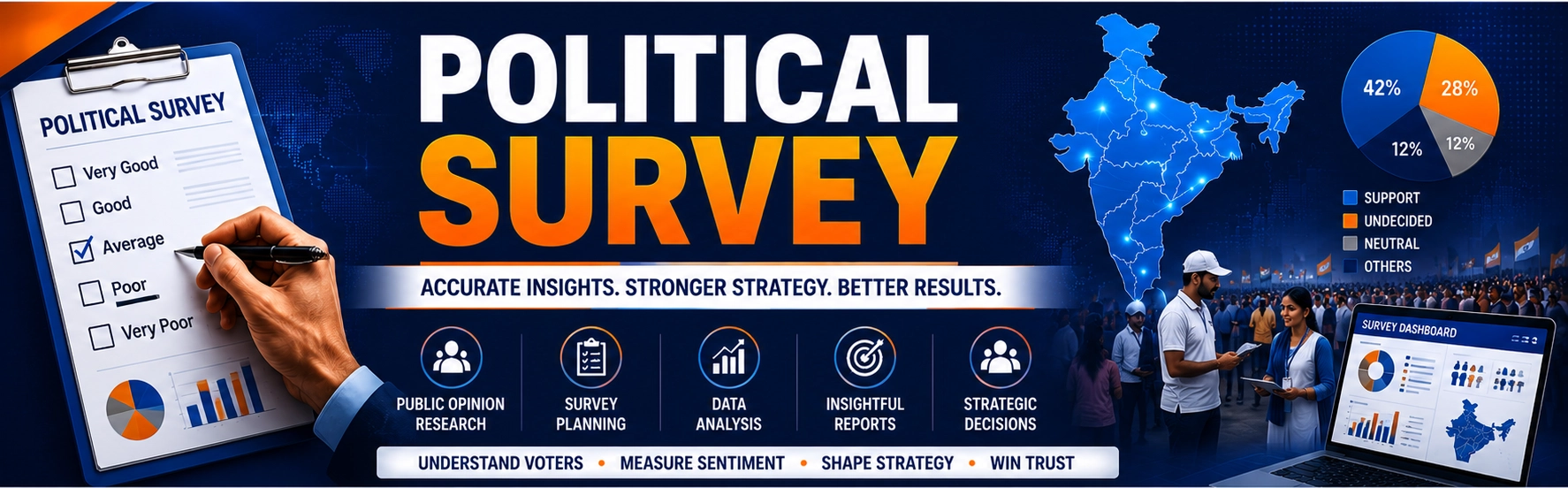
Political Survey is a systematic research process used to understand aggregate public opinion, political conditions, constituency issues, candidate assessments and election trends. Megamind combines Research + Field Operations + Data + Statistics + Technology to provide structured political and election research for political parties, candidates, prospective candidates, leaders, organizations and campaign teams.
What is a Political Survey?
A political survey is a structured research study in which a sample of respondents is asked a carefully designed set of questions about political, electoral or public issues.
The collected responses are processed and analyzed to understand aggregate patterns within the research population.
Depending on project objectives, a political survey may study:
- Current political preferences
- Candidate assessment
- Party assessment
- Leadership assessment
- Public issues
- Government-performance perceptions
- Constituency concerns
- Election awareness
- Vote-share estimates
- Political trend movement
Political survey findings are estimates from a research sample, not a record of how every voter thinks or will vote. Findings should therefore be interpreted alongside the survey dates, sample design, methodology, field quality and statistical limitations.
Why Political Surveys are Important
Election campaigns often receive information from local workers, public meetings, social media, news coverage and informal conversations. These sources can provide useful observations but may not represent the broader constituency.
Political surveys provide a more structured research method by using defined questions, sample design and analytical procedures.
- Measure current public opinion
- Understand important constituency issues
- Evaluate candidate awareness and assessment
- Study broader political trends
- Compare changes between survey periods
- Support constituency research
- Provide structured analytical evidence
- Reduce dependence on anecdotal information
Our Political Survey Services
Pre-Election Survey
Structured research conducted before polling to study current public opinion and election-related conditions.
Opinion Poll
Sample-based measurement of current political preferences, candidate assessments and public issues.
Constituency Survey
Research designed around a specific constituency and its electoral, geographic and public-issue context.
Candidate Assessment
Aggregate research into candidate awareness, public assessment and relevant political indicators.
Public Issue Research
Structured measurement of local and broader public concerns relevant to the research geography.
Leadership Assessment
Survey-based aggregate assessment of political leadership and public perceptions.
Vote Share Research
Survey-based estimation of aggregate party or candidate preference during the research period.
Trend Analysis
Comparison of comparable survey findings across time to study movement and stability.
Research Reporting
Detailed analytical reports containing methodology, findings, charts, comparisons and research limitations.
Our Political Survey Methodology
Professional political research requires a documented methodology from the initial research question through final reporting.
Understanding the Constituency Before Survey Design
Survey design should begin with a basic understanding of the constituency rather than using exactly the same sample structure everywhere.
Election Geography
Constituency boundaries, polling areas and relevant administrative geography.
Historical Elections
Previous results, vote share, turnout and winning margins.
Public Issues
Local civic, development, governance and constituency concerns.
Urban-Rural Context
Geographic differences relevant to research and field operations.
Survey Feasibility
Accessibility, field logistics and operational requirements.
Reporting Level
Determine whether findings are required at constituency or broader aggregate level.
Sampling in Political Surveys
Political surveys use samples because interviewing every elector is generally impractical.
A sample should be designed around the research objective and geography so that the final dataset can support meaningful aggregate analysis.
Sampling design may consider:
- Constituency geography
- Urban and rural distribution
- Polling-area coverage
- Population distribution
- Required reporting level
- Field feasibility
- Survey mode
- Expected response rates
- Sample allocation
- Statistical precision
The purpose of aggregate survey design is to understand broader patterns—not to create individual political profiles.
Sample Size and Survey Reliability
A larger sample can reduce sampling uncertainty under appropriate conditions, but sample size alone does not determine research quality.
A political survey can still be misleading if a large sample is collected from an unbalanced or biased selection of respondents.
Reliability also depends on:
- Sampling framework
- Geographic coverage
- Questionnaire design
- Survey timing
- Field execution
- Non-response
- Data validation
- Weighting methodology
Designing a Professional Political Survey Questionnaire
Questionnaire design is one of the most important parts of political survey research because wording can influence respondent answers.
A questionnaire should be:
- Clear and easy to understand
- Neutral in wording
- Relevant to the research objective
- Organized logically
- Appropriate in length
- Consistent across interviewers
- Suitable for field conditions
- Designed to minimize unnecessary personal data
Leading or loaded political questions should be avoided because they can distort survey responses.
Political Survey Data Collection Methods
Face-to-Face Surveys
Structured interviews conducted by trained field investigators.
Door-to-Door Research
Geographic field research conducted under a structured sampling and interview protocol.
Telephonic Surveys
Structured interviews using an appropriate telephone survey framework.
Digital Data Collection
Mobile or tablet-based questionnaires used by field teams.
Mixed-Mode Research
Combination of suitable methods where research design requires multiple collection channels.
Repeat Surveys
Comparable survey waves used to study changes in aggregate opinion over time.
Field Survey Team Management
Even a strong questionnaire and sample plan can produce poor research if field execution is inconsistent.
Field survey management may include:
- Investigator recruitment
- Survey training
- Questionnaire briefing
- Area allocation
- Supervisor assignment
- Field progress monitoring
- Daily reporting
- Quality checks
- Issue escalation
- Survey completion review
Survey Data Validation & Quality Checks
Raw survey records should be checked before analytical conclusions are produced.
Data validation may include:
- Missing-response checks
- Duplicate-record checks
- Interview-duration review
- Geographic coverage review
- Investigator-level pattern analysis
- Logical consistency checks
- Incomplete questionnaire review
- Sample progress monitoring
- Data-coding verification
- Cleaning documentation
Identifying Important Public Issues
Political survey research can go beyond voting-intention questions and measure public concerns across a constituency.
Depending on the survey scope, issue research may cover:
- Roads and local infrastructure
- Water and sanitation
- Electricity and public utilities
- Education
- Healthcare
- Employment
- Agriculture-related concerns
- Public services
- Local development
- Administrative issues
Candidate Assessment Through Political Surveys
Political surveys can measure aggregate public assessments of candidates using structured questions.
Candidate research may examine:
- Candidate awareness
- Public familiarity
- Leadership assessment
- Accessibility perceptions
- Public-record awareness
- Issue-related assessments
- Overall survey-based evaluation
Findings should be presented as aggregate survey results and should not be treated as assessments of individual voters.
Vote Share Estimation
If the questionnaire includes a current voting-intention question, survey responses can be used to estimate aggregate party or candidate preference during the survey period.
These figures represent survey estimates rather than official vote share and may change before polling day.
Learn more: What is Vote Share Analysis?
Political Survey & Election Trend Analysis
A single survey provides one snapshot. Multiple surveys conducted using comparable methodology can help identify whether aggregate opinion appears stable or is changing.
Survey trend analysis may compare:
- Vote-share estimates
- Candidate assessment
- Leadership assessment
- Party assessment
- Public issue priorities
- Government-performance assessment
Political Survey vs Opinion Poll
Political Survey
Can cover broader election research including constituency issues, candidate assessment, public opinion, political trends and electoral analysis.
Opinion Poll
Primarily measures current aggregate public opinion and voting intention during a defined survey period.
Explore: Opinion Poll Services
Political Survey, Opinion Poll & Exit Poll
These research types can serve different purposes during an election cycle.
Political Survey
Broad election and constituency research that can be conducted at different stages.
Opinion Poll
Pre-election snapshot of current public opinion and voting intention.
Exit Poll
Post-vote sample survey used to estimate aggregate voting patterns after respondents have voted.
Booth-Level & Polling-Area Survey Research
Political research may be geographically organized around polling areas where the research design and sample support this level of study.
Polling-area research can be integrated with:
- Historical election results
- Aggregate turnout
- Vote-share trends
- Polling-area geography
- Public issue findings
- Field observations
Small samples should not be over-interpreted, and polling-area findings should not be used to infer how specific individuals vote.
Related service: Booth Management
How Reliable are Political Surveys?
There is no universal accuracy level for every political survey.
Several factors can influence research findings:
Sampling Error
A sample may differ from the broader population by chance.
Coverage Error
Parts of the intended research population may be underrepresented.
Non-Response
People who decline participation may differ from participants.
Question Effects
Question wording and order can influence survey responses.
Field Quality
Inconsistent interviewing can introduce additional research error.
Political Change
Public opinion can change after the survey fieldwork ends.
Baseline Surveys & Tracking Surveys
Political surveys can be conducted once or repeated across the election cycle.
Baseline Survey
Establishes an initial research benchmark for public opinion, candidate assessment, issues and election trends.
Tracking Survey
Repeats comparable research to understand changes in aggregate public opinion over time.
Tracking research is most useful when questionnaire design, sampling approach and reporting methods remain sufficiently comparable across survey waves.
Technology in Political Survey Research
Digital Questionnaires
Mobile survey forms support structured data collection.
Central Database
Research records can be organized in a centralized data system.
Field Monitoring
Dashboards can support operational monitoring of survey progress.
Quality Checks
Digital validation can flag incomplete or unusual survey records.
Statistical Analysis
Analytical systems can support weighting, comparisons and aggregate estimation.
Visualization
Charts and dashboards make complex survey findings easier to interpret.
Role of AI in Political Survey Analysis
AI-assisted systems can support some parts of research processing, but they do not replace sound survey methodology or professional statistical review.
Appropriate applications may include:
- Data-quality screening
- Anomaly detection
- Open-response categorization
- Trend summarization
- Report summarization
- Visualization assistance
Research conclusions should remain subject to human methodological and analytical review.
Survey Privacy, Security & Data Governance
Political research can involve sensitive opinions and should use appropriate privacy and data-governance practices.
- Clear research purpose
- Appropriate respondent participation practices
- Minimal necessary data collection
- Secure digital data capture
- Role-based data access
- Survey confidentiality
- Aggregate analytical reporting
- Secure data storage
- Controlled data exports
- Avoid unnecessary individual political profiling
Political Survey Reports & Deliverables
Survey reporting should explain both the findings and how those findings were produced.
Depending on project scope, reports may include:
- Executive research summary
- Survey methodology
- Sample details
- Survey dates
- Candidate assessment
- Party assessment
- Public issue analysis
- Vote-share estimates
- Constituency-level findings
- Trend comparison
- Charts and dashboards
- Research limitations
Benefits of Professional Political Survey Research
- Structured measurement of public opinion
- Constituency issue research
- Candidate assessment
- Vote-share estimation
- Election trend analysis
- Historical and current comparison
- Evidence-based research reporting
- Repeat survey comparison
- Better research documentation
- Data-supported decision-making
Megamind's Political Survey Approach
Megamind treats political surveying as an integrated Research + Sampling + Field Operations + Data Quality + Statistical Analysis + Election Intelligence process.
Our broad framework can follow:
Research Objective → Constituency Understanding → Historical Election Review → Sampling Design → Questionnaire Design → Field Team Training → Survey Execution → Data Validation → Statistical Analysis → Candidate & Issue Research → Vote Share Analysis → Election Trend Analysis → Reporting → Continuous Research Review
The exact methodology depends on election type, constituency, geography, research objective, sample design, reporting level and field feasibility.
Explore Complete Election Services →Political Survey Services Across India
Megamind undertakes political survey and election research projects across India according to project requirements and field feasibility.
Research can be designed for:
- Lok Sabha constituencies
- Vidhan Sabha constituencies
- Municipal elections
- Local body elections
- State-level political studies
- Multi-constituency research
- Baseline election surveys
- Tracking political surveys
FAQs About Political Survey Services
1. What is a Political Survey?
A political survey is structured sample-based research used to measure aggregate public opinion, candidate assessments, public issues and election trends.
2. Why are political surveys important?
They provide structured research evidence about public opinion, political conditions and constituency issues.
3. What methods can be used?
Methods may include face-to-face surveys, field research, telephonic surveys and technology-assisted data collection.
4. Can you conduct constituency-level surveys?
Yes, where the sampling design and project scope support constituency-level aggregate reporting.
5. How reliable are political surveys?
Reliability depends on sampling, questionnaire design, field execution, response patterns, validation and statistical analysis.
6. Can a survey predict exact election results?
No. Surveys are estimates and cannot guarantee a future election result.
7. Can political surveys measure vote share?
Current aggregate voting intention can be estimated where the questionnaire and methodology support such analysis.
8. Can surveys identify important local issues?
Yes. Structured questionnaires can measure aggregate public views on local and broader issues.
9. What is the difference between political survey and opinion poll?
Political surveys can have a broader research scope, while opinion polls primarily measure current public opinion or voting intention.
10. Can booth-level research be conducted?
Research can be geographically organized around polling areas where the design supports it, but small samples should not be over-interpreted.
11. What is a tracking political survey?
It is repeated comparable research used to study changes in aggregate public opinion across time.
12. Does Megamind use digital survey tools?
Digital tools can support structured field data collection, quality control, monitoring and reporting.
13. How is political survey data protected?
Appropriate research projects should use secure data handling, controlled access, confidentiality and aggregate reporting practices.
14. Does Megamind conduct surveys across India?
Megamind undertakes political survey projects across India depending on project scope and field feasibility.
15. How can I discuss a political survey project?
Contact Megamind with the election, geography, research objective, expected sample coverage and reporting requirements.