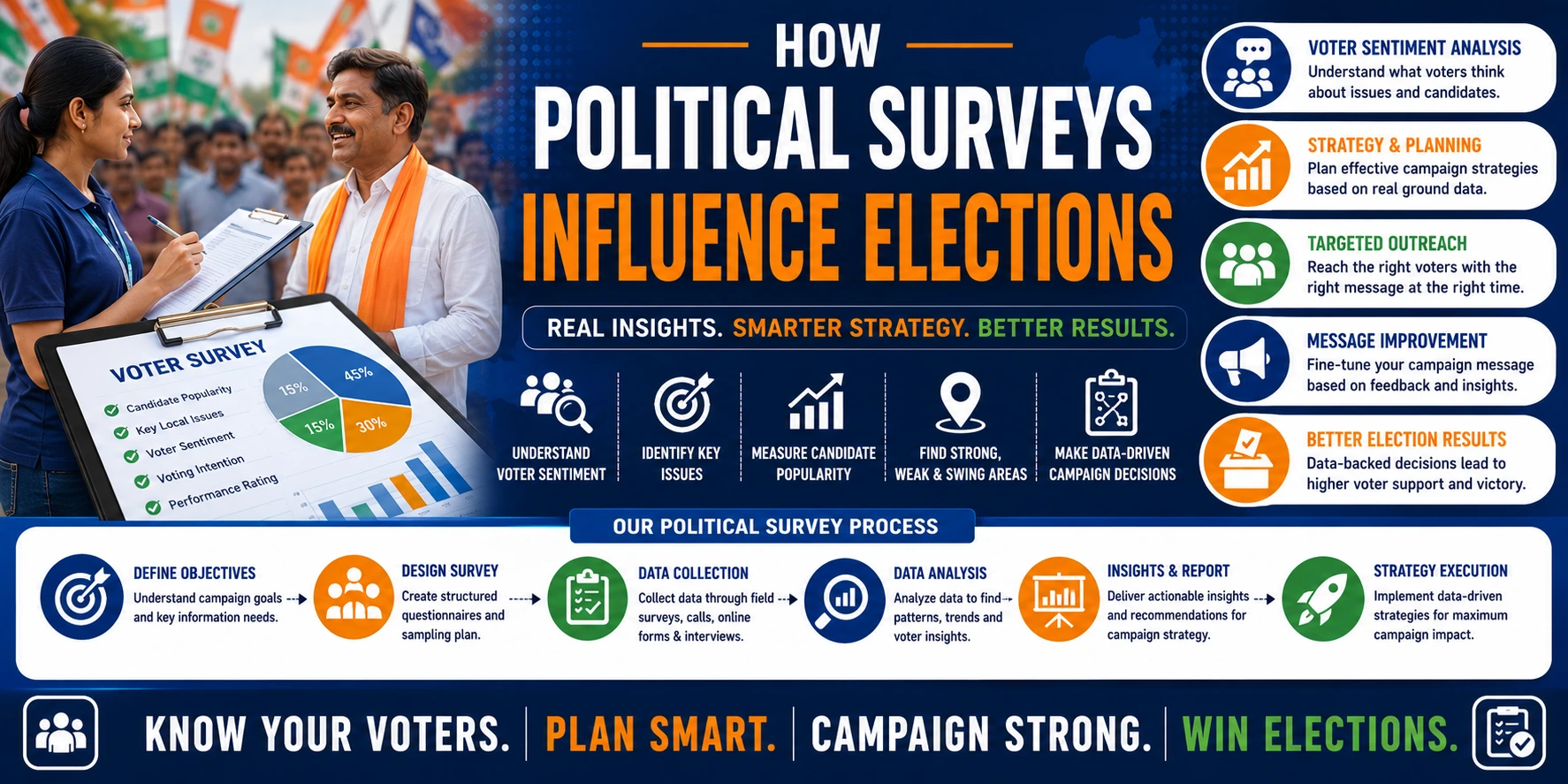
Political surveys have become an important part of modern election research because they provide a structured way to measure public opinion, local issues, candidate awareness, candidate evaluations and electoral trends at a particular point in time. Instead of depending entirely on assumptions, informal reports or isolated feedback, a professionally designed political survey uses systematic sampling, structured questionnaires, trained fieldwork, data validation and statistical analysis to create an evidence base for understanding the political environment. Surveys do not determine an election result. Their real value lies in helping political organizations understand what the available research is showing, where uncertainty remains and which questions require additional investigation.
What is a Political Survey?
A political survey is a structured research process used to collect and analyze responses about political or election-related questions.
Depending on the objective, political surveys may study:
- Public opinion
- Local and constituency issues
- Candidate awareness
- Candidate evaluations
- Political attitudes
- Public-service concerns
- Stated voting intention
- Changes in opinion over time
- Historical and current electoral trends
- Campaign feedback in aggregate
Learn more in our detailed guide: What is Political Survey and How It Works in India .
Why Political Surveys Matter in Elections
Elections generate a large amount of information from public meetings, field teams, media, social platforms, local representatives, historical results and direct citizen interactions.
The challenge is separating anecdotal impressions from information collected through a defined research process.
Political surveys can help:
- Measure public opinion systematically
- Identify frequently reported local issues
- Study candidate awareness and evaluation
- Compare findings across geographic areas
- Observe changes between survey waves
- Provide evidence for constituency research
- Test assumptions against field data
- Identify areas requiring further research
- Support structured internal planning
- Create documented research reports
The strongest value of a political survey is not that it “predicts” what will happen, but that it creates a measurable snapshot of selected political and public-opinion indicators during a defined research period. That snapshot can then be compared with historical data, field intelligence and later survey waves.
How Political Surveys Influence Election Planning
Political surveys can influence election planning indirectly by improving the information available to decision-makers.
Their role can be understood through six broad research functions:
Public Opinion Measurement
Provides structured measurements of selected public opinions during the survey period.
Issue Identification
Helps document which local and public issues are frequently reported by respondents.
Candidate Assessment
Measures candidate awareness, evaluation and other defined research indicators.
Constituency Research
Adds structured field evidence to broader constituency analysis.
Trend Monitoring
Repeated surveys can show how measured indicators change over time.
Decision Support
Helps teams compare assumptions with structured research before making internal operational decisions.
How Political Survey Research Becomes Election Intelligence
Political Surveys Help Measure Public Opinion
One of the main uses of political surveys is to measure opinions that cannot be understood reliably from isolated conversations or online discussions alone.
A survey may ask respondents about:
- Important public issues
- Candidate awareness
- Candidate evaluation
- Satisfaction with selected public services
- Awareness of political developments
- Evaluation of public performance
- Stated voting intention where relevant
- Other defined research questions
The results provide an aggregate research view rather than a description of every individual voter.
How Surveys Identify Local Public Issues
Constituencies can contain very different public-service and development concerns. Political surveys provide a structured method for measuring how frequently respondents mention or prioritize those issues.
Common research topics can include:
- Roads and transport
- Water supply
- Electricity
- Healthcare
- Education
- Employment
- Agriculture
- Local infrastructure
- Public administration
- Other constituency-specific concerns
The purpose of issue research is to document public concerns accurately and provide evidence for further analysis and public communication.
Political Surveys and Candidate Assessment
Surveys can measure defined candidate-related indicators without relying only on internal campaign impressions.
Research questions may examine:
- Candidate awareness
- Name recognition
- Public evaluation
- Awareness of public work
- Perceived accessibility
- Issue-related evaluations
- Changes between survey waves
Candidate-assessment research should use clear and neutral questions. Its purpose is to measure public responses rather than create a predetermined conclusion.
Survey findings may help a candidate or organization identify factual communication gaps, questions requiring clarification and areas where greater public accessibility or transparency may be useful.
Political Surveys Strengthen Constituency Research
A constituency cannot be understood from a single dataset. Comprehensive research may combine:
- Political survey findings
- Historical election results
- Aggregate electoral data
- Geographic information
- Local issue research
- Public infrastructure information
- Field observations
- Earlier survey waves
This creates a broader evidence base for understanding the constituency while preserving the limitations of each source.
Geographic Patterns in Political Survey Data
Political survey responses can be compared across appropriately defined geographic units when the sample design supports that level of analysis.
Geographic comparison may help researchers understand:
- Variation in reported local issues
- Differences in candidate awareness
- Variation in public-service evaluations
- Changes across survey waves
- Areas requiring additional field research
- Differences between urban and rural research areas
Small sample sizes should not be interpreted as precise micro-geographic measurements when the methodology does not support such conclusions.
Political Surveys and Booth-Level Analysis
Polling-area information can be useful for organizing field research and comparing aggregate historical election patterns.
Survey and electoral data may support:
- Geographic field planning
- Survey coverage monitoring
- Historical turnout comparison
- Aggregate election-result analysis
- Issue mapping
- Field-team coordination
- Operational reporting
Polling-station numbers, boundaries and voter allocation can change between elections. Historical booth data should therefore be verified before comparison.
Campaign-side booth research and coordination should also be distinguished from official polling-station administration. Electoral rolls, polling personnel, voting procedures, security and the formal conduct of polling are functions of the relevant election authorities.
How Tracking Surveys Show Change Over Time
A single survey provides a snapshot. Repeated surveys can provide a time series.
Baseline Survey → Tracking Wave 1 → Tracking Wave 2 → Later Pre-Election Survey
Tracking surveys can compare:
- Issue priorities
- Candidate awareness
- Candidate evaluations
- Public-service perceptions
- Stated voting intention where measured
- Other consistent research indicators
Maintaining comparable methodology is important. If the sample, questionnaire or collection mode changes substantially, apparent movement may partly reflect methodology rather than actual opinion change.
Role of Opinion Polls in Political Survey Research
An Opinion Poll is one form of political survey. It is generally designed to measure public opinion or stated political preferences before an election.
Opinion polls can provide information about:
- Current stated preferences
- Public issue priorities
- Candidate awareness
- Candidate evaluations
- Changes between polling waves
Opinion-poll findings represent the period in which the survey was conducted. Public opinion may subsequently change.
Read the complete guide: What is Opinion Poll and How It Works in India .
Exit Polls as a Specialized Survey Method
Exit polls differ from ordinary pre-election political surveys because selected respondents are approached after they have voted.
Exit polls can be used to estimate aggregate voting patterns from survey responses, but they remain survey-based estimates rather than official election results.
Learn more: What is Exit Poll and How It Works in India .
How Survey Data Supports Election Analysis
Survey data becomes more useful when it is validated, analyzed and interpreted within the correct methodological context.
Analysis may include:
- Response distributions
- Issue rankings
- Candidate-awareness measures
- Candidate-evaluation indicators
- Aggregate geographic comparisons
- Survey-wave comparisons
- Vote-preference estimates where surveyed
- Trend analysis
- Uncertainty assessment
These findings should be considered alongside the sample design, survey dates, data-collection method and known limitations.
Combining Political Surveys with Historical Election Data
Current survey findings can be studied alongside historical election information to provide context.
Historical analysis may include:
- Past vote share
- Historical winning margins
- Turnout patterns
- Party performance over time
- Candidate history
- Aggregate geographic patterns
Historical results describe what happened in previous elections; surveys describe measured responses during the current research period. Neither should automatically be treated as a guaranteed forecast.
Political Surveys and Data-Driven Decision-Making
Survey findings can improve internal decision-making by replacing some assumptions with measurable evidence.
For example, research can help an organization determine:
- Which issues require additional investigation
- Where field information is incomplete
- Whether candidate awareness has changed
- Whether public concerns differ geographically
- Whether previous assumptions are supported by research
- Whether another survey wave is required
- Which operational questions need management attention
Research does not replace political judgment, field experience or legal and operational considerations. It adds another evidence source to the decision-making process.
How Political Surveys Support Public Communication
Survey research can identify public issues and information gaps that may require clearer factual communication.
For example, if respondents repeatedly report confusion about a public policy, local project or candidate's publicly documented work, the organization may decide that accurate explanatory information is needed.
Survey research should not be treated as a tool for manipulating individual voters. Responsible use focuses on understanding aggregate public concerns and improving the accuracy, clarity and relevance of official public communication.
Political Surveys and Public Relations
Public-relations teams can use aggregate research findings to better understand which public questions require clarification and which issues are receiving significant public attention.
Survey-informed PR can support:
- Issue briefing documents
- Media preparation
- Fact sheets
- Public statements
- Candidate briefing
- Frequently asked questions
- Documentation of public concerns
- Consistent factual communication
Research findings should be represented accurately and should not be presented in a misleading way.
Political Survey Research and Digital Communication
Survey findings can help digital teams understand broad public issues and questions that may need factual explanation through official campaign channels.
Research may inform:
- Issue explainers
- Public-information posts
- Candidate activity updates
- Frequently asked questions
- Video explainers
- Website information
- Fact-checking material
- Public event information
Digital communication should follow applicable platform rules, election requirements, privacy principles and internal approval processes.
Political Surveys and Field Operations
Political surveys can also improve field operations by showing where research coverage is incomplete or where additional public-issue information is required.
Survey-based field planning may support:
- Area-wise research schedules
- Survey-team deployment
- Coverage monitoring
- Field quality checks
- Issue verification
- Additional qualitative research
- Coordinator reporting
- Follow-up research waves
Political Survey Data vs General Campaign Feedback
Political Survey Data
Collected through a defined sample, standardized questionnaire, documented methodology and structured analytical process.
General Field Feedback
Observations received from field teams, meetings, public interactions and local campaign operations. Useful for context, but not automatically representative.
Both can be valuable, but they answer different questions and should not be treated as interchangeable forms of evidence.
Why One Political Survey May Not Be Enough
Elections are dynamic. Public issues, political developments, candidate announcements, media events and other developments may change the environment after a survey has been completed.
Depending on the research objective, organizations may use multiple survey waves.
Baseline Research → Analysis → Field Verification → Tracking Survey → Comparative Analysis → Updated Reporting
Repeated research is most useful when key methodology remains sufficiently comparable between waves.
Accuracy and Reliability of Political Surveys
No political survey can promise perfect accuracy.
Survey reliability can be affected by:
- Sampling design
- Sample coverage
- Sample size
- Non-response
- Question wording
- Interviewer effects
- Field execution
- Data validation
- Weighting methodology
- Survey timing
- Changes in opinion after fieldwork
Survey findings should therefore be interpreted as research estimates or measurements associated with a particular methodology and period.
Margin of Error is Not the Same as Total Survey Error
A reported margin of error generally describes sampling uncertainty under specified assumptions.
It does not automatically include:
- Coverage problems
- Non-response bias
- Question wording effects
- Field errors
- Processing errors
- Model assumptions
- Opinion changes after data collection
Professional interpretation should therefore look beyond a single margin-of-error number.
Role of Technology in Modern Political Surveys
Technology can improve the speed, consistency and manageability of large survey projects.
Modern systems may support:
- Mobile survey applications
- Digital questionnaires
- Survey progress dashboards
- Field-team monitoring
- Automated validation rules
- Centralized data storage
- Quality-control alerts
- Charts and reporting dashboards
- Survey-wave comparison
Technology supports research methodology; it does not replace it.
AI-Assisted Analysis in Political Surveys
AI-assisted tools can support selected analytical and operational tasks when used with appropriate human review.
Examples include:
- Open-ended response classification
- Text summarization
- Translation assistance
- Data-quality flagging
- Research-document organization
- Pattern exploration
- Dashboard support
AI cannot correct a fundamentally poor sample or biased questionnaire, and it should not be presented as guaranteeing an election forecast.
Privacy and Data Governance in Political Surveys
Political research can involve information that requires careful handling. Data governance should therefore be part of the survey methodology from the beginning.
Good practices may include:
- Collect only necessary information
- Respect voluntary participation
- Avoid unnecessary sensitive personal profiling
- Limit access to authorized personnel
- Use secure data transmission
- Maintain appropriate access controls
- Document data-processing procedures
- Use aggregate reporting where appropriate
- Follow applicable privacy and data requirements
Major Challenges in Political Surveys
Sampling
An inappropriate or incomplete sample can produce misleading estimates.
Non-Response
People who do not participate may differ from those who do.
Question Design
Leading, unclear or poorly translated questions can distort measured responses.
Field Quality
Inconsistent interviewing or weak supervision can reduce data quality.
Changing Opinion
Public opinion may change after the survey has been completed.
Over-Interpretation
Small differences or limited samples can be given more significance than the methodology supports.
Best Practices for Using Political Survey Findings
- Review the methodology before the headline result
- Check survey dates
- Understand the sample design
- Review geographic coverage
- Consider non-response and other limitations
- Avoid treating small differences as certainty
- Compare multiple evidence sources
- Use repeated surveys for trend analysis where appropriate
- Protect respondent information
- Separate estimates from official results
- Document analytical assumptions
- Present findings accurately
Key Benefits of Political Surveys in Elections
When professionally designed and interpreted carefully, political surveys can provide several research and operational benefits.
- Structured measurement of public opinion
- Better understanding of public issues
- Evidence-based candidate assessment
- Improved constituency research
- Tracking of changes over time
- Verification of field assumptions
- Better research documentation
- Support for internal planning
- More systematic reporting
- Integration with broader election intelligence
How Professional Political Survey Services Help
Professional political survey projects require expertise across research design, field operations, technology, data quality and statistical analysis.
A professional research organization can support:
- Research-objective development
- Sampling design
- Questionnaire development
- Pilot testing
- Survey-team training
- Field deployment
- Digital data collection
- Quality monitoring
- Data validation
- Statistical analysis
- Dashboard development
- Analytical reporting
Explore Political Survey Services by Megamind .
Megamind's Political Survey & Election Intelligence Approach
Megamind combines field research, survey technology, data validation, political research and analytical reporting to build structured election-intelligence programmes.
Our political survey framework can follow:
Research Objective → Survey Design → Sampling Framework → Questionnaire → Field-Team Training → Data Collection → Quality Monitoring → Data Validation → Statistical Analysis → Research Reporting → Continuous Review
Depending on project requirements, survey findings can be integrated with Constituency Analysis, Candidate Assessment, Opinion Polls, Voter Data Analysis, Booth-Level Aggregate Analysis, Election Trend Analysis, Public Relations and Campaign Management .
Megamind provides election research and political survey support for political parties, candidates, leaders, prospective candidates, aspirants, campaign teams and political organizations across India.
Explore Political Survey Services →Political Surveys as Part of a Complete Election Research System
Political surveys are most informative when they are interpreted together with other relevant research rather than used in isolation.
Political Survey → Public Issue Research → Candidate Assessment → Constituency Analysis → Voter Data Analysis → Booth-Level Aggregate Analysis → Election Trend Analysis → Tracking Research → Analytical Reporting
This approach allows different research sources to complement one another while retaining their individual methodological limitations.
FAQs – How Political Surveys Influence Elections
1. How do political surveys influence elections?
Political surveys influence election planning by providing structured information about public opinion, local issues, candidate evaluations and electoral trends. They support research and decision-making rather than determining the election result themselves.
2. What information can a political survey provide?
Depending on its design, a survey can measure public issues, candidate awareness, candidate evaluations, public-service opinions, stated voting intention and other defined political research indicators.
3. Can political surveys predict election results?
Surveys can provide estimates and evidence about measured opinion during a particular period, but they cannot guarantee a future election result.
4. Why are political surveys better than assumptions?
A properly designed survey uses a defined sample, standardized questionnaire, field procedure and analytical methodology, making its evidence easier to evaluate than informal impressions alone.
5. How do surveys help identify local issues?
Surveys ask respondents structured questions about local concerns and allow researchers to summarize which issues are reported most frequently within the surveyed population.
6. How do political surveys help candidate assessment?
They can measure candidate awareness, recognition, public evaluation, perceived accessibility and other defined research indicators using neutral questions.
7. What is a tracking political survey?
A tracking survey repeats comparable measurements over time to observe changes in selected political or public-opinion indicators.
8. What is the role of political surveys in constituency analysis?
Surveys provide structured field evidence that can be studied alongside historical results, geography, public issues and other constituency research.
9. Are booth-level political surveys always reliable?
Reliability depends on whether the sample design supports analysis at that geographic level. Very small samples should not be over-interpreted.
10. How does technology improve political surveys?
Technology can support digital questionnaires, field monitoring, validation, centralized data management and reporting, but it does not replace sound research methodology.
11. Can AI improve political survey analysis?
AI-assisted tools can support tasks such as text classification, summarization and data-quality flagging, but human review and sound methodology remain essential.
12. What are the main limitations of political surveys?
Common limitations include sampling error, coverage problems, non-response, questionnaire effects, field variation and changes in opinion after data collection.
13. Is margin of error the total error in a political survey?
No. Margin of error generally describes sampling uncertainty under specified assumptions and does not include every possible source of survey error.
14. How should political survey data be handled?
Survey data should be handled using appropriate privacy, security, access-control, data-minimization and confidentiality practices.
15. Who can use professional political survey services?
Political parties, candidates, leaders, prospective candidates, aspirants, political organizations and campaign teams may use professional political research services according to project requirements.
Political Surveys Influence Elections Through Better Information
Political surveys influence elections primarily by improving the quality of information available to political organizations, researchers and campaign teams.
A professionally conducted survey can provide structured evidence about public opinion, local issues, candidate awareness, candidate evaluations, constituency conditions and changing electoral trends .
The value of that evidence depends on the quality of the research methodology. Sampling, questionnaire design, fieldwork, validation, statistical analysis and transparent interpretation all matter.
Political surveys should therefore be viewed not as a guarantee of electoral outcomes, but as an important component of a broader Election Intelligence and Political Research System.