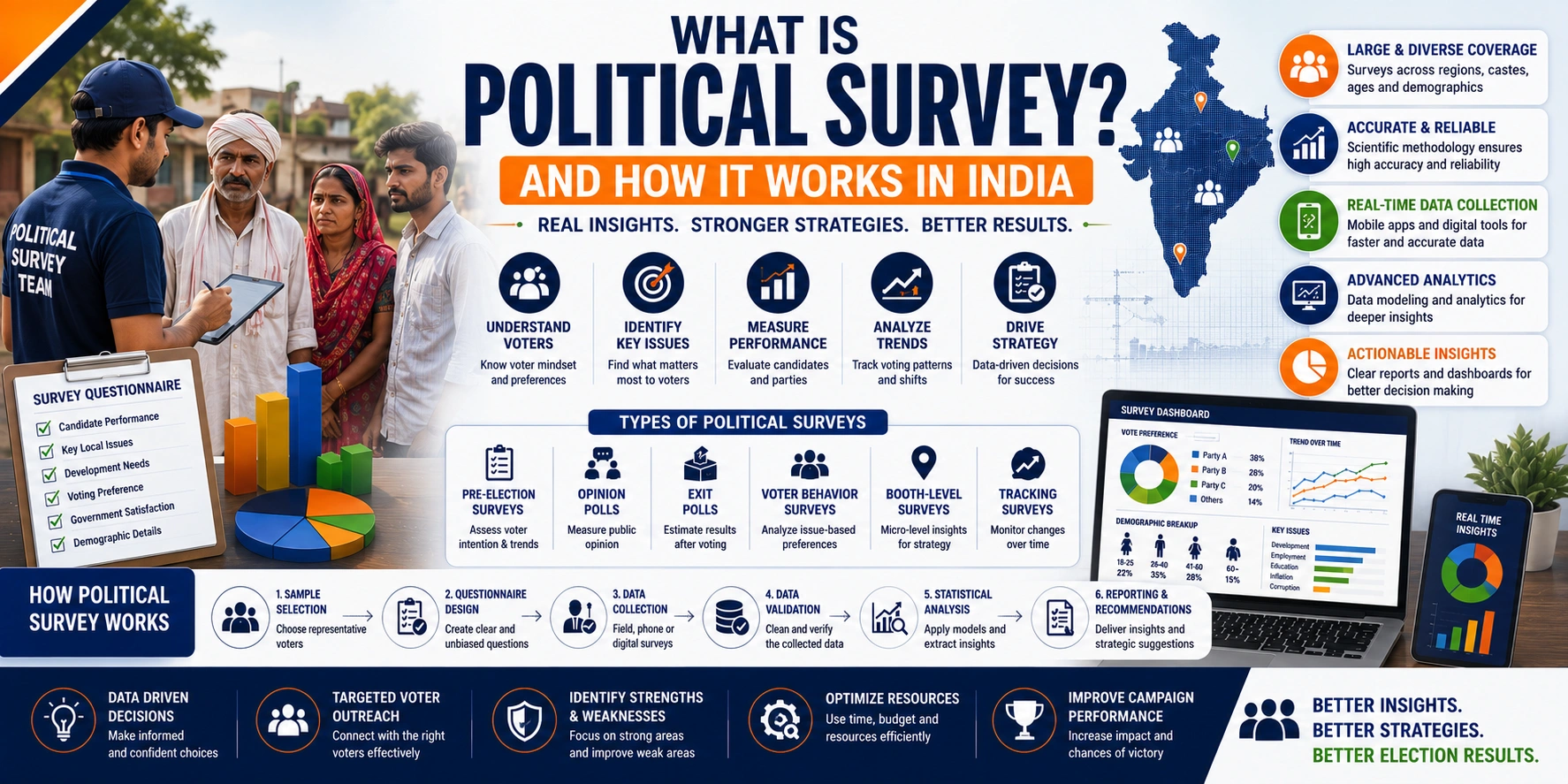
A Political Survey is a structured research process used to understand public opinion, political attitudes, constituency issues, candidate awareness, electoral trends and other questions relevant to an election or political research project. Political surveys combine research design, scientific sampling, questionnaire development, trained fieldwork, data validation, statistical analysis and structured reporting to convert collected responses into meaningful research findings. In India, political survey projects can range from a single constituency study to multi-constituency or statewide research programmes. The quality of the final findings depends not only on the number of interviews, but also on how carefully the complete research process is designed and executed.
What is a Political Survey?
A political survey is a systematic method of collecting responses from a defined sample in order to study political or election-related questions.
Depending on the research objective, a survey may study:
- Public opinion
- Constituency issues
- Candidate awareness
- Candidate evaluation
- Political attitudes
- Issue priorities
- Past voting patterns
- Voting intention at the time of survey
- Public-service concerns
- Election trend indicators
A survey does not interview every voter. Instead, researchers select a sample using a defined methodology and analyze the responses with appropriate statistical techniques.
Why Political Surveys are Different from Informal Feedback
Political organizations receive information from workers, public meetings, local representatives, social media, media reports and personal conversations. These inputs can be useful, but they are not automatically equivalent to a scientific survey.
A professional political survey uses a documented research process:
- Defined research objective
- Defined target population
- Sampling methodology
- Structured questionnaire
- Standard field procedure
- Data-quality controls
- Statistical analysis
- Documented reporting
These controls make survey findings easier to evaluate and interpret than unstructured impressions alone.
Why Political Surveys are Important
Political surveys provide a structured way to study what is happening on the ground at a particular point in time.
They can help researchers and political stakeholders:
- Understand major public issues
- Measure public awareness
- Study candidate evaluations
- Observe changes in public opinion
- Compare constituency-level findings
- Study electoral trends
- Evaluate campaign feedback in aggregate
- Identify questions requiring further field research
- Support evidence-based internal planning
- Create structured research reports
A political survey should be treated as a measurement exercise, not a guarantee of an election result. Survey findings represent responses collected from a sample during a defined period and should always be interpreted with the methodology, sample design, field conditions and uncertainty in mind.
Main Objectives of Political Surveys
Public Opinion
Measure views and attitudes on political or public issues at the time of research.
Issue Research
Understand which local or broader public issues are appearing in survey responses.
Candidate Assessment
Study awareness, public evaluation and other research indicators related to candidates.
Electoral Trends
Compare current survey findings with appropriate historical or earlier research data.
Constituency Research
Build a structured understanding of constituency-level political and public issues.
Tracking Change
Use repeated surveys to observe how measured opinion changes over time.
Types of Political Surveys
Pre-Election Survey
Research conducted before voting to measure public opinion, issues and election-related attitudes.
Opinion Poll
A structured survey designed to measure public opinion or stated voting intention at a particular time.
Tracking Survey
Repeated research used to observe changes in measured public opinion across time.
Constituency Survey
Research focused on issues, awareness, political trends and other indicators within a constituency.
Candidate Assessment Survey
Research used to study candidate awareness, evaluation and related public feedback.
Issue Survey
Focused research designed to understand public views about selected local or broader issues.
Is an Exit Poll a Political Survey?
An exit poll is also a survey-based research activity, but its timing and research question are different from a typical pre-election political survey.
Pre-Election Political Survey
Conducted before voting and may measure public opinion, issues, candidate evaluation or stated voting intention.
Exit Poll
Conducted after selected respondents have voted and asks participating respondents about their completed voting choice.
Neither should be confused with the official election result, which comes from the formal counting process.
How Political Surveys Work – Step by Step
Defining the Political Survey Objective
A survey should begin with a clear research objective. Without it, questionnaires often become too long and collect information that does not answer a defined research question.
Examples of research objectives include:
- Measure candidate awareness
- Study public issue priorities
- Measure stated voting intention
- Assess satisfaction with public services
- Study candidate evaluations
- Compare opinion across survey waves
- Understand constituency-level concerns
- Measure awareness of political developments
Each objective should be converted into measurable survey questions.
Defining the Survey Population
Researchers must define the population about which the survey intends to make observations.
Depending on the project, the geographic scope may be:
- Polling-area research
- Ward-level research
- Assembly constituency research
- Parliamentary constituency research
- District-level research
- Multi-constituency research
- State-level research
- Multi-state research
Geographic coverage should be documented clearly so that the findings are not interpreted beyond the population the survey was designed to study.
Sampling in Political Surveys
Sampling is one of the most important parts of political survey research.
Because interviewing every eligible voter is generally impractical, researchers select a subset of the population using a defined sampling approach.
A sample design may consider:
- Geographic coverage
- Urban and rural distribution
- Polling-area coverage
- Sample size
- Selection procedure
- Field feasibility
- Expected non-response
- Research budget and timeline
The sampling procedure should be documented so that the survey's representativeness and limitations can be evaluated.
How is Political Survey Sample Size Decided?
There is no single sample size that is automatically correct for every political survey.
Sample-size planning can depend on:
- Research objective
- Geographic coverage
- Required level of analysis
- Sampling design
- Expected response rate
- Desired statistical precision
- Available field resources
- Time available
A very large sample does not automatically make a survey reliable if the sample-selection process is systematically biased.
Political Survey Questionnaire Design
The questionnaire determines what information the survey actually measures.
Questions should generally be:
- Clear
- Neutral
- Easy to understand
- Relevant to the research objective
- Presented in a logical order
- Consistent across interviews
- Appropriately translated where required
- Tested before large-scale deployment
Leading or confusing questions can distort responses and reduce the usefulness of the research.
Why Pilot Testing is Important
Before a questionnaire is used at scale, a small pilot survey can identify problems that may not be obvious during questionnaire drafting.
Pilot testing can help identify:
- Questions respondents misunderstand
- Translation problems
- Missing response options
- Survey length problems
- Technical app issues
- Incorrect skip logic
- Field implementation difficulties
- Ambiguous terminology
Political Survey Fieldwork
Field execution converts the research plan into actual interviews. Even a well-designed survey can be weakened by inconsistent fieldwork.
Professional field planning may include:
- Surveyor training
- Area allocation
- Daily field schedules
- Respondent-selection instructions
- Questionnaire briefing
- Language guidance
- Data-submission procedures
- Escalation protocols
- Quality-control checks
- Field progress monitoring
Training Political Survey Field Teams
Surveyors should understand both the questionnaire and the research procedure.
Training can cover:
- Purpose of the research
- Respondent-selection method
- Question wording
- Neutral interviewing
- Use of survey application
- Handling refusals
- Privacy and confidentiality
- Field safety
- Quality requirements
- Submission procedures
Interviewers should record responses rather than influence them.
Methods of Political Survey Data Collection
Political surveys can use different modes of data collection depending on the research objective and available sampling frame.
Face-to-Face Survey
Trained interviewers conduct structured interviews in selected field locations.
Telephone Survey
Interviews are conducted remotely using an appropriate telephone sampling or contact framework.
Digital Survey
Responses are collected through online or digital survey systems where the research design supports that method.
Different collection methods can have different coverage, participation and response characteristics. These should be considered during analysis.
Mobile Apps in Political Surveys
Digital survey applications can improve field coordination and reduce manual data-entry requirements.
Depending on the project, survey systems may support:
- Digital questionnaires
- Controlled response options
- Skip logic
- Time stamps
- Survey progress monitoring
- Secure synchronization
- Supervisor dashboards
- Validation flags
- Field-team tracking at an appropriate operational level
- Centralized reporting
Technology can support research quality, but it does not replace sound sampling, questionnaire design or field supervision.
Political Survey Data Validation
Raw survey responses should generally be reviewed before analysis.
Validation procedures may examine:
- Missing responses
- Duplicate records
- Invalid response values
- Unusually short interviews
- Logical inconsistencies
- Field-team anomalies
- Location or allocation inconsistencies where applicable
- Unexpected response patterns
Validation rules should be defined carefully so that legitimate responses are not removed simply because they are unusual.
Quality Control in Political Surveys
Survey quality should be monitored throughout the project rather than checked only after fieldwork has ended.
Quality controls can include:
- Surveyor training
- Pilot testing
- Daily field monitoring
- Supervisor review
- Automated validation rules
- Sample-composition review
- Back-checking where appropriate
- Data-cleaning logs
- Version control
- Methodology documentation
Statistical Analysis of Political Survey Data
After validation, survey data can be summarized and analyzed to answer the original research questions.
Analysis may include:
- Response distributions
- Issue rankings
- Candidate-awareness measures
- Candidate-evaluation indicators
- Voting-intention estimates where surveyed
- Geographic comparisons
- Survey-wave comparisons
- Trend analysis
- Uncertainty assessment
- Research notes and interpretation
The analytical method should be appropriate to the sampling design and the questions being studied.
What is Weighting in Political Surveys?
In some surveys, researchers may apply statistical weights to adjust for known differences between the achieved sample and the intended research population or to account for aspects of the sample design.
Weighting should be methodologically justified and documented.
Excessive or poorly designed weighting can increase statistical uncertainty and should not be treated as a substitute for good sampling.
Margin of Error and Political Surveys
The term margin of error generally refers to sampling uncertainty under specified statistical assumptions.
It is important to understand that margin of error does not capture every possible source of survey error.
Other sources of uncertainty can include:
- Coverage error
- Non-response
- Question wording
- Interviewer effects
- Field execution
- Data processing
- Weighting assumptions
- Changes in opinion after the survey
How Accurate are Political Surveys?
There is no universal accuracy level that applies to every political survey.
Survey quality depends on the complete methodology, including:
- Sampling design
- Sample coverage
- Questionnaire quality
- Field execution
- Non-response
- Data validation
- Statistical treatment
- Timing of the research
Political opinions can also change after a survey is completed. Therefore, survey findings should be understood as measurements associated with a specific research period rather than guaranteed future outcomes.
Vote Share Estimation in Political Surveys
When a political survey asks respondents about voting intention, the responses may be used to estimate vote preference within the surveyed population under the chosen methodology.
A vote-share estimate is a survey-based statistical estimate, not an official election result.
Its interpretation should consider:
- Sample design
- Survey timing
- Non-response
- Undecided responses
- Weighting methodology
- Sampling uncertainty
- Other survey limitations
Political Survey and Election Trend Analysis
Political survey findings can be studied alongside historical electoral information and earlier survey waves to understand changes over time.
However, an observed trend is not automatically a prediction.
For a detailed explanation, see What is Election Trend Analysis?
Political Surveys for Constituency Analysis
Constituency-level political surveys can be combined with geographic, historical and field information to create a broader research view of the constituency.
Research may examine:
- Major public issues
- Candidate awareness
- Candidate evaluations
- Public-service concerns
- Historical election trends
- Geographic variation in aggregate survey findings
- Changes between survey waves
- Field observations
Survey results should be interpreted with other relevant evidence rather than treated as a complete description of the constituency.
Political Surveys and Booth-Level Analysis
Polling-area or booth-related geographic information can be useful for organizing field research and comparing aggregate electoral patterns.
Research teams should remember that polling-station numbers, boundaries and voter allocation may change between elections.
Therefore, historical booth data should be verified and mapped carefully before comparison with current research.
Learn more about Booth Management and election field operations.
Issue Analysis in Political Surveys
Political surveys can help measure which public issues respondents identify as important within a defined research area.
Examples may include:
- Roads and transport
- Water supply
- Electricity
- Education
- Healthcare
- Employment
- Agriculture
- Local infrastructure
- Public administration
- Other constituency-specific issues
Survey findings can help document the frequency and geographic distribution of issues reported by respondents.
Candidate Assessment Through Political Surveys
Candidate-related survey questions can study measurable public indicators such as:
- Candidate awareness
- Recognition
- Public evaluation
- Perceived accessibility
- Awareness of public work
- Issue-related evaluations
- Comparisons across survey waves
Candidate research should use neutral questions so that the questionnaire itself does not push respondents toward a particular answer.
What is a Political Tracking Survey?
A tracking survey repeats comparable measurements over time.
For example:
Baseline Survey → Survey Wave 2 → Survey Wave 3 → Final Pre-Election Research
Keeping key questions and methodology reasonably consistent helps researchers distinguish actual movement from differences created by changing the research design.
Political Survey vs Opinion Poll
Political Survey
A broad category of political research that can examine issues, candidate awareness, evaluations, public services, political attitudes and other research questions.
Opinion Poll
A type of survey focused specifically on measuring public opinion, often including stated political or voting preferences at a particular time.
Learn more: What is Opinion Poll?
Political Survey vs Exit Poll
Political Survey
Usually conducted to study political opinions, issues, evaluations or other election-related questions, often before voting.
Exit Poll
Conducted after selected respondents have cast their votes and asks participating respondents about their completed vote.
Learn more: What is Exit Poll?
Political Survey vs Official Election Result
A political survey measures responses from a sample. An official election result is determined through the formal election and counting process.
Survey estimates, opinion polls and exit polls should therefore not be described as official results.
Political Survey Reporting
A useful political survey report should explain both the findings and the methodology behind them.
Depending on the project, reporting may include:
- Research objective
- Survey dates
- Geographic coverage
- Sample size
- Sampling approach
- Data-collection mode
- Key findings
- Issue analysis
- Candidate-related indicators
- Trend comparisons
- Charts and dashboards
- Methodological limitations
Political Survey Dashboards
Digital dashboards can help research and management teams review field progress and aggregate survey findings.
A dashboard may display:
- Completed interviews
- Geographic coverage
- Field progress
- Validation status
- Issue findings
- Candidate-awareness measures
- Aggregate survey responses
- Survey-wave comparisons
- Quality-control alerts
- Research summaries
Dashboards are reporting tools; the underlying methodology remains essential to interpreting the displayed numbers.
Role of AI in Political Survey Analysis
AI-assisted analytical tools can support some research tasks, particularly where survey projects generate large volumes of structured or open-ended information.
Possible uses include:
- Open-ended response classification
- Text summarization
- Data-quality flagging
- Research-document organization
- Translation assistance
- Pattern exploration
- Dashboard support
AI should not be treated as a guarantee of survey accuracy or election prediction. Research design, data quality and human analytical review remain essential.
Privacy and Data Governance in Political Surveys
Political survey research can involve information that requires careful handling.
Good research-data practices can include:
- Collect only information necessary for the research
- Explain participation appropriately
- Respect voluntary participation
- Avoid unnecessary sensitive personal profiling
- Restrict access to survey data
- Use secure data-transfer systems
- Maintain appropriate data-quality records
- Report findings in aggregate where appropriate
- Follow applicable privacy and data requirements
Confidentiality in Political Survey Research
Respondents may be more comfortable participating when they understand how their information will be handled.
Research teams should avoid unnecessary disclosure of individual survey responses and should use access controls appropriate to the project.
Analytical reporting can generally focus on aggregate findings rather than identifying individual respondents.
Challenges and Limitations of Political Surveys
Sampling Error
A sample may differ from the wider population simply because only part of the population is interviewed.
Coverage Error
Some parts of the intended population may be harder to reach through the chosen survey method.
Non-Response
People who decline to participate may differ from those who complete the survey.
Question Effects
Wording, order or translation of questions can influence measured responses.
Field Variation
Inconsistent interview procedures can introduce additional survey error.
Changing Opinion
Public opinion can change after data collection has been completed.
Best Practices for Political Surveys
- Start with a clear research objective
- Define the target population
- Use an appropriate sampling method
- Keep questions neutral
- Pilot test the questionnaire
- Train field teams thoroughly
- Monitor fieldwork continuously
- Validate collected data
- Document weighting and analysis methods
- Report methodological limitations
- Protect respondent information
- Distinguish survey estimates from official results
Why Use Professional Political Survey Services?
Large political survey projects require coordination across research, field operations, technology, data management, quality control and statistical analysis.
A professional survey organization can support:
- Research design
- Sampling framework
- Questionnaire development
- Survey application configuration
- Field-team recruitment and training
- Field deployment
- Quality monitoring
- Data validation
- Statistical analysis
- Dashboard development
- Analytical reporting
- Survey documentation
Explore Megamind Political Survey Services for professional survey and election-research requirements.
Megamind's Approach to Political Surveys
Megamind approaches political surveys as a complete research, fieldwork, technology, data-quality and analytical reporting system rather than simply a data-collection exercise.
Depending on the research requirement, our framework can follow:
Research Objective → Survey Design → Sampling Framework → Questionnaire Development → Pilot Testing → Field-Team Training → Digital Data Collection → Quality Monitoring → Data Validation → Statistical Analysis → Analytical Reporting
Survey findings can be integrated with Constituency Analysis, Election Trend Analysis, Candidate Assessment, Opinion Poll Research, Voter Data Analysis, Booth-Level Aggregate Analysis and Election Campaign Management according to project requirements.
Megamind provides political survey and election-research support for political parties, candidates, leaders, prospective candidates, aspirants, campaign teams and political organizations across India.
Explore Political Survey Services →Political Survey Services Across India
Political survey methodology can be applied to different election contexts across India, including parliamentary, assembly, municipal and other electoral research projects.
Survey execution may require different field structures depending on:
- State
- Constituency size
- Urban-rural geography
- Language requirements
- Transport and field accessibility
- Survey mode
- Research timeline
- Required sample coverage
Megamind's election research and political survey services can support projects in Uttar Pradesh, Punjab, Delhi, Haryana, Rajasthan, Bihar, Madhya Pradesh, Maharashtra, Gujarat, Uttarakhand and other regions across India according to project requirements.
Political Surveys Within Election Intelligence
Political surveys become more useful analytically when their findings are studied alongside other appropriate election research.
Political Survey → Public Issue Research → Constituency Analysis → Candidate Assessment → Opinion Poll → Voter Data Analysis → Booth-Level Aggregate Analysis → Election Trend Analysis → Analytical Reporting
Each research component answers different questions. Combining them can provide a broader evidence base while preserving the methodological limitations of each source.
FAQs About Political Surveys
1. What is a political survey?
A political survey is a structured research process used to collect and analyze sample responses about political opinions, public issues, candidate evaluations and other election-related questions.
2. Why are political surveys conducted?
They are conducted to measure public opinion, study issues, evaluate political indicators and create structured evidence for research and decision-making.
3. How is a political survey conducted?
A typical process includes research design, sampling, questionnaire development, fieldwork, validation, statistical analysis and reporting.
4. What is sampling in a political survey?
Sampling is the process of selecting a subset of the defined population for interview using a specified research methodology.
5. How large should a political survey sample be?
The appropriate sample size depends on the research objective, geographic scope, sampling design, desired precision and other methodological considerations.
6. Are political surveys always accurate?
No. Survey findings are estimates or measurements based on a sample and can be affected by sampling, non-response, questionnaire design, fieldwork, processing and changes in public opinion.
7. What is the difference between a political survey and an opinion poll?
Political survey is a broader research category, while an opinion poll generally focuses specifically on measuring public opinion or stated preferences at a particular time.
8. What is the difference between an opinion poll and an exit poll?
Opinion polls are conducted before voting, while exit polls survey selected respondents after they have voted.
9. Can a political survey predict an election result?
A survey may provide estimates or evidence about measured opinion at the time of research, but it cannot guarantee a future election result.
10. What is a tracking survey?
A tracking survey repeats comparable research over time to observe changes in measured public opinion or other indicators.
11. What is political survey data validation?
Data validation is the process of checking collected survey records for completeness, consistency, duplication, invalid values and other quality concerns.
12. What is weighting in a political survey?
Weighting is a statistical adjustment sometimes used to account for aspects of the sample design or known differences between the achieved sample and the intended research population.
13. What is margin of error in political surveys?
Margin of error generally describes sampling uncertainty under specified statistical assumptions. It does not represent every possible source of survey error.
14. Can political surveys be conducted digitally?
Yes. Digital systems can support questionnaire administration, data collection, validation and reporting where the research design is suitable for that method.
15. How is respondent privacy handled?
Good survey practice uses appropriate data minimization, access controls, confidentiality procedures and aggregate reporting, subject to the project's requirements and applicable rules.
16. Who can use professional political survey services?
Political parties, candidates, leaders, prospective candidates, aspirants, political organizations and campaign teams may use professional election-research services according to project requirements.
Political Surveys Turn Field Responses into Structured Election Research
A Political Survey is not simply a collection of voter interviews. It is a complete research process involving research design, sampling, questionnaire development, fieldwork, quality control, data validation, statistical analysis and reporting.
The usefulness of a political survey depends on the quality of every stage of this process.
When methodology is clearly defined and findings are interpreted with appropriate limitations, political surveys can provide valuable evidence about public opinion, constituency issues, candidate evaluations and electoral trends at a particular point in time.
When combined responsibly with constituency research, historical electoral data, Opinion Polls, Voter Data Analysis and Election Trend Analysis, survey research can form an important part of a broader election-intelligence framework.