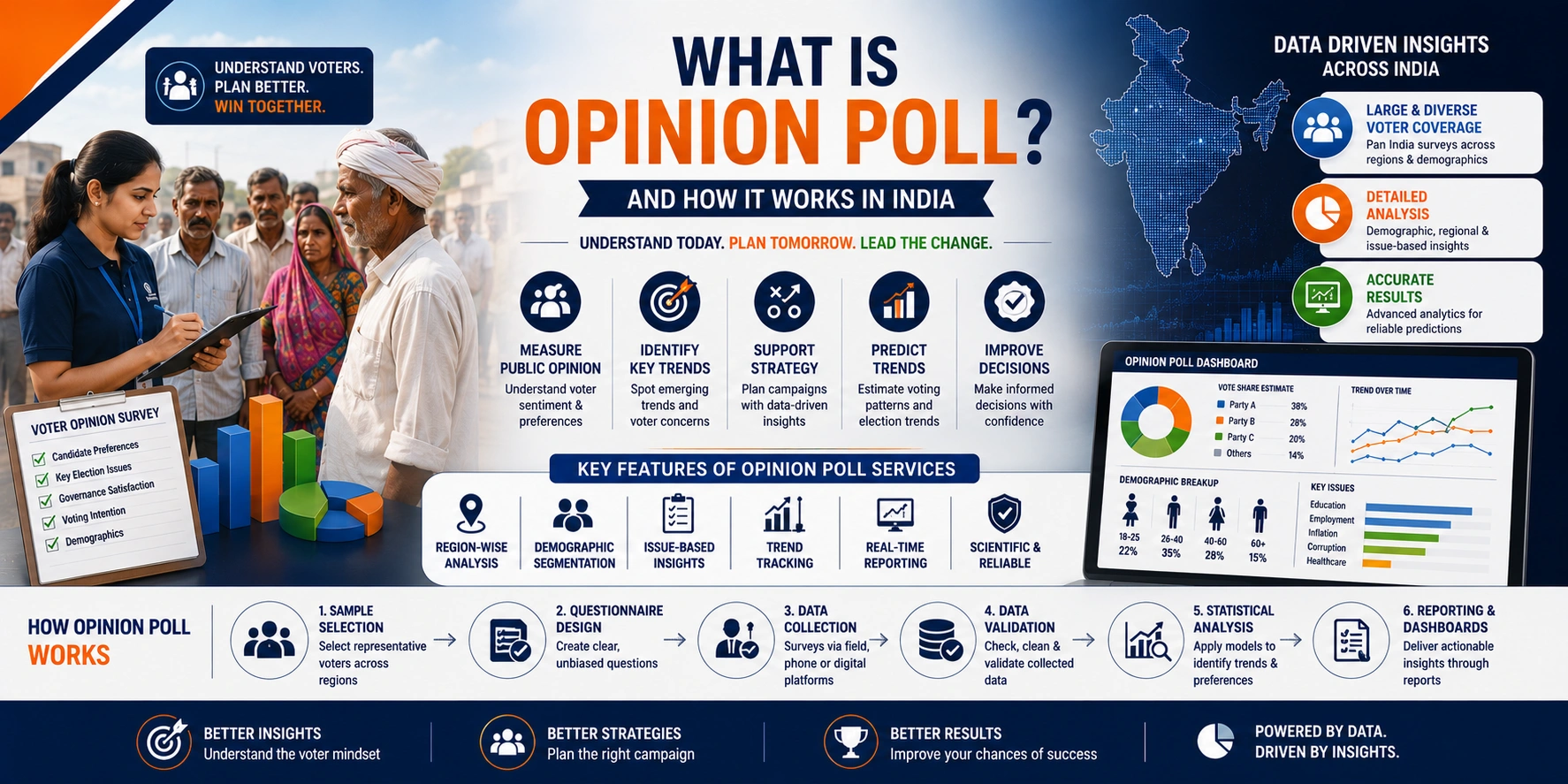
Opinion Polls are structured public-opinion research studies conducted before an election to understand the views, preferences, concerns and political attitudes of a defined population at a particular point in time. In a large and diverse democracy such as India, professionally designed opinion polls can help researchers, media organizations, political parties, candidates, leaders and campaign teams understand the broader electoral environment through systematic data collection and statistical analysis. However, an opinion poll is not an official election result and should not be treated as a guaranteed prediction. It is a measurement of opinion during a defined research period and its findings depend on sampling, questionnaire design, fieldwork, response patterns, weighting, data quality and analytical methodology.
What is an Opinion Poll?
An opinion poll is a survey designed to measure public opinion on political parties, candidates, public issues, leadership, government performance or other election-related questions.
Instead of asking every eligible voter in a constituency, state or country, researchers normally collect responses from a sample selected according to a defined research methodology.
The collected responses are then validated, analyzed and summarized to estimate patterns within the population represented by the research.
- Conducted before voting takes place
- Measures opinions at a particular point in time
- Uses a defined sample rather than the entire electorate
- Uses structured questionnaires
- Requires systematic fieldwork
- Uses statistical analysis
- Can track changes over time
- Includes uncertainty and methodological limitations
What Does an Opinion Poll Measure?
An election opinion poll can study several dimensions of public opinion depending on the research objective.
Common areas of study may include:
- Current party preference
- Current candidate preference
- Important public issues
- Leadership evaluations
- Government-performance perceptions
- Public priorities
- Candidate awareness
- Political trend changes
- Issue salience
- Levels of uncertainty or undecided responses
The exact questionnaire should be determined by the research objective rather than by a desire to produce a predetermined result.
An opinion poll measures reported opinion or preference at the time of the survey . It does not count votes and it does not replace the official election process. Public opinion can change between the survey date and polling day.
How Opinion Polls Work in India
Conducting an opinion poll in India requires careful research design because elections can cover large populations, multiple geographic regions and varied social, economic and political environments.
A professional opinion poll normally moves through several connected research stages.
Research Objective and Study Design
Every professional opinion poll should begin with a clearly defined research question.
Researchers should determine:
- What information needs to be measured?
- Which election or geographic area is being studied?
- Who is the target population?
- What is the required fieldwork period?
- Which survey mode is appropriate?
- What level of geographic reporting is required?
- How will data quality be monitored?
- How will findings and limitations be reported?
Clear research design reduces ambiguity and helps ensure that the survey methodology is aligned with the questions being studied.
Sample Design in Opinion Polls
One of the most important elements of an opinion poll is the sample.
Since interviewing every voter is generally impractical, researchers select a smaller group intended to provide information about a much larger population.
Sample design may consider:
- Target population
- Constituency or state coverage
- Urban and rural geographic coverage
- Polling-area or locality distribution
- Sample allocation
- Survey mode
- Expected response rates
- Operational field constraints
A large sample alone does not automatically make a poll representative. The way respondents are selected can be as important as the number of interviews completed.
What is Sample Size in an Opinion Poll?
Sample size refers to the number of respondents included in the survey.
The appropriate sample size depends on factors such as:
- Purpose of the study
- Population being represented
- Required precision
- Sampling method
- Geographic reporting requirements
- Expected non-response
- Available time and field resources
- Analytical design
Increasing sample size can reduce some forms of sampling uncertainty, but it cannot automatically correct biased selection, poor questionnaires, non-response problems or fieldwork errors.
Questionnaire Design
Questionnaire design has a direct effect on the quality of an opinion poll.
Questions should be understandable, relevant and as neutral as practical. Leading or confusing wording can affect responses and introduce measurement error.
A questionnaire may contain:
- Screening questions
- Political awareness questions
- Issue-priority questions
- Leadership evaluation questions
- Party or candidate preference questions
- Government-performance questions
- Undecided or no-response options where appropriate
- Quality-control fields required for survey administration
Why Question Wording and Order Matter
Survey responses can be affected by how a question is written and by questions that appear immediately before it.
Professional questionnaire design therefore considers:
- Neutral wording
- Clear response options
- Logical question sequence
- Avoidance of double-barrelled questions
- Avoidance of unnecessary assumptions
- Appropriate language and translation
- Survey length
- Pilot testing where practical
Field Survey and Data Collection
Once the research design and questionnaire are finalized, data is collected from respondents using the selected survey methodology.
Depending on the project, collection may involve:
- Face-to-face field interviews
- Computer-assisted personal interviews
- Telephone surveys
- Approved digital survey methods
- Mixed-mode research designs
The survey mode should be chosen according to the target population, geographic coverage, research objective, accessibility and potential sources of survey error.
Role of Trained Field Teams
Good sampling and questionnaire design can still produce poor data if field procedures are not followed consistently.
Field teams should be trained on:
- Survey objectives
- Respondent-selection procedure
- Correct question wording
- Neutral interviewing
- Recording responses accurately
- Handling non-response
- Survey privacy and confidentiality
- Field-quality procedures
Supervisory checks and standardized instructions can improve consistency across multiple survey locations.
Digital Data Collection in Opinion Polls
Digital survey applications can reduce manual data-entry work and allow field information to reach the central research team more quickly.
Depending on project design, digital systems can support:
- Structured digital questionnaires
- Mandatory-field validation
- Skip logic
- Time-stamped submissions
- Field progress monitoring
- Supervisor review
- Centralized data transfer
- Research dashboards
Technology can support survey administration, but it does not replace sound sampling, questionnaire design, training or statistical judgment.
Data Validation and Quality Control
Raw survey responses should normally undergo quality checks before final analysis.
Validation procedures may include:
- Completeness checks
- Duplicate-response checks
- Logical consistency checks
- Interview-duration review
- Field-team performance review
- Unusual response-pattern checks
- Supervisor verification where appropriate
- Documentation of exclusions or corrections
Quality control should be planned before fieldwork rather than added only after problems appear.
What is Weighting in Opinion Polls?
Survey samples do not always perfectly match the intended population structure. Researchers may therefore use statistical weighting when justified by the study design.
Weighting changes the contribution of observations to the final estimate according to documented analytical rules.
Weighting should not be used simply to force survey findings toward an expected political result. Its assumptions and methodology should be carefully documented.
Statistical Analysis of Opinion Poll Data
After validation and any appropriate weighting, researchers analyze the survey data.
Analysis may include:
- Response distributions
- Current vote-preference estimates
- Issue-priority analysis
- Leadership evaluations
- Geographic comparisons
- Changes between survey waves
- Undecided-response levels
- Uncertainty and methodological limitations
Findings should be interpreted in the context of how and when the survey was conducted.
Vote Preference and Vote Share Estimation
One of the most visible outputs of an election opinion poll is an estimate of current voting preference.
This estimate is derived from survey responses and the analytical methodology used by the research team.
It is important to distinguish between:
Survey Estimate
An estimate derived from sampled responses collected during a specific survey period.
Official Vote Share
The share calculated from votes officially counted through the formal election process.
An opinion poll estimate should therefore not be presented as an official result.
Can Opinion Polls Predict Seats?
Some election studies convert estimated vote preferences into possible seat ranges or scenarios.
However, translating vote estimates into seats is more complex than reporting survey percentages because election outcomes depend on the geographic distribution of votes, constituency-level contests, local candidates, alliances and other factors.
Any seat projection should therefore clearly explain its assumptions and uncertainty rather than being presented as a guaranteed result.
How Accurate Are Opinion Polls?
There is no universal accuracy level that applies to every opinion poll.
Survey quality can be affected by:
- Sampling design
- Sample coverage
- Sample size
- Non-response
- Question wording
- Interviewing quality
- Data processing
- Weighting assumptions
- Timing of fieldwork
- Changes in public opinion after the survey
A professionally conducted Opinion Poll Service in India should focus on transparent methodology, disciplined fieldwork, statistical quality and responsible interpretation rather than promising a particular level of predictive accuracy.
What is Margin of Error in an Opinion Poll?
Margin of error is a statistical concept used with certain probability-based sample estimates to describe uncertainty arising from sampling.
It is important to understand that margin of error does not describe every possible source of survey error.
Other sources may include:
- Coverage error
- Non-response error
- Measurement error
- Question wording effects
- Fieldwork error
- Data-processing error
- Weighting assumptions
- Changes in opinion after fieldwork
For this reason, a poll should not be evaluated solely by a single margin-of-error figure.
The most useful way to interpret an opinion poll is as a time-specific research snapshot. The survey tells us what the collected data indicated during its fieldwork period. It should be read together with methodology, sample design, field dates, uncertainty and wider political context.
What is a Tracking Opinion Poll?
A single opinion poll provides information from one research period. Repeated surveys can provide a stronger view of how measured public opinion changes over time.
A tracking programme may examine:
- Changes in party preference
- Changes in candidate preference
- Changes in issue importance
- Leadership-rating movement
- Undecided-response movement
- Changes following major political events
Comparisons are most meaningful when survey methodology remains reasonably consistent across waves.
Opinion Polls and Election Trend Analysis
Opinion polls can provide one input into broader Election Trend Analysis .
Historical election results explain what happened in previous elections, while opinion polls can provide a current survey-based view of public attitudes.
Combining historical context with current research can help analysts distinguish between long-term electoral patterns and more recent changes in measured opinion.
Opinion Poll vs Political Survey
Opinion Poll
Usually focuses on measuring current public opinion, political preference, issues, leadership assessments and related electoral attitudes.
Political Survey
Can have a broader research scope that may include local issues, governance perceptions, constituency conditions, candidate assessment, public priorities and other political research questions.
The terms can overlap in practical usage, but the research objective and methodology should always be clearly defined.
Explore Political Survey Services for broader election and constituency research requirements.
What is the Difference Between an Opinion Poll and an Exit Poll?
Opinion Poll
Conducted before voting and measures reported public opinion or voting preference during the survey period.
Exit Poll
Conducted in connection with voters who have already voted and asks about reported voting behaviour after the vote has been cast.
Both are survey-based research methods, but their timing, research population and interpretation differ.
Read our detailed guide: Exit Poll vs Opinion Poll .
Opinion Poll vs Official Election Result
Opinion Poll
A sample-based research estimate collected before the election and subject to survey uncertainty and changing public opinion.
Official Election Result
Determined through the formal voting and counting process administered by the relevant election authorities.
Only the formal election process determines the official result. Opinion polls should never be described as substitutes for official counting.
Why Opinion Polls Are Important
Professionally conducted opinion polls can provide structured information about the electoral environment before voting takes place.
They can help researchers and decision-makers:
- Measure current public opinion
- Understand major public issues
- Track changes between survey periods
- Assess public awareness
- Study leadership evaluations
- Understand geographic differences in aggregate survey findings
- Identify questions requiring further research
- Build evidence-based analytical reports
Role of Issue Analysis in Opinion Polls
Elections are influenced by a wide range of public concerns. Opinion polls can systematically measure which issues respondents identify as important during the research period.
Depending on the study, issue research may examine areas such as:
- Local infrastructure
- Public services
- Employment concerns
- Development priorities
- Governance perceptions
- Local administrative issues
- Public safety concerns
- Other constituency-specific priorities
Issue analysis can help create a more complete research picture than vote-preference questions alone.
Constituency and Area-Level Opinion Analysis
Survey findings may be analyzed across geographic units when the research design and available sample support such analysis.
Geographic reporting can help researchers compare aggregate responses across:
- Constituencies
- Regions
- Urban and rural areas
- Administrative areas
- Localities or survey zones
Small-area findings require particular caution because sample sizes can become much smaller when a larger survey is divided into geographic subgroups.
Role of Data in Opinion Poll Research
Opinion poll research generates structured survey data that can be analyzed at both overall and aggregate geographic levels.
Professional data management may include:
- Survey response management
- Data cleaning
- Validation
- Survey coding
- Weighting where appropriate
- Statistical summaries
- Trend comparison
- Charts and dashboards
- Methodological documentation
- Research reporting
The objective is to turn field responses into a transparent and interpretable research dataset rather than simply produce a headline number.
Privacy and Data Governance in Opinion Polls
Political opinions and voting preferences can be sensitive information. Opinion-poll research should therefore use appropriate privacy, confidentiality and data-security practices.
Good research practice can include:
- Voluntary participation
- Clear explanation of the survey purpose where appropriate
- Collection of only necessary information
- Avoidance of unnecessary sensitive personal profiling
- Secure data transmission
- Restricted access to survey records
- Aggregate reporting where appropriate
- Appropriate retention and deletion procedures
Survey data should be handled according to applicable legal, contractual and research requirements.
Major Challenges in Opinion Polls
Sampling Error
A sample estimate can differ from the value that would be observed if the entire target population were measured.
Coverage Error
Some parts of the intended population may be harder to reach through the selected survey method.
Non-Response
Some selected respondents may decline or be unavailable to participate.
Measurement Error
Question wording, interviewer effects or misunderstanding can influence responses.
Changing Opinion
Public opinion can change after fieldwork because of new events or developments.
Interpretation
Survey estimates may be overstated when uncertainty and methodology are not communicated clearly.
Common Misunderstandings About Opinion Polls
- A poll is not an official election result
- A larger sample does not automatically remove all bias
- Margin of error is not the only source of uncertainty
- A poll measures opinion during its fieldwork period
- Small subgroup estimates may have greater uncertainty
- Survey methodology matters as much as headline percentages
- Seat projections involve additional assumptions
- Different polls can produce different estimates without either being intentionally misleading
Best Practices for Professional Opinion Poll Research
- Define the research population clearly
- Use an appropriate sampling methodology
- Use clear and neutral questions
- Train field teams consistently
- Monitor fieldwork quality
- Validate survey responses
- Document weighting and analytical decisions
- Report fieldwork dates
- Explain important methodological limitations
- Protect respondent information
- Avoid overstating survey certainty
- Distinguish estimates from official election results
How Professional Opinion Poll Services Help
Large election surveys require coordination across research design, field operations, data systems, quality control and statistical analysis.
A professional Opinion Poll Company in India may support:
- Research-objective development
- Sampling framework
- Questionnaire design
- Field-team planning
- Surveyor training
- Digital survey systems
- Field monitoring
- Data validation
- Statistical analysis
- Trend analysis
- Dashboards
- Analytical reports
Professional methodology does not eliminate all uncertainty, but it can improve consistency, transparency and the quality of the research process.
Megamind's Approach to Opinion Poll Research
Megamind approaches opinion polling as an integrated research process combining field intelligence, structured methodology, technology, data validation and statistical analysis.
Depending on the research requirement, the workflow can follow:
Research Objective → Sampling Framework → Questionnaire Design → Field Planning → Survey-Team Deployment → Digital Data Collection → Data Validation → Statistical Analysis → Trend Interpretation → Analytical Reporting
Opinion Poll research can also be integrated with Political Survey, Constituency Analysis, Voter Data Analysis, Booth-Level Aggregate Analysis, Election Trend Analysis, Candidate Assessment and broader Election Intelligence according to the scope of the project.
Megamind provides political research and election intelligence services for political parties, candidates, leaders, prospective candidates, aspirants, campaign teams and political organizations across India.
Explore Opinion Poll Services →Conducting Opinion Polls Across India
Opinion-poll methodology in India must account for major differences in geography, language, infrastructure, media access and field conditions across states and constituencies.
A nationwide, state-level or constituency-level study may therefore require different sampling, field and reporting frameworks.
Research planning may need to consider:
- State and constituency boundaries
- Urban and rural coverage
- Local language requirements
- Field accessibility
- Survey-team distribution
- Interview mode
- Quality-control capacity
- Reporting level required by the study
The methodology should be adapted to the research environment without compromising consistency and transparency.
Election Rules, Publication and Compliance
Political survey and opinion-poll projects should consider applicable election laws, Election Commission directions, publication restrictions, contractual requirements and privacy obligations relevant to the specific project and election period.
Rules and restrictions can depend on the election, timing and method of publication. Organizations conducting or publishing political research should therefore verify the requirements applicable at the relevant time rather than relying on a generic assumption.
Opinion Poll Within Election Intelligence
An opinion poll becomes more informative when its findings are interpreted alongside other relevant election research rather than in isolation.
Historical Election Data → Constituency Research → Political Survey → Opinion Poll → Issue Analysis → Election Trend Analysis → Field Intelligence → Continuous Research → Analytical Reporting
Each research method answers a different question. Combining appropriate sources can provide a broader evidence base while maintaining a clear distinction between observed data, survey estimates and analytical interpretation.
FAQs About Opinion Polls
1. What is an opinion poll?
An opinion poll is a structured survey used to measure the views, preferences or attitudes of a sample of people about political candidates, parties, issues or other subjects.
2. When is an election opinion poll conducted?
Election opinion polls are generally conducted before voting takes place. Different polls may be conducted at different stages of the pre-election period.
3. How does an opinion poll work?
Researchers define the study population, select a sample, design a questionnaire, collect responses, validate the data, analyze it and report survey estimates.
4. Does an opinion poll survey every voter?
Usually no. Opinion polls generally use a sample intended to provide information about a larger population.
5. What is sample size in an opinion poll?
Sample size is the number of respondents included in the survey. Appropriate size depends on the methodology, precision requirements and reporting objectives.
6. How accurate is an opinion poll?
There is no fixed accuracy level for every poll. Quality depends on sampling, coverage, response patterns, questionnaire design, fieldwork, analysis and timing.
7. What is margin of error?
Margin of error is a statistical measure associated with sampling uncertainty in certain probability-based survey estimates. It does not capture every source of survey error.
8. Can opinion polls predict election results?
Opinion polls can provide estimates of measured public preference during the survey period, but they cannot guarantee the final election result.
9. Can voter opinion change after a poll?
Yes. Public opinion may change after fieldwork because of political events, campaign developments, new information or individual decisions.
10. What is the difference between an opinion poll and an exit poll?
An opinion poll is conducted before voting and measures reported preferences or opinions. An exit poll is conducted in connection with people who have already voted and asks about reported voting behaviour.
11. What is a tracking poll?
A tracking poll uses repeated survey measurements to examine how measured public opinion changes over time.
12. Why do different opinion polls sometimes show different results?
Polls may differ because of sampling, field dates, survey mode, questionnaire wording, response patterns, weighting methods and normal statistical variation.
13. Is a large sample always more accurate?
Not necessarily. Sample size matters, but a very large poorly selected sample can still produce biased estimates. Sample design and data quality are also important.
14. What information should a professional poll disclose?
Appropriate disclosure may include fieldwork dates, sample information, survey mode, geographic coverage, questionnaire information and relevant methodological limitations, depending on the research and publication context.
15. What is the difference between an opinion poll and an official result?
An opinion poll is a sample-based research estimate. The official election result is determined only through the formal voting and counting process administered by the relevant election authorities.
Opinion Polls Provide a Research-Based Snapshot of Public Opinion
Opinion Polls are an important part of modern election research because they provide a structured way to measure public attitudes before voting takes place.
A professionally designed poll combines research planning, sampling, questionnaire design, trained fieldwork, digital data collection, validation, statistical analysis and transparent reporting .
At the same time, opinion polls must be interpreted responsibly. They measure opinion during a specific period, contain statistical and non-statistical uncertainty, and cannot guarantee a future election result.
Their greatest value comes from providing systematic, transparent and evidence-based insight into public opinion, political issues and electoral trends.