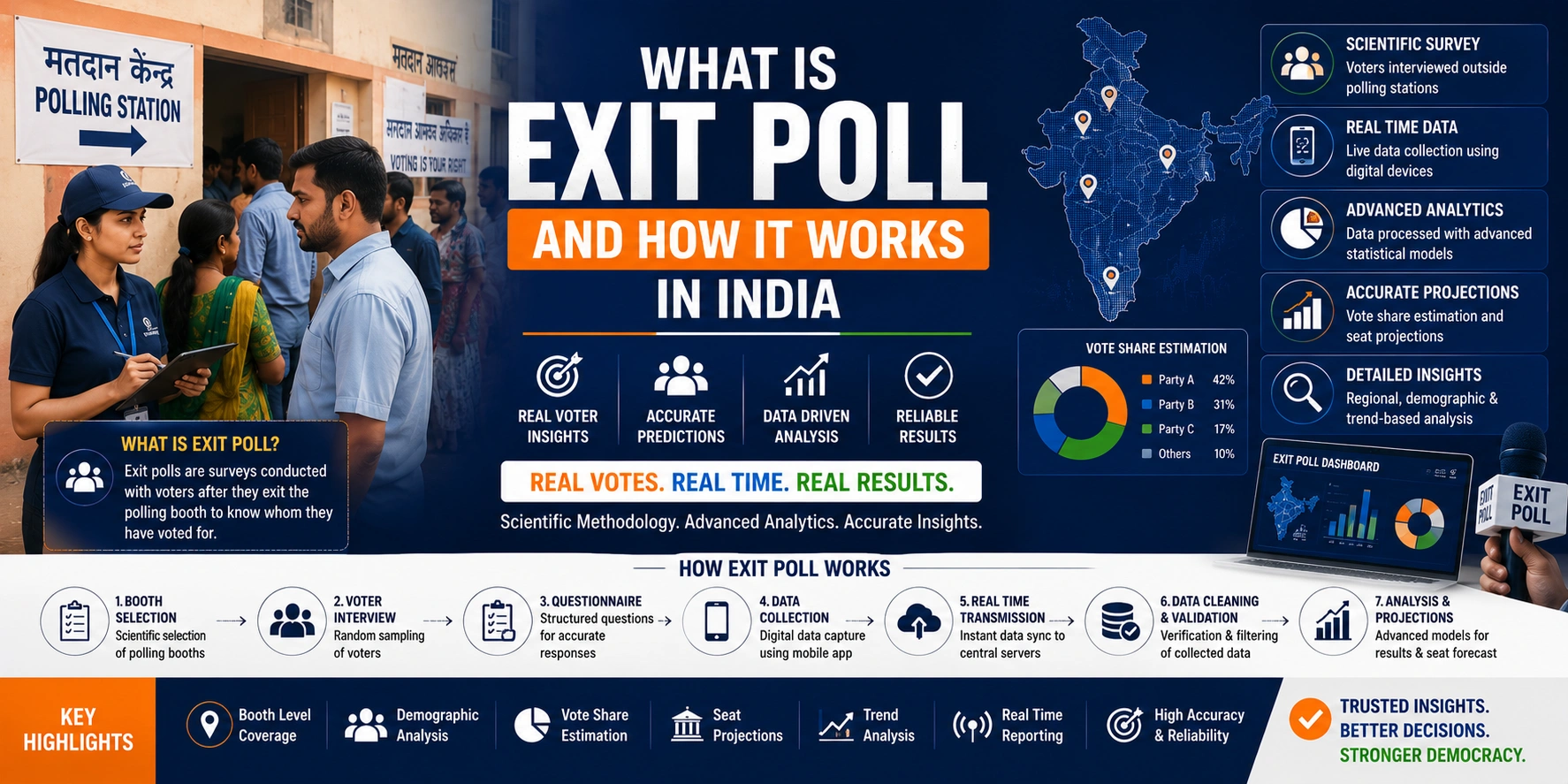
An Exit Poll is a post-voting survey designed to study how participating voters report that they voted after leaving a polling location. Researchers collect responses from a scientifically selected sample and analyze the aggregated information using statistical methods to estimate vote share, identify electoral patterns and, where methodology permits, develop broader estimates of the election outcome. Exit polls can provide valuable early electoral insights, but they remain survey-based estimates rather than official election results.
What is an Exit Poll?
An exit poll is a survey conducted after people have cast their votes. Selected voters are invited to participate voluntarily and report information about their voting decision through a structured research process.
Unlike a pre-election Opinion Poll, which asks respondents about voting intention before voting, an exit poll is conducted after the respondent has voted.
Individual responses are combined and analyzed statistically. Depending on the scope and methodology, the study may produce estimates of:
- Overall vote share
- Regional electoral patterns
- Constituency-level trends where supported
- Differences across sampled geographic areas
- Party or candidate performance estimates
- Possible seat ranges or projections
An Exit Poll is not an official election result. It is a statistical estimate based on survey responses from a sample of voters. The official result is determined only through the formal counting process conducted by the relevant election authorities.
How Does an Exit Poll Work in India?
Conducting an exit poll across India's large and diverse electoral environment requires careful research design, field coordination, sampling, data validation and statistical analysis.
A professional exit poll typically moves through several stages:
Exit Poll Research Design
A reliable exit poll begins before field teams reach polling locations. The research team first defines what the study is intended to measure and how observations will be collected.
The design may specify:
- Election and geographic coverage
- Sampling methodology
- Required sample size
- Field-location selection
- Respondent-selection procedure
- Questionnaire design
- Quality-control rules
- Analytical and reporting methodology
These decisions are important because weaknesses in the original research design cannot always be corrected later through statistical analysis.
Sampling in Exit Polls
It is generally impractical to interview every voter. Exit polls therefore depend on sampling.
A sample is a selected subset of observations intended to provide information about a larger electoral population.
Sampling design may consider factors such as geographic spread, constituency characteristics, historical electoral information, polling-location distribution and operational feasibility.
The important principle is that sample selection should follow a documented methodology rather than convenient or arbitrary respondent selection.
Why Sample Size Matters
Sample size influences the statistical precision of survey estimates, but a larger sample alone does not automatically make an exit poll reliable.
A very large but poorly selected sample can still produce misleading estimates. Sample design, coverage, non-response, field execution and data quality are also important.
Professional exit-poll methodology therefore considers sample size and sample quality together.
Exit Poll Questionnaire Design
Exit poll questionnaires are generally designed to be short, clear and suitable for field conditions.
Questions should avoid unnecessary complexity and should be tested before large-scale deployment.
Depending on the research objective, the questionnaire may include voting-choice questions and a limited set of contextual research questions.
Participation should remain voluntary, and field procedures should respect respondent privacy and applicable election requirements.
Role of Field Survey Teams
Even a strong statistical design can be weakened by inconsistent field execution. Field-team training is therefore a critical component of professional exit polling.
Field surveyors may be trained in:
- Respondent-selection procedure
- Neutral survey administration
- Questionnaire handling
- Voluntary participation
- Privacy and confidentiality practices
- Digital application use
- Field reporting procedures
- Escalation of operational issues
Privacy and Confidentiality in Exit Polls
Voting choice is sensitive information. Exit poll research should therefore be designed with appropriate confidentiality and data- minimization practices.
Participation should be voluntary, and the survey should collect only information necessary for the defined research purpose.
- Voluntary participation
- Clear research purpose
- Minimal necessary data collection
- Appropriate confidentiality safeguards
- Controlled system access
- Secure data transmission where used
- Aggregate reporting where appropriate
- Responsible data retention practices
Digital Data Collection in Exit Polls
Digital survey systems can improve the speed and consistency of large-scale exit poll operations.
Depending on project requirements, a digital system can support:
- Mobile survey applications
- Structured questionnaire controls
- Time-stamped field records
- Location or field-unit monitoring where appropriate
- Centralized data transmission
- Field-progress dashboards
- Automated validation rules
- Central analytical databases
Technology can improve operational efficiency, but it does not replace sound sampling, neutral fieldwork or statistical methodology.
Exit Poll Data Cleaning and Validation
Raw field data should be reviewed before analytical estimates are produced.
Quality-control procedures may check:
- Incomplete questionnaires
- Duplicate records
- Invalid response values
- Unusual response patterns
- Field-location inconsistencies
- Missing data
- Sample-distribution differences
- Operational anomalies
Data cleaning should follow documented rules so that analytical decisions remain consistent and reviewable.
How Vote Share is Estimated in an Exit Poll
Once validated responses are available, researchers aggregate the survey data to estimate reported voting patterns within the sampled population.
Depending on the research design, statistical adjustments or weighting may be applied to account for known differences in sampling or response patterns.
The methodology used for weighting should be documented because different assumptions can affect the resulting estimates.
Vote-share estimates should therefore be presented as statistical estimates rather than exact measurements of the final official vote.
How Seat Projections are Developed
Translating an estimated vote share into a seat projection can be more complex than estimating overall vote percentages.
In constituency-based elections, seats are determined by individual constituency results rather than only by statewide or nationwide vote share.
Projection models may therefore consider:
- Estimated vote-share patterns
- Historical constituency results
- Regional variation
- Constituency-level competitiveness
- Alliance structure
- Model assumptions
- Sampling uncertainty
- Available current research
Because modelling introduces additional assumptions, seat projections should generally be interpreted with more caution than raw survey observations.
How Accurate are Exit Polls?
There is no universal accuracy level that applies to every exit poll. The reliability of an exit poll depends on its research design, sampling, response patterns, field execution, data quality and analytical methodology.
Important factors include:
- Quality of sample design
- Geographic coverage
- Sample size
- Respondent-selection procedure
- Non-response patterns
- Field-team consistency
- Data validation
- Weighting methodology
- Statistical assumptions
- Seat-projection model
A professionally conducted exit poll aims to reduce uncertainty and improve the quality of estimates, but no methodology can guarantee that a survey estimate will exactly match the final official election result.
Margin of Error and Uncertainty
Survey estimates contain uncertainty because they are based on a sample rather than every voter.
A reported statistical margin of error can describe one component of sampling uncertainty under the assumptions of the methodology being used.
However, real-world exit polls may also be affected by non-response, coverage differences, field implementation and modelling assumptions.
For this reason, professional reporting should communicate uncertainty clearly instead of presenting estimates as guaranteed outcomes.
Difference Between Exit Poll and Opinion Poll
Opinion Poll
Conducted before voting to measure public opinion, preferences or stated voting intention at a particular point in time.
Exit Poll
Conducted after respondents have voted and asks selected participants about their reported voting decision.
Both are survey-research methods, but they measure different stages of the electoral process.
For a detailed comparison, read Exit Poll vs Opinion Poll .
Exit Poll vs Official Election Result
Exit Poll
A survey-based statistical estimate developed from a sample of voluntary respondent reports and analytical modelling.
Official Result
The formal electoral outcome determined through the official vote-counting process conducted by the relevant election authorities.
Exit-poll findings should never be represented as a substitute for official election results.
Why are Exit Polls Important?
Exit polls can provide an early research-based picture of reported voting patterns after voting has taken place.
Depending on methodology and legal publication requirements, the findings may support electoral analysis by media organizations, researchers, political organizations and other stakeholders.
- Provides early post-voting estimates
- Supports vote-share analysis
- Shows regional variation
- Supports election research
- Provides comparative electoral data
- Supports post-election analysis
- Provides inputs for analytical reporting
- Creates research data for future trend studies
Challenges in Conducting Exit Polls
Exit polls combine large-scale fieldwork with statistical research. This creates both operational and analytical challenges.
Non-Response
Some selected voters may decline to participate, potentially affecting the composition of collected responses.
Sampling Coverage
A sample may not fully capture every type of geographic or electoral variation.
Field Consistency
Large field teams require strong training, supervision and standardized procedures.
Time Pressure
Large volumes of field information may need to be validated and analyzed within a limited reporting window.
Regional Variation
Electoral patterns may vary considerably across constituencies and regions.
Model Uncertainty
Vote-share and seat estimates depend on analytical assumptions that introduce uncertainty.
Exit Polls in Multi-Phase Elections
Large elections in India may take place across multiple phases. This creates additional operational requirements for field deployment, data security, coordination and reporting.
Research teams may need to manage information collected on different polling dates while maintaining consistent survey procedures across all phases.
Publication or dissemination of exit-poll findings must also respect the election laws, Election Commission directions and restrictions applicable to the particular election and period.
Exit Polls and Election Compliance in India
Exit poll research in India should be planned and conducted with attention to applicable election laws, Election Commission directions, polling-place requirements and restrictions relating to publication or dissemination.
Because requirements can depend on the election and the notification in force, operational and publication plans should be checked against the applicable rules before deployment or release.
Professional research operations should also maintain neutrality, respondent confidentiality, secure data handling and documented field procedures.
Role of Technology in Modern Exit Polls
Technology can connect field survey operations with centralized data management and analytical teams.
A modern exit poll technology framework may include:
- Mobile survey applications
- Field-team monitoring systems
- Central data servers
- Automated quality checks
- Live operational dashboards
- Vote-share analytical dashboards
- Statistical modelling systems
- Structured reporting tools
Why Professional Exit Poll Services Matter
Large-scale exit polling requires more than a questionnaire. It involves research methodology, field-team management, technology, data validation, statistical analysis and controlled reporting.
A professional framework can bring these functions together through:
- Research planning
- Sampling framework
- Questionnaire development
- Field-team deployment
- Digital survey systems
- Centralized data management
- Quality-control processes
- Statistical analysis and reporting
Learn more about Megamind's Exit Poll Services .
Megamind's Approach to Exit Poll Research
Megamind approaches exit polling as an integrated research, field operations, data-management and analytical process.
Depending on project requirements, the workflow can include:
Research Design → Sampling Framework → Field Planning → Survey-Team Deployment → Digital Data Collection → Data Validation → Statistical Analysis → Vote Share Estimation → Analytical Reporting
Our focus is on structured methodology, disciplined field execution, reliable data handling, transparent analysis and clear reporting of estimates and limitations.
Exit Poll services can also be integrated with Political Survey, Opinion Poll, Voter Data Analysis, Election Trend Analysis, Constituency Intelligence and election data processing according to the research requirement.
Explore Exit Poll Services →FAQs About Exit Polls
What is an Exit Poll?
An Exit Poll is a survey conducted after selected voters have cast their votes, asking them about their reported voting decision.
When is an Exit Poll conducted?
Exit-poll interviews are conducted after participating respondents have voted, subject to applicable election rules and field requirements.
How are voters selected for an Exit Poll?
Respondent selection should follow the survey's documented sampling and field methodology rather than arbitrary selection.
Is participation in an Exit Poll compulsory?
No. Survey participation should be voluntary.
Is an Exit Poll the official election result?
No. An exit poll is a survey-based estimate. Only the official counting process determines the formal election result.
What is the difference between Exit Poll and Opinion Poll?
Opinion polls are generally conducted before voting and measure stated opinion or intention, while exit polls survey selected respondents after they have voted.
Can an Exit Poll estimate vote share?
Yes. Properly designed exit-poll data can be statistically analyzed to produce vote-share estimates, subject to sampling and other forms of uncertainty.
Can Exit Polls estimate seats?
Statistical models may be used to develop seat projections, but these involve additional assumptions and remain estimates rather than official results.
Are Exit Polls always accurate?
No. Reliability varies according to sampling, field execution, non-response, data quality and analytical methodology.
Why do different Exit Polls sometimes show different results?
Different organizations may use different samples, geographic coverage, weighting methods, field procedures and projection models.
Why is data validation important?
Validation helps identify incomplete, inconsistent, duplicate or unusual records before statistical estimates are produced.
How does technology support Exit Polls?
Technology can support digital data collection, centralized monitoring, validation, dashboards, statistical analysis and reporting.
Who may require professional Exit Poll services?
Media organizations, research organizations, political organizations and other eligible clients may require professional exit-poll research, subject to applicable election requirements.
Exit Polls Combine Field Research, Data and Statistical Analysis
An Exit Poll is a specialized form of election research conducted after selected respondents have voted.
A professional exit poll brings together research design, scientific sampling, trained field teams, digital data collection, validation, statistical analysis, vote-share estimation and structured reporting .
Its value depends not simply on the number of interviews but on the quality of the complete research process.
Exit polls can provide useful early estimates and analytical insights, but uncertainty remains inherent in survey research and statistical modelling.
For that reason, exit-poll estimates should be communicated responsibly and should never be presented as a replacement for official election results.