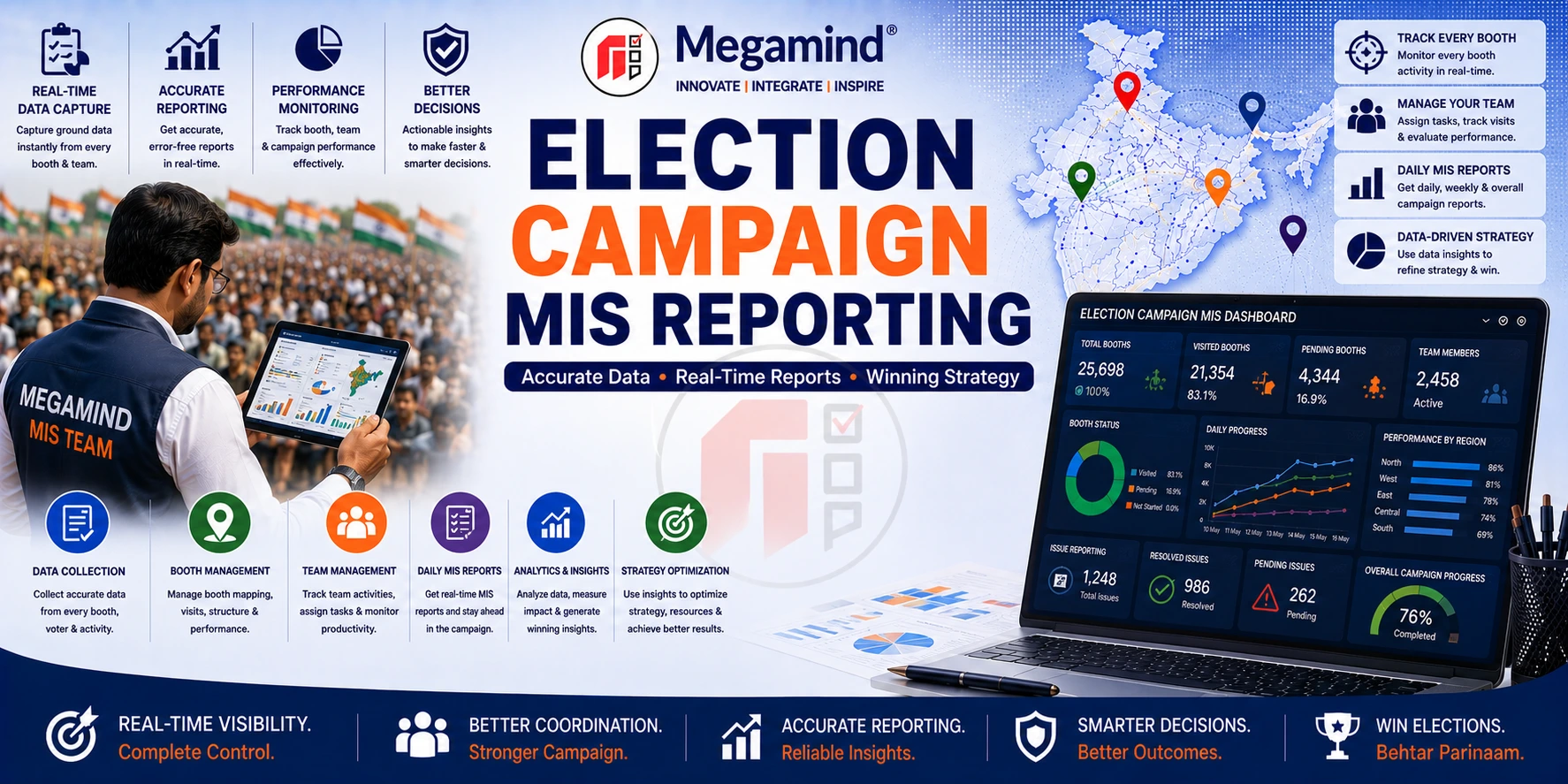
Election campaigns can generate operational information from campaign offices, field teams, supervisors, candidate programs, public events, research teams, digital operations, campaign monitoring and Election War Room activities. Megamind's Election Campaign MIS & Reporting System converts approved campaign-side information into a structured reporting chain: Campaign Activity → Field Report → Verification → Consolidation → KPI Review → Issue Tracking → MIS Dashboard → Management Report → War Room Review → Corrective Action .
What is an Election Campaign MIS & Reporting System?
An Election Campaign MIS & Reporting System is a structured campaign-side management information framework used to collect, organize, validate, consolidate and present legitimate campaign operational information.
MIS stands for Management Information System . In an election campaign, the purpose of MIS is to help authorized campaign leadership understand what has been planned, what has been reported as completed, what remains pending, what operational issues have been identified and what requires management attention.
A structured Campaign MIS can include:
- Daily campaign activity reports
- Field operations reports
- Campaign team reports
- Candidate program reports
- Public meeting operational reports
- Task status reports
- Pending-action reports
- Campaign KPI reports
- Issue and escalation reports
- Research status reports
- Digital campaign operational reports
- Constituency-wise reports
- Weekly management summaries
- Election War Room reports
A campaign does not become measurable merely because large volumes of information are collected. Useful MIS requires clear reporting definitions, responsible ownership, consistent formats, verification, reporting frequency, context and management review.
Why Election Campaign MIS & Reporting Matters
Campaign leadership may receive information from many teams simultaneously. Without a structured reporting process, important operational information can become fragmented.
Common problems can include:
- Different reporting formats
- Reports arriving at different times
- Multiple versions of campaign data
- Unclear activity status
- Unclear task ownership
- Pending actions without follow-up
- Issues without escalation
- Incomplete field reporting
- Manual spreadsheet consolidation
- Delayed management visibility
- Research mixed with informal observations
- Operational metrics confused with voter opinion
A structured MIS creates a consistent information layer between campaign execution and campaign management.
Our Election Campaign MIS & Reporting Services
Campaign MIS Framework
Development of structured campaign reporting hierarchy, reporting formats, responsibilities, frequencies and management review workflows.
Daily Campaign Reporting
Consolidated daily reporting for authorized campaign activities, operational status, tasks, issues and pending actions.
Field Reporting System
Structured reporting formats and workflows for authorized field teams, supervisors and campaign management.
Campaign KPI Reporting
Operational campaign indicators designed to help management review activity completion, reporting status and execution progress.
Issue & Escalation Reporting
Structured reporting of campaign-side operational issues, priority, ownership, escalation, pending actions and closure.
Constituency Reporting
Consolidated campaign-side operational reporting across appropriate constituency or campaign geographic structures.
Candidate Program Reporting
Structured operational reporting around authorized candidate campaign schedules, programs and related coordination.
Campaign Dashboard
Management dashboards presenting selected campaign activities, KPIs, tasks, issues and reporting status.
Weekly Performance Reporting
Periodic management review of operational trends, recurring gaps, pending actions and campaign execution status.
Research Reporting Integration
Appropriate integration of aggregate political research and survey findings as distinct research inputs.
Management Summary
Concise reporting designed to surface key campaign operational status, pending decisions, issues and management actions.
Election War Room Reporting
Integrated campaign reporting for authorized War Room monitoring, coordination, escalation and management review.
Election Campaign Reporting Framework
A structured reporting system establishes how information moves from campaign operations to management.
Election Campaign Reporting Hierarchy
Campaign reporting should define who reports what, to whom, in which format and at what frequency.
A reporting hierarchy can include:
- Campaign team reporting
- Field coordinator reporting
- Supervisor reporting
- Constituency coordination reporting
- Functional team reporting
- Campaign manager reporting
- War Room reporting
- Leadership management summary
The exact hierarchy can be customized according to the campaign organization and approved operational structure.
Campaign Reporting Responsibility Matrix
Each important report should have a clearly defined responsibility structure.
Report Owner
Defines the authorized role responsible for preparing or submitting a report.
Reporting Frequency
Defines whether the report is activity-based, daily, weekly or another approved frequency.
Reviewer
Defines the appropriate supervisor or management role responsible for review.
Required Fields
Establishes the minimum operational information required for consistency.
Escalation Rule
Defines when a reported issue or delay requires additional management attention.
Closure
Defines how pending actions and issues are marked reviewed or completed.
Daily Election Campaign Report
A Daily Election Campaign Report can provide campaign leadership with a structured view of the day's authorized operational activity.
Depending on campaign requirements, the report can include:
- Date and reporting period
- Planned campaign activities
- Reported completed activities
- Pending activities
- Candidate program status
- Field team reporting status
- Public meeting operational status
- Campaign task status
- Operational issues
- Escalated issues
- Pending management actions
- Important operational observations
- Research project status
- Digital campaign operational status
- Next-day priorities
Daily Campaign MIS Reporting Workflow
Ground Campaign & Field Reporting MIS
Ground campaign operations can involve multiple teams and supervisors working across different campaign areas.
Structured field MIS can consolidate authorized operational reporting such as:
- Planned field activity
- Reported activity status
- Field team reporting completeness
- Supervisor review status
- Candidate program coordination
- Public event operational reporting
- Campaign material status
- Operational issue reporting
- Pending actions
- Management escalation
Explore: Ground Campaign Management
Field Report Completeness & Quality Review
A field report should not automatically enter a management dashboard merely because it has been submitted.
Appropriate reporting-quality checks can include:
- Required-field completion
- Reporting date and time
- Responsible reporting unit
- Activity category
- Status consistency
- Duplicate-report checks
- Supervisor review where appropriate
- Supporting operational evidence where appropriate
- Correction status
- Final reporting status
Candidate Schedule & Campaign Program Reporting
Candidate campaign programs can involve coordination across scheduling, field teams, event teams, communication teams and campaign management.
Candidate program MIS can include:
- Planned campaign program
- Program date and time
- Campaign-side location information
- Responsible campaign team
- Operational readiness status
- Program completion status
- Reported operational issues
- Pending follow-up
- Relevant approved communication status
- Management observations
Public Meeting, Rally & Campaign Event Reporting
Campaign events can be included in MIS from an operational management perspective.
Reporting can cover:
- Event plan status
- Campaign-side coordination status
- Authorized team responsibilities
- Campaign material status
- Communication coordination status
- Reported operational issues
- Pending actions
- Post-event operational review
Any estimates or informal observations from campaign events should be clearly described and should not automatically be represented as statistically representative public opinion.
Campaign Task & Pending Action Reporting
Campaign plans often generate actions across multiple teams. MIS can make task ownership and pending work visible to authorized management.
Task reporting can include:
- Task title
- Responsible team
- Assigned role
- Priority
- Start date
- Due date
- Current status
- Dependencies
- Delay status
- Management note
- Next action
- Closure status
Campaign Issue & Escalation Reporting
Campaign issues require structured visibility so that important operational problems are not lost in informal communication.
Issue MIS can include:
- Issue reference
- Issue category
- Date reported
- Reporting unit
- Priority
- Responsible team
- Current status
- Action taken
- Escalation level
- Issue age
- Pending action
- Closure status
Pending Issue Aging & Closure Reporting
The number of open issues alone may not provide sufficient management context. MIS can also show how long important operational issues have remained unresolved.
New Issues
Recently reported operational issues awaiting appropriate review.
In Progress
Issues assigned to an authorized team with action underway.
Pending
Issues waiting for an identified dependency, response or approved action.
Escalated
Important unresolved operational issues requiring higher management attention.
Resolved
Issues for which the required operational action has been reported.
Closed
Issues reviewed and formally closed according to the campaign process.
Election Campaign KPI Reporting Framework
Campaign KPIs should be selected according to operational objectives and reporting requirements.
Examples of campaign-side operational indicators can include:
- Planned campaign activities
- Reported completed activities
- Pending activities
- Task completion status
- Overdue task count
- Field report submission status
- Reporting completeness
- Open issue count
- Escalated issue count
- Issue closure status
- Candidate program completion status
- Research project status
- Digital operational activity status
- Management action closure status
These indicators measure campaign operations. They do not directly measure how individuals intend to vote.
Campaign KPI Definition & Reporting Dictionary
Different teams may interpret the same KPI differently unless its definition is documented.
A KPI dictionary can define:
- KPI name
- KPI purpose
- Operational definition
- Data source
- Reporting owner
- Calculation method
- Reporting frequency
- Review responsibility
- Known limitations
- Update status
Campaign Plan vs Reported Execution
One important MIS function is comparing approved campaign plans with reported operational execution.
Campaign Plan
Defines approved activities, responsibilities, timelines, reporting expectations and operational priorities.
Reported Execution
Records submitted operational status, completed activities, pending work, reported issues and management follow-up.
Differences between plan and reported execution can be surfaced for management review without treating operational activity as a prediction of election outcome.
Election Campaign MIS Dashboard
Dashboards can provide authorized campaign management with a concise view of selected operational information.
Activity Dashboard
Planned, reported completed and pending campaign activities.
Field Dashboard
Authorized field reporting status and operational summaries.
KPI Dashboard
Selected campaign operational indicators and reporting status.
Task Dashboard
Assigned, completed, pending and overdue campaign tasks.
Issue Dashboard
Open, pending, escalated, resolved and closed operational issues.
Management Dashboard
Consolidated campaign information prepared for authorized leadership review.
Campaign Status & Exception Reporting
Management reporting can prioritize exceptions rather than requiring leadership to review every underlying activity.
A status framework can distinguish:
- Activities progressing according to plan
- Activities requiring attention
- Activities with significant operational delay
- Issues awaiting action
- Issues requiring escalation
- Reports not received
- Reports awaiting verification
- Management decisions pending
Status definitions should be documented so that campaign teams interpret them consistently.
Weekly Election Campaign Performance Report
Daily MIS focuses on current operations, while weekly reporting can help management identify broader operational patterns.
Weekly reporting can include:
- Weekly activity summary
- Plan vs reported execution
- Operational KPI summary
- Field reporting trend
- Task completion trend
- Issue trend
- Recurring operational problems
- Pending management actions
- Research project updates
- Digital operational summary
- Candidate program summary
- Priorities for the next reporting period
Campaign Management Executive Summary
Senior campaign leadership may not require every detailed operational record. A management summary can surface the information that requires attention.
An executive summary can include:
- Overall operational status
- Major completed activities
- Important pending activities
- Key operational KPIs
- Critical open issues
- Escalated matters
- Important reporting gaps
- Research updates
- Management decisions required
- Priority actions
Constituency-Wise Campaign MIS & Reporting
Campaign organizations operating across multiple constituencies may require standardized reporting that allows management to review operations at different levels.
Constituency reporting can include:
- Campaign activity status
- Field reporting status
- Task completion status
- Candidate program status
- Operational issue status
- Reporting completeness
- Research project status
- Management pending actions
Constituency-level operational comparisons should be based on clearly defined campaign metrics rather than inferred political preferences of identifiable individuals.
Assembly Segment & Multi-Constituency Reporting
Larger political campaigns may require reports to roll up from local campaign units to Assembly segments, Parliamentary constituencies, regional teams or central management.
A structured reporting hierarchy can support:
- Local campaign operational reports
- Supervisor consolidation
- Assembly constituency summaries
- Assembly-segment summaries
- Parliamentary campaign summaries
- Regional campaign summaries
- Central management MIS
- War Room reporting
Political Research & Survey Reporting Integration
Political research can be included within management reporting when it is kept methodologically distinct from routine campaign operational information.
Appropriate research reporting can include:
- Research project status
- Survey fieldwork status
- Aggregate survey findings
- Historical election analysis
- Constituency research
- Public issue research
- Research methodology notes
- Research limitations
- Report publication date
- Research update status
Explore: Political Research & Election Intelligence and Political Survey Services .
Field Feedback vs Representative Political Survey
Field Feedback
Operational observations submitted by campaign teams can help management understand local campaign context, implementation issues and reported field developments.
Representative Survey
Public-opinion estimates require an appropriate research design, sampling approach, fieldwork, quality controls, analysis and methodological reporting.
MIS should preserve this distinction so that anecdotal campaign feedback is not presented as representative public opinion.
Political Data Analytics & Campaign MIS
Appropriate aggregate election data can provide additional context to campaign management reporting.
This can include:
- Historical election results
- Aggregate vote-share analysis
- Turnout analysis
- Winning-margin analysis
- Multi-election comparisons
- Aggregate constituency analysis
- Aggregate booth-result analysis
- Research summary integration
Historical aggregate election data does not reveal how an identifiable individual voted and should not be used to infer an individual's private political preference.
Digital Election Campaign Reporting
Appropriate operational information from authorized digital campaign activities can be included in campaign MIS.
Depending on project scope, digital reporting can include:
- Content publishing status
- Campaign content calendar status
- Approved platform activity
- Content production status
- Digital task status
- Digital issue status
- Selected platform-provided metrics
- Management observations
Online views, reactions, comments, shares or follower changes describe digital activity. They should not automatically be interpreted as representative voter support, vote share or election outcome.
Explore: Digital Election Campaign Management
Political Campaign Content & Creative Reporting
Campaign content operations can be included within MIS from a production and workflow perspective.
Reporting can include:
- Content request status
- Draft status
- Creative production status
- Fact-review status
- Approval status
- Publishing status
- Pending content tasks
- Production delays
- Approved asset status
- Content calendar status
Political PR & Media Management Reporting
Appropriate campaign PR and media operations can also be incorporated into management reporting.
MIS can include:
- Media activity status
- Press communication workflow status
- Candidate media program status
- Approved communication status
- Media monitoring summary
- Reported communication issues
- Pending media actions
- Management review points
Explore: Political PR & Media Management
Election Monitoring & Campaign Performance Reporting
Election Monitoring and Campaign MIS work closely together, but they have different primary roles.
Election Monitoring
Focuses on reviewing authorized campaign activity, operational execution, KPIs, issues, gaps and performance status.
Campaign MIS & Reporting
Defines how approved operational information is collected, consolidated, structured and presented for campaign management.
Election War Room MIS & Management Reporting
Election War Room teams can use structured MIS to bring together relevant campaign-side operational information.
War Room reporting can include:
- Campaign activity summary
- Field reporting summary
- Campaign KPI status
- Candidate program status
- Open issue summary
- Escalated issue summary
- Pending-action summary
- Research update
- Digital operational update
- Communication update
- Management decision tracker
- Priority action list
Explore: Election War Room Management
Campaign Management Decision & Action Tracker
MIS becomes more useful when management decisions are connected to follow-up actions.
A decision and action tracker can record:
- Review date
- Issue or subject
- Management decision
- Responsible campaign team
- Assigned action
- Due date
- Current status
- Follow-up note
- Escalation status
- Closure status
Pending Action & Closure Reporting
Reporting should not end when an issue is identified. Important campaign actions can remain visible until appropriately reviewed and closed.
Closure reporting can help distinguish:
- New action
- Assigned action
- Action in progress
- Action awaiting dependency
- Delayed action
- Escalated action
- Reported completed action
- Reviewed and closed action
Campaign Reporting Frequency & Review Cycle
Not every campaign metric requires the same reporting frequency. Excessive reporting can create noise, while delayed reporting can reduce operational usefulness.
Activity-Based
Reports triggered by defined campaign activities or operational events.
Daily
Routine operational status and pending-action reporting.
Weekly
Trend, KPI, issue and management performance summaries.
Phase-Based
Review aligned with defined campaign phases and milestones.
Exception-Based
Reporting when an important operational threshold, delay or issue occurs.
Management Review
Consolidated reporting aligned with leadership and War Room review requirements.
Campaign MIS Source-of-Information Register
Reports can become misleading when the origin of important information is unclear.
A source register can document:
- Report category
- Information source
- Reporting team
- Submission method
- Reporting frequency
- Review responsibility
- Verification status
- Last update
- Known limitation
- Approved use
Reporting Date, Time & Data Freshness
Management should be able to understand whether a report reflects current campaign operations or older information.
Appropriate MIS fields can include:
- Reporting period
- Submission date
- Submission time
- Last updated date
- Last updated time
- Reporting unit
- Verification status
- Current reporting status
Campaign Report Version & Change Management
Multiple report versions can create confusion during fast-moving campaign operations.
Appropriate version management can help document:
- Report version
- Report creation date
- Last update
- Updated by
- Correction note
- Approval status
- Current version
- Archived version
Campaign Reporting Quality Control
Structured reporting requires quality controls to reduce avoidable errors and misleading summaries.
MIS quality checks can include:
- Required-field validation
- Duplicate-report review
- Missing-report identification
- Logical consistency checks
- Date and period checks
- Source-reference checks
- Supervisor review
- Correction tracking
- Reporting completeness review
- Management-report reconciliation
Campaign MIS Software & Reporting Automation
Technology can reduce repetitive manual consolidation and provide more consistent reporting workflows where appropriate.
Campaign reporting technology can support:
- Digital reporting forms
- Role-based report submission
- Reporting dashboards
- Task reporting
- Issue reporting
- Automated status consolidation
- Report filters
- Management summaries
- Report exports
- Report archive
- Audit logs
- Controlled access
Campaign MIS & Reporting vs Political Campaign Technology
Election Campaign MIS & Reporting
Focuses on reporting architecture, reporting formats, information consolidation, KPIs, management summaries, issue reporting, reporting quality and review cycles.
Political Campaign Technology
Focuses on the broader software infrastructure, applications, dashboards, task systems, field reporting technology, access controls and digital campaign operating systems.
Campaign MIS vs Campaign Performance Monitoring
MIS & Reporting
Organizes how campaign operational information is collected, checked, consolidated and presented to authorized management.
Performance Monitoring
Reviews campaign operational execution, indicators, gaps, issues and performance against defined campaign plans.
The two functions can be integrated while retaining their distinct roles.
MIS within Election Campaign Management
Campaign MIS can act as the information and reporting layer within broader Election Campaign Management.
An integrated structure can follow:
Election Strategy → Campaign Planning → Ground Execution → Research → Communication → Digital Campaign → Campaign Monitoring → MIS & Reporting → Election War Room → Management Review
Explore: Election Campaign Management
Election Campaign MIS Across Different Campaign Phases
Election-Day Campaign-Side MIS & Reporting
Where applicable, campaign-side MIS on election day should remain limited to lawful and permitted campaign operational activities.
Campaign MIS should not be represented as administering or controlling:
- Official electoral rolls
- Polling station administration
- Official voter identification
- Ballots
- EVM administration
- Official turnout systems
- Vote counting
- Official election results
- Election authority functions
Official election administration remains the responsibility of the relevant authorized election authorities.
Campaign MIS Data Privacy & Information Governance
Campaign reporting systems can contain internal operational information. Appropriate governance should therefore be considered throughout the reporting lifecycle.
Responsible practices can include:
- Defined reporting purpose
- Data minimization
- Role-based access
- Controlled information sharing
- Secure storage
- Appropriate access review
- Purpose limitation
- Retention controls
- Controlled exports
- Source documentation
- Audit records where appropriate
- Aggregate reporting where appropriate
Campaign MIS Without Sensitive Individual Political Profiling
A campaign reporting system does not require creating sensitive individualized political profiles.
Megamind's responsible framework focuses on legitimate campaign operations, aggregate research and management reporting rather than inferring an identifiable person's political preference or persuadability from sensitive characteristics such as religion, caste, ethnicity, health, sexuality or other sensitive personal attributes.
Historical constituency or booth-level aggregate results describe geographic totals. They should not be used to infer how an identifiable individual voted.
Accurate, Transparent & Contextual Campaign Reporting
MIS should not create a false appearance of certainty.
Responsible campaign reporting should distinguish between:
- Verified operational information
- Reported but pending-review information
- Informal field observations
- Representative survey findings
- Historical election data
- Digital platform metrics
- Management assumptions
- Unknown or incomplete information
Reports should not fabricate activities, survey findings, performance figures, public support or election results.
Campaign Activity Does Not Automatically Equal Voter Support
A campaign can execute many activities, produce significant content or receive high online engagement while public opinion remains uncertain.
Operational reporting can answer questions such as:
- Was the campaign activity reported as completed?
- Was the required report submitted?
- Are tasks pending?
- Are operational issues unresolved?
- Are defined campaign KPIs being reported?
It cannot, by itself, establish how people will vote.
Responsible & Compliant Election Campaign Reporting
Campaign MIS should support legitimate campaign-side management and operate consistently with applicable election rules, privacy requirements and other relevant obligations.
Reporting systems should not facilitate or falsely document:
- Voter intimidation
- Coercion
- Vote buying
- Unlawful inducements
- Impersonation
- Fabricated campaign achievements
- Fabricated survey findings
- Fabricated official election information
- Unauthorized election-system access
- Interference with polling
- Interference with vote counting
- Other unlawful campaign activity
Election Campaign MIS for Assembly Elections
An Assembly election campaign can use MIS to consolidate authorized reporting across campaign functions within a constituency.
An Assembly Campaign MIS can connect:
- Candidate campaign office
- Campaign management
- Ground campaign teams
- Field supervisors
- Research team
- Digital campaign team
- Communication team
- Campaign monitoring
- Issue reporting
- War Room
- Management review
Election Campaign MIS for Parliamentary Elections
Parliamentary campaigns may require multi-level reporting across Assembly segments and campaign teams.
Reporting can support:
- Assembly-segment operational reports
- Constituency campaign summaries
- Field reporting consolidation
- Candidate program reporting
- Task reporting
- Issue and escalation reporting
- Research reporting
- Digital campaign reporting
- Campaign KPI reporting
- Central management MIS
- War Room reporting
MIS for Different Political Campaign Scales
Single Candidate
Focused campaign reporting for a candidate, campaign office and authorized functional teams.
Assembly Constituency
Constituency-wide operational MIS and campaign management reporting.
Parliamentary Campaign
Multi-segment reporting with consolidated management summaries.
Multi-Constituency
Standardized reporting across multiple campaign units.
Regional Campaign
Hierarchical reporting from constituency operations to regional management.
Party-Level Campaign
Appropriate consolidated operational reporting across authorized campaign structures.
Election Campaign MIS & Reporting Deliverables
Deliverables can be customized according to campaign size, election type, reporting requirements and agreed project scope.
- Campaign MIS Framework
- Reporting Hierarchy
- Reporting Responsibility Matrix
- Daily Campaign Report Format
- Field Reporting Format
- Candidate Program Report
- Campaign Event Report
- Task Status Report
- Pending Action Report
- Issue & Escalation Report
- Issue Aging Report
- Campaign KPI Framework
- KPI Definition Dictionary
- Campaign Dashboard
- Weekly Performance Report
- Constituency Campaign Report
- Research Status Report
- Digital Campaign Report
- Management Executive Summary
- War Room MIS
- Management Decision Tracker
- Action Closure Tracker
- Reporting Quality Checklist
- Report Source Register
- Reporting Archive Structure
Benefits of Structured Election Campaign MIS
- Consistent campaign reporting
- Clear reporting responsibilities
- Improved operational visibility
- Faster identification of pending work
- Structured issue escalation
- Improved management follow-up
- Better field-report consolidation
- Clearer campaign KPI reporting
- Reduced manual report fragmentation
- Improved campaign documentation
- Better War Room information flow
- Improved management review
- More consistent multi-constituency reporting
- Better reporting accountability
Common Election Campaign Reporting Challenges
- Too many reporting formats
- Late report submission
- Missing reports
- Duplicate information
- Unclear data sources
- Unverified field information
- Inconsistent KPI definitions
- Too much reporting without prioritization
- Important issues hidden inside long reports
- Weak management follow-up
- Multiple spreadsheet versions
- Operational data mixed with survey findings
- Digital engagement confused with voter support
- Reports without clear limitations
Customized Election Campaign MIS & Reporting System
Campaign reporting requirements can differ according to election type, organization structure and management needs.
Megamind can structure MIS projects according to:
- Election type
- Campaign scale
- Number of constituencies
- Campaign organization structure
- Reporting hierarchy
- Reporting frequency
- Campaign functions
- Field reporting requirements
- KPI requirements
- Dashboard requirements
- Management reporting requirements
- War Room requirements
Who Can Use Election Campaign MIS & Reporting?
- Political parties
- Political candidates
- Prospective candidates
- Political leaders
- Candidate campaign offices
- Election campaign organizations
- Campaign management teams
- Ground campaign management teams
- Political research teams
- Digital campaign teams
- Campaign monitoring teams
- Election War Room teams
Campaign MIS Does Not Guarantee Election Results
Election Campaign MIS can improve reporting consistency, operational visibility, campaign coordination, issue tracking and management review.
It cannot determine individual voter decisions or guarantee an election outcome.
Campaign reports should therefore describe what the underlying information actually supports and avoid presenting operational activity as certainty about public opinion or election results.
Collect → Validate → Consolidate → Report → Review → Act
Megamind combines Election Campaign Management + Ground Operations + Political Research + Campaign Monitoring + Data Analytics + Software Technology + Election War Room Management to build structured Election Campaign MIS & Reporting frameworks.
Our reporting cycle can follow:
Define Reporting Requirements → Assign Responsibilities → Collect Authorized Reports → Review Completeness → Validate → Consolidate → Update KPIs → Flag Issues → Prepare Management MIS → Review → Track Action & Closure
The objective is to transform fragmented campaign information into structured, contextual and usable management reporting.
Discuss Campaign MIS Requirements →Why Megamind for Election Campaign MIS & Reporting?
Election campaign reporting requires more than creating spreadsheets or dashboards. The reporting structure needs to reflect campaign organization, field operations, research methodology, management responsibilities and decision workflows.
- Election campaign domain understanding
- Structured reporting frameworks
- Campaign management integration
- Ground reporting integration
- Political research integration
- Campaign KPI frameworks
- Issue and escalation reporting
- Management dashboards
- Multi-constituency reporting
- War Room integration
- Campaign technology capability
- Customized MIS design
- Reporting quality controls
- Responsible information governance
FAQs About Election Campaign MIS & Reporting System
1. What is an Election Campaign MIS & Reporting System?
It is a structured campaign-side management information framework that consolidates authorized operational reports, campaign activities, tasks, field updates, issues, KPIs and management summaries for review and coordination.
2. What is Campaign MIS?
Campaign MIS is a Management Information System used to organize legitimate campaign-side operational information into structured reports, dashboards, summaries and management review formats.
3. Does Megamind provide Election Campaign MIS services in India?
Yes. Megamind provides customized Election Campaign MIS and Reporting solutions in India according to election type, campaign structure, reporting hierarchy and agreed project scope.
4. Can daily election campaign reports be prepared?
Yes. Daily campaign reporting can consolidate authorized operational information such as activity status, field reporting, candidate programs, tasks, issues, pending actions and management observations.
5. Can weekly campaign performance reports be prepared?
Yes. Weekly reports can consolidate campaign activity trends, operational KPIs, pending actions, recurring issues, reporting status and management review points.
6. Can field campaign reports be integrated into MIS?
Yes. Authorized field reports can be consolidated through structured reporting formats and appropriate verification workflows before management reporting.
7. Can constituency-wise campaign reports be prepared?
Yes. Depending on project scope, campaign-side operational reporting can be organized constituency-wise, Assembly-segment-wise or according to another appropriate campaign structure.
8. Can campaign KPIs be included in MIS reports?
Yes. Operational campaign KPIs such as planned activities, completed activities, reporting completeness, task status and issue status can be included where relevant.
9. Can campaign issues and escalations be included in reports?
Yes. MIS reports can include operational issue categories, priority, ownership, escalation status, pending actions and closure status.
10. Can Election Campaign MIS integrate with an Election War Room?
Yes. Campaign MIS can provide structured operational reporting, dashboards, issue summaries, pending actions and management reports for authorized Election War Room operations.
11. Can digital campaign reports be included in Campaign MIS?
Yes. Appropriate operational metrics from authorized digital campaign activities can be included, while recognizing that online engagement is not equivalent to representative voter support or election results.
12. Can political survey findings be included in Election Campaign MIS?
Appropriate aggregate survey findings can be included as a distinct research input, with methodology and limitations kept separate from operational campaign metrics.
13. Can Election Campaign MIS include candidate program reporting?
Yes. Candidate program reporting can include planned and completed campaign-side programs, operational status, coordination requirements and pending actions.
14. What is an Election Campaign Dashboard?
It is a management interface that summarizes selected campaign-side operational information, reporting status, KPIs, tasks, issues and other authorized indicators.
15. Can campaign reports be customized?
Yes. Reporting formats can be customized according to campaign structure, election type, management requirements, reporting frequency and agreed project scope.
16. Can reports be prepared for Assembly elections?
Yes. Election Campaign MIS can be structured for Assembly election campaigns and their authorized campaign operations.
17. Can MIS reporting support Parliamentary election campaigns?
Yes. Parliamentary campaign MIS can consolidate reporting across appropriate campaign units and Assembly segments depending on project structure.
18. Can campaign reports have role-based access?
Yes. Where software systems are used, access can be structured according to authorized operational roles and reporting responsibilities.
19. How is campaign reporting information verified?
Verification can use defined reporting formats, source references, supervisor review, completeness checks, consistency checks and other appropriate quality-control procedures.
20. Is field feedback the same as a political survey?
No. Informal field feedback can provide operational context but should not automatically be represented as statistically representative public opinion.
21. Does high digital engagement mean high voter support?
No. Digital engagement describes online activity and should not automatically be treated as representative voter support, vote share or election outcome.
22. Does Campaign MIS identify how individual voters will vote?
No. Responsible Campaign MIS does not require inferring an identifiable individual's political preference or vote from aggregate campaign or election information.
23. How is campaign reporting data protected?
Appropriate controls can include role-based access, data minimization, controlled sharing, secure storage, audit records, retention controls and other security measures according to project requirements.
24. Is Campaign MIS the same as official election reporting?
No. Campaign MIS is an internal campaign-side management system. Official turnout, polling, counting and election-result information remains under authorized election authorities.
25. Does Election Campaign MIS & Reporting guarantee election victory?
No. MIS can improve operational visibility, reporting and campaign coordination, but it cannot guarantee public opinion, voting behavior or election results.
From Campaign Activity to Structured Management Information
Election campaigns can generate large volumes of operational information. The value of that information depends on whether it can be organized, reviewed, understood and acted upon responsibly.
Megamind's Election Campaign MIS & Reporting System framework connects Field Reporting + Campaign Activities + Task Status + KPI Reporting + Issue Management + Research Updates + Dashboards + Management Summaries + Election War Room Reporting .
The objective is to give authorized campaign management a more structured view of campaign-side operations while preserving important distinctions between operational activity, informal field feedback, research findings, digital metrics and actual election outcomes.
Build a Structured MIS & Reporting System for Your Election Campaign
Discuss your Daily Campaign Reporting, Field MIS, Campaign KPI Dashboard, Issue & Escalation Reporting, Constituency Reports, Management Summaries, Campaign Performance Reports and Election War Room MIS requirements with Megamind.
Discuss Campaign MIS & Reporting