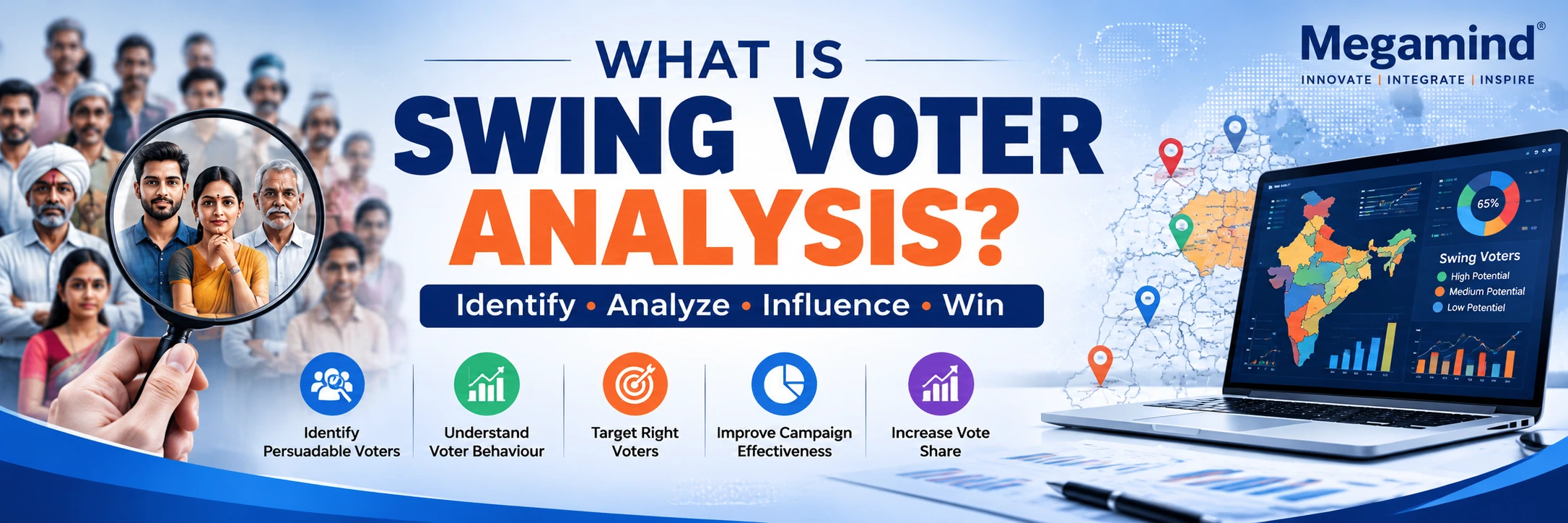
Electoral preferences are not always permanent. Across different elections, some citizens may continue supporting the same political party or candidate, while others may reconsider their preference because of changing candidates, government performance, local issues, political developments or other factors. Swing Voter Analysis is a form of election research used to study these broader patterns of changing political preference. Rather than attempting to label or target individual voters, a professionally designed analysis can examine aggregate survey findings, historical election results, vote-share movement, constituency-level patterns, booth-level aggregate trends and issue-based changes in public opinion .
What is a Swing Voter?
The term swing voter generally refers to a voter whose political preference is not consistently associated with the same party or candidate across elections or at different stages of an election period.
A person's preference may change for many reasons, including:
- Candidate choice
- Government performance
- Local development issues
- Economic conditions
- Public services
- Leadership assessment
- Current political developments
- Changes in political alliances
Importantly, these factors do not affect every person in the same way, and a research finding about a population should not be assumed to describe any particular individual.
What is Swing Voter Analysis?
Swing Voter Analysis is the structured study of changes and potential movement in political preferences within an electorate.
It can combine multiple research sources to examine questions such as:
- How stable are current political preferences?
- How has vote share changed across past elections?
- Which public issues are becoming more important?
- How do survey findings change over time?
- How stable are constituency-level political trends?
- Where has historical vote movement been comparatively larger?
- Are candidate evaluations changing?
- How uncertain are current survey estimates?
The objective is to understand political movement at an analytical level, not to assign a political label to an individual citizen.
Swing analysis should be understood as measurement of political movement and uncertainty, not as a guaranteed prediction of future voting behaviour. Political preferences can change, survey estimates contain uncertainty, and election outcomes depend on many interacting factors.
Why Swing Voter Analysis is Important in Election Research
Election results are rarely static. Vote shares can move between elections, political alliances can change, new candidates can emerge, local issues can develop and public evaluations of governments can change.
Swing analysis helps researchers understand this movement rather than looking only at the final result of one election.
- Measures changes in political preferences
- Provides context to historical election results
- Supports political trend analysis
- Identifies changes in public issue priorities
- Helps interpret survey movement over time
- Supports constituency-level research
- Adds context to vote-share analysis
- Improves understanding of electoral uncertainty
Core Objectives of Swing Voter Analysis
Measure Stability
Understand how stable or changeable aggregate political preferences appear in research.
Track Movement
Compare survey waves or historical elections to identify changes over time.
Understand Issues
Study which public issues are associated with changing political discussion and opinion.
Study Geography
Compare aggregate trends across constituencies and electoral areas.
Evaluate Uncertainty
Distinguish stable findings from results that remain within statistical uncertainty.
Support Research
Identify questions that may require additional surveys, fieldwork or electoral-data analysis.
Key Components of Swing Voter Analysis
Historical Results
Previous election results provide a baseline for studying long-term vote movement.
Political Surveys
Structured surveys can measure current opinion and changes between research waves.
Vote Share Analysis
Vote-share comparison helps quantify aggregate movement between parties or candidates.
Issue Analysis
Research can track how the importance of public issues changes during an election period.
Geographic Analysis
Constituency and booth-level aggregate results help reveal geographic variation.
Trend Tracking
Repeated observations help distinguish temporary movement from more persistent trends.
Candidate Assessment
Survey research can examine changes in aggregate candidate evaluation and recognition.
Data Validation
Source quality, sample quality and consistency checks are necessary before drawing conclusions.
Statistical Interpretation
Analysts must consider sampling error and other forms of uncertainty when interpreting movement.
How Swing Voter Analysis is Conducted
Role of Political Surveys in Swing Voter Analysis
Political surveys are an important source for studying changes in aggregate political opinion.
A properly designed survey may measure:
- Current voting intention
- Strength or certainty of stated preference
- Candidate evaluation
- Government performance assessment
- Priority public issues
- Satisfaction with public services
- Political awareness
- Changes between survey waves
Repeated surveys can help analysts understand whether aggregate opinion is relatively stable or changing over time.
Explore: Political Survey Services .
Role of Tracking Surveys
A single survey provides a snapshot at a particular time. Repeated surveys conducted with comparable methodologies can provide more information about the direction and stability of public opinion.
Baseline Survey → Second Survey Wave → Trend Comparison → Additional Field Research → Updated Analysis
However, changes between survey waves must be interpreted alongside sample design, sample size, field dates and statistical uncertainty.
Swing Voter Analysis and Opinion Polls
Opinion polls can provide estimates of public preference at a particular point in time.
When several comparable polls are available, analysts can study whether aggregate preference appears stable or whether measurable movement is occurring.
Opinion polls remain estimates rather than official election results, and individual polls should be interpreted within their methodological limitations.
Learn more: Opinion Poll Services .
Role of Vote Share Analysis
Vote share represents the percentage of valid votes received by a party or candidate within a defined election.
Comparing vote shares across elections can help analysts understand historical political movement.
If a party's vote share changes from one comparable election to another, the difference can be described as an aggregate vote-share movement. The reason for that movement, however, cannot be established from election results alone and may require survey and field research.
Learn more: What is Vote Share Analysis?
Historical Election Results and Swing Analysis
Historical results provide an important reference point for understanding electoral movement.
Researchers may compare:
- Party vote share
- Candidate vote share
- Winning margins
- Turnout percentages
- Constituency-level results
- Booth-level aggregate results
- Alliance changes
- Candidate changes
Historical comparison requires context. Constituency boundaries, alliances, candidates, electoral conditions and other factors may differ between elections.
Swing Voter Analysis vs Election Trend Analysis
Swing Analysis
Focuses more specifically on changes or instability in political preferences and vote movement.
Election Trend Analysis
Examines a wider range of historical patterns including vote share, turnout, margins, party performance and geographic trends.
The two methods complement each other but should not be treated as identical.
Role of Constituency Analysis
Political movement can vary considerably between constituencies. Constituency analysis provides geographic, electoral and local context for interpreting aggregate trends.
Research can examine:
- Historical election results
- Vote-share movement
- Winning-margin history
- Turnout trends
- Candidate changes
- Local public issues
- Infrastructure and public services
- Survey findings
This provides a broader understanding of the constituency without requiring individual political profiling.
Related: What is Constituency Profiling?
Role of Booth-Level Analysis
Where reliable historical results are available, booth-level aggregate data can provide more detailed geographic context.
Analysts can compare:
- Historical booth-level vote totals
- Vote-share changes
- Turnout changes
- Winning-margin movement
- Patterns across neighboring polling areas
- Changes between comparable elections
Booth data should be treated as aggregate electoral information. It does not reveal how a particular individual voted.
Analysts must also verify comparability because polling-station boundaries, numbering and voter allocation can change between elections.
Explore: Booth Management .
Turnout and Swing Analysis
Changes in turnout can affect election results, but turnout movement should not automatically be interpreted as movement toward or away from a particular political party.
Turnout can be influenced by numerous factors including election competitiveness, weather, local conditions, voter-roll changes, administrative arrangements and broader political interest.
Researchers should therefore analyze turnout separately before linking it to broader political trends.
Issue-Based Analysis
Public priorities can change during an election period. Political research may therefore track how important different issues appear in aggregate survey findings.
Depending on the constituency, research topics might include:
- Employment
- Inflation and household costs
- Education
- Healthcare
- Agriculture
- Roads and infrastructure
- Water and electricity
- Local administration
- Public safety
- Other locally relevant public issues
Issue research can help explain political context, but researchers should avoid assuming that any one issue determines an individual's voting decision.
Candidate Assessment and Political Preference
Candidate selection can affect aggregate political preferences, particularly when candidates differ substantially in public recognition, experience or local profile.
Survey research may examine aggregate measures such as:
- Candidate awareness
- Public familiarity
- Performance evaluation
- Accessibility perception
- Leadership assessment
- Issue-related evaluation
Such findings should be reported as aggregate research results rather than used to assign political characteristics to particular individuals.
Role of Voter Data Analysis
Electoral data can provide useful context for swing analysis when it is used appropriately.
Analysis can focus on aggregate information such as:
- Electoral-roll totals
- Polling-area geography
- Historical turnout
- Historical election results
- Constituency-level electoral trends
- Booth-level aggregate trends
- Changes in electorate size
- Data completeness and consistency
Individual political preference should not be inferred simply from demographic characteristics or unrelated personal information.
Explore: Voter Data Analysis .
Can Social Media Sentiment Identify Swing Voters?
Social media can provide information about online discussion, but it has significant limitations as a measure of the overall electorate.
Platform users may not represent the voting population, highly active users can dominate discussions, automated activity can distort signals, and online engagement does not necessarily equal voting preference.
Digital discussion may therefore provide supplementary research context, but it should not automatically be treated as representative public opinion or used to label individual users by political preference.
Role of AI and Data Analytics in Swing Analysis
Artificial intelligence and statistical tools can assist researchers in organizing large datasets, comparing historical results, identifying aggregate patterns and producing analytical visualizations.
Appropriate analytical uses may include:
- Historical election-data comparison
- Survey-data quality checks
- Aggregate trend detection
- Time-series comparison
- Geographic visualization
- Dashboard generation
- Research-report automation
- Data anomaly detection
AI outputs should be reviewed by analysts. Models do not eliminate sampling error, data-quality problems or uncertainty, and they should not be treated as guaranteed predictors of individual voting behaviour.
Importance of Data Quality
The quality of swing analysis depends directly on the quality and comparability of the underlying data.
- Verify election-result sources
- Check survey sample quality
- Document field dates
- Review non-response
- Check duplicate or incomplete records
- Verify geographic boundaries
- Document weighting methodology
- Maintain research audit trails
Margin of Error and Research Uncertainty
Small changes in survey percentages should not automatically be interpreted as genuine political movement.
Researchers need to consider:
- Sample size
- Sampling design
- Margin of error
- Non-response
- Question wording
- Fieldwork quality
- Weighting assumptions
- Timing of the survey
The statistical margin of error itself does not capture every possible source of survey error.
Privacy and Data Governance
Political preference can be sensitive information. Election research and analytics should therefore use responsible data-governance practices.
- Use appropriate and lawful data sources
- Collect only information needed for the research
- Prefer aggregate reporting where appropriate
- Limit access to research data
- Secure digital systems
- Document data sources and methodology
- Avoid unnecessary sensitive personal profiling
- Maintain confidentiality of survey responses
Swing Analysis vs Voter Segmentation
Swing Analysis
Examines aggregate changes and instability in political preference across time, surveys or elections.
Voter Segmentation
Organizes research observations into analytical categories for reporting and understanding broader patterns.
Both methods should be applied carefully and should avoid unnecessary sensitive personal profiling.
Swing Analysis is Not the Same as Election Prediction
Swing analysis examines observed or estimated political movement. Election prediction attempts to estimate a future outcome.
A constituency may show measurable changes in political opinion without those changes being sufficient to determine the final election result.
Candidate changes, alliances, turnout, campaign developments and other events can also affect the final result.
Therefore, swing analysis should be presented with its assumptions and limitations rather than as a guaranteed forecast.
Benefits of Professional Swing Analysis
- Provides structured understanding of vote movement
- Adds context to historical election results
- Improves interpretation of tracking surveys
- Supports constituency research
- Connects survey findings with electoral trends
- Highlights areas requiring further research
- Supports evidence-based analytical reporting
- Improves understanding of political uncertainty
Challenges in Swing Voter Analysis
Changing Opinion
Political preferences can change between research and polling day.
Survey Error
Sampling, non-response and questionnaire effects can influence survey estimates.
Historical Comparability
Candidates, alliances and constituency conditions may change between elections.
Geographic Changes
Polling-station arrangements or voter allocation may change over time.
Data Quality
Incomplete or inconsistent datasets can create misleading analytical patterns.
Overinterpretation
Small statistical changes can be mistaken for meaningful political movement.
Best Practices for Swing Voter Analysis
- Define the research question clearly
- Use comparable historical data
- Use scientifically designed surveys
- Track methodology across survey waves
- Validate field data
- Interpret small movements cautiously
- Document assumptions and limitations
- Use aggregate electoral analysis
- Verify booth and constituency comparability
- Combine quantitative and field research
- Protect research data
- Avoid unnecessary individual political profiling
How Professional Swing Analysis Services Help
Professional political research teams can integrate survey research, electoral data, historical results, field observations and statistical analysis into a structured study of political movement.
Professional support may include:
- Research framework development
- Historical election analysis
- Political survey design
- Tracking surveys
- Vote-share analysis
- Constituency analysis
- Booth-level aggregate analysis
- Issue research
- Data validation
- Statistical analysis
- Dashboards and visualization
- Analytical reporting
Megamind's Approach to Swing & Vote Movement Analysis
Megamind approaches swing analysis as part of a broader Election Research and Political Intelligence Framework.
Our analytical process can follow:
Research Objective → Electoral Data Collection → Historical Comparison → Political Survey → Data Validation → Vote Share Analysis → Constituency & Booth-Level Aggregate Analysis → Trend Comparison → Statistical Interpretation → Analytical Reporting
Depending on project requirements, this research can be integrated with Political Surveys, Opinion Polls, Voter Data Analysis, Constituency Analysis, Booth Analysis and broader Election Intelligence services.
Megamind supports political parties, candidates, leaders, prospective candidates, aspirants, campaign teams and political organizations with structured election research and analytical services across India.
Explore Political Survey Services →Integrating Swing Analysis with Election Research
Swing analysis becomes more informative when interpreted alongside other forms of election research.
Historical Results → Political Survey → Opinion Poll → Vote Share Analysis → Election Trend Analysis → Constituency Analysis → Booth-Level Aggregate Analysis → Field Research → Analytical Reporting
Each research method answers a different question. Combining them carefully can provide a more complete picture than relying on a single dataset or indicator.
FAQs – Swing Voter Analysis
1. What is a swing voter?
The term generally refers to a voter whose political preference is not consistently associated with the same party or candidate across elections or over time.
2. What is Swing Voter Analysis?
It is the study of changes and instability in political preferences using sources such as surveys, historical election results and aggregate electoral trends.
3. How is political swing measured?
Depending on the research question, analysts may compare historical vote shares, survey estimates, tracking polls and other aggregate electoral indicators.
4. Can swing analysis predict an election result?
It can provide information about observed or estimated political movement, but it does not guarantee a future election result.
5. What is the role of political surveys?
Surveys can measure current aggregate opinion and, when repeated with comparable methodology, help researchers study changes over time.
6. What is the role of historical election data?
Historical results provide a baseline for comparing vote share, turnout, margins and geographic electoral patterns across elections.
7. Can booth-level results be used in swing analysis?
Yes, aggregate booth-level results can provide geographic context when the data is reliable and comparable. They do not reveal how an individual voter voted.
8. Is turnout change the same as political swing?
No. Turnout can change for many reasons and should not automatically be interpreted as movement toward or away from a particular party.
9. Can social media accurately identify swing voters?
Social-media discussion can provide supplementary context, but platform activity is not necessarily representative of the electorate and should not be used as a simple substitute for structured research.
10. How does AI help with swing analysis?
AI and analytical tools can assist with data organization, aggregate pattern detection, visualization and quality checks, but results still require human interpretation.
11. What is the difference between swing analysis and election trend analysis?
Swing analysis focuses specifically on changes in political preference, while election trend analysis can examine a broader set of historical electoral patterns.
12. Why is margin of error important?
Survey estimates contain statistical uncertainty, so small percentage changes may not always represent genuine changes in public opinion.
13. Why is data quality important?
Incomplete, inconsistent or non-comparable data can create misleading patterns and incorrect conclusions.
14. What data should be used responsibly?
Research should use appropriate data sources, minimize unnecessary personal information, protect survey confidentiality and avoid unnecessary sensitive political profiling.
15. Can swing analysis be conducted across India?
Yes. The research framework can be adapted to different states and constituencies, while accounting for local electoral context, data availability and research requirements.
Swing Voter Analysis Helps Explain Political Movement
Swing Voter Analysis provides a structured way to understand how political preferences and vote patterns may change across time, surveys and elections.
Professional analysis can combine historical election results, political surveys, opinion polls, vote-share analysis, constituency research, booth-level aggregate trends and field research to build a more complete understanding of electoral movement.
However, swing analysis should not be treated as a guaranteed prediction or as a method for assigning political characteristics to individual citizens.
Its greatest value lies in research, trend measurement, uncertainty analysis and evidence-based understanding of the electoral environment .