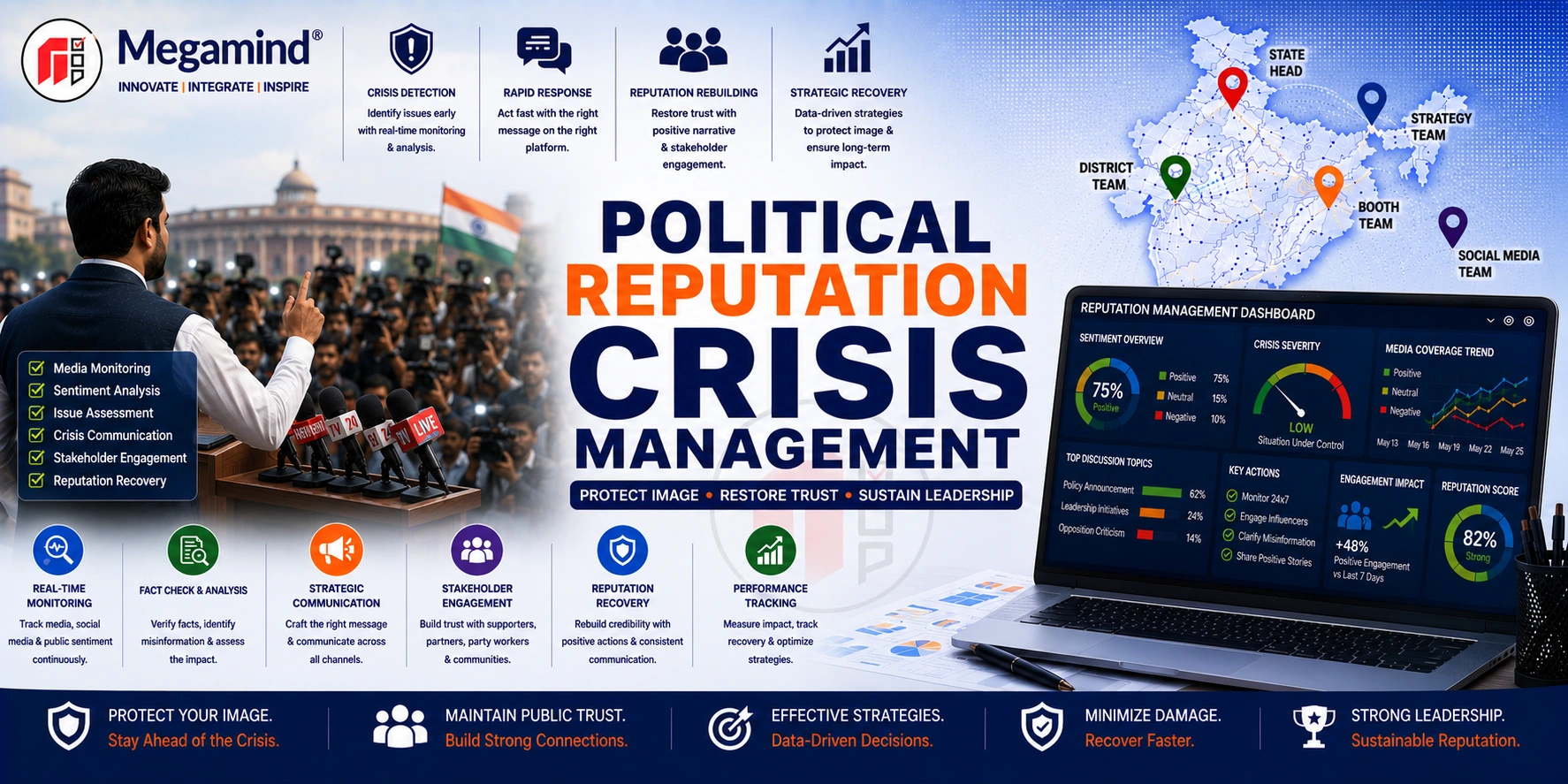
Political reputation can be affected by public statements, campaign events, media reports, digital discussions, allegations, factual disputes, communication mistakes and rapidly developing political events. Megamind's Political Reputation & Crisis Management framework creates a structured operating chain: Monitor → Detect → Verify → Assess → Classify → Escalate → Prepare → Approve → Communicate → Monitor → Review → Recover .
What is Political Reputation & Crisis Management?
Political Reputation & Crisis Management is the structured process of identifying, monitoring, verifying, assessing and managing reputation-related issues that may affect a political candidate, leader, campaign or organization.
The service combines reputation monitoring with crisis preparedness and coordinated response management.
It can help answer operational questions such as:
- What reputation-related issues are emerging?
- Where did the information originate?
- Is the information verified?
- Is it a factual issue, allegation or commentary?
- How urgent is the issue?
- Which campaign team should review it?
- Does management escalation become necessary?
- Is a factual clarification appropriate?
- Who is authorized to approve communication?
- Which communication channels are appropriate?
- What happened after the response?
- What longer-term reputation action may be required?
A political reputation issue should not automatically trigger an immediate public reaction. The first requirement is often to understand what happened, identify the original source, verify available information, assess significance and determine whether a response is necessary. Speed is important in a genuine crisis, but unverified speed can create a second crisis.
Why Political Reputation & Crisis Management Matters
Modern political communication operates across television, newspapers, digital media, social platforms, public meetings, interviews, speeches and direct campaign communication.
Information can move quickly between these environments. Without a defined crisis-management process, campaign teams may react inconsistently or without adequate verification.
Common reputation-management challenges can include:
- Delayed detection of important public issues
- Unverified information reaching campaign management
- Different teams giving inconsistent responses
- No defined issue severity framework
- No clear escalation process
- Unclear communication approval authority
- Media and digital teams working separately
- Old information being presented without context
- Allegations being confused with established facts
- Repeated responses increasing issue visibility
- No documentation of previous responses
- No post-crisis reputation review
Our Political Reputation & Crisis Management Services
Political Reputation Assessment
Structured review of relevant public information, communication history, media context and known reputation issues.
Reputation Monitoring
Organized monitoring of relevant public, media and digital developments for reputation-related issues.
Political Issue Monitoring
Identification, documentation and review of emerging campaign-side reputation and communication issues.
Crisis Preparedness
Development of crisis roles, escalation procedures, verification steps, approval workflows and response readiness.
Issue Verification
Structured review of sources, available evidence, factual status and uncertainty before campaign communication decisions.
Crisis Response Coordination
Coordination of authorized campaign teams, verification, communication review, approval and follow-up during significant issues.
Factual Clarification Support
Preparation and coordination of evidence-supported factual clarification where appropriate and authorized.
Media Crisis Coordination
Coordination with authorized PR and media functions for factual statements, press responses and media communication.
Digital Reputation Monitoring
Review of relevant publicly available digital developments without treating online activity as representative voter opinion.
Escalation Management
Defined issue ownership, severity classification, management escalation and pending-action tracking.
Reputation Recovery Planning
Structured post-issue review, factual communication, unresolved-question tracking and longer-term reputation planning.
Election War Room Integration
Integration of reputation monitoring, verification, escalation, communication coordination and management review with War Room operations.
Political Reputation Assessment
A reputation-management project can begin with a structured assessment of the existing public-information environment.
The assessment can review relevant areas such as:
- Candidate public profile
- Leadership communication history
- Publicly available biography information
- Relevant media coverage
- Previous public statements
- Known public controversies
- Previously issued clarifications
- Public campaign communication
- Relevant digital presence
- Publicly documented allegations
- Verified responses or records
- Existing reputation-management processes
The purpose is not to manufacture an artificial image. It is to understand the existing information environment and establish an evidence-based reputation-management process.
Political Reputation Risk Audit
A reputation audit can identify areas where campaign teams may require stronger documentation, monitoring, communication discipline or crisis preparedness.
Information Audit
Review important public claims, records, statements and available supporting information.
Communication Audit
Review consistency across authorized campaign, candidate, media and digital communication.
Media Audit
Review relevant public media coverage and recurring reputation themes.
Digital Audit
Review relevant public digital presence and documented reputation issues.
Process Audit
Review how the campaign currently detects, verifies, escalates and responds to issues.
Readiness Audit
Review whether crisis roles, contacts, approvals and response processes are ready.
Establishing a Political Reputation Baseline
Monitoring becomes more useful when campaign teams understand the existing reputation environment before a new issue occurs.
A baseline can document:
- Established public facts
- Authorized candidate information
- Frequently discussed public issues
- Recurring media themes
- Previous factual clarifications
- Relevant public records
- Known unresolved public questions
- Existing communication positions
- Important source documents
- Approved spokesperson information
Political Reputation Monitoring Framework
Reputation monitoring is most useful when information is collected and organized through a defined process rather than simply forwarding every mention to senior campaign leadership.
A monitoring framework can record:
- Date and time
- Issue category
- Original source
- Source type
- Available evidence
- Verification status
- Public visibility
- Operational significance
- Assigned reviewer
- Escalation status
- Response status
- Current issue status
Political Media Reputation Monitoring
Relevant publicly available media coverage can be reviewed to identify developments that may affect campaign communication or reputation management.
Monitoring can cover appropriate public sources such as:
- News reports
- Published interviews
- Television coverage
- Press statements
- Public press conferences
- Published opinion or commentary
- Candidate public statements
- Party public statements
- Publicly available corrections
- Officially published information where relevant
Reporting should distinguish factual reporting from commentary, allegation and opinion.
Political Digital Reputation Monitoring
Digital platforms can surface issues quickly, but digital visibility alone does not establish whether a claim is accurate or whether it reflects broader public opinion.
Digital reputation monitoring can focus on:
- Relevant public posts
- Public campaign references
- Publicly visible issue trends
- Published videos
- Public statements
- Relevant high-visibility claims
- Publicly available corrections
- Source identification
- Issue verification status
- Authorized response status
Online Activity Is Not Representative Public Opinion
Views, likes, shares, comments, reposts, hashtags and other platform activity can help identify what is publicly visible online.
They should not automatically be interpreted as representative public opinion, constituency-wide sentiment, voting intention, vote share or election outcome.
Where representative public opinion is required, an appropriately designed Political Survey should be treated separately from digital monitoring.
Political Reputation Issue Intake System
Reputation issues can reach a campaign from many sources. A structured intake process can reduce duplication and confusion.
An issue intake record can include:
- Issue reference number
- Date and time identified
- Person or team reporting the issue
- Original source
- Issue summary
- Available supporting material
- Initial verification status
- Initial severity
- Assigned reviewer
- Required next action
Verify Before Responding
Reputation management should distinguish between the fact that a claim exists and whether the claim itself has been established.
Verification can involve:
- Identifying the earliest available source
- Reviewing the complete statement or material
- Checking whether content is presented out of context
- Reviewing available public records
- Checking authorized campaign records
- Separating direct evidence from commentary
- Identifying missing information
- Recording conflicting evidence
- Documenting uncertainty
- Escalating specialist review where required
Facts, Allegations, Opinions & Unverified Claims
Reputation reports should avoid presenting every statement as having the same evidentiary status.
Political Crisis Preparedness Framework
Crisis management should begin before a crisis occurs.
A preparedness framework can establish:
- Crisis management roles
- Primary issue coordinator
- Verification responsibilities
- Management escalation contacts
- Communication responsibilities
- Authorized spokesperson process
- Media coordination process
- Digital coordination process
- Approval hierarchy
- Relevant specialist review process
- Emergency meeting process
- Issue documentation format
- Monitoring process
- Post-crisis review process
Political Crisis Management Team Structure
Significant reputation issues can require coordinated review by multiple authorized campaign functions.
Campaign Management
Provides authorized operational coordination and management review.
Research & Verification
Reviews available sources, records, evidence and factual status.
Communication
Coordinates authorized factual communication and approved messaging.
PR & Media
Coordinates authorized press and media communication where required.
Digital Operations
Coordinates approved digital communication and public digital monitoring.
Election War Room
Supports centralized campaign-side monitoring, escalation and management coordination.
Political Crisis Severity Classification
Not every negative mention is a crisis. A severity framework can help campaign teams determine the appropriate level of review.
Classification should be based on documented operational criteria rather than emotional reaction.
Factors Used to Assess a Political Reputation Issue
Depending on context, an issue can be reviewed against factors such as:
- Source credibility
- Verification status
- Nature of available evidence
- Public visibility
- Media visibility
- Digital visibility
- Rate of development
- Candidate relevance
- Campaign operational impact
- Need for factual clarification
- Legal or compliance implications requiring specialist review
- Risk of unnecessary amplification
Political Crisis Escalation Matrix
A defined escalation matrix helps ensure that significant issues reach the appropriate authorized campaign roles without sending every minor mention to senior management.
The matrix can define:
- Issue severity
- Initial reviewer
- Functional owner
- Campaign manager escalation
- Senior management escalation
- Communication review requirement
- PR/media review requirement
- Digital review requirement
- Specialist review where appropriate
- Approval authority
- Monitoring responsibility
- Closure authority
Political Crisis Response Management Process
Not Every Political Reputation Issue Requires a Public Response
Responding to every low-visibility claim can sometimes give additional visibility to an issue that would otherwise remain limited.
An authorized campaign review can consider:
- Whether the issue is verified
- Whether the issue is materially relevant
- Whether reliable evidence is available
- Whether a factual clarification is needed
- Whether silence could create material confusion
- Whether a response could unnecessarily amplify the issue
- Whether another authorized source has already clarified it
- Whether specialist review is required
- Which channel, if any, is appropriate
- Who is authorized to communicate
Evidence-Based Political Clarification
Where a public clarification is appropriate, it should be based on available reliable evidence and approved information.
A clarification workflow can include:
- Identify the specific claim
- Identify available evidence
- Confirm factual status
- Document source material
- Prepare a concise clarification
- Complete required review
- Obtain authorized approval
- Select an appropriate communication channel
- Publish through authorized accounts or spokespersons
- Monitor subsequent developments
Principles for Responsible Political Crisis Communication
- Verify before making factual claims
- Distinguish allegations from established facts
- Use authorized communication channels
- Maintain source documentation
- Avoid fabricated achievements
- Avoid false endorsements
- Avoid impersonation
- Avoid fabricated quotations
- Avoid manipulated evidence presented as authentic
- Avoid knowingly false counterclaims
- Correct material errors where appropriate
- Follow applicable election and communication requirements
Political Media Crisis Response Coordination
Significant reputation issues may generate media inquiries, interview requests, requests for clarification or press coverage.
Media crisis coordination can include:
- Media issue identification
- Relevant source collection
- Fact verification coordination
- Approved factual briefing
- Authorized spokesperson coordination
- Press response coordination
- Statement approval workflow
- Interview briefing support
- Media monitoring after response
- Correction tracking where relevant
This specialist crisis layer can work with Political PR & Media Management .
Political Digital Crisis Management
Digital issues can develop rapidly and require coordination between monitoring, verification, communication and authorized publishing teams.
Digital crisis coordination can include:
- Original digital source identification
- Relevant public-content review
- Verification status
- Issue severity assessment
- Approved response decision
- Content preparation
- Fact review
- Approval workflow
- Authorized publishing coordination
- Post-response monitoring
Explore: Digital Election Campaign Management .
Crisis Content & Creative Coordination
Crisis communication may require approved statements, factual cards, video statements, briefing notes, FAQs or other campaign content.
Content production should remain connected to the verified source material and approved communication position.
The workflow can connect:
Verified Information → Communication Brief → Draft → Fact Review → Approval → Creative Preparation → Authorized Publishing → Monitoring
Candidate Statement & Briefing Coordination
Where a candidate or authorized spokesperson is expected to address a significant issue, preparation can focus on accurate briefing rather than creating unsupported claims.
A briefing pack can include:
- Verified issue summary
- Timeline of relevant events
- Available supporting records
- Confirmed facts
- Unverified or disputed points
- Previously issued statements
- Likely factual questions
- Approved clarification points
- Information that still requires verification
- Relevant supporting documents
Political Rapid Response Coordination
Rapid response should mean faster coordination—not removal of verification and approval controls.
A rapid-response workflow can predefine:
- Monitoring responsibility
- Emergency contact list
- Primary issue coordinator
- Verification team
- Management escalation path
- Communication lead
- Approval authority
- Authorized publishing channels
- Post-response monitoring
- Issue closure review
Political Crisis Response Time Framework
Different issues require different levels of urgency. A response-time framework can define internal review expectations according to severity.
It can establish target timeframes for:
- Initial issue acknowledgment
- Source collection
- Initial verification
- Severity assessment
- Management escalation
- Communication drafting
- Required review
- Approval
- Authorized publication
- Post-response review
Internal speed targets should never require teams to represent unverified information as established fact.
Responsible Handling of Rumours & Unverified Political Claims
Campaign teams may encounter rumours or claims for which adequate verification is unavailable.
Responsible handling can include:
- Record the original claim
- Identify the original source where possible
- Assess available evidence
- Mark unverified information clearly
- Avoid repeating the claim unnecessarily
- Avoid creating a fabricated counter-story
- Determine whether factual clarification is possible
- Monitor material developments
- Update status when evidence changes
Political Communication Correction & Update Workflow
If authorized campaign communication contains a material factual error, a defined correction process can help the team review and address it appropriately.
A correction workflow can include:
- Error identification
- Original material review
- Fact verification
- Impact assessment
- Correction preparation
- Approval
- Update or correction publication
- Version documentation
- Internal learning review
Political Reputation Issue Register
A centralized issue register can create continuity between monitoring, verification, communication and management review.
An issue register can contain:
- Issue ID
- Issue title
- Date detected
- Source
- Source reference
- Verification status
- Severity level
- Assigned owner
- Management escalation status
- Communication decision
- Response status
- Supporting documents
- Latest update
- Current status
- Closure notes
Political Reputation & Crisis Management Dashboard
A management dashboard can summarize authorized operational information without replacing detailed source review.
Open Issues
Number and status of currently open reputation issues.
Severity Status
Distribution of monitored issues across defined operational severity levels.
Verification Status
Issues verified, under review, disputed or still requiring additional information.
Response Status
Issues requiring no response, under preparation, approved, communicated or closed.
Pending Actions
Outstanding verification, communication or management-review actions.
Management Escalations
Priority issues requiring authorized senior campaign review.
Political Reputation & Crisis Reporting
Depending on campaign requirements, reporting can be structured at different frequencies.
- Daily reputation monitoring summary
- Priority issue alert
- Issue verification note
- Crisis briefing note
- Management escalation report
- Media issue summary
- Digital issue summary
- Response status report
- Pending-action report
- Weekly reputation review
- Post-crisis assessment report
Reputation Management & Election Campaign MIS
Reputation issues can be incorporated into authorized campaign reporting systems so that management can review issue status alongside other campaign operations.
The reporting chain can follow:
Issue Detected → Verification → Severity → Owner → Response Decision → Action → Monitoring → MIS → Management Review → Closure
Explore: Election Campaign MIS & Reporting System .
Political Crisis Management & Election War Room
During intensive campaign periods, the Election War Room can provide a centralized campaign-side environment for reputation monitoring and crisis coordination.
War Room integration can connect:
- Reputation monitoring
- Media monitoring
- Digital monitoring
- Issue intake
- Source verification
- Severity classification
- Management escalation
- Communication coordination
- Response approval status
- Pending-action tracking
- Post-response monitoring
- Management reporting
Explore: Election War Room Management .
Crisis Roles within Campaign Organization
Crisis management becomes more effective when responsibilities are established before an urgent issue develops.
Campaign organization can define:
- Issue monitoring owner
- Verification owner
- Communication owner
- Media coordination owner
- Digital coordination owner
- Campaign management reviewer
- Approval authority
- Escalation authority
- War Room coordinator
- Post-crisis review owner
Explore: Campaign Organization & Team Management .
Technology for Political Reputation & Crisis Management
Appropriate campaign technology can help organize issue records, reporting and authorized management workflows.
Technology support can include:
- Issue-management dashboard
- Issue status tracking
- Severity classification
- Task assignment
- Document references
- Response status
- Pending-action tracking
- Management reporting
- Role-based access
- Audit records where appropriate
Explore: Political Campaign Technology & Software Solutions .
Political Reputation Data & Information Governance
Reputation-management projects can involve internal campaign records, public-source material, draft communications and issue documentation.
Appropriate information governance can include:
- Purpose limitation
- Data minimization
- Source documentation
- Role-based access
- Controlled sharing
- Secure storage
- Document versioning
- Approval records
- Retention controls
- Appropriate deletion or archival processes
Reputation Management Without Sensitive Individual Political Profiling
Political reputation and crisis management does not require building sensitive political profiles of individual voters.
Reputation work can focus on relevant public information, verified campaign records, public media, public communication and legitimate campaign operational information.
Megamind's responsible framework does not require inferring an identifiable individual's political preference or persuadability from religion, caste, ethnicity, health, sexuality or other sensitive personal characteristics.
Responsible Use of Public and Campaign Information
The fact that information appears online does not remove the need for responsible handling.
Projects should use information for legitimate and defined purposes, avoid unnecessary collection of personal data, maintain appropriate access controls and follow applicable privacy, election, communication and platform requirements.
Crisis Management Without Fabricated Political Information
Reputation management should not create another information problem while attempting to respond to the first one.
Responsible political crisis management should not rely on:
- Fabricated achievements
- Fabricated endorsements
- False quotations
- Impersonation
- Falsified public records
- Knowingly false accusations
- Manipulated evidence presented as authentic
- Fabricated news reports
- Misrepresentation of paid content as independent journalism
- False official notices
Election, Communication & Platform Compliance
Political crisis communication may intersect with election rules, advertising requirements, platform policies, privacy requirements and other applicable obligations.
Where an issue raises legal or regulatory questions, appropriate qualified specialist review should be obtained rather than treating campaign communication management as a substitute for legal advice.
Political Reputation Recovery Planning
Crisis management does not necessarily end when the immediate issue becomes less active.
A recovery review can examine:
- Current issue status
- Remaining factual questions
- Publicly available corrections
- Unresolved media inquiries
- Communication consistency
- Candidate briefing requirements
- Stakeholder communication requirements
- Ongoing monitoring requirements
- Longer-term reputation implications
- Process improvements
Post-Crisis Political Reputation Recovery Cycle
Political Reputation & Crisis Management vs Candidate Image Management
Political Reputation & Crisis Management
Focuses on reputation risks, issue monitoring, crisis preparedness, verification, escalation, factual response coordination and post-crisis recovery.
Candidate Image & Reputation Management
Focuses more broadly on the candidate's authentic long-term public profile, communication consistency, leadership positioning and ongoing reputation management.
Explore: Candidate Image & Reputation Management .
Political Crisis Management vs Political PR & Media Management
Political Reputation & Crisis Management
Concentrates on reputation-risk monitoring, significant issue assessment, crisis readiness, verification, escalation, response coordination and recovery.
Political PR & Media Management
Concentrates on broader routine media relations, press communication, media coordination, interviews, press conferences, press releases and ongoing media engagement.
Political Reputation Management vs Political Branding
Reputation & Crisis Management
Protects operational readiness around reputation issues through monitoring, verification, coordination and evidence-based response processes.
Political Branding & Communication
Develops broader authentic political positioning, campaign identity, leadership communication and coordinated public communication.
Explore: Political Branding & Communication .
Political Reputation Management Across the Campaign Lifecycle
Reputation & Crisis Management within Election Campaign Management
Reputation management should not operate in isolation from the rest of the campaign.
It can integrate with:
- Election Strategy & Planning
- Political Research & Election Intelligence
- Political Branding & Communication
- Candidate Image & Reputation Management
- Political PR & Media Management
- Political Campaign Content & Creative Management
- Digital Election Campaign Management
- Campaign Organization & Team Management
- Election Monitoring & Campaign Performance
- Election Campaign MIS & Reporting
- Election War Room Management
Explore: Election Campaign Management .
Political Reputation Management for Assembly Campaigns
Assembly campaigns often operate in highly localized media and public-information environments.
A constituency-level reputation framework can connect:
- Candidate campaign office
- Campaign management
- Local media monitoring
- Digital monitoring
- Research and verification
- Communication team
- PR and media team
- Content team
- Campaign MIS
- Election War Room
Reputation & Crisis Management for Parliamentary Campaigns
Parliamentary campaigns can involve a wider geographic area, multiple Assembly segments and a larger volume of campaign communication.
A structured model can coordinate:
- Central campaign reputation monitoring
- Assembly-segment issue reporting
- Media monitoring
- Digital monitoring
- Verification team
- Issue escalation
- Communication coordination
- Management review
- MIS reporting
- War Room integration
Reputation Management Across Multiple Constituencies
Multi-constituency projects can use standardized issue classification, reporting and escalation while preserving the context of each constituency.
Standardization can cover:
- Issue categories
- Verification status
- Severity levels
- Reporting format
- Escalation matrix
- Response approval workflow
- Dashboard structure
- Management review
Political Reputation Management for Different Campaign Scales
Candidate-Level Project
Focused reputation assessment, monitoring, preparedness and issue-management framework for an individual authorized campaign.
Constituency Campaign
Integrated monitoring and crisis workflow for an Assembly or similar constituency campaign.
Parliamentary Campaign
Multi-segment monitoring, centralized escalation, communication coordination and reporting.
Multi-Constituency Project
Standardized reputation monitoring and escalation across multiple campaign units.
Campaign War Room
High-frequency monitoring, issue escalation, verification and management review.
Integrated Campaign
Reputation management integrated with research, communication, digital, PR, MIS and campaign management.
Who Can Use Political Reputation & Crisis Management?
- Political parties
- Political candidates
- Prospective candidates
- Political leaders
- Candidate campaign offices
- Assembly election campaigns
- Parliamentary election campaigns
- Multi-constituency campaign organizations
- Political communication teams
- Authorized Election War Rooms
Political Reputation & Crisis Management Deliverables
Deliverables can be customized according to project scope, campaign scale, monitoring requirements and communication responsibilities.
- Political Reputation Assessment
- Reputation Risk Audit
- Reputation Baseline Report
- Reputation Monitoring Framework
- Media Monitoring Framework
- Digital Reputation Monitoring Framework
- Political Issue Register
- Issue Intake Format
- Source Verification Framework
- Evidence Classification Framework
- Crisis Preparedness Plan
- Crisis Team Responsibility Matrix
- Issue Severity Matrix
- Crisis Escalation Matrix
- Crisis Response Workflow
- Communication Approval Workflow
- Factual Clarification Framework
- Candidate Briefing Format
- Rapid Response Framework
- Correction & Update Workflow
- Reputation Dashboard
- Daily Reputation Report
- Priority Issue Alert Format
- Weekly Reputation Review
- Post-Crisis Review Report
- Reputation Recovery Plan
- War Room Integration Framework
Benefits of Structured Political Reputation Management
- Better reputation monitoring discipline
- Earlier identification of significant issues
- Clear separation of facts and allegations
- Improved source verification
- Defined crisis roles
- Clear issue escalation
- Better communication coordination
- Improved response approval discipline
- Better PR and digital coordination
- Centralized issue documentation
- Improved management visibility
- Better post-crisis learning
- Stronger War Room integration
- More consistent factual communication
Common Political Reputation & Crisis Management Challenges
- Responding before verification
- Reacting to every negative mention
- No central issue register
- No issue severity classification
- Unclear response authority
- Different teams issuing inconsistent communication
- Media and digital teams working independently
- Unverified claims entering management reports
- Weak source documentation
- No correction workflow
- No crisis rehearsal or preparedness
- Weak escalation process
- No post-crisis review
- Treating online engagement as representative voter opinion
Customized Political Reputation & Crisis Management
Reputation-management requirements vary according to the candidate, campaign scale, communication environment, election phase and existing campaign organization.
Projects can be customized according to:
- Candidate requirements
- Election type
- Campaign geography
- Campaign duration
- Media environment
- Digital campaign requirements
- Monitoring frequency
- Reporting frequency
- Existing PR and communication team
- Campaign MIS requirements
- Election War Room requirements
- Multi-constituency requirements
Political Reputation Management Does Not Guarantee Public Opinion or Election Results
Structured reputation management can improve monitoring, preparedness, verification, coordination and factual communication.
It cannot guarantee favorable media coverage, eliminate all criticism, control independent public discussion, determine individual political preferences or guarantee an election result.
Monitor → Verify → Assess → Coordinate → Respond → Review
Megamind connects Political Research + Reputation Monitoring + Candidate Communication + PR & Media + Digital Campaign + Content Management + Campaign MIS + Election War Room within a structured reputation and crisis-management framework.
Our operational cycle can follow:
Establish Baseline → Monitor Public Information → Detect Issue → Identify Source → Verify Evidence → Classify Issue → Assess Severity → Escalate → Prepare Factual Response → Review → Approve → Coordinate Communication → Monitor Development → Review Recovery → Improve Preparedness
The objective is not to create artificial narratives. The objective is to help authorized campaign teams understand reputation issues, verify information, coordinate factual communication and manage significant developments through a disciplined process.
Discuss Reputation & Crisis Management Requirements →Why Megamind for Political Reputation & Crisis Management?
Political crisis management requires more than monitoring public mentions. Effective management requires source verification, campaign coordination, communication workflows, issue escalation, reporting and management visibility.
- Political campaign domain understanding
- Political research integration
- Structured reputation assessment
- Media and digital monitoring coordination
- Issue verification framework
- Crisis preparedness planning
- Severity and escalation frameworks
- Factual communication coordination
- Political PR integration
- Digital campaign integration
- Campaign content integration
- Campaign MIS integration
- Campaign technology capability
- Election War Room integration
- Customized campaign frameworks
FAQs About Political Reputation & Crisis Management
1. What is Political Reputation & Crisis Management?
Political Reputation & Crisis Management is the structured process of monitoring reputation-related issues, preparing for potential communication crises, assessing verified information, coordinating authorized factual responses, managing escalation and reviewing reputation recovery requirements.
2. Why is reputation management important in political campaigns?
Political campaigns operate in fast-moving public, media and digital environments. Structured reputation management helps authorized campaign teams identify issues, verify information, coordinate communication and respond through defined review and approval processes.
3. Does Megamind provide Political Reputation & Crisis Management services in India?
Yes. Megamind provides customized Political Reputation & Crisis Management support in India according to campaign requirements, project scope and authorized communication responsibilities.
4. What is political reputation monitoring?
Political reputation monitoring is the organized review of relevant public, media, digital and campaign information to identify reputation-related developments that may require verification, review or authorized response.
5. What is political crisis preparedness?
Political crisis preparedness establishes roles, escalation procedures, verification steps, approval responsibilities, communication channels and response workflows before a significant reputation issue occurs.
6. Can Megamind develop a political crisis response framework?
Yes. A customized framework can define issue intake, verification, severity classification, escalation, responsible teams, approval requirements, factual response coordination, monitoring and post-issue review.
7. Can political media issues be monitored?
Relevant publicly available media coverage can be monitored and organized for campaign-side review, subject to project scope and applicable requirements.
8. Can digital reputation issues be monitored?
Relevant publicly available digital developments can be monitored for issue identification and authorized campaign review. Online activity should not automatically be treated as representative public opinion or voting intention.
9. How are political crisis issues verified?
Verification can involve identifying the original source, reviewing available evidence, separating confirmed information from allegations or commentary, checking authorized records where appropriate and documenting uncertainty before communication decisions are made.
10. Can factual clarification be coordinated during a political crisis?
Yes. Where reliable evidence and authorization are available, factual clarification can be prepared and coordinated through appropriate communication and approval channels.
11. Does crisis management include spreading counter-rumours or fabricated information?
No. Responsible crisis management should not rely on fabricated claims, impersonation, false endorsements, manipulated evidence or knowingly false information.
12. Can crisis communication integrate with Political PR & Media Management?
Yes. Reputation and crisis workflows can coordinate with authorized PR and media operations for factual statements, media responses, press coordination and communication review.
13. Can crisis management integrate with Digital Election Campaign Management?
Yes. Digital monitoring, approved digital responses, content coordination and reporting can connect with the broader crisis-management workflow.
14. Can Political Reputation & Crisis Management integrate with Candidate Image Management?
Yes. Candidate Image Management can support longer-term public positioning, while Political Reputation & Crisis Management focuses more specifically on reputation risks, significant issues, crisis preparedness, response coordination and recovery.
15. Can political crisis issues be classified by severity?
Yes. An operational severity framework can classify verified or potentially significant issues according to factors such as urgency, source credibility, public visibility, operational impact and communication requirements.
16. What is a political crisis escalation matrix?
A crisis escalation matrix defines which authorized campaign roles should review different categories of issues, when management escalation is required and who is responsible for approval and follow-up.
17. Can a crisis communication approval workflow be created?
Yes. A workflow can define drafting, fact review, legal or compliance review where required, management approval, authorized publication and subsequent monitoring.
18. Can political reputation reports and dashboards be prepared?
Yes. Depending on project scope, authorized dashboards and reports can summarize monitored issues, verification status, severity, response status, pending actions and management review requirements.
19. Can Political Reputation & Crisis Management integrate with an Election War Room?
Yes. Reputation monitoring, issue escalation, verification, communication coordination and management review can be integrated with authorized Election War Room operations.
20. Can the service support Assembly and Parliamentary election campaigns?
Yes. The framework can be customized for Assembly, Parliamentary and multi-constituency campaigns according to scale and agreed project requirements.
21. Does political reputation management require sensitive voter profiling?
No. Reputation and crisis management can focus on public information, campaign operations, media and communication issues without inferring identifiable individuals' political preferences or using sensitive personal attributes for political profiling.
22. Can reputation recovery be planned after a political crisis?
Yes. After the immediate issue is stabilized, an authorized recovery plan can focus on factual communication, unresolved questions, stakeholder communication, monitoring and longer-term reputation review.
23. What deliverables can Political Reputation & Crisis Management include?
Deliverables can include reputation assessments, issue registers, monitoring frameworks, crisis response plans, severity matrices, escalation matrices, verification workflows, approval processes, communication coordination frameworks, dashboards and post-crisis review reports.
24. Can this service integrate with full Election Campaign Management?
Yes. Political Reputation & Crisis Management can operate as a specialist reputation-risk and crisis-response layer within broader Election Campaign Management.
25. Does Political Reputation & Crisis Management guarantee a positive reputation or election victory?
No. Structured reputation and crisis management can improve preparedness, coordination and factual communication, but it cannot guarantee public opinion, media coverage, voter behavior or election results.
Building a Structured Political Reputation & Crisis Management System
Political reputation cannot be managed effectively through isolated reactions to individual news reports, posts or allegations.
A stronger system connects: Reputation Monitoring + Source Verification + Issue Classification + Crisis Preparedness + Escalation + Factual Communication + Media Coordination + Digital Coordination + Campaign MIS + Election War Room + Reputation Recovery .
Megamind's Political Reputation & Crisis Management framework is designed to help authorized political campaigns organize these functions into a disciplined, evidence-aware and accountable management process.
Build a Structured Political Reputation & Crisis Management Framework
Discuss your Political Reputation Assessment, Reputation Monitoring, Crisis Preparedness, Issue Verification, Media & Digital Monitoring, Crisis Escalation, Factual Communication, Reputation Reporting, Recovery Planning and Election War Room integration requirements with Megamind.
Discuss Reputation & Crisis Management