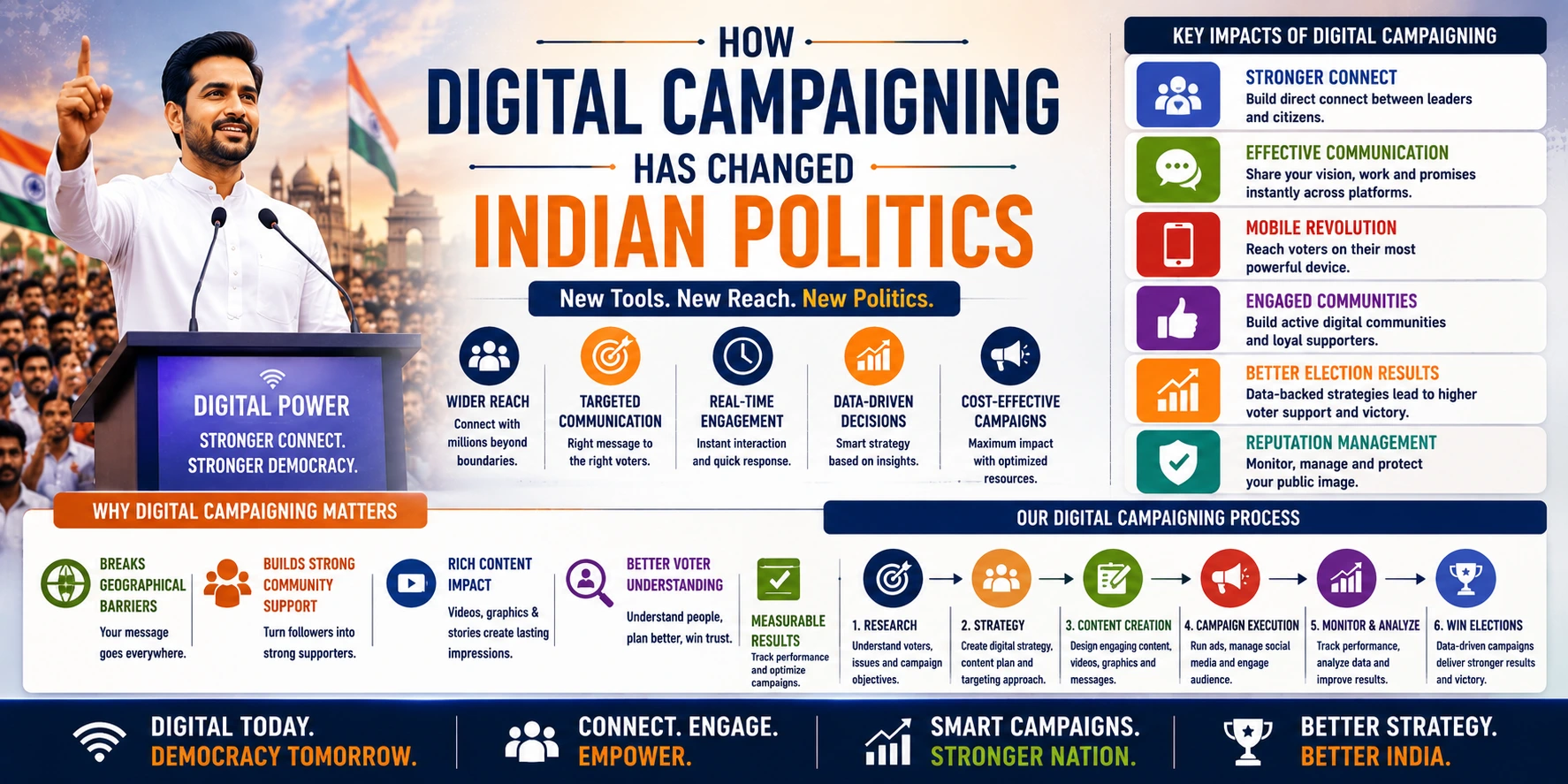
Digital campaigning has significantly changed how political communication is planned, produced, distributed and measured in India. Election campaigns that once depended primarily on rallies, public meetings, posters, print advertisements and door-to-door communication now operate in an environment where social media, messaging platforms, websites, online video, digital advertising and analytics can function alongside traditional ground campaigning. This transformation is not simply about moving political communication from offline to online platforms. Digital campaigning has changed the speed, scale, format, frequency and measurability of political communication and has created a more continuous relationship between public events, media coverage, digital content and ground activity.
What is Digital Campaigning in Politics?
Digital campaigning in politics refers to the organized use of digital platforms, online communication channels, content, advertising, technology and analytics for political communication and campaign operations.
It may include social-media management, campaign websites, video communication, online advertising, messaging channels, content production, digital public relations, online-event promotion, campaign monitoring and performance analytics.
Digital campaigning is therefore broader than simply posting on social media. A mature digital campaign connects strategy, communication, content, distribution, monitoring and analytics into one coordinated system.
How Digital Campaigning Changed Indian Politics
Digital platforms changed the political communication environment by reducing the distance between campaign organizations and the public. Information that once depended heavily on physical events or traditional media distribution can now be published and updated rapidly across multiple digital channels.
- Made political communication faster and more continuous
- Expanded communication beyond physical campaign events
- Created direct digital channels for public information
- Increased the importance of video and visual communication
- Made communication performance more measurable
- Connected campaign events with real-time digital coverage
- Created new requirements for online reputation monitoring
- Made rapid-response communication more important
Digital campaigning has not made traditional campaigning irrelevant. Instead, modern election campaigns increasingly operate as an integrated digital + ground communication ecosystem. A rally, field visit or public meeting can generate digital content, while digital communication can inform people about upcoming ground activities.
Traditional Campaigning vs Digital Campaigning
Traditional and digital campaigning use different communication environments, but they do not necessarily compete with each other. They can perform complementary functions within an integrated campaign.
Traditional Campaigning
Includes rallies, public meetings, door-to-door outreach, posters, pamphlets, local events, field teams and other physical campaign activities.
Digital Campaigning
Includes websites, social media, digital content, video, messaging platforms, online advertising, digital PR and analytics.
Ground campaigning provides physical presence and local interaction, while digital communication can provide speed, continuity, documentation and broader distribution.
Key Components of a Political Digital Campaign
A professional digital campaign usually involves several connected functions rather than a single social-media channel.
Digital Strategy
Defines communication objectives, platform roles, content priorities, workflows and measurement standards.
Social Media
Manages official campaign communication, updates, public information and digital engagement.
Content Production
Produces graphics, videos, photographs, explainers, speeches, campaign updates and other digital material.
Video Communication
Uses short videos, interviews, speeches, event coverage and longer-form video for digital communication.
Digital Advertising
Uses platform advertising tools to distribute permitted campaign communication within applicable rules.
Digital PR
Coordinates public statements, media content, campaign updates and online reputation monitoring.
Messaging Channels
Supports authorized organizational communication, volunteer coordination and distribution of campaign information.
Analytics
Measures content reach, engagement, traffic, advertising performance and other operational indicators.
Monitoring
Tracks campaign communication, public issues, media developments and digital-platform activity.
Role of Social Media in Indian Politics
Social media has become an important channel for political communication because it allows political parties, candidates and leaders to publish information without depending entirely on traditional media distribution.
Platforms such as Facebook, Instagram, YouTube and X can be used for campaign updates, speeches, public-event coverage, issue explanations, announcements and other political communication.
- Official campaign announcements
- Public meeting and event updates
- Speeches and interview distribution
- Issue and policy communication
- Campaign photographs and video coverage
- Public statements and clarifications
- Live communication during major events
- Digital archive of campaign activities
WhatsApp and Messaging Platforms in Political Campaigns
Messaging platforms can play an important role in internal campaign coordination and authorized information distribution. They allow campaign teams to share schedules, public-event information, approved communication material and operational updates quickly.
They can also help coordinate volunteers and field teams where appropriate. However, responsible use is important. Communication should respect applicable privacy requirements, platform policies, consent expectations and election-related rules.
Unverified information should not be distributed merely because messaging platforms make forwarding fast and easy.
YouTube, Reels and Video-Based Political Communication
Video has become one of the most visible forms of online political communication. It can document events, explain complex subjects and make speeches or public statements available beyond the physical audience present at an event.
Different formats can serve different communication purposes.
- Candidate or leader introduction videos
- Public meeting and rally highlights
- Interviews and discussions
- Issue-explainer videos
- Development and project information
- Short-form reels and vertical videos
- Long-form speeches and conversations
- Live streaming of permitted public events
Role of Content Strategy in Digital Campaigning
Publishing frequently is not the same as having a content strategy. Political communication can become fragmented when different teams publish unrelated messages without common priorities or approval processes.
A structured content system can define what information should be communicated, which format is appropriate, which platform should carry it and how published information will be reviewed.
- Campaign and organizational updates
- Issue and policy explainers
- Public-event coverage
- Leadership communication
- Short-form visual content
- Long-form informational content
- Media statements and clarifications
- Frequently asked public questions
How a Structured Digital Campaign Works
A professional digital campaign requires a workflow connecting planning, content creation, publishing, monitoring and analysis.
Role of Online Advertising in Political Campaigns
Online advertising allows political campaigns to distribute approved digital communication through advertising platforms while controlling factors such as budget, schedule and geographic coverage where the platform and applicable rules permit.
Unlike organic publishing, paid distribution provides additional measurement information such as impressions, reach, video views, clicks and expenditure.
Political advertising can be subject to platform-specific requirements and election-related rules. Campaign teams should therefore review applicable authorization, disclosure, expenditure and content requirements before running advertisements.
- Campaign announcement promotion
- Public-event information
- Issue and policy communication
- Video distribution
- Website and information-page promotion
- Reach and impression measurement
- Budget and delivery monitoring
- Creative-performance comparison
Why Campaign Websites Still Matter
Social-media platforms are important distribution channels, but a campaign website can provide a more stable source for official information.
Websites can organize biographies, public statements, campaign updates, policy information, event details, media resources and contact information in one searchable location.
Unlike a social-media feed, a website also allows information to be structured into permanent pages that can be referenced from multiple digital channels.
Digital Campaigning and Political Branding
Digital platforms have increased the importance of consistency in political communication. A campaign may communicate through websites, social-media profiles, videos, advertisements, press material and offline events simultaneously.
Consistent visual identity and factual communication can make it easier for the public to identify official campaign material and distinguish it from unofficial or misleading content.
- Consistent use of official identity
- Clear visual standards
- Consistent information across platforms
- Organized campaign templates
- Professional photography and video standards
- Clear identification of official channels
How Digital Campaigning Changed Political Communication
Political communication was traditionally shaped by scheduled events, newspapers, television coverage and physical campaign material. Digital platforms have created an environment where political communication can occur continuously.
Campaign organizations can publish statements, event information and clarifications rapidly, but this speed also increases the importance of verification and internal approval.
- Faster publication of official information
- Continuous campaign updates
- Direct access to official statements
- Rapid clarification of inaccurate information
- Coordination between media and digital teams
- Permanent digital archive of communication
Role of Data Analytics in Digital Campaigning
One of the major differences between many traditional communication channels and digital platforms is the availability of measurable operational data.
Digital teams can review indicators such as reach, impressions, video views, website traffic, clicks and engagement to understand how content is being distributed and consumed.
These indicators should be interpreted carefully. A high number of views or interactions does not automatically demonstrate public opinion, electoral support or election outcomes.
- Content reach and impressions
- Video views and completion indicators
- Website visits and traffic sources
- Content interaction trends
- Advertising delivery and expenditure
- Publishing consistency
- Response and moderation workload
- Platform-wise performance comparison
What Should a Digital Campaign Measure?
Effective measurement should be connected to the purpose of the digital activity rather than focusing on one headline metric.
Reach
Measures how widely campaign information is being distributed across digital channels.
Content Consumption
Reviews views, watch time and other indicators showing how published content is being consumed.
Traffic
Measures visits to official websites, information pages and other campaign-owned digital properties.
Engagement
Reviews interactions with published content while recognizing that engagement alone does not equal political support.
Operational Response
Measures publishing speed, issue-response time and coordination across digital teams.
Paid Media Delivery
Reviews expenditure, impressions, reach and other permitted advertising-performance indicators.
How Digital Campaigning Supports Ground Campaigning
Digital campaigning can be most useful when it reflects real campaign activity rather than functioning as an isolated online operation.
Ground events can generate photographs, videos, speeches and local updates for digital communication. Digital channels can, in turn, distribute information about public meetings, campaign schedules and other permitted activities.
- Publicizes scheduled campaign events
- Documents rallies and public meetings
- Shares field and campaign updates
- Supports internal team communication
- Creates digital records of ground activity
- Connects field reporting with central communication teams
This connection is particularly useful when digital teams coordinate with broader Election Campaign Management operations.
Digital Campaigning and Political Public Relations
Political public relations now operates across both traditional and digital media. Public statements, interviews, press conferences and campaign updates may appear on news platforms and social media almost simultaneously.
Digital PR therefore requires coordination between media teams, content teams and campaign leadership so that official information remains consistent.
Monitoring can also help identify inaccurate information or confusion that may require a factual clarification through official channels.
Misinformation, Verification and Digital Campaign Responsibility
The same speed that makes digital communication useful can also allow inaccurate or misleading information to spread quickly.
Political digital teams therefore need strong verification processes. Claims, statistics, photographs, videos and quotations should be checked before publication, particularly when they relate to rapidly developing events.
- Verify important claims before publication
- Check the source and context of photographs and videos
- Maintain approval workflows for official communication
- Correct significant factual errors promptly
- Distinguish official campaign communication clearly
- Maintain records of approved digital material
AI and the Future of Political Digital Campaigning
Artificial intelligence is increasingly affecting digital content production, monitoring, transcription, translation, research and analytics.
AI tools may help campaign teams organize information, create drafts, process large amounts of content or improve operational efficiency. However, political communication requires additional care because inaccurate AI-generated information, synthetic media or misleading representations can create serious credibility and compliance risks.
Human review, factual verification, responsible use and compliance with applicable rules should therefore remain central to AI-assisted political communication.
Privacy and Responsible Data Use in Digital Campaigning
Digital campaign operations may involve website analytics, contact information, advertising data, field information and other forms of campaign data.
Campaign organizations should use lawful and appropriately sourced data, limit access according to operational requirements and maintain suitable security controls.
- Use appropriately sourced and authorized data
- Limit unnecessary collection of personal information
- Maintain role-based access where practical
- Protect campaign databases and digital accounts
- Review third-party platform permissions
- Maintain secure password and account practices
- Respect applicable privacy and data-protection requirements
- Document important data-management processes
Account Security and Digital Campaign Continuity
Political digital accounts can become important communication assets during an election campaign. Loss of account access, unauthorized publishing or security breaches can disrupt campaign communication.
Digital teams should therefore maintain appropriate account ownership, administrator records, recovery methods, access controls and internal responsibility for important campaign accounts.
- Use strong account-security practices
- Enable available multi-factor authentication
- Maintain authorized administrator lists
- Remove unnecessary access promptly
- Secure account recovery information
- Maintain backups of important campaign content
Election Rules, Platform Policies and Digital Compliance
Political digital campaigning operates within a broader regulatory and platform-policy environment. Requirements can differ depending on the election period, communication format, advertising platform and nature of the content.
Campaign teams should review applicable Election Commission directions, election laws, advertising requirements, expenditure rules, platform policies, privacy obligations and other relevant requirements before publishing or promoting campaign material.
Rules and platform policies can change. Compliance should therefore be treated as an ongoing campaign-management responsibility rather than a one-time checklist.
Accessibility and Multilingual Digital Communication
India is linguistically diverse, and digital audiences use different devices, internet speeds and content formats. Accessible communication can make public information easier to understand.
Depending on campaign requirements, digital teams may consider regional languages, subtitles, readable graphics, mobile-friendly pages and clear audio or visual presentation.
- Mobile-friendly campaign websites
- Readable text and graphic design
- Subtitles for important video content
- Regional-language communication where appropriate
- Clear information hierarchy
- Optimized media for different connection speeds
Challenges of Digital Campaigning
Digital campaigning provides powerful communication tools, but it also creates operational, reputational and information-management challenges.
- Misinformation and unverified content
- Fast-moving online criticism and controversies
- High volume of content across multiple platforms
- Maintaining consistency between campaign teams
- Changing platform algorithms and policies
- Digital advertising restrictions and requirements
- Account-security and access-management risks
- Difficulty distinguishing meaningful metrics from vanity metrics
- Need for continuous monitoring and rapid coordination
- Balancing speed with factual verification
Best Practices for Political Digital Campaigning
A structured digital campaign should prioritize consistency, verification, coordination and measurable operations.
- Define clear digital communication objectives
- Maintain an approved content calendar
- Establish publishing and approval responsibilities
- Verify important information before publication
- Coordinate digital communication with ground activities
- Measure relevant operational performance indicators
- Maintain account and data-security standards
- Review applicable platform and election requirements
- Maintain records of important campaign communication
- Use analytics as evidence, not as a substitute for political research
Why Professional Digital Campaign Management Matters
Political digital campaigning can involve strategy, graphic design, video production, social-media operations, website management, advertising, monitoring, analytics and coordination with ground teams.
Professional campaign-management teams can help establish clear workflows across these functions so that digital communication remains organized and connected with the broader campaign.
Depending on requirements, Digital Promotion can be integrated with political research, public relations, election campaign management, booth operations and other campaign functions.
Megamind's Approach to Political Digital Campaigning
Megamind approaches political digital campaigning as an integrated Research + Strategy + Content + Technology + Monitoring process.
The process begins with understanding the campaign requirement, communication environment and available research. A structured digital framework can then be developed covering platform management, content planning, digital creatives, video communication, advertising, monitoring and analytics according to project requirements.
Megamind's wider election-service capabilities also allow digital operations to be coordinated, where required, with political surveys, electoral data analysis, booth management, public relations and election campaign management.
The objective is to provide political parties, candidates, leaders, prospective candidates, campaign teams and political organizations with an organized digital communication and campaign-management framework.
Explore Megamind Digital Promotion Services →The Future of Digital Campaigning in Indian Politics
Digital campaigning will continue to evolve as platforms, technology, media-consumption patterns and campaign-management systems change.
Video, multilingual communication, mobile-first content, data analytics, campaign dashboards, automation and AI-assisted tools are likely to remain important parts of the digital environment.
At the same time, digital communication will continue to require human judgment, field understanding, factual verification, responsible data practices and coordination with real-world campaign operations.
The most mature approach is therefore not simply to become “more digital,” but to integrate digital capabilities into a disciplined research, communication and campaign-management system.
FAQs About Digital Campaigning in Indian Politics
What is digital campaigning in politics?
Digital campaigning is the organized use of online platforms, digital content, websites, video, advertising, messaging, monitoring and analytics for political communication and campaign operations.
How has digital campaigning changed Indian politics?
It has made political communication faster, more continuous, more multimedia-oriented and more measurable while connecting online communication with traditional campaign activity.
Has digital campaigning replaced ground campaigning?
No. Digital and ground campaigning perform different functions and can be coordinated within a broader campaign-management framework.
Which digital channels are used in political campaigns?
Depending on requirements, campaigns may use websites, social media, online video, messaging platforms, digital advertising and other permitted digital communication channels.
Why is video important in digital political communication?
Video can document events, distribute speeches, explain issues and make political communication available beyond the physical audience present at an event.
What is the role of analytics in digital campaigning?
Analytics can measure operational indicators such as reach, impressions, video views, website traffic and advertising performance. These metrics should not automatically be treated as measures of electoral support.
How does digital campaigning support ground campaigns?
Digital channels can distribute information about ground activities and document campaign events, while field teams can provide verified updates and material for digital communication.
Why is misinformation management important?
Digital information can spread rapidly, making verification, approval workflows and prompt factual correction important parts of responsible campaign communication.
Can AI be used in political digital campaigning?
AI can assist with research, organization, drafting, translation, monitoring and other operational tasks, but political communication should remain subject to human review, factual verification and applicable rules.
Do political digital advertisements have special requirements?
Political advertising may be subject to election-related rules and platform-specific requirements. Campaign teams should review the requirements applicable to the relevant election, platform and advertisement before publication.
Why is data privacy important in political digital campaigns?
Digital operations may involve contact, analytics and campaign data. Appropriate sourcing, access controls, security and compliance with applicable privacy requirements are therefore important.
Who can use professional political digital campaign services?
Political parties, candidates, leaders, prospective candidates, campaign teams and political organizations may use professional digital services according to their communication and campaign requirements.
Digital Campaigning is Now an Integral Part of Political Communication
Digital campaigning has changed Indian politics by creating faster, continuous and measurable channels for political communication. Social media, video, websites, messaging platforms, digital advertising and analytics have expanded the tools available to modern campaign organizations.
The significance of this change goes beyond technology. Political campaigns now need systems for content production, publishing, monitoring, verification, analytics, digital security and coordination with ground operations.
At the same time, digital metrics should not be confused with electoral outcomes, and digital communication should not replace political research or ground understanding.
A professional digital campaign therefore works best as one part of a broader election-management framework that combines research, communication, technology, field coordination and responsible campaign operations .