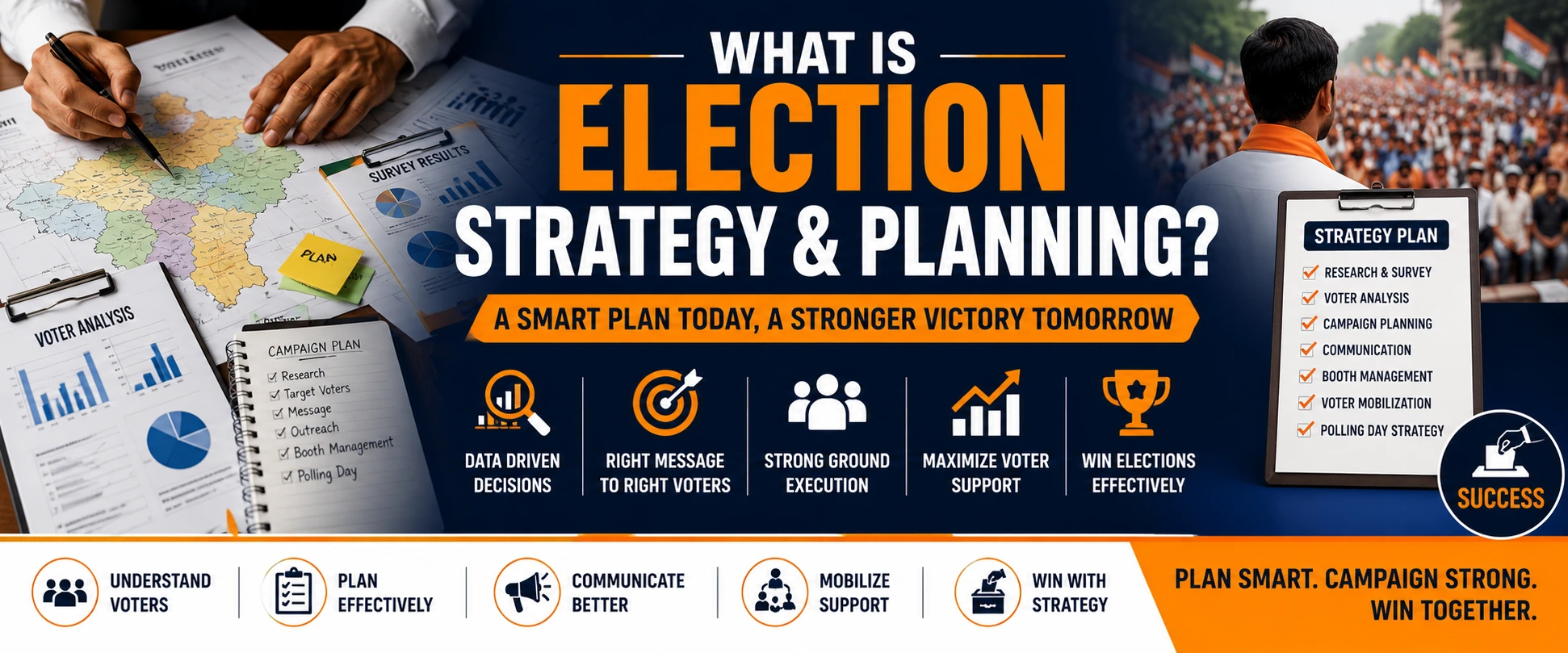
Election strategy and planning is the structured process through which a political campaign converts research, constituency understanding, organizational resources and campaign objectives into a coordinated plan of action. Modern election campaigns involve many interconnected functions including political research, constituency analysis, surveys, electoral data analysis, field organization, booth management, communication, digital promotion, public relations, resource planning and monitoring. Election strategy provides the framework that connects these functions, establishes priorities, defines responsibilities and enables campaign leadership to review execution throughout the election cycle.
What is Election Strategy and Planning?
Election strategy and planning refers to the systematic process of understanding the political and constituency environment, defining campaign priorities, organizing available resources and coordinating campaign activities within a common framework.
Strategy answers the broader questions: What is the campaign environment? What are the major issues? What should the campaign prioritize? What resources are available? How should different teams coordinate? How will progress be reviewed?
Planning converts those strategic decisions into practical actions, responsibilities, schedules, workflows, budgets and monitoring systems.
In simple terms, strategy defines direction while planning organizes execution.
Difference Between Election Strategy and Election Planning
Election Strategy
Defines overall campaign direction, priorities, positioning, resource priorities and the framework within which campaign decisions are made.
Election Planning
Converts strategy into timelines, responsibilities, field structures, communication calendars, budgets, reporting systems and operational activities.
A strategy without implementation planning can remain theoretical, while planning without a clear strategy can produce disconnected campaign activity.
Professional election management therefore requires both.
Why Election Strategy and Planning is Important
Election campaigns operate within limited time, budget, manpower and organizational capacity. Without clear planning, different campaign teams may work independently, priorities may change frequently and important information may not reach decision-makers on time.
A structured strategy creates a common direction for campaign operations.
- Defines clear campaign priorities
- Improves constituency understanding
- Connects research with campaign planning
- Supports organized resource allocation
- Improves coordination between campaign teams
- Creates structured communication planning
- Strengthens field-operation management
- Enables continuous campaign monitoring
Election strategy should not be treated as a single document prepared at the beginning of a campaign. A professional strategy works as a continuous management cycle: Research → Analysis → Strategy → Planning → Execution → Monitoring → Feedback → Review. As verified information changes, operational priorities may also need review.
Main Objectives of Election Strategy and Planning
Election strategy provides an organizational framework for managing multiple campaign functions throughout the election cycle.
Understand the Constituency
Build a structured understanding of geography, electoral history, local issues and political conditions.
Define Priorities
Identify major campaign requirements and organize them within a practical sequence.
Organize Resources
Plan campaign manpower, time, budgets, technology and organizational capacity.
Coordinate Teams
Connect research, field, booth, digital, communication and management teams.
Structure Execution
Convert strategic decisions into defined activities, timelines and responsibilities.
Monitor Progress
Establish reporting and review mechanisms for campaign leadership.
Key Components of Election Strategy and Planning
A comprehensive election strategy can combine several specialized campaign functions.
Political Research
Study the constituency environment, electoral history, political context and major public issues.
Political Survey
Use structured research methodologies to understand public opinion and constituency-level issues.
Constituency Intelligence
Organize geographic, electoral, issue and campaign information into a practical constituency view.
Electoral Data Analysis
Analyze appropriate aggregate electoral information, past results and area-level trends.
Campaign Planning
Define campaign phases, priorities, responsibilities, timelines and operational requirements.
Booth Management
Organize campaign-side local teams, area coordination, reporting and field operations.
Ground Campaign
Coordinate field activities, local events, public outreach and campaign teams.
Digital Communication
Manage public digital content, online campaign presence and communication schedules.
Monitoring & Reporting
Track campaign operations, field reports and implementation against the approved plan.
Step-by-Step Election Strategy and Planning Process
Professional election planning can be organized into a structured workflow in which each stage supports the next.
Role of Political Research in Election Strategy
Election strategy should begin with information rather than assumptions. Political research provides the factual and analytical foundation for campaign planning.
Research may examine constituency history, previous election results, geographic conditions, public issues, political competition, local organizational structures and other relevant campaign factors.
The objective is to give campaign leadership a clearer understanding of the environment in which decisions are being made.
Role of Political Surveys in Election Strategy
Political surveys can provide structured information about public opinion, issue priorities, candidate awareness, political preferences and other research questions defined within the survey methodology.
A professional Political Survey should use an appropriate research design, questionnaire, sampling approach, field process, quality controls and analysis methodology.
Survey findings can complement electoral data, constituency research and field observations, helping campaign leadership distinguish evidence from assumptions.
Survey findings should also be interpreted within the limitations of the methodology, sample and timing of the research.
Role of Electoral Data Analysis
Electoral data analysis can help campaign teams understand historical patterns and geographic differences across a constituency.
Depending on the availability and lawful use of information, analysis may include past election results, turnout history, polling-area trends, constituency-level changes and other appropriately aggregated electoral indicators.
- Past election-result analysis
- Area-wise electoral trends
- Historical turnout patterns
- Polling-area comparisons
- Vote-share trend analysis
- Geographic campaign intelligence
- Constituency-level comparisons
- Research and field-data integration
Data should support strategic understanding without creating unnecessary sensitive personal profiles of individual voters.
Importance of Constituency Analysis
Every constituency has a distinct combination of geography, settlement patterns, political history, public issues, infrastructure, organizational networks and campaign conditions.
Constituency analysis brings these different information sources together into a structured view that campaign leadership can use for planning.
This can include:
- Constituency geography
- Ward, village and locality structure
- Historical election patterns
- Major local issues
- Political competition
- Campaign organization
- Field-team capacity
- Operational and logistical requirements
Candidate Profile and Communication Consistency
Campaign communication should accurately and consistently present relevant information about the candidate or political organization.
Candidate background, public work, policy positions, local priorities, campaign commitments and verified achievements may form part of public communication depending on the campaign.
Consistency is important because speeches, public meetings, printed material, media statements, websites and digital platforms should not provide contradictory information.
Strategy therefore helps coordinate what information is approved, how it is presented and which teams are responsible for maintaining communication consistency.
Role of Communication Strategy in Elections
Election campaigns communicate through multiple channels, including speeches, public meetings, press interactions, printed material, websites, social platforms and field teams.
A communication strategy helps organize these channels around accurate, approved and consistent campaign information.
- Campaign information framework
- Public speech points
- Issue-related communication
- Candidate profile information
- Public-event communication
- Digital content calendar
- Media statements
- Internal communication guidelines
Role of Booth Management in Election Planning
Campaign-side booth management provides a local organizational structure through which field responsibilities, area coordination and reporting can be managed.
Depending on campaign requirements, booth or area teams can help with local campaign coordination, field reporting, volunteer organization, communication distribution and escalation of operational issues.
A structured Booth Management system can connect local campaign activity with constituency-level campaign management.
- Area and booth mapping
- Campaign-team organization
- Coordinator responsibilities
- Field-activity reporting
- Local issue reporting
- Campaign material coordination
- Team communication
- Operational monitoring
Campaign Booth Management vs Official Polling Administration
Political campaign booth management should not be confused with the official administration of polling stations.
Electoral rolls, polling personnel, polling-station administration, voting procedures, security arrangements and the official conduct of polling are functions of the relevant election authorities and authorized officials.
Campaign teams must remain separate from official polling administration and operate within applicable election rules.
Role of Field Campaign Operations
Field operations convert campaign plans into organized activity across constituencies, wards, villages and localities.
Ground operations can include team coordination, public meetings, campaign events, authorized door-to-door outreach, campaign material distribution, field reporting and local issue collection.
The field structure should define who is responsible for each area, how activity is reported and how operational problems are escalated.
This allows campaign management to maintain better visibility over large-scale field activity.
Role of Digital Strategy in Election Campaigns
Digital communication has become an important component of modern election campaigns.
Websites, social-media platforms, online video, public digital content and other online communication channels can help political organizations publish information, communicate public positions and provide updates about campaign activities.
Digital strategy can include:
- Digital communication planning
- Website and campaign information
- Social-media content calendars
- Public video content
- Campaign-event updates
- Press and statement distribution
- Digital asset management
- Performance monitoring
Digital communication should follow applicable platform policies, election requirements and campaign authorization processes.
Role of Public Relations in Election Strategy
Public relations helps organize communication between a political campaign, media organizations and the wider public.
PR planning can include press releases, interviews, media briefings, public statements, event communication, factual clarifications and crisis-response procedures.
A professional PR structure can also establish approval processes so that public communication remains accurate and consistent across different campaign representatives.
Integrating Ground and Digital Campaign Operations
Ground and digital teams should not operate as completely separate campaign systems.
Field teams can report verified information about campaign activities, recurring local issues and operational developments. Communication teams can use appropriate verified information when preparing public updates and campaign content.
At the same time, central communication teams can provide field teams with approved campaign information and public updates.
Ground Activity → Field Reporting → Verification → Campaign Review → Communication Coordination → Digital/Public Updates → Ground Teams
Team, Time, Budget and Resource Planning
Election campaigns operate within fixed timelines and finite resources. Resource planning is therefore a core part of election strategy.
Campaign leadership needs visibility into team availability, field requirements, communication needs, technology, logistics, schedules and budgets.
- Team structure
- Role allocation
- Campaign timelines
- Budget planning
- Field logistics
- Technology requirements
- Communication resources
- Reporting responsibilities
Role of Technology in Election Strategy and Planning
Technology can help campaign organizations coordinate information and operations when multiple teams are working simultaneously.
Depending on campaign requirements, digital systems may support field reporting, campaign dashboards, survey management, area mapping, issue reporting, team coordination and document management.
- Campaign dashboards
- Survey-data management
- Area-level reporting
- Field-team coordination
- Campaign activity monitoring
- Issue-report management
- Digital document management
- Management reporting
Role of an Election War Room
An election war room can function as a campaign coordination and information-management centre.
Depending on the scale of the campaign, it may consolidate reports from research, field, booth, digital, media and management teams.
Its operational role may include:
- Daily campaign reporting
- Field-information consolidation
- Issue tracking
- Team coordination
- Communication monitoring
- Campaign calendar review
- Operational escalation
- Management dashboards
Campaign Monitoring and Feedback
Election planning should include mechanisms for reviewing whether approved activities are actually being implemented.
Monitoring can examine campaign progress, field-team reports, survey findings, operational gaps, communication activity and other relevant indicators.
The purpose is not simply to collect more data. Information should be verified, summarized and delivered to the appropriate decision-makers in a usable format.
This creates a continuous management cycle:
Plan → Execute → Measure → Review → Coordinate → Improve
Data Governance in Election Strategy
Election campaigns can work with information from surveys, field operations, public electoral sources and internal campaign systems. Managing that information responsibly is important.
Campaign organizations should define what information is necessary, where it comes from, who can access it and how long it should be retained.
- Use appropriately sourced information
- Collect only necessary campaign data
- Avoid unnecessary sensitive personal profiling
- Apply access controls
- Secure campaign databases
- Maintain data-quality checks
- Document important information sources
- Follow applicable privacy requirements
Polling-Day Planning and Campaign Coordination
Election-day operations require careful distinction between lawful campaign-side coordination and the official administration of polling.
Campaign organizations may need internal communication structures, authorized representatives, field reporting, legal/compliance coordination and processes for escalating legitimate operational concerns.
Official polling-station administration, voting procedures, polling personnel, security arrangements and conduct of polling remain under the authority of the relevant election officials.
All campaign-side activities should comply with applicable election laws, Election Commission directions, local administrative requirements and restrictions in force at the relevant time.
Election Compliance and Campaign Planning
Compliance should form part of election planning from the beginning rather than being considered only near polling day.
Depending on the election and activity involved, campaigns may need to consider applicable election laws, Election Commission directions, the Model Code of Conduct when in force, expenditure requirements, advertising requirements, permissions and local administrative rules.
Digital platforms may also have their own policies governing political and election-related content.
Because requirements can change, campaign organizations should verify the rules applicable to the relevant election and activity.
Common Challenges in Election Strategy and Planning
Election campaigns operate in fast-moving environments, making coordination and disciplined execution important.
- Incomplete constituency information
- Changing political conditions
- Limited campaign time
- Budget and manpower constraints
- Coordination across large field teams
- Inconsistent campaign communication
- Unverified field information
- Misinformation and information gaps
- Data-quality problems
- Difficulty monitoring large-scale execution
Best Practices for Election Strategy and Planning
Professional election planning should combine research, clear responsibilities, realistic resource allocation and regular review.
- Start with constituency research
- Separate evidence from assumptions
- Define campaign priorities clearly
- Assign responsibilities to specific teams
- Create realistic timelines
- Use structured reporting formats
- Verify important field information
- Maintain communication consistency
- Protect campaign information
- Review strategy as conditions change
How Professional Election Strategy Services Help
Professional election strategy and campaign-management services can help organize complex campaign activities within a common management framework.
Depending on project requirements, professional support may include research, political surveys, constituency analysis, electoral data analysis, field planning, booth management, digital communication, public relations, reporting and campaign monitoring.
A professional Election Campaign Management structure can also establish defined workflows between specialist teams, helping campaign leadership maintain greater visibility over execution.
Megamind's Approach to Election Strategy and Planning
Megamind approaches election strategy as an integrated process connecting political research, constituency intelligence, planning, campaign execution and monitoring.
Depending on project requirements, the process can follow:
Constituency Understanding → Political Research & Survey → Electoral Data Analysis → Strategy Development → Campaign Planning → Ground & Digital Execution → Monitoring → Continuous Feedback & Review
This framework can integrate Political Survey, Voter Data Analysis, Booth Management, Election Campaign Management, Digital Promotion, Public Relations and campaign technology within an organized campaign-management structure.
Megamind provides election strategy and campaign-management support for political parties, candidates, leaders, prospective candidates, aspirants, campaign teams and political organizations according to project requirements.
Explore Complete Election Services →Election Strategy and Planning Across India
Election strategy and planning can be applied across Lok Sabha, Vidhan Sabha, municipal and other local electoral contexts in India.
However, no single strategy should be assumed to fit every constituency.
Geography, electoral history, public issues, political competition, organizational capacity, campaign resources and local conditions can differ substantially from one constituency to another.
A large rural constituency may require a very different field and communication structure from a densely populated urban constituency.
Professional strategy should therefore begin with the actual constituency environment and available evidence.
Election Strategy Within a Complete Campaign Management System
Election strategy becomes more useful when specialist campaign functions are connected rather than managed in isolation.
Political Research → Survey → Constituency Intelligence → Electoral Data Analysis → Campaign Strategy → Ground & Booth Operations → Digital & PR → Monitoring → Continuous Review
Each function has a different role. Research generates evidence, strategy establishes direction, planning organizes resources, execution implements activities and monitoring provides operational visibility.
FAQs About Election Strategy and Planning
What is election strategy?
Election strategy is the framework that defines campaign direction, priorities, organizational requirements and the basis for campaign decisions.
What is election planning?
Election planning converts strategic decisions into practical timelines, responsibilities, budgets, team structures and operational activities.
What is the difference between election strategy and planning?
Strategy defines direction and priorities, while planning organizes how approved activities will be implemented.
Why is political research important for election strategy?
Political research helps campaign teams understand constituency conditions, electoral history, local issues and other factors relevant to campaign planning.
How do political surveys support election planning?
Surveys can provide structured evidence about public opinion and issue priorities when conducted using an appropriate research methodology.
What is constituency intelligence?
Constituency intelligence is the structured organization and analysis of geographic, electoral, issue, research and campaign information relevant to a constituency.
What role does electoral data analysis play?
Electoral data analysis can help identify historical and area-level patterns that support constituency understanding and campaign planning.
Why is booth management important?
Campaign-side booth management can provide a local structure for organizing field teams, area coordination and reporting.
Is campaign booth management the same as polling-station administration?
No. Official polling-station administration and voting procedures are responsibilities of the relevant election authorities and authorized officials.
How does digital communication fit into election strategy?
Digital communication provides channels for publishing campaign information, public updates and approved content as part of the wider communication plan.
What is the role of campaign monitoring?
Monitoring helps campaign leadership understand implementation, field activity, operational gaps and other relevant campaign developments.
Can election strategy change during a campaign?
Operational priorities may be reviewed when reliable new information or changing campaign conditions justify an adjustment.
Who can use professional election strategy services?
Political parties, candidates, leaders, prospective candidates, aspirants, campaign teams and political organizations may use professional election strategy and campaign-management services according to their requirements.
Election Strategy Connects Research, Planning and Execution
Election strategy and planning provide the organizational framework through which complex campaign activities can be coordinated.
A professional approach begins with political research, constituency understanding and reliable information , converts those inputs into strategic priorities and then connects them with planning, field operations, communication, resource management and monitoring.
Political surveys, electoral data analysis, booth management, ground campaigning, digital communication, public relations and campaign technology can each contribute different capabilities to this system.
The central purpose of election strategy is therefore to create clarity, coordination, disciplined execution and continuous campaign review throughout the election cycle.