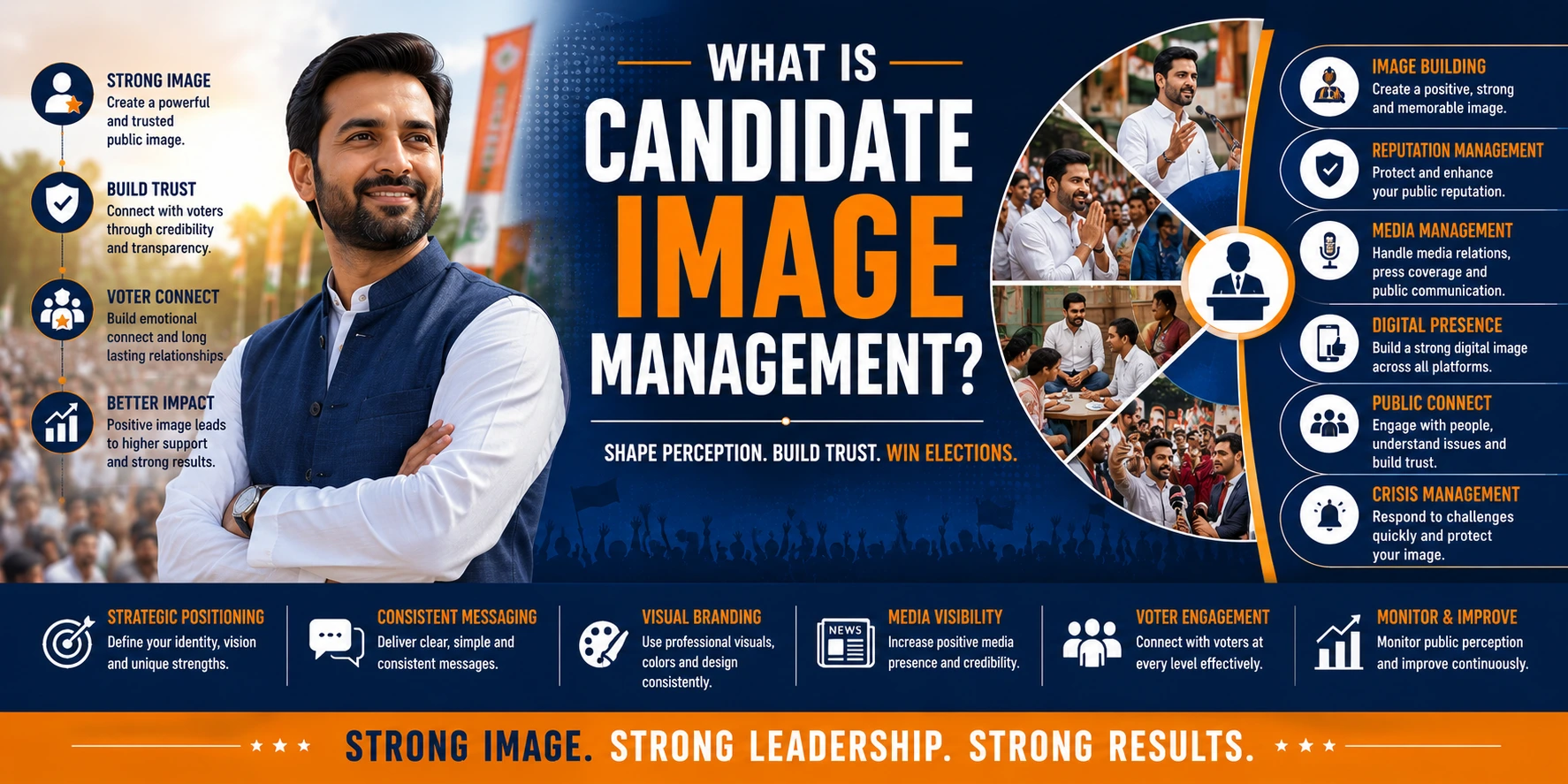
Candidate image management is the structured process of understanding, presenting, communicating and protecting the public identity of a political candidate or leader. In modern elections, a candidate is evaluated not only through speeches, campaign material or party affiliation, but also through public conduct, accessibility, communication style, leadership record, issue knowledge, media interactions, digital presence and consistency between words and actions. Professional candidate image management brings these elements together so that the candidate's public communication remains clear, authentic, factual, consistent and professionally managed across ground, media and digital platforms.
What is Candidate Image Management?
Candidate image management is a coordinated framework for managing how a political candidate presents their leadership, public work, values, priorities, experience and communication across different public platforms.
It can include public-image assessment, political branding, communication planning, visual identity, media preparation, digital presence, reputation monitoring, ground interaction and crisis communication.
The purpose is not to manufacture an artificial personality. Sustainable political reputation is stronger when public communication accurately reflects the candidate's actual record, priorities, behaviour and leadership approach.
Why Candidate Image Management is Important
Political candidates communicate with the public through many different channels. A speech at a public meeting, a television interview, a social media post, a press statement and a constituency visit can all contribute to the candidate's overall public identity.
When these interactions are inconsistent or poorly coordinated, the candidate's priorities and public position may become unclear. Candidate image management creates a professional framework for maintaining consistency across these channels.
- Creates a clear and recognizable public identity
- Improves consistency across communication channels
- Helps communicate leadership experience and public work clearly
- Supports professional media and public interaction
- Strengthens coordination between campaign communication teams
- Provides a framework for reputation monitoring
- Supports responsible communication during difficult situations
- Contributes to long-term political reputation management
Strong candidate image management begins with authenticity and consistency. Communication, visuals, public conduct and digital presence should reflect the candidate's actual leadership record and stated priorities. A public identity that cannot be supported by real conduct or verifiable information is difficult to sustain over the long term.
Core Objectives of Candidate Image Management
Candidate image management should begin with clearly defined communication and reputation objectives. These objectives provide direction to public relations, digital teams, media teams, designers and field communication.
- Define a clear and authentic candidate identity
- Communicate leadership experience and public priorities
- Maintain consistency across public communication
- Improve clarity of the candidate's positions and activities
- Establish professional media communication processes
- Maintain a credible and organized digital presence
- Monitor misinformation and reputation-related issues
- Build a sustainable long-term public leadership profile
Key Elements of Candidate Image Management
Candidate image is created through multiple connected elements. These elements should support one another rather than operate as separate communication activities.
Public Identity
Defines how the candidate's leadership experience, values, priorities and public role are presented.
Political Branding
Establishes consistent visual and communication standards across campaign materials and public platforms.
Public Communication
Organizes speeches, statements, public information and communication around clear and consistent themes.
Media Relations
Supports professional press interaction, interview preparation, media coordination and public statements.
Digital Presence
Maintains organized websites, social profiles, videos, digital content and other online public information.
Ground Presence
Connects public communication with constituency visits, public meetings and other direct interactions.
Reputation Monitoring
Tracks relevant media, digital information and public feedback concerning the candidate.
Crisis Communication
Establishes responsible procedures for responding to significant controversies, misinformation or communication issues.
Continuous Review
Reviews communication consistency, information accuracy and reputation-related developments throughout the campaign.
Candidate Image Audit
Before developing an image-management plan, it is useful to understand the candidate's existing public profile. An image audit reviews how the candidate is currently represented across public, media, digital and campaign channels.
The purpose of the audit is to identify inconsistencies, information gaps, communication strengths and reputation risks that may require professional attention.
- Review existing candidate biography and public profile
- Assess website and social media information
- Review major media coverage and public interviews
- Evaluate visual consistency across campaign material
- Review public speeches and communication themes
- Identify outdated or inconsistent information
- Document significant reputation-related issues
- Establish a baseline for future monitoring
Authentic Candidate Positioning
Candidate positioning defines the central public identity around which communication is organized. Effective positioning should be based on credible characteristics rather than artificial labels.
Relevant factors may include the candidate's professional experience, public-service record, constituency involvement, leadership responsibilities, policy priorities, organizational role and documented work.
Clear positioning helps different campaign teams communicate the same factual leadership profile without creating contradictory descriptions across speeches, digital platforms and campaign materials.
Role of Political Branding in Candidate Image
Political branding provides visual and communication consistency. Photographs, typography, campaign graphics, video presentation, websites and printed materials should appear professionally coordinated.
Branding should support recognition and clarity without replacing substantive information about the candidate's record, priorities and public work.
Learn more about Political Branding .
Candidate Communication Management
Candidates communicate through speeches, interviews, press statements, public meetings, social platforms, videos and direct public interactions. Each channel may have a different format, but the underlying information should remain consistent.
Communication management helps teams maintain factual accuracy, clarity and coordination across these different channels.
- Maintain clear and consistent public information
- Prepare accurate speech and briefing material
- Coordinate important statements across campaign teams
- Keep communication aligned with documented public work
- Use accessible language for public information
- Review important claims before publication
Role of Media Management in Candidate Image
Media interactions can become an important part of a candidate's public record. Interviews, press conferences, statements and media briefings should therefore be prepared and coordinated professionally.
Media management can include factual briefing material, interview preparation, press coordination, statement review and monitoring of significant published coverage.
- Press release and statement preparation
- Media briefing and factual information support
- Interview preparation
- Press conference coordination
- Monitoring significant media coverage
- Correction of material factual inaccuracies through proper channels
Digital Image Management
Websites, social media profiles, online videos, news results and digital archives can form a long-lasting part of a political candidate's public presence.
Digital image management focuses on maintaining accurate, consistent and professionally organized candidate information across official online channels.
- Professional management of official social profiles
- Consistent candidate biography and public information
- Organized photo and video presentation
- Website and official digital information management
- Monitoring relevant online mentions and misinformation
- Maintaining archives of important statements and public work
Ground-Level Public Engagement and Candidate Image
A candidate's public identity is not created only through media or digital channels. Public meetings, constituency visits and direct interactions also contribute to the candidate's visible leadership profile.
Ground activity provides opportunities to listen to local concerns, communicate public work and understand constituency conditions directly. It should remain coordinated with the broader campaign and public communication framework.
- Constituency visits and public interactions
- Public meetings and community events
- Local issue discussions
- Interaction with community and organizational representatives
- Documentation of constituency activities
- Ground feedback reporting to campaign leadership
Connecting Candidate Image with Real Public Work
Long-term political reputation becomes more credible when communication is supported by verifiable public work. Instead of relying only on slogans or promotional descriptions, campaign teams can maintain accurate records of initiatives, constituency activities, public engagements, responsibilities and relevant achievements.
This documentation also helps media, digital and field teams use consistent information when preparing biographies, websites, campaign material, speeches and public statements.
Claims about achievements should be checked for accuracy and supported by appropriate evidence before they are published.
Importance of Professional Visual Presentation
Visual presentation contributes to communication quality across posters, websites, social media, press material, presentations and campaign videos.
A consistent visual system can include approved candidate photographs, typography, layout standards, logo usage, graphic templates and guidelines for official digital content.
Professional visual management reduces inconsistency and helps campaign teams identify official communication more easily across multiple channels.
Crisis Communication and Reputation Management
Political campaigns can face misinformation, controversial claims, inaccurate reporting, unexpected events or communication mistakes. Uncoordinated responses can create additional confusion.
A professional crisis-communication framework establishes responsibility for verifying information, preparing responses, coordinating official statements and documenting significant developments.
- Monitor significant reputation-related developments
- Verify facts before issuing a response
- Identify authorized communication representatives
- Prepare clear and factual official statements
- Correct demonstrably false information through appropriate channels
- Maintain documentation of important communications
Not every criticism requires a response. The appropriate approach depends on factual accuracy, relevance, scale and potential public significance.
Step-by-Step Candidate Image Management Process
A professional candidate image-management programme can be organized into a series of connected stages.
Role of Research in Candidate Image Management
Image management should not be developed entirely from internal campaign assumptions. Research can help teams understand the constituency's important issues, information gaps and the candidate's existing public profile.
Depending on the requirement, research may include political surveys, constituency research, media analysis, field feedback and review of publicly available information.
Research findings can then inform communication priorities without replacing the need for accurate, authentic and responsible public communication.
Explore Megamind's Political Survey Services for broader election and constituency research.
Candidate Image Management and Political Public Relations
Candidate image management and political public relations are closely connected, but they are not exactly the same.
Candidate image management focuses on the overall consistency of the candidate's public identity, while public relations focuses more directly on media communication, press coordination, public information and reputation-related communication.
Integrating both functions helps ensure that the candidate's public, media and digital communication operates within one coordinated framework.
Explore Political Public Relations Services .
Long-Term Political Reputation Management
Public reputation does not begin when an election is announced and does not automatically end after polling day. Political leaders continue to communicate with constituents, organizations, media and the public between elections.
Maintaining accurate public information, documenting constituency work, communicating important activities and keeping official digital channels updated can contribute to a more organized long-term public profile.
For this reason, candidate image management can also be viewed as part of broader political communication and leadership reputation management rather than only as an election-period activity.
Accuracy, Transparency and Responsible Image Management
Candidate image management should be based on accurate information and responsible communication. False claims, manipulated information or misleading representations can create legal, reputational and public trust risks.
Campaign teams should establish review procedures for important claims, candidate biographies, public-work information, media statements and official digital content.
- Use accurate and verifiable candidate information
- Distinguish facts from opinion or campaign claims
- Correct significant factual errors when identified
- Maintain responsible handling of personal and campaign data
- Follow applicable election and advertising requirements
- Maintain clear responsibility for official communication
Benefits of Professional Candidate Image Management
Professional image management primarily improves the organization, consistency and quality of candidate communication.
- Clearer presentation of the candidate's public profile
- Consistent communication across multiple platforms
- Better coordination between media, digital and field teams
- Professional management of candidate information and visuals
- More organized response to reputation-related issues
- Better documentation of public activities and communication
- Improved preparedness for media interactions
- Stronger continuity in long-term public communication
Challenges in Candidate Image Management
Candidate image management can become difficult when many people and communication channels operate simultaneously without common standards.
- Inconsistent public information across campaign channels
- Outdated biographies, profiles or campaign material
- Uncoordinated statements from different teams
- Inaccurate information or misinformation online
- Weak coordination between digital and ground communication
- Poor-quality or inconsistent visual material
- Rapidly developing reputation-related situations
- Difficulty maintaining communication discipline across large teams
Best Practices for Candidate Image Management
Effective image management requires consistent systems rather than occasional publicity activity.
- Begin with an objective candidate image audit
- Build communication around authentic leadership attributes
- Maintain one approved source of candidate information
- Use professional and consistent visual standards
- Coordinate media, digital and ground communication
- Verify important claims before publication
- Monitor reputation-related developments regularly
- Prepare a clear crisis-communication process
- Keep official digital profiles accurate and updated
- Maintain continuity beyond the election period
How Professional Candidate Image Management Services Help
Candidate image management can involve multiple specialist functions, including political research, communication planning, public relations, graphic design, media coordination, digital management and reputation monitoring.
Professional support can help organize these functions within one framework and establish standards for candidate information, communication, visuals and monitoring.
Depending on the assignment, candidate image management may also be integrated with broader Election Campaign Management , political research and campaign technology requirements.
Megamind's Approach to Candidate Image Management
Megamind approaches candidate image management as an integrated research, communication and reputation-management process rather than only a publicity exercise.
Depending on the assignment, the process may begin with political and constituency research, review of the candidate's existing public profile and assessment of current media and digital presence.
These inputs can support development of an authentic candidate identity framework, communication standards, visual presentation, media coordination, digital management and reputation-monitoring processes.
Candidate image management can also be integrated with Megamind's broader capabilities in Political Survey, Election Campaign Management, Public Relations, Digital Promotion, Booth Management and election intelligence.
Explore Political Public Relations Services →Candidate Image Management Across India
Candidate image-management requirements can vary significantly across Indian elections because political communication environments differ by constituency, election type, media landscape, geography and local issues.
Lok Sabha, Vidhan Sabha, municipal, panchayat and other local elections may require different levels of public communication, media coordination, digital management and ground presence.
A professional image-management framework should therefore be adapted to the candidate's actual political context rather than applying the same communication model to every election or constituency.
FAQs About Candidate Image Management
What is candidate image management?
Candidate image management is the structured process of understanding, presenting, communicating and protecting a political candidate's public identity across ground, media and digital channels.
Why is candidate image management important?
It helps maintain clear, accurate and consistent candidate information and improves coordination between communication, media, digital and field teams.
What is a candidate image audit?
An image audit reviews the candidate's existing public profile, biography, media coverage, visual presentation, digital presence and major communication themes to identify strengths, inconsistencies and information gaps.
Is candidate image management the same as political branding?
No. Political branding is one component of candidate image management. Image management also includes public communication, media relations, digital presence, ground interaction, reputation monitoring and crisis communication.
What is the role of public relations in candidate image management?
Public relations supports media communication, press coordination, public statements and reputation-related communication within the broader candidate image framework.
How is social media used in candidate image management?
Official social media channels can be used to publish candidate information, public activities, statements, videos and other campaign communication in an organized and consistent format.
What is political reputation management?
Political reputation management involves monitoring important public information, media coverage and digital developments, maintaining accurate official communication and responding responsibly to significant reputation-related issues.
How should misinformation about a candidate be handled?
Important claims should first be verified. Demonstrably false information can then be addressed through appropriate official, media, platform or legal channels depending on the circumstances.
Is candidate image management required only during elections?
No. Public representatives and political leaders may maintain organized public communication and reputation-management systems between elections as part of their long-term public profile.
Who can use candidate image management services?
Political candidates, leaders, prospective candidates, campaign teams and political organizations may use professional candidate image-management support according to their requirements.
Candidate Image Management is More Than Political Branding
Candidate image management is a comprehensive public communication and reputation-management process. It brings together public identity, political branding, media relations, digital presence, ground engagement, factual communication and reputation monitoring.
Its strongest foundation is authenticity. A professionally designed image cannot substitute for leadership conduct, public work or accurate information. Instead, professional image management helps organize and communicate those real attributes clearly and consistently.
When research, communication, visual identity, public relations, digital management and ground activity operate within one coordinated framework, candidates and campaign teams can maintain a more professional, consistent and sustainable public presence.