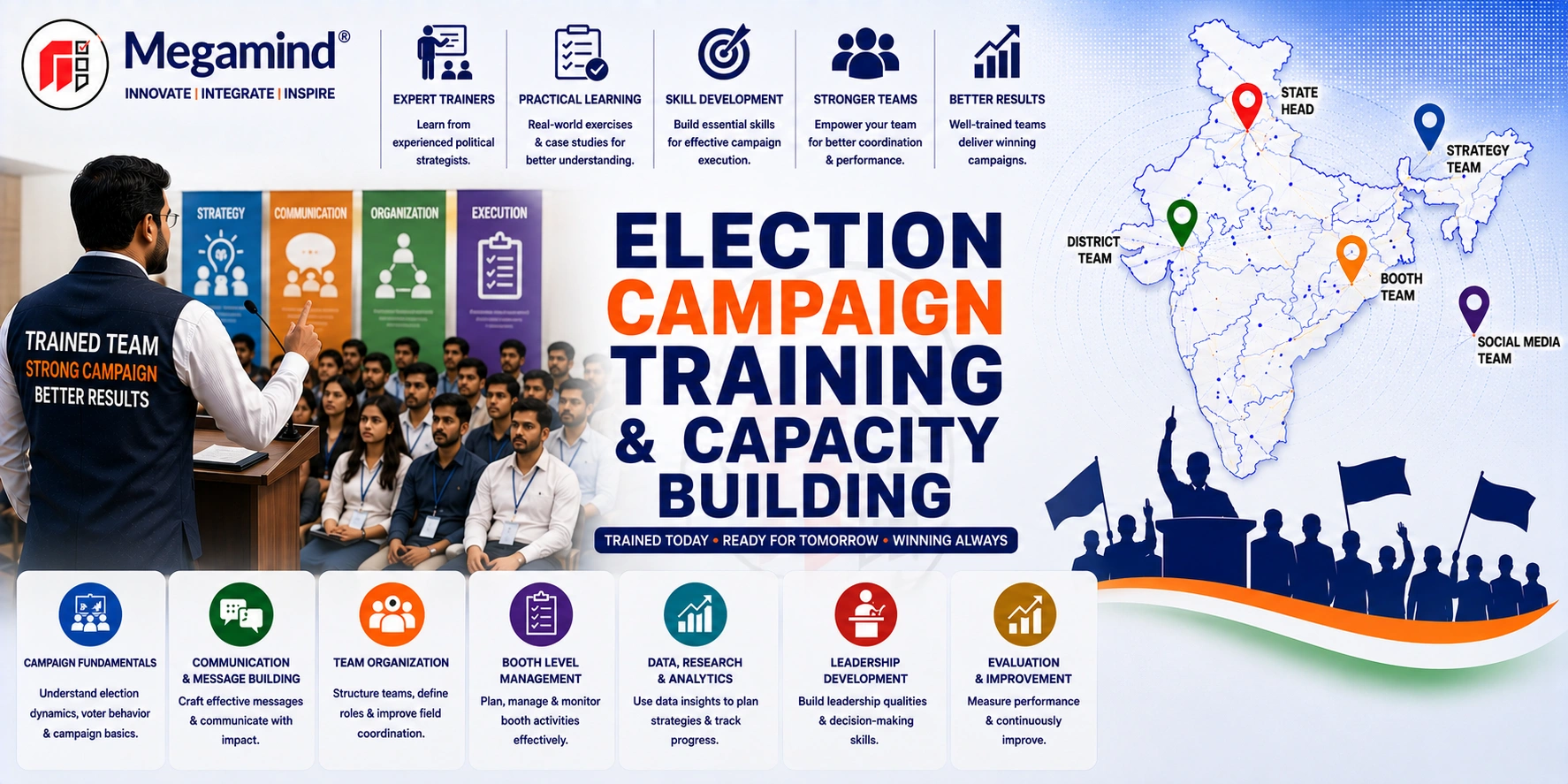
Election campaigns depend on people. Strategy, technology, reporting systems and campaign plans become operational only when campaign personnel understand what they are responsible for, how work should be performed, where information should be reported, when an issue should be escalated and who is responsible for the next action. Megamind's Election Campaign Training & Capacity Building framework creates a structured cycle: Assess → Design → Train → Practice → Evaluate → Deploy → Monitor → Refresh → Improve .
What is Election Campaign Training & Capacity Building?
Election Campaign Training & Capacity Building is a structured process for developing the operational capabilities of authorized political campaign teams.
Training can help different campaign roles understand campaign organization, assigned responsibilities, workflows, reporting systems, coordination channels, escalation procedures, technology tools and operational standards.
Capacity building goes further than a one-time training session. It can establish:
- Defined campaign roles
- Standard operating procedures
- Role-based training modules
- Training manuals
- Reporting formats
- Supervisor responsibilities
- Escalation procedures
- Operational checklists
- Training assessment
- Refresher training
- Trainer development
- Continuous performance improvement
A large campaign team does not automatically create a strong campaign organization. The real operational advantage comes when people understand their roles, follow common processes, report consistently, escalate issues correctly and coordinate across field, management, MIS and War Room functions.
Why Election Campaign Training is Important
Campaign organizations can grow rapidly. New coordinators, field personnel, volunteers and supervisors may join at different stages of the election cycle.
Without standardized onboarding and training, different teams may interpret the same campaign responsibility in different ways.
Common operational problems can include:
- Unclear campaign roles
- Duplicate responsibilities
- Weak field coordination
- Inconsistent reporting
- Delayed issue escalation
- Different reporting formats
- Weak supervisor review
- Incomplete activity records
- Poor technology adoption
- Weak War Room coordination
- Unclear communication authority
- Inconsistent election-day preparedness
Our Election Campaign Training & Capacity Building Services
Campaign Team Onboarding
Structured introduction to campaign organization, roles, workflows, reporting systems and coordination channels.
Campaign Manager Training
Training for campaign managers on planning, coordination, review, reporting, escalation and operational management.
Field Team Training
Role-based field training covering assigned activities, coordination, reporting, issue escalation and operational discipline.
Booth Team Orientation
Campaign-side orientation for booth-level teams covering lawful responsibilities, organization, reporting and coordination.
Supervisor Development
Training for supervisors on task allocation, team review, reporting quality, issue management and escalation.
Volunteer Orientation
Standardized orientation covering assigned roles, coordination channels, conduct expectations and reporting requirements.
Campaign MIS & Reporting Training
Training in activity reporting, issue reporting, status updates, data quality and management reporting workflows.
Campaign Technology Training
Role-based training for authorized campaign software, dashboards, task systems and reporting technology.
War Room Team Training
Operational training for information intake, task coordination, issue tracking, escalation, review and management reporting.
Campaign Communication Protocol Training
Training in authorized communication workflows, escalation, factual accuracy and coordination between campaign functions.
Election-Day Operational Training
Training for lawful campaign-side election-day roles, reporting, communication, issue escalation and coordination.
Train-the-Trainer Program
Development of selected campaign coordinators or supervisors to deliver standardized operational training to additional teams.
Election Campaign Training Needs Assessment
Before training begins, Megamind can review the campaign organization to determine which teams require training, what they need to learn and how the training should be delivered.
A training-needs assessment can review:
- Campaign organization structure
- Role definitions
- Existing team capability
- New team onboarding requirements
- Field organization
- Booth organization
- Supervisor structure
- Reporting systems
- MIS requirements
- Technology systems
- War Room processes
- Election-day operational requirements
Campaign Skill & Process Gap Assessment
Training should solve identified operational gaps rather than simply repeat generic campaign concepts.
Role Clarity Gap
Identifies whether campaign personnel understand their responsibilities and reporting lines.
Process Gap
Reviews whether teams understand standard campaign workflows and operating procedures.
Reporting Gap
Reviews completeness, consistency and timeliness of campaign reporting.
Technology Gap
Identifies difficulties in using authorized campaign software and reporting systems.
Coordination Gap
Reviews communication between field, supervisors, management and War Room teams.
Supervision Gap
Reviews whether supervisors can allocate, monitor, review and escalate work effectively.
Training Different Campaign Roles Differently
A campaign manager, field coordinator, booth team member, reporting executive and War Room operator do not perform the same work.
Training should therefore be designed according to role.
Structured Campaign Team Onboarding
New campaign personnel should understand the campaign operating system before beginning assigned responsibilities.
An onboarding module can explain:
- Campaign organization
- Reporting hierarchy
- Role responsibilities
- Team coordination channels
- Daily activity workflow
- Reporting requirements
- Issue escalation
- Information handling
- Technology access
- Meeting structure
- Communication authority
- Operational conduct standards
Election Campaign Manager Training
Campaign managers require visibility across multiple campaign functions and must coordinate people, activities, information and review systems.
Management training can cover:
- Campaign organization structure
- Campaign planning cycle
- Team responsibility mapping
- Activity planning
- Task allocation
- Review meeting structure
- Issue escalation
- Reporting discipline
- Campaign MIS review
- Performance monitoring
- War Room coordination
- Decision follow-up
Campaign Supervisor & Coordinator Training
Supervisors connect campaign management with operational teams. Their effectiveness can directly influence reporting quality and field coordination.
Supervisor development can include:
- Team briefing
- Daily task allocation
- Attendance and availability review
- Activity status review
- Reporting quality checks
- Issue identification
- Issue escalation
- Team support
- Meeting discipline
- Pending-action tracking
- Management reporting
- Performance feedback
Political Field Team Training
Field personnel need practical operational guidance that connects directly to their assigned campaign-side responsibilities.
Field training can include:
- Campaign organization orientation
- Assigned field responsibilities
- Activity scheduling
- Supervisor coordination
- Public interaction standards
- Activity reporting
- Issue reporting
- Escalation procedures
- Information handling
- Campaign technology usage
- Daily review requirements
- Operational discipline
This training layer can support Ground Campaign Management .
Campaign-Side Booth Team Training
Booth-level campaign organization can involve many authorized campaign personnel operating within a localized geographic structure.
Training can focus on campaign-side responsibilities such as:
- Booth team organization
- Defined campaign roles
- Supervisor coordination
- Activity reporting
- Issue escalation
- Campaign information flow
- Authorized public communication
- Reporting formats
- Operational checklists
- Election-day campaign-side coordination
Training is for lawful campaign-side organization and does not replace official instructions issued by election authorities.
Explore: Booth Management .
Political Campaign Volunteer Training
Volunteers may join a campaign with different levels of prior experience. A short standardized orientation can help them understand what is expected before deployment.
Volunteer orientation can cover:
- Campaign structure
- Assigned responsibilities
- Supervisor details
- Daily reporting
- Public conduct expectations
- Accurate representation of campaign role
- Information handling
- Issue escalation
- Attendance and availability
- Campaign communication channels
Megamind Election Campaign Training Process
Customized Election Campaign Training Modules
Megamind can design modular training according to the campaign's organization and project requirements.
Foundation Module
Campaign organization, roles, workflows, responsibilities and coordination.
Field Operations Module
Field responsibilities, activity execution, reporting and supervisor coordination.
Reporting Module
Reporting formats, status updates, issue reporting and information quality.
Technology Module
Authorized campaign software, dashboards, task systems and digital reporting.
War Room Module
Information intake, issue tracking, escalation, reporting and management coordination.
Election-Day Module
Lawful campaign-side coordination, reporting, communication and issue escalation.
Campaign SOP Development & Training
Training becomes more sustainable when campaign teams have written operational references after the training session ends.
SOPs can be developed for:
- Campaign onboarding
- Daily team briefing
- Activity assignment
- Field reporting
- Issue reporting
- Supervisor review
- Management escalation
- MIS reporting
- War Room reporting
- Communication approval
- Document handling
- Election-day campaign-side coordination
Election Campaign Operations Manual
A campaign operations manual can bring key organizational information into one standardized reference.
Depending on project scope, the manual can include:
- Campaign organization chart
- Role descriptions
- Reporting hierarchy
- Operational workflows
- Standard operating procedures
- Daily reporting formats
- Issue escalation matrix
- Meeting formats
- Technology usage guidance
- Information-handling guidance
- Quick-reference checklists
- Important campaign-side coordination procedures
Election Campaign Reporting Training
Campaign reporting is useful only when team members understand what should be reported, when it should be reported and how status should be represented.
Reporting training can cover:
- Daily activity reports
- Task status
- Completed vs pending activity
- Issue reporting
- Escalation reporting
- Supporting information
- Supervisor verification
- Reporting deadlines
- Data completeness
- Correction of reporting errors
- MIS entry standards
- Management summary requirements
Election Campaign MIS & Reporting System Training
Where an Election Campaign MIS is deployed, users should be trained according to their access level and responsibilities.
MIS training can include:
- User login and access responsibilities
- Task entry
- Activity updates
- Issue reporting
- Status classification
- Supporting-document references
- Supervisor review
- Dashboard interpretation
- Pending-action review
- Management reporting
- Information security
- Appropriate access control
Explore: Election Campaign MIS & Reporting System .
Political Campaign Technology & Software Training
Campaign technology creates value only when authorized users understand how to use it correctly.
Technology training can cover:
- Campaign management software
- Task management system
- Field reporting system
- Campaign dashboards
- Issue tracking
- Document workflow
- Team coordination system
- Reporting system
- Role-based access
- Information security practices
Explore: Political Campaign Technology & Software Solutions .
Election War Room Team Training
An Election War Room requires defined processes for information intake, review, task coordination, issue escalation and management reporting.
War Room training can include:
- War Room organization
- Role responsibilities
- Information intake
- Field coordination
- Task assignment
- Issue logging
- Issue escalation
- Dashboard updates
- Management reporting
- Review meetings
- Communication coordination
- Shift handover where applicable
Explore: Election War Room Management .
Campaign Organization & Team Management Training
Training can help managers and coordinators understand how campaign roles connect across different organizational levels.
Organization training can cover:
- Campaign organization chart
- Role mapping
- Reporting hierarchy
- Team allocation
- Supervisor structure
- Responsibility matrix
- Coordination channels
- Meeting structure
- Issue escalation
- Performance review
Explore: Campaign Organization & Team Management .
Internal Campaign Communication Training
Campaign personnel should understand which information they are authorized to communicate and which matters should be escalated.
Training can address:
- Internal communication channels
- Reporting authority
- Public communication authority
- Media inquiry escalation
- Digital communication coordination
- Factual accuracy
- Unverified information handling
- Issue escalation
- Communication approval
- Correction process
Training for Accurate & Responsible Campaign Communication
Campaign training can reinforce responsible communication practices across operational teams.
- Do not present unverified claims as facts
- Do not fabricate achievements
- Do not fabricate endorsements
- Do not impersonate another person or organization
- Do not fabricate quotations
- Do not falsify campaign or public records
- Do not present manipulated evidence as authentic
- Use authorized campaign communication channels
- Escalate uncertain information
- Correct material errors where appropriate
Campaign Team Public Interaction Standards
Field personnel and volunteers can be trained to interact respectfully and within their authorized campaign role.
Training can reinforce:
- Respectful public interaction
- Accurate representation of campaign role
- Clear supervisor escalation
- Appropriate information handling
- No intimidation or harassment
- No coercive conduct
- No unlawful inducements
- No impersonation of election officials
- No interference with official election processes
- Compliance with applicable campaign requirements
Campaign Data & Information Handling Training
Campaign personnel may work with internal operational information, reporting systems and authorized project data.
Appropriate training can cover:
- Purpose-based information access
- Role-based access
- Data minimization
- Secure password practices
- Controlled document sharing
- Authorized reporting channels
- Device security
- Incident escalation
- Responsible retention
- Appropriate deletion or archival processes
Campaign Training Without Sensitive Individual Political Profiling
Operational training does not require campaign personnel to infer an identifiable person's political preference or persuadability from sensitive personal characteristics.
Training can focus on organization, lawful campaign operations, reporting, coordination, technology, information handling and responsible public interaction without building sensitive political profiles based on religion, caste, ethnicity, health, sexuality or similar sensitive characteristics.
Practical Campaign Training Exercises
Operational learning can be strengthened through practical exercises using hypothetical or authorized campaign scenarios.
Reporting Exercise
Practice completing standardized campaign activity and issue reports.
Escalation Exercise
Practice identifying which issues should be escalated and to which authorized role.
Supervisor Exercise
Practice task allocation, review and pending-action management.
MIS Exercise
Practice authorized reporting, task updates and dashboard workflows.
War Room Exercise
Practice campaign-side information intake, escalation and management reporting.
Handover Exercise
Practice documenting pending work when responsibility moves between authorized teams.
Campaign Training Knowledge & Readiness Assessment
Training completion should not be measured only by attendance.
Depending on the program, assessment can include:
- Pre-training knowledge review
- Post-training knowledge check
- Role understanding
- Workflow understanding
- Reporting exercise
- Escalation exercise
- Technology exercise
- Supervisor observation
- Operational readiness checklist
- Refresher-training recommendation
Campaign Team Readiness Scorecard
An operational readiness scorecard can summarize whether a campaign unit has completed required training and whether additional support is required.
Building Internal Campaign Trainers
Large campaigns may require training to be delivered across many teams and locations.
A train-the-trainer model can prepare selected authorized supervisors or coordinators to deliver approved standardized modules.
Trainer preparation can cover:
- Training objectives
- Module structure
- Trainer presentation guide
- Participant materials
- Practical exercises
- Frequently asked questions
- Attendance process
- Assessment process
- Escalation of unresolved questions
- Training quality review
Cascade Training Model for Large Campaigns
Large political campaigns can use a structured cascade model to expand training while preserving standardization.
A typical model can follow:
Master Training → Senior Coordinators → Constituency Trainers → Supervisors → Field & Booth Teams → Assessment → Refresher Training
Standardized trainer materials, participant guides, assessments and reporting can help reduce differences between training delivered in different locations.
Campaign Refresher & Corrective Training
Training requirements can change as campaign operations expand or new systems are introduced.
Refresher training can be triggered by:
- Recurring reporting errors
- New campaign workflows
- Role changes
- New technology deployment
- Repeated escalation problems
- Supervisor feedback
- Operational review findings
- Campaign phase changes
- War Room process changes
- Election-day preparation requirements
Connecting Campaign Monitoring with Training
Campaign monitoring can help identify recurring operational gaps that should be addressed through additional training.
The learning loop can follow:
Monitor Operations → Identify Repeated Gap → Analyze Cause → Update Training → Retrain Team → Review Improvement
Explore: Election Monitoring & Campaign Performance .
Campaign Training Records & Capacity-Building MIS
Larger training programs can maintain structured administrative records to understand training coverage and pending requirements.
Training records can include:
- Training batch
- Training date
- Location
- Training module
- Trainer
- Participant role
- Attendance status
- Assessment status
- Training completion
- Refresher requirement
- Supervisor remarks
- Next training action
Election Campaign Training Dashboard
Teams Identified
Campaign teams and roles included in the approved training plan.
Training Completed
Training batches and authorized personnel who have completed assigned modules.
Pending Training
Teams or modules still pending under the training plan.
Assessment Status
Operational knowledge or readiness checks completed after training.
Refresher Required
Teams requiring additional training based on assessment or operational review.
Training Coverage
Overall training implementation across authorized campaign units.
Using War Room Observations to Improve Campaign Capability
The Election War Room may identify recurring operational issues across reporting, coordination, escalation or task completion.
These observations can be converted into training requirements without treating isolated operational observations as representative public opinion.
Examples include:
- Repeated reporting delays
- Incorrect status updates
- Unclear escalation
- Weak supervisor review
- Incomplete task closure
- Technology usage errors
- Communication gaps
- Weak handover procedures
Election-Day Campaign-Side Operational Training
Election-day campaign operations can require high levels of role clarity, communication and reporting discipline.
Authorized campaign-side training can cover:
- Campaign-side role confirmation
- Reporting hierarchy
- Communication channels
- Shift or availability planning
- Operational reporting
- Issue escalation
- War Room coordination
- Management updates
- Responsible information handling
- Compliance with official election instructions
Training does not authorize campaign personnel to interfere with voting, election officials, polling procedures, counting or any other official election-administration process.
Campaign Operations Simulation & Readiness Drill
Before major campaign phases, authorized teams can conduct operational simulations to test whether reporting and coordination processes are understood.
A simulation can test:
- Team communication
- Task assignment
- Field reporting
- Issue escalation
- Supervisor review
- MIS update
- War Room intake
- Management escalation
- Pending-action tracking
- Shift handover
Campaign Training vs Campaign Capacity Building
Campaign Training
Focuses on helping campaign personnel understand a particular role, process, system, responsibility or operational requirement.
Campaign Capacity Building
Builds longer-term organizational capability by combining training with role definitions, SOPs, supervisor development, manuals, assessment, reporting systems and continuous improvement.
Campaign Organization & Team Management vs Campaign Training
Campaign Organization & Team Management
Defines and manages the campaign organization, roles, teams, supervisors, reporting hierarchy, task allocation and coordination structure.
Training & Capacity Building
Develops the knowledge and operational capability required for those people to perform the defined roles and workflows consistently.
Training Across the Election Campaign Lifecycle
Election Campaign Training for Assembly Constituencies
Assembly campaigns can use a constituency-level training structure that connects campaign management with supervisors, field personnel and booth-level teams.
A training hierarchy can include:
- Candidate campaign management
- Constituency campaign manager
- Functional coordinators
- Area or sector supervisors
- Field teams
- Booth teams
- Reporting personnel
- MIS personnel
- War Room personnel
Election Campaign Training for Parliamentary Campaigns
Parliamentary campaigns may require training to be standardized across multiple Assembly segments and organizational levels.
Training can be organized for:
- Parliamentary campaign management
- Assembly-segment coordinators
- Functional campaign teams
- Field supervisors
- Field personnel
- Booth-level campaign teams
- Reporting and MIS personnel
- Central War Room personnel
Standardized Training Across Multiple Constituencies
Multi-constituency campaigns can use common training standards while allowing operational modules to reflect legitimate local campaign requirements.
Standardization can include:
- Common role definitions
- Standard training modules
- Common SOPs
- Standard reporting formats
- Common escalation structure
- Trainer guides
- Participant handbooks
- Common assessment methods
- Training MIS
- Central training review
Election Campaign Training Delivery Models
Classroom Training
Structured in-person sessions for campaign managers, coordinators and operational teams.
Field Orientation
Practical role-based orientation connected to authorized campaign operations.
Online Training
Remote sessions where appropriate for distributed campaign teams.
Train-the-Trainer
Development of authorized internal trainers for scalable campaign training.
Refresher Sessions
Short corrective sessions addressing identified operational gaps.
Readiness Drills
Operational simulations to review reporting, coordination and escalation readiness.
Election Campaign Training Materials
Depending on project scope, training programs can be supported with standardized materials.
- Training presentation
- Trainer guide
- Participant handbook
- Role guide
- Campaign SOP manual
- Reporting guide
- Quick-reference cards
- Operational checklists
- Escalation matrix
- Assessment questionnaire
- Attendance format
- Refresher-training guide
Practical & Localized Campaign Training
Training effectiveness depends on whether participants can understand and apply the material.
Depending on project requirements, training materials and delivery can be adapted for different operational roles, literacy levels and appropriate local-language needs while preserving standardized campaign procedures.
Who Can Use Election Campaign Training & Capacity Building?
- Political parties
- Political candidates
- Prospective candidates preparing campaign organizations
- Candidate campaign offices
- Campaign managers
- Constituency coordinators
- Field supervisors
- Field campaign teams
- Booth-level campaign teams
- Campaign volunteers
- Reporting and MIS teams
- Authorized Election War Room teams
Training Programs for Different Campaign Scales
Candidate Campaign
Focused training for a candidate's campaign management and operational teams.
Assembly Constituency
Constituency-wide training for managers, supervisors, field and booth teams.
Parliamentary Campaign
Multi-segment training with standardized coordination and reporting processes.
Multi-Constituency Project
Standardized modules and train-the-trainer systems across multiple campaign units.
War Room Project
Specialized training for campaign-side information, reporting and coordination teams.
Integrated Campaign
Training connected with complete campaign organization, technology, MIS and monitoring.
Election Campaign Training & Capacity Building Deliverables
Deliverables can be customized according to campaign organization, training scale, geography, roles and project requirements.
- Training Needs Assessment
- Campaign Capability Gap Assessment
- Role-Based Training Plan
- Training Calendar
- Campaign Onboarding Module
- Campaign Manager Training Module
- Supervisor Training Module
- Field Team Training Module
- Booth Team Orientation Module
- Volunteer Orientation Module
- MIS & Reporting Training Module
- Campaign Technology Training Module
- War Room Training Module
- Election-Day Operational Training Module
- Train-the-Trainer Program
- Campaign Operations Manual
- Role Guides
- Standard Operating Procedures
- Reporting Formats
- Operational Checklists
- Trainer Guide
- Participant Handbook
- Training Attendance Records
- Knowledge Assessment
- Readiness Assessment
- Training Dashboard
- Refresher Training Plan
- Capacity Building Review Report
Benefits of Election Campaign Training & Capacity Building
- Clearer campaign roles
- Faster team onboarding
- More standardized campaign operations
- Better field coordination
- Improved supervisor capability
- More consistent reporting
- Better issue escalation
- Improved MIS usage
- Better campaign technology adoption
- Stronger War Room coordination
- Better operational documentation
- Reduced process confusion
- Improved campaign readiness
- Continuous learning through refresher training
Common Campaign Training & Capacity Challenges
- Teams joining at different campaign stages
- Unclear job responsibilities
- No standardized onboarding
- Different teams using different processes
- Weak supervisor capability
- Inconsistent field reporting
- Low technology adoption
- Incorrect MIS usage
- Weak escalation discipline
- Training without practical exercises
- No training assessment
- No refresher program
- No written SOPs
- No training coverage tracking
Customized Election Campaign Training Programs
Campaign training should reflect the actual organization, responsibilities and systems used by the project.
Programs can be customized according to:
- Election type
- Campaign scale
- Constituency structure
- Number of campaign personnel
- Campaign roles
- Field organization
- Booth organization
- Technology platform
- MIS structure
- War Room requirements
- Training language requirements
- Campaign timeline
Training Improves Capability — It Does Not Guarantee Election Results
Campaign training and capacity building can improve role clarity, operational consistency, reporting discipline, technology adoption and campaign coordination.
Training cannot guarantee voter behavior, public opinion, vote share or election outcomes.
Assess → Train → Standardize → Evaluate → Improve
Megamind connects Campaign Organization + Field Operations + Booth Management + Campaign Technology + MIS & Reporting + Campaign Monitoring + Election War Room with structured training and capacity building.
Our capability-building cycle can follow:
Assess Campaign Structure → Identify Roles → Identify Capability Gaps → Design Training Modules → Develop SOPs → Train Managers → Train Supervisors → Train Operational Teams → Practice Workflows → Assess Readiness → Deploy Teams → Monitor Operations → Identify Gaps → Deliver Refresher Training → Improve Campaign Capability
The objective is to create an operational campaign organization in which authorized personnel understand their responsibilities and can work through consistent, accountable and documented processes.
Discuss Campaign Training Requirements →Why Megamind for Election Campaign Training & Capacity Building?
Effective training requires understanding both the campaign organization and the operational systems that campaign personnel are expected to use.
- Election campaign domain understanding
- Campaign organization expertise
- Field operations integration
- Booth management integration
- Role-based training design
- Supervisor development
- Campaign SOP development
- Campaign manual development
- MIS & reporting integration
- Campaign technology capability
- Campaign monitoring integration
- Election War Room integration
- Train-the-trainer capability
- Customized training programs
- Continuous capacity-building approach
FAQs About Election Campaign Training & Capacity Building
1. What is Election Campaign Training & Capacity Building?
Election Campaign Training & Capacity Building is a structured process for preparing authorized campaign managers, coordinators, field teams, booth teams, supervisors, volunteers, reporting teams and War Room personnel to perform defined campaign responsibilities consistently and effectively.
2. Why is campaign team training important?
Training helps campaign personnel understand their roles, workflows, reporting responsibilities, escalation procedures, communication standards, technology systems and operational requirements before campaign activities intensify.
3. Does Megamind provide Election Campaign Training services in India?
Yes. Megamind provides customized Election Campaign Training and Capacity Building programs in India according to campaign scale, organizational structure, project requirements and authorized team responsibilities.
4. Who can receive election campaign training?
Training programs can be developed for campaign managers, constituency coordinators, field coordinators, supervisors, booth teams, volunteers, reporting teams, MIS personnel, digital and communication teams and authorized Election War Room personnel.
5. Can Megamind provide field team training?
Yes. Field team training can cover campaign structure, assigned responsibilities, activity planning, coordination, reporting, escalation, public interaction standards, data handling and operational discipline.
6. Can booth teams receive campaign-side operational training?
Yes. Authorized campaign-side booth teams can receive training on lawful campaign organization, responsibilities, coordination, reporting, issue escalation and election-day campaign-side operational procedures without representing the training as official election-administration instruction.
7. Does Megamind provide campaign supervisor training?
Yes. Supervisor training can focus on team management, activity planning, task allocation, field review, reporting quality, issue escalation, coordination and performance review.
8. Can campaign managers receive training?
Yes. Campaign manager training can cover organization structure, planning, coordination, review systems, reporting, escalation, meeting discipline, campaign MIS and War Room integration.
9. Can training include campaign MIS and reporting?
Yes. Training can cover reporting formats, data-entry standards, activity status, issue reporting, escalation, dashboard interpretation, management reporting and appropriate information handling.
10. Can Election War Room teams be trained?
Yes. Authorized War Room personnel can be trained in campaign-side information intake, task coordination, issue tracking, escalation, reporting, review meetings and communication with field and management teams.
11. Can campaign technology training be included?
Yes. Where campaign software or digital systems are deployed, role-based training can cover authorized access, task workflows, reporting systems, dashboards, issue tracking and responsible information handling.
12. Can volunteer training be included?
Yes. Volunteer orientation can explain assigned responsibilities, campaign structure, coordination channels, reporting requirements, public conduct expectations and escalation procedures.
13. Can training be customized for Assembly election campaigns?
Yes. Training modules can be customized for Assembly constituencies according to campaign organization, team structure, geography, campaign phase and operational requirements.
14. Can training support Parliamentary election campaigns?
Yes. Parliamentary campaign training can support multi-segment organization, constituency coordination, reporting standardization, supervisor development, management review and War Room integration.
15. Can Megamind provide train-the-trainer programs?
Yes. A train-the-trainer model can prepare selected authorized coordinators or supervisors to deliver standardized campaign operational training to additional teams using approved materials and processes.
16. What is campaign capacity building?
Campaign capacity building goes beyond a single training session. It develops organizational capability through defined roles, standard operating procedures, training materials, reporting systems, supervisor development, review mechanisms and continuous learning.
17. Can training include SOPs and campaign manuals?
Yes. Depending on project scope, training can be supported by role guides, SOPs, reporting formats, checklists, escalation matrices, quick-reference guides and campaign operations manuals.
18. Can training effectiveness be reviewed?
Yes. Training effectiveness can be reviewed through attendance records, knowledge checks, practical exercises, supervisor observations, reporting quality, workflow compliance and follow-up refresher requirements.
19. Can refresher training be provided during a campaign?
Yes. Refresher sessions can address recurring operational gaps, new workflows, reporting errors, technology updates, revised responsibilities or campaign-phase requirements.
20. Does campaign training include responsible public interaction standards?
Yes. Training can include lawful and respectful public interaction, accurate representation of campaign roles, appropriate information handling and clear escalation of issues that personnel are not authorized to resolve.
21. Does election campaign training involve sensitive voter profiling?
No. Operational campaign training does not require inferring identifiable individuals' political preferences or persuadability from sensitive personal characteristics such as religion, caste, ethnicity, health or sexuality.
22. Can election-day campaign personnel receive training?
Yes. Authorized campaign personnel can receive training on lawful campaign-side responsibilities, reporting, communication, escalation and coordination. Such training does not replace instructions issued by election authorities or authorize interference with official election administration.
23. What deliverables can campaign training include?
Deliverables can include training-needs assessments, role-based curricula, SOPs, campaign manuals, training presentations, trainer guides, participant handbooks, checklists, reporting formats, assessment tools, attendance records, refresher plans and capacity-building reports.
24. Can training integrate with complete Election Campaign Management?
Yes. Training and capacity building can operate as the people-readiness layer of a broader Election Campaign Management system, supporting organization, field operations, reporting, technology, monitoring and War Room coordination.
25. Does campaign training guarantee election success?
No. Training can improve role clarity, operational consistency, reporting discipline and campaign coordination, but it cannot guarantee voter behavior, public opinion or election results.
Building a Trained & Operationally Ready Election Campaign Organization
Campaign capability is not created only by hiring more people. It is created when people understand their roles, use common workflows, report consistently, coordinate with supervisors and know how to escalate operational issues.
A structured capacity-building system connects: Organization + Roles + Training + SOPs + Field Operations + Reporting + Technology + Supervision + Monitoring + War Room + Refresher Training .
Megamind's Election Campaign Training & Capacity Building framework is designed to help authorized political campaigns convert organizational plans into trained, coordinated and operationally prepared campaign teams.
Build a Trained & Operationally Ready Election Campaign Team
Discuss your Campaign Team Onboarding, Manager Training, Supervisor Development, Field Team Training, Booth Team Orientation, Volunteer Training, Campaign MIS Training, Technology Training, War Room Training, Train-the-Trainer and Election-Day Operational Preparedness requirements with Megamind.
Discuss Campaign Training Requirements