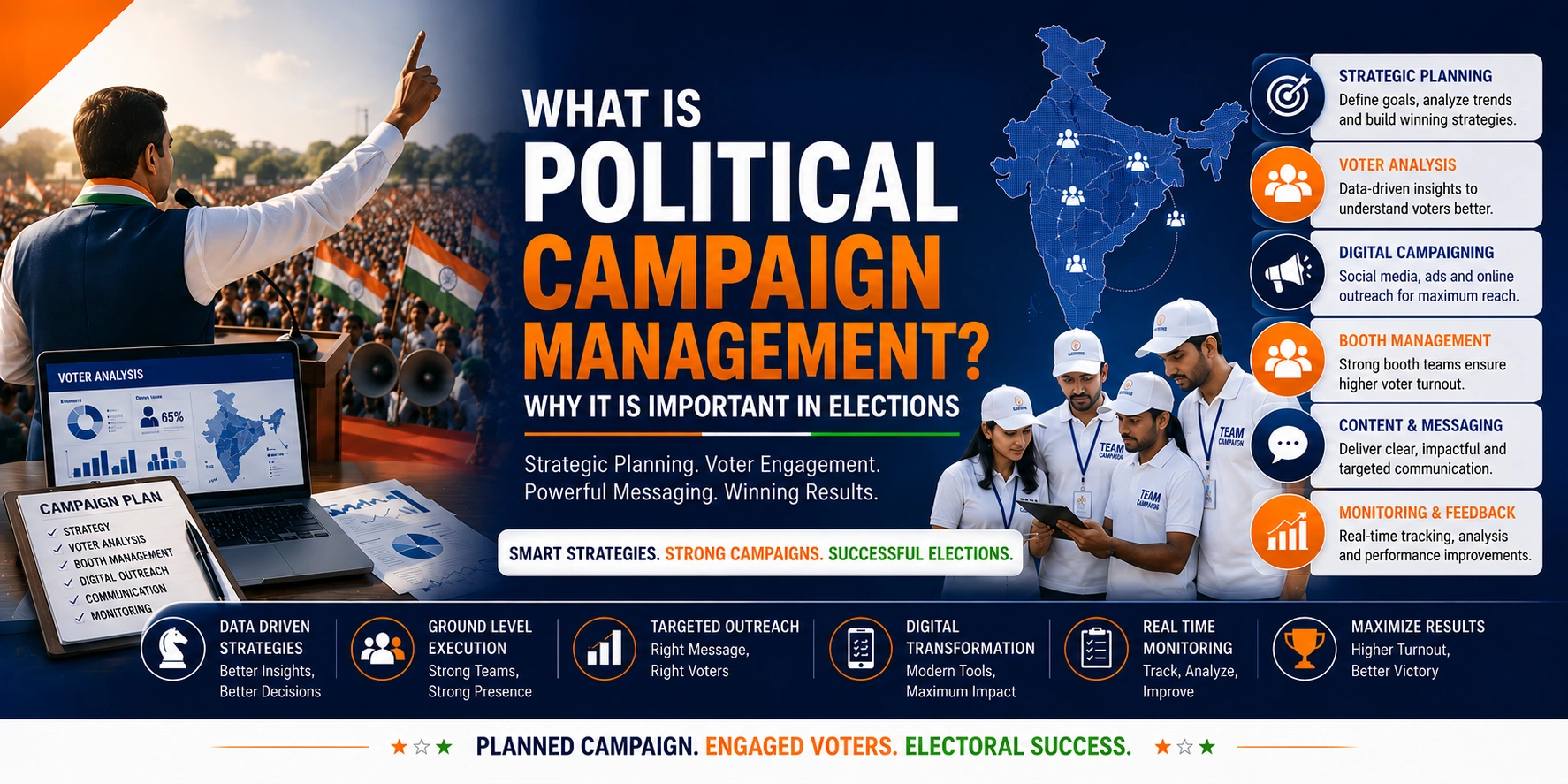
Political campaign management is the structured process of researching, planning, organizing, coordinating, executing and monitoring election campaign activities. Modern election campaigns involve multiple interconnected functions including constituency research, political surveys, electoral data analysis, campaign strategy, booth-level organization, field operations, communication, digital platforms, public relations, resource planning and continuous monitoring. Effective campaign management brings these functions together within a coordinated operational framework so that political parties, candidates, leaders and campaign teams can make informed decisions, manage resources efficiently and maintain consistency between strategy and execution.
What is Political Campaign Management?
Political campaign management is the systematic organization of the activities, resources, teams, information and communication required to conduct an election campaign.
It begins with understanding the political environment and constituency and continues through strategy development, operational planning, campaign execution, monitoring and review.
Campaign management does not refer to one individual activity. It acts as an umbrella framework connecting multiple election functions such as political research, voter and electoral data analysis, booth management, field outreach, digital communication, public relations and campaign technology.
The exact structure of a campaign can vary according to the size of the constituency, election type, available resources, political environment and campaign objectives.
Why Political Campaign Management is Important
Election campaigns involve many activities taking place simultaneously across different locations and communication channels. Without a clear management structure, different teams may operate independently, information can become fragmented and resources may not be used efficiently.
Campaign management provides an organized system through which leadership can establish priorities, allocate resources, coordinate teams, review ground information and monitor campaign activities.
- Creates a clear campaign structure and operational roadmap
- Connects political research with campaign planning
- Improves coordination between central and ground teams
- Supports disciplined use of manpower, time and resources
- Provides systems for monitoring campaign activities
- Improves flow of field information to campaign leadership
- Supports consistency across field and digital operations
- Enables regular review of changing constituency conditions
A modern political campaign is best understood as an integrated management system. Research provides information, strategy establishes direction, field and digital teams execute activities, monitoring provides feedback, and campaign leadership uses this information to review operational priorities throughout the election cycle.
Core Objectives of Political Campaign Management
Campaign objectives should be clearly defined before large-scale execution begins. Different campaigns may have different priorities, but campaign management generally seeks to establish an organized framework for research, communication, operations and decision-making.
- Understand constituency conditions and important public issues
- Develop a coherent campaign strategy and operational roadmap
- Create clear coordination between leadership and campaign teams
- Plan public communication consistently across campaign channels
- Organize field activities at constituency and booth levels
- Use available resources in a structured and accountable manner
- Establish regular monitoring and feedback systems
- Maintain operational readiness throughout the campaign lifecycle
Core Elements of Political Campaign Management
Professional political campaign management combines multiple specialized functions. Each performs a different role, but their value increases when they operate within one coordinated campaign framework.
Political Research
Studies constituency conditions, electoral history, public issues and the broader political environment.
Campaign Strategy
Converts research and campaign objectives into priorities, timelines, operational plans and measurable activities.
Constituency Intelligence
Organizes geographical, electoral and ground-level information to build a structured understanding of the constituency.
Electoral Data Analysis
Examines historical election data, turnout patterns, survey information and relevant operational metrics.
Booth Management
Organizes booth-level information, field-team structures, reporting and operational coordination.
Ground Campaign
Coordinates public meetings, local outreach, field communication and other permitted ground activities.
Digital Communication
Manages websites, social platforms, digital content and broader online campaign communication.
Public Relations
Supports organized interaction with media, public communication and campaign information dissemination.
Monitoring & Reporting
Consolidates campaign information, tracks operational progress and supports management review.
Step-by-Step Political Campaign Management Process
Professional campaign management normally follows a phased process. Although every election is different, the overall framework can be organized into connected stages from initial research through continuous monitoring.
Role of Political Research in Campaign Management
Campaign decisions become more reliable when they begin with a structured understanding of the constituency rather than assumptions alone.
Political research can include constituency profiling, historical election analysis, public issue research, political surveys, field observations and other relevant sources of electoral information.
Research helps campaign teams understand what information is already available, what questions remain unanswered and where additional ground assessment may be required.
A professional political survey can complement existing electoral data by providing structured information about current public concerns, perceptions and constituency conditions.
Role of Data in Modern Political Campaign Management
Data has become an important operational resource in modern elections. Historical election results, turnout information, booth-level records, survey findings, field reports and campaign activity data can help teams develop a more structured understanding of the constituency.
The value of data depends on its quality, relevance and interpretation. Large quantities of information are not useful unless they are properly organized, verified and connected with practical ground understanding.
- Historical election result analysis
- Booth-wise electoral pattern assessment
- Turnout and election trend analysis
- Survey data organization and interpretation
- Field feedback and issue reporting
- Campaign activity and operational monitoring
Data should support professional judgement rather than replace it. Combining quantitative information with verified field research usually provides a more complete view of political and operational conditions.
Importance of Constituency Analysis
Every constituency has its own electoral history, geographical structure, local leadership network, public issues and campaign environment. Understanding these differences is essential before developing a detailed election plan.
Constituency analysis can bring together historical election results, booth geography, survey findings, local issue mapping, organizational information and verified field feedback.
This creates a broader information base from which campaign leadership can establish operational priorities and allocate resources more systematically.
Importance of Booth Management in Political Campaigns
A constituency may contain hundreds or thousands of polling booths. Booth management helps divide large election operations into smaller, manageable units and provides campaign leadership with a more detailed view of ground activities.
A structured booth-management framework may include booth mapping, electoral information organization, field-team coordination, local issue reporting, monitoring and polling-day communication.
Campaign teams can explore booth management services for more detailed information about booth-level research, data and operational coordination.
Role of Field Operations in Campaign Management
Field operations create direct interaction between campaign organizations and the public. Depending on election rules and campaign requirements, ground activities may include public meetings, local interactions, door-to-door communication, constituency visits and other permitted campaign activities.
Managing field operations requires scheduling, logistics, team coordination, reporting and integration with the broader campaign strategy.
- Field-team planning and coordination
- Local campaign activity scheduling
- Public meeting and event coordination
- Door-to-door campaign organization
- Ground feedback and field reporting
- Coordination with booth and constituency teams
Role of Digital Communication in Political Campaigns
Digital platforms have expanded the communication environment of modern political campaigns. Websites, social media platforms, online video, digital content and other communication channels can help campaign teams distribute information and maintain regular public communication.
Digital campaigning should operate as part of the broader campaign framework rather than as an isolated activity. Online communication is more effective operationally when it is coordinated with research, field information, campaign schedules and public relations.
- Social media account management
- Digital content planning and publishing
- Website and online information management
- Video and multimedia communication
- Digital campaign performance monitoring
- Coordination between digital and ground teams
Political Communication and Message Consistency
Election campaigns communicate through many channels including speeches, public meetings, media interactions, websites, social platforms and printed material. Without coordination, different campaign units may communicate inconsistent or outdated information.
Campaign management helps establish communication processes that keep public information aligned with campaign priorities and verified facts.
Clear communication planning also makes it easier to coordinate between political leadership, media teams, field teams, digital teams and public relations professionals.
Role of Public Relations in Election Campaigns
Public relations supports organized interaction between campaign organizations, media and the wider public. It can include press communication, media coordination, public statements, event information and other forms of campaign communication.
PR activities should be based on accurate information and coordinated with the overall campaign structure so that public communication remains consistent and professionally managed.
Role of Technology in Campaign Management
Modern election campaigns may involve large teams working across many geographical locations. Technology can help centralize information, improve reporting and support coordination between campaign units.
- Centralized campaign information systems
- Digital dashboards and reporting platforms
- Field data collection applications
- Booth and constituency information management
- Campaign activity monitoring
- Coordination between central and field teams
Technology works best when supported by clearly defined processes, reliable data and trained teams. Software alone cannot replace strong campaign organization and professional ground understanding.
Role of an Election War Room
An election war room can function as a central coordination and information centre for major campaign activities. It brings together updates from field teams, research units, communication teams, digital operations and campaign leadership.
A structured war-room system can help organize incoming information, maintain activity dashboards, coordinate operational priorities and improve communication between different parts of the campaign.
Learn more about Election War Room Management .
Why Continuous Campaign Monitoring Matters
Political conditions can change during an election campaign. New public issues may emerge, field activity may vary across areas and campaign operations may require adjustment.
Continuous monitoring provides campaign leadership with regular information about operational progress. The purpose is not simply to collect reports, but to identify important changes and maintain coordination across campaign functions.
- Field activity monitoring
- Booth-level reporting
- Digital campaign performance review
- Survey and public-feedback updates
- Operational issue reporting
- Resource and schedule review
Managing Teams, Time, Budget and Resources
Campaign management is also a resource-management exercise. Election campaigns operate within limited timeframes and usually involve multiple teams, logistical requirements, communication channels and operational expenses.
Structured planning can help campaign leadership define responsibilities, establish schedules, avoid duplication of work and maintain better visibility over operational resources.
- Team and manpower planning
- Campaign calendar and scheduling
- Budget and operational planning
- Technology and infrastructure requirements
- Logistics and field coordination
- Reporting responsibility and accountability
Election Compliance and Responsible Campaign Operations
Professional campaign management should incorporate applicable election laws, Election Commission directions, advertising requirements, campaign expenditure rules, platform policies and local administrative instructions.
Teams should also maintain appropriate standards for data handling, information accuracy, public communication and operational documentation.
Compliance should not be treated as a final-stage activity. It is better integrated into planning, communication approval, field operations and reporting processes from the beginning of the campaign.
Common Challenges in Political Campaign Management
Political campaigns can be difficult to manage because many activities must be coordinated within limited time periods and rapidly changing environments.
- Large and geographically diverse constituencies
- Coordination of multiple campaign teams
- Incomplete or inconsistent field information
- Rapidly changing local political conditions
- Resource and time constraints
- Managing simultaneous ground and digital activities
- Maintaining communication consistency
- Ensuring timely monitoring and reporting
Best Practices for Political Campaign Management
Strong campaign management is built through preparation, structured processes and disciplined execution. Teams should establish systems before campaign activity reaches its most intensive stage.
- Begin with reliable constituency research
- Define campaign objectives and responsibilities clearly
- Maintain one coordinated campaign framework
- Use structured and verified information
- Connect central strategy with ground operations
- Establish regular monitoring and reporting systems
- Coordinate digital and field communication
- Review operations as constituency conditions evolve
- Maintain election-law and data-handling compliance
- Document important operational decisions and learnings
How Professional Campaign Management Services Help
Large election campaigns can require expertise across research, data, technology, field operations, communications and monitoring. Professional campaign-management organizations can help integrate these functions into a single operational framework.
Depending on the scope of work, professional support may include political research, constituency analysis, surveys, booth management, data processing, field-team coordination, digital communication, public relations, campaign monitoring and technology platforms.
A professional election campaign management company can also provide centralized coordination where multiple campaign functions need to operate simultaneously.
Megamind's Approach to Political Campaign Management
Megamind approaches election campaign management as an integrated process combining political research, data intelligence, technology, strategic planning, field coordination, digital capabilities and continuous monitoring.
The process begins with understanding the constituency, political environment and campaign requirement. Relevant electoral data, surveys, ground research and operational information can then be organized to support campaign planning.
Depending on the assignment, Megamind's election-management framework can integrate Political Survey, Opinion Poll, Voter Data Analysis, Booth Management, Election Campaign Management, Digital Promotion, Public Relations, field operations and campaign monitoring.
The objective is to provide political parties, candidates, leaders, prospective candidates and campaign teams with a structured framework through which research, strategy, technology and campaign execution can operate together.
Explore Election Campaign Management Services →Political Campaign Management in India
Campaign management in India can be particularly complex because elections take place across highly diverse constituencies. Geographic size, population density, infrastructure, media environment, local leadership, public issues and field conditions can differ substantially from one constituency to another.
Large rural constituencies may require different field and logistical structures from metropolitan constituencies. Similarly, state elections, parliamentary elections, municipal elections and other electoral contests may require different scales of research, team deployment and campaign coordination.
For this reason, effective campaign management requires adaptable systems rather than a single standard model for every election.
FAQs About Political Campaign Management
What is political campaign management?
Political campaign management is the structured process of researching, planning, organizing, coordinating, executing and monitoring activities related to an election campaign.
What are the main components of campaign management?
Major components can include political research, strategy, constituency analysis, electoral data, booth management, field operations, digital communication, public relations, resource planning and monitoring.
Why is research important before starting a political campaign?
Research helps campaign teams understand constituency conditions, electoral history, public issues and existing information before major strategic and operational decisions are made.
What is the role of data in election campaign management?
Data can support historical election analysis, booth-level assessment, survey interpretation, field reporting and operational monitoring when it is reliable, relevant and properly interpreted.
How does booth management fit into campaign management?
Booth management organizes campaign operations at the polling-booth level and helps connect constituency-wide planning with local field coordination, reporting and monitoring.
What is the role of digital campaigning?
Digital campaigning supports online public communication through websites, social platforms, digital content, video and other online channels while operating within the broader campaign plan.
Why is campaign monitoring important?
Monitoring helps leadership understand operational progress, receive field updates, identify coordination gaps and review campaign priorities as conditions evolve.
What does a political campaign management company do?
Depending on the assignment, a political campaign management company may support research, planning, data analysis, booth operations, field coordination, digital communication, public relations, technology and campaign monitoring.
Who can use political campaign management services?
Political parties, candidates, leaders, prospective candidates, campaign teams and political organizations may use professional campaign-management services according to their requirements.
Is the same campaign strategy suitable for every constituency?
No. Constituencies differ in geography, electoral history, public issues, organizational structure and campaign environment. Campaign planning should therefore reflect the characteristics of the specific constituency.
Political Campaign Management as an Integrated Election Framework
Political campaign management provides the operational structure required to connect election research, strategy, teams, technology, communication and field execution.
Modern campaigns generate large amounts of information and involve many activities taking place simultaneously. The role of campaign management is to organize these activities within a coordinated system that provides leadership with reliable information, clear responsibilities and regular operational visibility.
Effective campaign management depends on reliable research, disciplined planning, professional team coordination, responsible use of technology and continuous monitoring.
When these capabilities operate together, political parties, candidates and campaign teams can manage complex election operations in a more structured, informed and efficient manner.