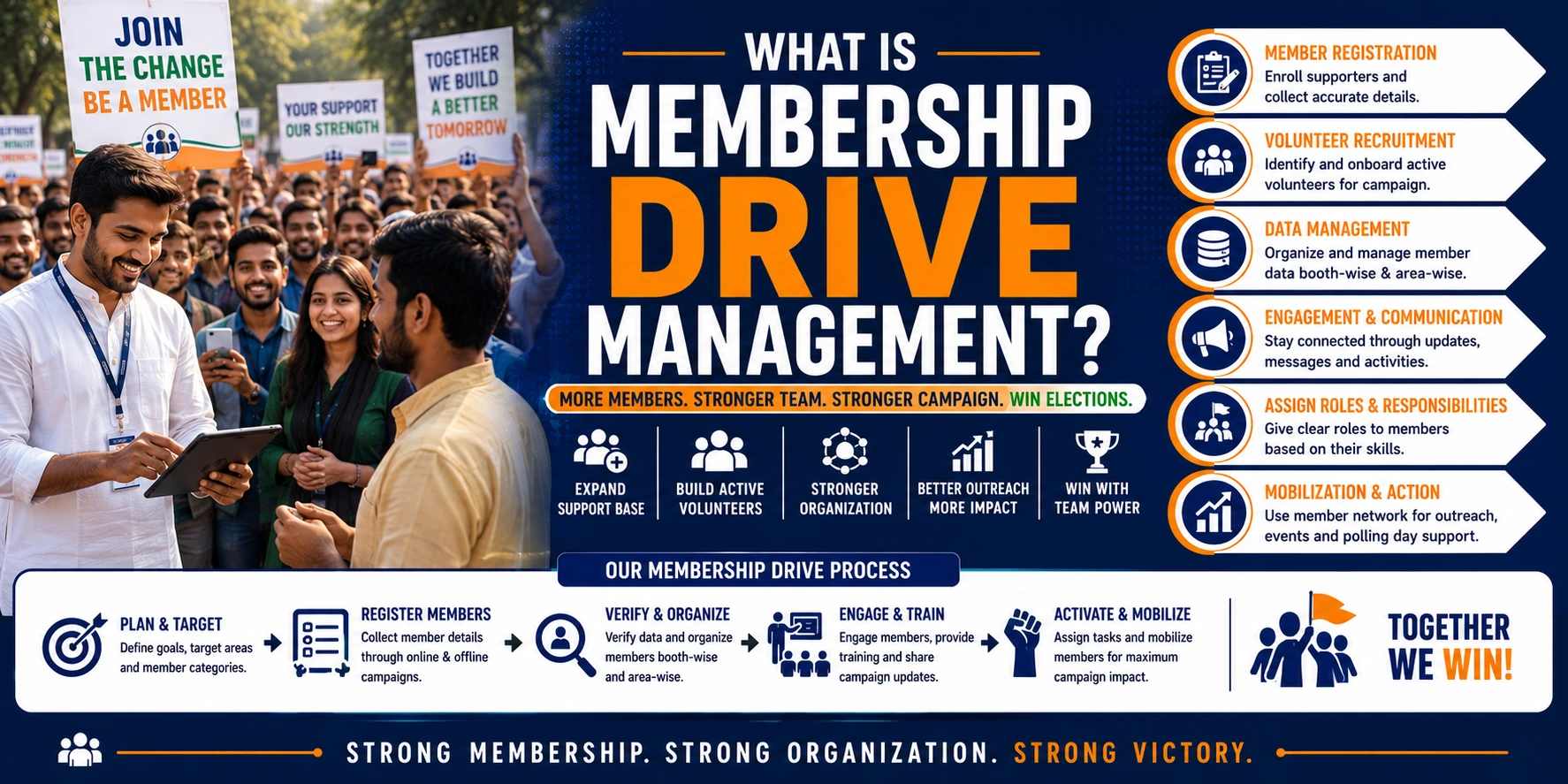
Membership Drive Management is the structured process of enrolling, verifying, organizing, communicating with and managing individuals who voluntarily choose to become members of a political organization, campaign network or public movement. A professionally managed membership drive is more than a registration exercise. It creates an organized system through which membership records, volunteer opportunities, local organizational structures, communication, training and campaign activities can be managed consistently. In large election campaigns, membership management can support organization building, volunteer development, field coordination, campaign communication and long-term political administration when implemented responsibly.
What is Membership Drive Management?
Membership Drive Management is the systematic process of planning, conducting and managing a membership-enrollment programme.
The process may include:
- Membership programme planning
- Registration-form design
- Offline and digital enrollment
- Member record management
- Duplicate-data checking
- Membership verification
- Communication and onboarding
- Volunteer opportunity management
The objective is to maintain an accurate, organized and useful membership system rather than simply collect a large number of names or contact numbers.
Why Membership Drive Management is Important
Political organizations may operate across large geographic areas with different local units, coordinators, volunteers and campaign activities.
A structured membership system can create an organizational foundation that supports:
- Member registration
- Local organizational development
- Volunteer identification
- Internal communication
- Area-level coordination
- Training and orientation
- Event coordination
- Long-term membership records
A membership drive should be treated as an organization and data-management programme. Collecting registrations is only the first step. Verification, onboarding, communication, role management and secure recordkeeping determine whether the membership database remains useful over time.
Main Objectives of Membership Drive Management
Member Enrollment
Provide a structured process through which eligible individuals can voluntarily register for membership.
Data Quality
Maintain complete, accurate and duplicate-controlled membership records.
Local Organization
Organize membership records according to legitimate administrative or geographic structures.
Communication
Maintain appropriate communication channels for official organizational updates and activities.
Volunteer Development
Provide interested members with opportunities to participate in defined organizational or campaign activities.
Administration
Create a reliable system for membership status, records, updates and organizational reporting.
Key Components of Membership Drive Management
Programme Planning
Define membership objectives, operating areas, timeline, registration channels and management responsibilities.
Registration Form
Develop clear forms that collect only information reasonably necessary for membership administration.
Field Registration
Use authorized local teams or organizational events for offline enrollment where appropriate.
Digital Registration
Provide online enrollment channels through approved websites, forms or digital systems.
Verification
Check duplicate, incomplete or invalid records according to defined data-quality rules.
Database Management
Store and maintain membership records through controlled and secure systems.
Member Communication
Provide appropriate official organizational information and activity updates.
Volunteer Opportunities
Allow interested members to opt into defined organizational or campaign-support activities.
Monitoring
Review registration progress, data quality, communication systems and administrative issues.
How Membership Drive Management Works
Planning a Membership Drive
A membership campaign should begin with an operational plan.
The planning stage can define:
- Membership programme objective
- Geographic coverage
- Registration period
- Enrollment channels
- Coordinator responsibilities
- Verification process
- Data-management system
- Member communication process
Defining these elements before enrollment begins can reduce duplicate processes and improve data consistency.
Membership Form Design
Membership forms should be easy to understand and should collect only information that is reasonably necessary for membership administration.
Depending on organizational requirements, a registration form may include:
- Name
- Necessary contact information
- Address or geographic area where required
- Membership unit or organizational area
- Preferred communication channel
- Optional volunteer interest
- Required declaration or consent
- Registration reference number
Unnecessary sensitive personal information should not be collected merely because a field is technically available.
Field-Based Membership Registration
Membership enrollment may be conducted through authorized local offices, organizational meetings, public programmes or designated membership teams.
Field teams should follow standardized registration procedures so that records remain consistent.
- Use approved forms
- Explain the membership process clearly
- Ensure voluntary registration
- Check required fields
- Avoid duplicate registration where possible
- Protect submitted information
- Provide registration acknowledgment where used
- Transfer records securely to the central system
Digital Membership Drive Management
Digital tools can help organizations manage membership enrollment across large geographic areas.
Depending on project requirements, digital membership systems may include:
- Website membership forms
- Mobile-friendly registration pages
- Unique registration links
- QR-code access to official forms
- Digital acknowledgment messages
- Centralized databases
- Verification workflows
- Administrative dashboards
Digital registration should use official channels and appropriate privacy and security safeguards.
Field Membership Drive vs Digital Membership Drive
Field Registration
Conducted through authorized local teams, offices, meetings or physical enrollment activities. It can be useful where personal assistance is required during registration.
Digital Registration
Conducted through online forms or official digital systems and can provide centralized data capture and faster administrative processing.
Large programmes may use both approaches within one centralized membership-management system.
Member Verification and Duplicate Management
Large membership drives can generate duplicate, incomplete or inconsistent records.
A verification workflow may include checks for:
- Duplicate registrations
- Incomplete required fields
- Invalid contact formats
- Repeated registration identifiers
- Incorrect geographic assignment
- Data-entry inconsistencies
- Inactive or withdrawn records
- Administrative exceptions
Verification rules should be documented and should avoid making unsupported assumptions about individual members.
Membership Database Management
A membership database is the administrative foundation of a large-scale membership programme.
A professional system may support:
- Unique membership records
- Registration status
- Geographic or organizational assignment
- Contact-information updates
- Volunteer opt-in records
- Communication preferences
- Membership-status changes
- Administrative reporting
Membership records should be updated systematically rather than maintained across disconnected spreadsheets or informal message groups wherever a centralized system is practical.
Membership Status and Voluntary Organizational Roles
Not every member needs to participate in campaign work. Membership and active volunteering should therefore be treated as separate concepts.
Registered Member
A person registered under the organization's membership process. Membership itself does not require participation in every campaign activity.
Volunteer
A member or other eligible participant who voluntarily opts into defined organizational or campaign-support activities.
Active roles can be assigned according to legitimate operational requirements, availability and consent.
Member Onboarding
Registration is only the beginning of membership administration. New members may require basic onboarding information.
Onboarding can include:
- Membership confirmation
- Organizational information
- Official contact channels
- Membership rights and responsibilities where applicable
- Communication preferences
- Volunteer opportunities
- Local office or coordinator information
- Process for updating membership details
Membership Drives and Volunteer Management
Some registered members may voluntarily choose to participate in campaign or organizational activities.
Interested members can be connected with a professional Volunteer Management system.
Volunteer-management processes can then handle:
- Volunteer opt-in
- Role assignment
- Training
- Area allocation
- Task management
- Activity reporting
- Coordinator communication
- Safety and conduct guidance
Role of Membership Drives in Grassroots Campaigning
Membership systems can support Grassroots Campaigning by providing an organized administrative structure for local members and volunteers.
Depending on organizational requirements, membership records may help manage:
- Local organizational units
- Member communication
- Volunteer opportunities
- Organizational meetings
- Campaign event support
- Training programmes
- Area-level administration
- Internal reporting
Membership Management and Booth-Level Organization
Campaign-side Booth Management may require local organizational teams across small geographic units.
Membership records may help campaign administrators understand where registered organizational members and willing volunteers are located, provided the information is used responsibly.
Appropriate administrative uses can include:
- Local member administration
- Volunteer team organization
- Coordinator assignment
- Campaign event support
- Training coordination
- Internal communication
- Area-based reporting
- Operational planning
Membership data should not be treated as a substitute for official electoral records or as proof of wider voter preferences.
Membership Database vs Electoral Roll
Membership Database
An organization's internal record of people who have enrolled through its membership process.
Electoral Roll
The official voter-registration record maintained under the electoral system by the relevant election authorities.
A political membership database does not create, replace or modify official voter-registration status.
Membership Communication System
A large membership programme needs reliable official communication channels.
Communication systems may support:
- Membership acknowledgments
- Administrative notices
- Organizational meeting information
- Training information
- Volunteer opportunities
- Official campaign updates
- Contact-detail verification
- Membership-record updates
Communication should respect member preferences and applicable rules regarding messaging and personal data.
Role of Data in Membership Drive Management
Membership data is primarily an organizational and administrative resource.
Aggregate membership reports can help management understand:
- Number of registrations
- Registration growth over time
- Geographic distribution of members
- Data-completeness rates
- Duplicate-registration rates
- Volunteer opt-in levels
- Communication delivery status
- Membership administrative workload
These metrics describe the membership programme itself. They should not automatically be interpreted as constituency-wide electoral support or voting intention.
Membership Data vs Political Survey Data
A membership database contains information about individuals who voluntarily joined an organization. It is therefore not necessarily representative of the wider electorate.
Membership Data
Administrative information about registered members and the operation of the membership programme.
Political Survey Data
Research information collected using a defined questionnaire, sample design, field process and analytical methodology.
When broader public-opinion analysis is required, a professionally designed Political Survey should be used rather than treating membership numbers as a public opinion poll.
Technology for Membership Drive Management
Technology can improve the administration of large membership programmes.
A membership-management system may include:
- Online registration portal
- Mobile-friendly forms
- Centralized member database
- Duplicate detection
- Verification workflows
- Member-status management
- Administrative dashboards
- Communication management
- Volunteer opt-in management
- Management reports
Security of Membership Systems
Membership databases can contain personal and organizational information and should therefore be protected appropriately.
- Restrict access to authorized personnel
- Use strong authentication where available
- Avoid unnecessary data exports
- Maintain secure backups where appropriate
- Remove access when responsibilities change
- Protect administrator accounts
- Review suspicious activity
- Maintain basic incident-response procedures
Privacy and Data Governance in Membership Drives
Membership management requires responsible collection, storage and use of personal information.
Good data-governance practices include:
- Explain why information is being collected
- Collect only reasonably necessary information
- Avoid unnecessary sensitive personal profiling
- Use appropriate access controls
- Maintain accurate records
- Provide processes for permitted updates
- Secure stored information
- Follow applicable privacy requirements
Member Engagement After Registration
Membership programmes should not stop after registration.
Appropriate organizational engagement may include:
- Membership confirmation
- Administrative updates
- Local organization meetings
- Training programmes
- Volunteer opportunities
- Public organizational events
- Internal feedback mechanisms
- Membership-record updates
Members should be able to participate according to their own interests, availability and the organization's applicable rules.
Membership Drive Reporting and Dashboards
Management dashboards can provide operational visibility into the membership programme.
Reports may include:
- Total registrations
- New registrations by period
- Area-wise membership counts
- Verification pending
- Duplicate records identified
- Incomplete registrations
- Volunteer opt-ins
- Communication status
Reporting should focus on organizational administration and data quality rather than unnecessary profiling of individuals.
Monitoring a Membership Drive
Continuous monitoring helps identify administrative and operational gaps while the drive is active.
Management can review:
- Registration progress
- Data completeness
- Duplicate levels
- Verification workload
- Coordinator reporting
- Digital system availability
- Member communication issues
- Pending administrative tasks
Benefits of Professional Membership Drive Management
- Creates structured membership records
- Improves data quality
- Supports local organizational development
- Improves member communication
- Supports volunteer development
- Reduces duplicate and incomplete records
- Improves administrative reporting
- Supports long-term organizational continuity
- Improves digital and field enrollment coordination
- Creates a more organized membership system
Common Challenges in Membership Drive Management
Duplicate Records
The same individual may be registered more than once through different channels.
Incomplete Data
Missing or inaccurate information can reduce the usefulness of membership records.
Verification Workload
Large enrollment volumes can create significant administrative verification requirements.
Disconnected Systems
Separate field and digital databases can create duplicate information and reporting gaps.
Communication
Large membership networks require organized and appropriate communication systems.
Data Security
Membership information requires access control and responsible data handling.
Best Practices for Membership Drive Management
- Define membership objectives clearly
- Use standardized registration forms
- Collect only necessary information
- Use voluntary enrollment procedures
- Maintain a centralized database where practical
- Check duplicate and incomplete records
- Use defined verification rules
- Protect membership information
- Separate membership from volunteer participation
- Maintain appropriate communication preferences
- Monitor registration quality
- Review administrative processes regularly
How Professional Membership Drive Services Help
Professional campaign-management and technology teams can help organizations design and administer large membership programmes.
Depending on requirements, professional support may include:
- Membership-drive planning
- Registration-form design
- Field enrollment systems
- Digital registration portals
- Database design
- Verification workflows
- Duplicate-data management
- Member communication systems
- Administrative dashboards
- Volunteer-management integration
These functions can be integrated with Election Campaign Management and other organizational or election-support services according to project requirements.
Megamind's Approach to Membership Drive Management
Megamind approaches membership-drive management as a combination of organization planning, field operations, technology, data quality, communication and ongoing administration.
Depending on project requirements, the process can follow:
Membership Strategy → Area & Organizational Structure → Registration Setup → Field & Digital Enrollment → Data Validation → Member Database → Onboarding & Communication → Volunteer Integration → Monitoring & Reporting
Membership-drive management can be integrated with Volunteer Management, Grassroots Campaigning, Booth Management, Political Survey, Digital Promotion, Public Relations, Data Management and Election Campaign Management according to organizational requirements.
Megamind provides election research, organization-management, campaign technology and campaign-support services for political parties, candidates, leaders, prospective candidates, aspirants, campaign teams and political organizations across India.
Explore Complete Election Services →Membership Drive Management Across India
Political membership programmes may be organized across national, state, constituency, municipal, ward, village and other local organizational structures.
The appropriate model can vary significantly depending on geography, organizational structure, digital access, local administration and available field resources.
Rural programmes may require stronger field-registration capacity, while urban programmes may make greater use of digital registration alongside locality-based organizational teams.
A flexible membership-management framework can combine both methods while maintaining one standardized database and reporting process.
Membership Drive Management Within a Complete Campaign System
Membership administration is most useful when integrated with organizational, volunteer and campaign-management systems.
Membership Planning → Registration → Verification → Member Database → Communication → Volunteer Opt-In → Local Organization → Campaign Operations → Monitoring & Continuous Administration
This creates a clear distinction between member registration, organization administration and optional campaign participation while connecting all three through a structured management system.
FAQs About Membership Drive Management
What is Membership Drive Management?
Membership Drive Management is the structured process of enrolling, verifying, organizing and administering members of a political organization, campaign network or public movement.
Why is membership management important?
It helps organizations maintain accurate member records, communication, local organization and administrative continuity.
What information should a membership form collect?
It should collect only information reasonably necessary for membership administration, contact, geographic assignment and other legitimate organizational requirements.
Can membership registration be done online?
Yes. Organizations can use official online forms, websites and other approved digital registration systems.
Why is member verification necessary?
Verification helps identify duplicate, incomplete or invalid membership records and improves database quality.
Is every registered member a campaign volunteer?
No. Membership and volunteering are separate. Members may choose whether they want to participate in optional organizational or campaign activities.
How can membership drives support volunteer management?
Members who voluntarily express interest can be connected with structured volunteer-management processes for defined roles and activities.
Is a membership database the same as an electoral roll?
No. A membership database is an organization's internal record, while electoral rolls are official voter-registration records maintained by election authorities.
Can membership numbers be treated as election survey results?
No. Members are a self-selected organizational group and do not necessarily represent the broader electorate.
How does technology help membership management?
Technology can support digital registration, centralized databases, verification, duplicate management, dashboards and member communication.
Why is privacy important in membership drives?
Membership systems contain personal information, so organizations should minimize unnecessary collection, restrict access and protect stored records.
What are the major challenges in large membership drives?
Common challenges include duplicate records, incomplete information, verification workload, disconnected systems, communication issues and data security.
Who can use professional membership-drive services?
Political parties, candidates, leaders, campaign teams, political organizations and other eligible organizations may use professional membership-management support according to project requirements.
Membership Drive Management Builds Structured Political Organization
Membership Drive Management is much more than collecting contact information. It is an organizational system for managing enrollment, verification, records, communication and voluntary participation.
A professionally managed programme combines planning, registration, digital and field enrollment, data validation, secure membership records, onboarding, communication and administrative reporting .
Membership systems can also support volunteer development, grassroots organization and broader campaign management when individual participation is voluntary and information is used responsibly.
The objective is to create an accurate, organized, secure and sustainable membership system that supports long-term organizational administration.