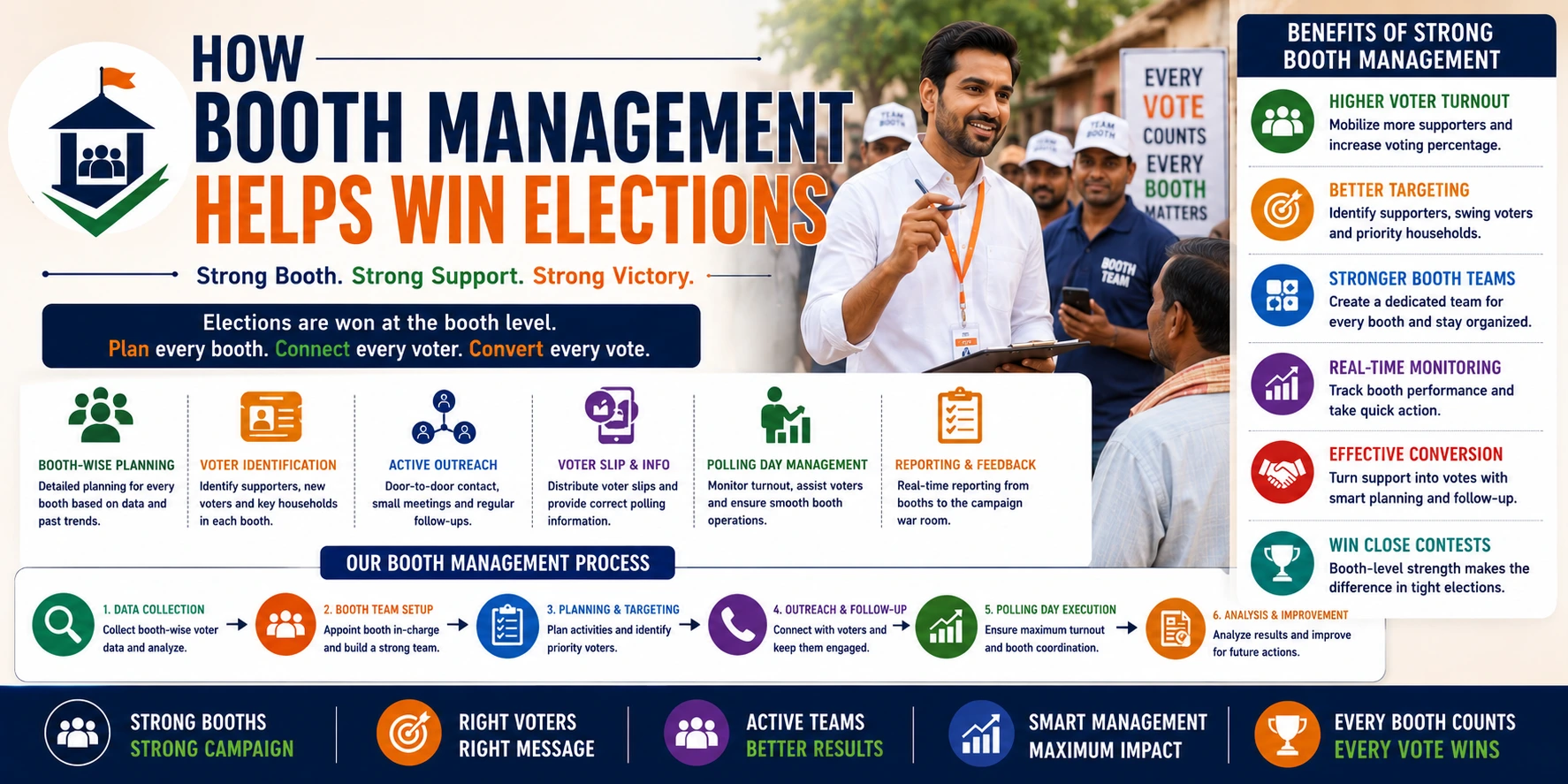
Booth management is one of the most important operational components of an election campaign. A constituency may contain hundreds or even thousands of polling booths, each representing a distinct ground-level environment with its own electoral history, local issues, field conditions and campaign activity. Effective booth management helps political parties, candidates and campaign teams organize these complex ground operations into smaller, manageable units. By combining booth-level information, field coordination, monitoring, reporting and technology, campaign leadership can develop a clearer picture of constituency conditions and manage election operations in a more structured and informed manner.
What is Booth Management?
Booth management is the systematic planning, organization, coordination and monitoring of election-related operations at the polling-booth level. It creates an operational framework through which campaign teams can organize booth information, assign responsibilities, coordinate field activities, receive ground feedback and monitor campaign execution.
Instead of viewing an entire constituency as one large electoral unit, booth management divides campaign operations into smaller areas that can be studied and managed more systematically.
Modern booth management can involve booth mapping, electoral data organization, historical result analysis, local issue assessment, field-team coordination, ground reporting, technology-enabled monitoring and polling-day operations.
Why Booth Management Matters in Elections
Election campaigns operate at multiple levels. Leadership may develop constituency-wide strategy, communication themes and campaign plans, but implementation ultimately takes place across local areas and polling booths.
Booth management helps connect broader campaign planning with ground-level execution. It provides campaign teams with a structure for understanding local conditions, organizing field operations and maintaining communication between central campaign leadership and local teams.
- Creates structured booth-level campaign operations
- Improves coordination between leadership and field teams
- Provides better visibility into different polling areas
- Supports systematic collection of ground feedback
- Helps identify operational gaps across the constituency
- Improves monitoring and reporting of field activities
- Supports organized polling-day coordination
- Connects research and data with practical field execution
The strength of booth management lies in its ability to connect information with execution. Electoral data can explain what has happened historically, while field research can explain current ground conditions. Booth management brings these inputs together within an operational system that enables campaign teams to organize, monitor and review activities across the constituency.
How Booth Management Strengthens Election Campaigns
Effective election management requires more than visibility through rallies, advertising, digital communication or public meetings. Campaign teams also need reliable ground information and an operational system capable of coordinating activities across the constituency.
Booth management strengthens this process by providing a clear structure for planning, field coordination, reporting and review. Campaign leadership can understand where activities are progressing according to plan, where additional assessment may be required and where operational coordination needs improvement.
- Booth-Wise Planning: Creates a structured operational plan for different polling areas
- Ground Intelligence: Organizes verified field observations and local feedback
- Issue Mapping: Helps identify important local concerns across different areas
- Team Coordination: Establishes clear responsibilities and reporting structures
- Campaign Monitoring: Provides regular visibility into field activities and progress
- Polling-Day Coordination: Supports structured communication and operational reporting
Three Pillars of Effective Booth Management
Although booth-management models vary according to campaign requirements, three broad elements form the foundation of a strong operational system: information, organization and monitoring.
Reliable Information
Booth-level planning requires organized electoral information, historical data, constituency research and verified ground feedback.
Ground Organization
Field teams require clearly defined responsibilities, communication structures and operational processes for different polling areas.
Continuous Monitoring
Regular field reporting and review help campaign leadership understand progress, identify gaps and maintain operational coordination.
Booth-Level Electoral Data Analysis
Booth-level data provides an important analytical foundation for election planning. Historical election results, turnout information, polling-station geography and other legitimate electoral information can help campaign teams understand how different parts of a constituency have behaved over time.
Historical data should not be treated as a prediction of future voting behaviour. Political conditions can change between elections. For this reason, booth-level electoral analysis becomes more useful when it is considered alongside current surveys, field research, local issues and verified ground feedback.
- Historical booth-wise election result analysis
- Previous election turnout assessment
- Polling-area geographical mapping
- Comparison of electoral patterns over time
- Integration of survey and field research findings
- Identification of areas requiring additional ground assessment
Role of Booth-Level Teams
Booth-level teams provide an important connection between campaign leadership and ground operations. Their role may include collecting information, coordinating permitted campaign activities, reporting local developments and maintaining communication with higher levels of the campaign organization.
The exact structure of a booth team varies according to the campaign, constituency and applicable election regulations. Regardless of structure, clear responsibilities and reliable reporting are important for effective coordination.
- Booth or area coordination
- Field information collection
- Ground activity reporting
- Local issue and feedback documentation
- Communication with campaign coordinators
- Polling-day operational reporting
Local Issue Mapping and Field Feedback
Constituency-wide political issues may not affect every locality in the same way. Infrastructure, civic services, employment, agriculture, transportation, development and other local concerns can vary considerably across polling areas.
Structured booth-level reporting can help campaign teams document these differences and develop a more accurate picture of ground conditions. Field observations should be verified and consolidated rather than relying on isolated assumptions or informal reports.
This local information can complement broader political survey findings and other constituency research.
Booth Management Workflow
A structured booth-management operation generally develops through a sequence of connected stages. Information collected at one stage supports planning and review at subsequent stages.
Role of Data and Reporting in Booth Management
Effective booth management depends on the quality of information available to campaign leadership. Large quantities of unstructured information do not automatically create useful intelligence. Data needs to be organized, verified and presented in a format that supports operational review.
Booth-wise reports can bring together historical electoral information, field observations, survey findings, local issues and campaign activity updates. Regular reporting can help campaign leadership compare operations across different areas and identify where further assessment may be required.
- Booth-wise information organization
- Historical electoral trend assessment
- Field activity reporting
- Local issue documentation
- Survey and ground-feedback integration
- Operational progress monitoring
How Technology Supports Booth Management
Modern election campaigns may involve geographically distributed field teams and large volumes of operational information. Technology can make this information easier to collect, organize, review and communicate.
Digital systems can support booth mapping, structured field reporting, centralized information management, dashboards and coordination between campaign leadership and field teams.
- Mobile applications for structured field reporting
- Centralized booth information systems
- Digital dashboards for operational monitoring
- Field activity and progress reporting
- Data analytics for operational assessment
- Centralized coordination and information flow
Technology is most effective when it supports disciplined field processes. Digital tools can improve the speed and organization of information, but reliable ground teams remain essential for understanding local context.
Booth Management Before Polling Day
Booth management should begin well before polling day. Early preparation allows campaign teams to organize information, establish field structures, understand local conditions and test reporting systems before election operations become more intensive.
- Organizing and reviewing booth information
- Mapping polling locations and operational areas
- Conducting ground-level assessment
- Establishing field-team responsibilities
- Setting up communication and reporting processes
- Reviewing field progress at regular intervals
Polling-Day Booth Management
Polling day is one of the most operationally demanding stages of an election campaign. Multiple teams may need to communicate simultaneously, while campaign leadership requires timely and reliable information from different polling areas.
A well-defined booth-management structure can help maintain communication, coordinate authorized personnel, consolidate field reports and provide campaign leadership with an organized overview of ground operations.
- Structured booth-level communication
- Coordination of authorized field personnel
- Collection of operational field updates
- Centralized reporting to campaign coordinators
- Documentation of field-level operational issues
- Coordination within applicable election regulations
All polling-day activities should be carried out in accordance with applicable election laws, Election Commission directions and local administrative requirements.
How Booth Management Supports Overall Campaign Strategy
Booth management should not operate independently from the broader election strategy. Its value increases when booth-level information is connected with political research, constituency analysis, field feedback, campaign management and communication planning.
Ground reports can provide campaign leadership with additional context for reviewing constituency conditions. At the same time, broader campaign strategy can provide direction to booth-level operational teams.
This creates a continuous information cycle: Research → Planning → Ground Operations → Monitoring → Feedback → Review .
Benefits of Strong Booth Management
The primary benefit of booth management is improved operational visibility and coordination. When campaign activities are organized booth by booth, leadership can develop a more detailed understanding of what is happening across the constituency.
- More structured ground-level campaign operations
- Improved field-team accountability and coordination
- Better organization of booth-wise information
- Stronger connection between research and field operations
- More consistent ground reporting
- Improved visibility into local campaign conditions
- Better coordination between field and central teams
- More organized polling-day operations
Common Challenges in Booth Management
Booth management can become complex because it involves large quantities of information, geographically distributed field teams and continuous coordination. Without clear systems, reporting quality and operational consistency may decline.
- Incomplete or outdated booth information
- Inconsistent field reporting
- Weak coordination between campaign levels
- Uneven field activity across polling areas
- Rapid changes in local political conditions
- Communication and logistical difficulties
- Information duplication or reporting delays
- Lack of centralized monitoring systems
Best Practices for Booth Management
Strong booth management depends on disciplined preparation rather than last-minute activity. Campaign teams should establish reliable systems early and continuously review the quality of information received from the field.
- Begin booth mapping and information organization early
- Use reliable and appropriately sourced electoral information
- Define field-team responsibilities clearly
- Create standardized reporting formats
- Verify important ground information before acting on it
- Integrate field reports with broader campaign research
- Use technology to support rather than replace field operations
- Maintain compliance with applicable election regulations
How Professional Booth Management Services Help
Managing booth-level operations across a large constituency can require substantial coordination, data organization, field supervision and reporting infrastructure. Professional election-management organizations can help establish systems that bring these functions together.
Depending on the scope of an assignment, professional support may include booth mapping, electoral data analysis, political research, field coordination, reporting systems, campaign monitoring and technology-enabled election management.
A professional booth management company in India can help integrate booth operations with broader political research, constituency analysis and election campaign management requirements.
Megamind's Approach to Booth Management
Megamind approaches booth management as an integrated election-operations framework combining political research, electoral data, technology, field coordination, monitoring and structured reporting.
Our approach begins with understanding the constituency and organizing relevant booth-level information. Depending on campaign requirements, this may be followed by booth mapping, electoral data analysis, ground assessment, field-team coordination, monitoring systems and centralized reporting.
Rather than treating research, data and field execution as separate activities, the objective is to connect them within a structured operational framework that provides campaign leadership with clearer, more organized and timely ground information.
Explore Megamind Booth Management Services →Booth Management Across Indian Elections
Election constituencies across India can differ significantly in geography, population density, infrastructure, political environment and local administrative conditions. A booth-management model therefore needs to be adapted to the characteristics of each constituency.
Metropolitan constituencies may require a different field structure from large rural or mixed constituencies. Similarly, communication, transportation, team deployment and reporting requirements may differ substantially across regions.
Effective booth management therefore depends on a combination of local understanding, reliable field networks, organized information systems and adaptable operational planning.
FAQs About Booth Management in Elections
What is booth management in an election?
Booth management is the structured planning, organization, coordination and monitoring of election-related operations at the polling-booth level.
Why is booth management important?
It helps campaign teams divide a large constituency into smaller operational units, organize booth information, coordinate field teams and maintain structured reporting from different polling areas.
How does booth management support an election campaign?
Booth management connects broader campaign planning with ground-level operations by organizing information, responsibilities, monitoring and communication across polling areas.
What is the role of booth-level data?
Booth-level data can help campaign teams understand historical electoral patterns, turnout information, geographical differences and other relevant constituency-level information when combined with current research and verified field feedback.
How is technology used in booth management?
Technology can support booth mapping, field reporting, centralized information management, dashboards, analytics and communication between field teams and campaign leadership.
Does booth management start only on polling day?
No. Effective booth management generally begins well before polling day with booth mapping, information organization, ground assessment, team coordination and reporting-system preparation.
What is polling-day booth management?
Polling-day booth management focuses on structured communication, coordination of authorized field personnel, operational reporting and information flow within applicable election rules.
Who can use professional booth management services?
Political parties, candidates, leaders, prospective candidates, campaign teams and political organizations may use professional booth-management support according to their operational requirements.
Booth Management Connects Strategy with Ground Operations
Booth management is an important operational framework for organizing election activities at the polling-booth level. Its value lies in connecting constituency research, electoral information, field teams, technology, monitoring and reporting within a coordinated system.
Strong booth management does not depend on any single dataset, tool or field activity. It depends on the ability to combine reliable information with disciplined organization and continuous ground-level feedback.
When political research, data intelligence, field coordination and technology work together, campaign teams can develop a clearer understanding of constituency conditions and manage complex election operations in a more structured, informed and efficient manner.