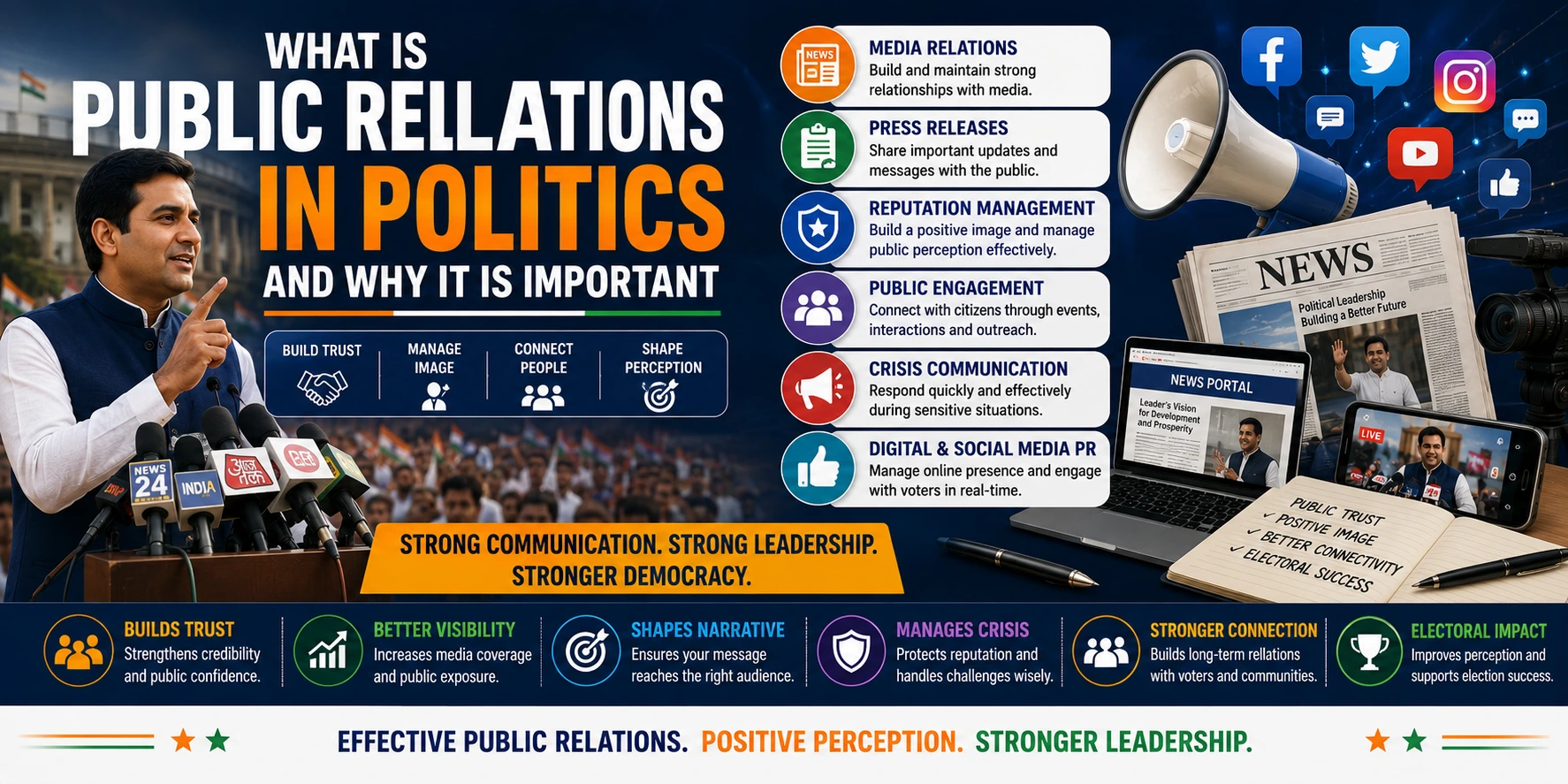
Public relations in politics is the structured management of public communication, media relations, official information, reputation, digital communication and crisis response for political leaders, candidates, political parties and organizations. Modern political communication operates continuously across newspapers, television, digital news platforms, websites, social media, public meetings, interviews and direct public interactions. Because information moves quickly across these channels, political organizations need clear processes for verifying information, preparing official communication, coordinating media activity and responding responsibly when important public questions or controversies arise. Effective political PR is therefore much broader than publicity. It is an organized communication function focused on accuracy, clarity, consistency, accessibility, transparency and professional media coordination .
What is Public Relations in Politics?
Public relations in politics refers to the professional management of communication between political organizations or public figures and the different audiences that interact with them.
These audiences may include:
- Citizens and the general public
- Journalists and news organizations
- Political workers and campaign teams
- Public-interest organizations
- Local stakeholders
- Event participants
- Digital audiences
- Other relevant institutions
Political PR includes press communication, interviews, media briefings, public statements, speech support, event communication, digital PR, reputation monitoring, crisis communication and documentation.
Political PR is More Than Publicity
Publicity is only one possible outcome of public relations. Professional political PR is primarily about building a reliable communication system.
Publicity
Primarily focuses on attracting public or media attention to an event, announcement, activity or public figure.
Public Relations
Covers research, communication planning, media coordination, information verification, public statements, reputation, monitoring and crisis response.
Why Public Relations is Important in Politics
Political organizations operate in an environment where statements, policy positions, public activities and political developments can receive immediate attention.
Without a structured communication system, different representatives may provide inconsistent information, media questions may remain unanswered and inaccurate information may circulate without timely clarification.
Professional political PR helps organizations:
- Communicate official information clearly
- Maintain consistency across communication channels
- Coordinate media communication professionally
- Explain policies, positions and public work
- Respond to legitimate public questions
- Prepare for interviews and media briefings
- Monitor significant public discussions
- Respond to verified misinformation
- Manage communication during crises
- Maintain accurate communication records
Sustainable political reputation cannot be created through publicity alone. It is supported by authentic public work, factual communication, accessibility, consistency, transparency and responsible responses . PR helps communicate and document these elements; it should not substitute for them.
Core Objectives of Political Public Relations
Clear Communication
Present official information, policies, activities and positions in understandable language.
Media Coordination
Maintain organized professional communication with journalists and media organizations.
Information Accuracy
Verify important facts before distributing official public communication.
Reputation Management
Maintain consistent, factual and responsible communication around a political organization or public figure.
Crisis Readiness
Establish clear processes for verifying issues and preparing timely official responses.
Public Accessibility
Make important public information easier to find and understand through appropriate communication channels.
How Political Public Relations Works
Political PR is most effective when communication is handled through a repeatable process rather than through isolated announcements.
Key Components of Political Public Relations
A comprehensive political PR system may combine several communication functions.
Media Relations
Professional coordination with newspapers, television, digital news and regional media.
Press Communication
Preparation and distribution of press releases, notes, statements and official updates.
Candidate Communication
Support for speeches, interviews, briefing notes and factual public communication.
Digital PR
Coordination of websites, official social channels, online updates and digital news communication.
Reputation Management
Monitoring public information and maintaining consistent, documented communication.
Crisis Communication
Verification, coordination and official communication during rapidly developing situations.
Event Communication
Information support for public meetings, conferences, briefings and political events.
Monitoring
Tracking relevant media coverage, official mentions and significant information developments.
Documentation
Maintaining organized records of releases, statements, coverage, responses and communication assets.
Role of Media Relations in Political PR
Media relations is one of the most visible components of political public relations.
A professional media-relations function can support:
- Press releases
- Media advisories
- Press conferences
- Media briefings
- Interview coordination
- Background information
- Official statements
- Fact sheets
- Event information
- Correction and clarification notices
The objective should be to make verified information available in a clear and timely manner while respecting editorial independence.
Press Releases and Official Political Communication
A press release provides journalists and the public with an official written account of an announcement, event, statement or development.
A professional political press release should generally answer:
- What happened?
- Who is involved?
- When did it happen?
- Where did it happen?
- Why is it relevant?
- What verified supporting information is available?
- Who is the authorized media contact?
Clear attribution and factual verification are especially important in political communication.
Public Relations and Candidate Communication
Political PR can help candidates communicate their documented work, public positions, priorities and responses more consistently.
Candidate communication support may include:
- Media briefing documents
- Speech research and preparation
- Interview preparation
- Issue briefing notes
- Public FAQs
- Fact sheets
- Event communication
- Official statements
Candidate communication should remain consistent with authentic public identity and verifiable facts. PR should not manufacture accomplishments or create misleading claims.
Also read: What is Candidate Image Management?
What is Political Reputation Management?
Political reputation management is the long-term process of monitoring public information, maintaining factual consistency, addressing legitimate concerns and responding appropriately when inaccurate information becomes significant.
Responsible reputation management may include:
- Monitoring important media references
- Maintaining factual records
- Verifying disputed claims
- Preparing corrections where appropriate
- Responding to legitimate public questions
- Maintaining consistent official information
- Documenting public work and activities
- Reviewing communication risks
Reputation management should not mean hiding accurate criticism. Credible communication requires distinguishing factual errors from legitimate disagreement or scrutiny.
Digital Public Relations in Politics
Political communication now takes place continuously across digital platforms. Websites, social media accounts, online news, video platforms and messaging channels can all distribute information rapidly.
Digital PR may include:
- Official website updates
- Press release publishing
- Social media communication
- Video statements
- Event updates
- Online media coordination
- Fact-check information
- Public FAQs
- Digital monitoring
- Communication archives
Political organizations should maintain clear ownership and approval procedures for official digital accounts to reduce errors and unauthorized communication.
Explore: Digital Promotion Services .
Social Media and Political Public Relations
Social platforms allow political organizations to publish information directly through official channels, but they also create additional responsibilities.
Good social-media PR practices can include:
- Clear identification of official accounts
- Internal content approval
- Verification before publication
- Consistent factual information
- Correction of material errors
- Account-access security
- Archiving important communication
- Monitoring significant misinformation
Political Surveys and Public Relations
Political surveys can provide aggregate research about public issues, candidate awareness and questions that may require clearer public information.
Survey research may help PR teams understand:
- Frequently reported public issues
- Areas of public-information confusion
- Candidate-awareness levels
- Questions requiring factual clarification
- Changes in measured public opinion over time
Survey findings should be used as research evidence rather than as a mechanism for individualized persuasion.
Learn more: Political Survey Services .
Media Monitoring in Political PR
Media monitoring helps communication teams maintain awareness of significant developments across traditional and digital channels.
Monitoring may cover:
- News reports
- Television coverage
- Regional media
- Digital news
- Official social media mentions
- Major public-information issues
- Published interviews
- Verified misinformation incidents
Monitoring should support awareness and response planning rather than intrusive profiling of individuals.
Political PR and Misinformation Management
False or misleading information can spread rapidly, particularly during politically active periods.
A responsible response process can follow:
Detect → Verify → Assess Significance → Collect Evidence → Prepare Factual Clarification → Approve → Publish → Monitor
Verification is essential. Not every criticism, disagreement or unfavorable opinion is misinformation.
Crisis Management in Political Public Relations
Political crises can develop quickly. A disputed statement, factual error, public controversy, unexpected event or misinformation incident may generate immediate media attention.
A crisis-communication process should emphasize:
- Rapid fact verification
- Clear internal responsibility
- Authorized spokespersons
- Accurate initial communication
- Regular updates when facts change
- Consistent information across channels
- Documentation of important decisions
- Post-crisis review
Political Crisis Communication Workflow
Political PR vs Political Communication
Political Communication
A broad field covering how political information, ideas, policies, speeches and public messages are communicated across different channels.
Political Public Relations
A specialized communication function focused on media relations, public information, reputation, monitoring, documentation and crisis response.
Political PR is therefore one component of a wider political communication system.
Political PR vs Political Advertising
Political PR
Includes media relations, press information, interviews, public statements, reputation monitoring and crisis communication.
Political Advertising
Uses paid media placements subject to applicable platform, advertising and election-related rules.
Both may form part of broader campaign communication, but they use different processes and distribution mechanisms.
Role of PR in an Election War Room
During active campaign periods, a communication or war-room structure can help coordinate multiple information streams.
PR-related responsibilities may include:
- Media monitoring
- Press coordination
- Statement preparation
- Fact verification
- Interview briefing
- Issue tracking
- Digital communication coordination
- Crisis escalation
- Communication documentation
Clear approval responsibilities are especially important in a fast-moving communication environment.
Measuring Political PR Performance
PR performance should not be judged only by the volume of publicity. Operational measurement can examine whether communication is timely, accurate, consistent and accessible.
Useful indicators may include:
- Response time to media enquiries
- Accuracy of published information
- Correction rate
- Media-query resolution
- Press release distribution records
- Communication consistency
- Website information availability
- Content approval turnaround
- Crisis-response readiness
- Documentation completeness
Accuracy, Transparency and Ethics in Political PR
Political communication can affect public understanding of important issues. Accuracy and transparency are therefore fundamental to professional PR practice.
Responsible political communication should:
- Verify factual claims
- Correct material errors
- Use clear attribution
- Avoid fabricated achievements
- Avoid misleading edited content
- Distinguish fact from opinion
- Respect privacy
- Protect confidential information appropriately
- Maintain records of important official communication
Privacy and Data Management in Political PR
PR teams may handle journalist contact information, event records, internal communication, photographs, videos, research material and other organizational data.
Good data-management practices may include:
- Collecting only necessary information
- Role-based access
- Secure account credentials
- Controlled sharing of internal documents
- Secure media-asset storage
- Appropriate retention procedures
- Maintaining communication archives
- Following applicable privacy requirements
Digital Security in Political Public Relations
Political communication channels can become high-value digital assets. Unauthorized access to an official account can create confusion and reputational risk.
Basic controls can include:
- Strong unique passwords
- Multi-factor authentication
- Limited administrative access
- Regular access review
- Secure backup of communication assets
- Defined account-recovery procedures
- Removal of access when team roles change
Political PR During Elections
Election-period political communication may be subject to additional requirements depending on the election, communication channel and type of material involved.
Political organizations and communication teams should therefore review applicable:
- Election laws and directions
- Election Commission requirements
- Model Code requirements when applicable
- Advertising requirements
- Platform policies
- Media-related requirements
- Privacy and data-protection obligations as applicable
Specific legal or regulatory requirements should be verified for the relevant election and communication activity.
Major Challenges in Political Public Relations
Fast News Cycles
Teams may have limited time to verify facts before public questions intensify.
Misinformation
False or misleading claims can spread quickly across digital channels.
Message Consistency
Multiple representatives can create confusion when communication is not coordinated.
Crisis Pressure
Rapidly developing situations require fast but accurate communication.
Information Overload
Teams must distinguish important communication issues from routine online noise.
Multi-Channel Coordination
Print, television, websites and social channels require coordinated information management.
Best Practices for Political Public Relations
- Verify before publishing
- Define authorized spokespersons
- Maintain an approval workflow
- Prepare issue briefing documents
- Keep communication factual and understandable
- Correct significant errors transparently
- Maintain professional media relations
- Monitor significant communication developments
- Prepare a crisis-response process
- Secure official digital accounts
- Maintain organized communication archives
- Review communication performance regularly
Benefits of Professional Political Public Relations
Professionally managed political PR can improve the quality and organization of public communication.
- Clearer official communication
- Better media coordination
- Consistent information across channels
- Faster factual clarification
- Improved crisis preparedness
- Better communication documentation
- More organized digital communication
- Stronger internal coordination
- Improved accessibility of public information
- Better long-term communication management
How Professional Political PR Services Help
Professional political PR requires coordination across research, writing, media relations, digital communication, monitoring and management.
Depending on requirements, a professional PR team may support:
- Communication assessment
- PR planning
- Media coordination
- Press releases
- Speech and briefing support
- Interview preparation
- Event communication
- Digital PR
- Media monitoring
- Reputation monitoring
- Misinformation verification
- Crisis communication
- Reporting and documentation
Megamind's Political Public Relations Approach
Megamind approaches political PR as an integrated research, communication, media coordination, monitoring and reputation-management system rather than simply a publicity activity.
Our framework can follow:
Communication Assessment → Research & Issue Understanding → PR Planning → Fact Verification → Content & Media Preparation → Public Communication → Media Coordination → Digital PR → Monitoring → Crisis Response → Reporting & Continuous Review
Depending on project requirements, PR can be integrated with Political Surveys, Candidate Assessment, Digital Promotion, Election Campaign Management, Constituency Research and Election Intelligence to maintain coordinated public communication.
Megamind provides political public relations and communication support for political parties, candidates, leaders, prospective candidates, aspirants, campaign teams and political organizations across India.
Explore Public Relations Services →Political Public Relations Across India
India's political communication environment includes national, regional and local media operating across multiple languages and digital platforms.
Political PR requirements can therefore vary considerably between Lok Sabha, Vidhan Sabha, municipal, panchayat and other political or public communication projects.
Effective communication planning may need to account for:
- National and regional media
- Local news organizations
- Multiple languages
- Print and television communication
- Digital news
- Official social channels
- Local public issues
- Campaign schedules
- Election-period requirements
Professional PR therefore requires both centralized coordination and an understanding of the local communication environment.
Political PR as Part of a Complete Election Communication System
Public relations works best when it is coordinated with research, field information and official digital communication.
Political Research → Public Issue Understanding → Communication Planning → Media Relations → Candidate Communication → Digital PR → Monitoring → Crisis Communication → Reporting & Continuous Review
This framework helps political organizations maintain a structured communication process across different channels while preserving accuracy and accountability.
FAQs – Public Relations in Politics
1. What is public relations in politics?
Political public relations is the structured management of communication, media relations, public information, reputation, digital communication and crisis response for political leaders and organizations.
2. Why is public relations important in politics?
It helps political organizations communicate official information clearly, coordinate media relations, maintain consistency and respond professionally to important public questions and communication issues.
3. Is political PR the same as publicity?
No. Publicity mainly focuses on attention or exposure, while PR includes research, planning, media relations, public information, monitoring, reputation and crisis communication.
4. What does a political PR team do?
Depending on the project, it may handle press communication, media coordination, briefing documents, interviews, event communication, digital PR, monitoring and crisis response.
5. What is media relations in political PR?
Media relations is professional communication with journalists and news organizations through releases, briefings, interviews, statements and verified information.
6. What is digital PR in politics?
Digital political PR covers official websites, social media communication, online press information, video statements, digital monitoring and other online public-information activities.
7. What is political reputation management?
It involves maintaining factual consistency, monitoring important public information, addressing legitimate concerns and responding appropriately to material inaccuracies.
8. What is crisis communication in politics?
Crisis communication is the structured process of verifying facts, coordinating responsible teams and communicating accurate information during rapidly developing situations.
9. How should political PR respond to misinformation?
Teams should first verify the claim, assess its significance, collect supporting facts and publish a clear factual clarification when appropriate.
10. How do political surveys support PR?
Surveys can provide aggregate research about public issues, candidate awareness and information gaps that may require further public communication or clarification.
11. What is the difference between political PR and political advertising?
PR includes media relations, public information and reputation communication, while advertising uses paid media placements subject to relevant advertising and election requirements.
12. Can political PR guarantee a positive public image?
No. Reputation depends on many factors including public work, conduct, events, communication and public evaluation. PR can improve communication quality but cannot guarantee public opinion.
13. What skills are important in political PR?
Research, writing, media coordination, fact verification, communication planning, digital operations, monitoring and crisis-management skills are all important.
14. Is political PR useful outside election periods?
Yes. Public representatives and political organizations may require ongoing communication about public work, policy positions, events, media enquiries and important public developments.
15. Who can use professional political PR services?
Political parties, candidates, leaders, prospective candidates, aspirants, campaign teams and political organizations may use professional PR support according to their communication requirements.
Political PR is the Management of Trustworthy Public Communication
Public relations in politics is much more than media publicity. It is a structured system for managing public information, media relations, candidate communication, digital PR, reputation monitoring, misinformation response and crisis communication .
Professional political PR helps organizations communicate more clearly and consistently while maintaining processes for verification, approvals, monitoring and documentation.
Its long-term effectiveness depends on authentic public work, factual information, responsible communication and transparency. Public relations can communicate these elements effectively, but it should never substitute for them.
When combined with political research, surveys, digital communication and organized campaign management, PR becomes an important component of a comprehensive Political Communication and Election Intelligence System.