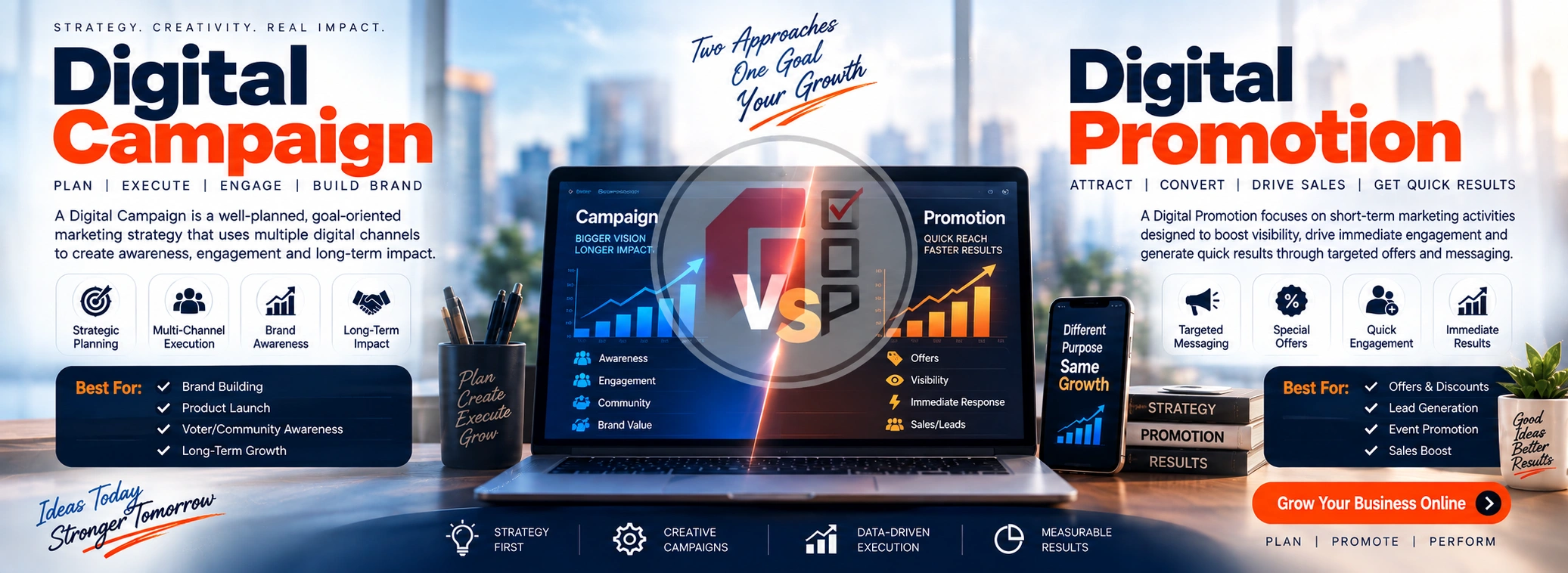
Digital Campaign and Digital Promotion Are Related — But Not the Same
Digital communication now involves websites, social media, videos, online advertising, search visibility, mobile communication and numerous content formats. Because many of these activities overlap, terms such as Digital Campaign, Digital Promotion and Digital Marketing are sometimes used without clearly distinguishing their roles.
The simplest distinction is one of scope. A Digital Campaign usually represents a wider strategic and operational programme. Digital Promotion generally represents a more focused activity designed to increase the visibility and distribution of particular communication.
Digital Promotion can therefore exist as an independent short-term activity, or it can operate as one important component inside a larger Digital Campaign.
A Digital Campaign is the complete journey. Digital Promotion is one of the mechanisms that can help distribute and amplify communication during that journey.
Digital Campaign vs Digital Promotion at a Glance
Digital Campaign
A planned and coordinated programme designed around defined communication or marketing objectives and executed through appropriate digital channels over a specified period.
- Broader strategic scope
- Defined campaign objectives
- Communication planning
- Content and creative coordination
- Multi-channel execution
- Promotion as one activity
- Ongoing monitoring
- Campaign-level reporting
Digital Promotion
A focused digital activity designed to increase the visibility, distribution or amplification of approved content, information, videos, events, announcements, products, services or public communication.
- More focused scope
- Visibility-oriented activity
- Content amplification
- Video promotion
- Event communication
- Social media promotion
- Paid promotion where appropriate
- Promotion-level reporting
What is a Digital Campaign?
A Digital Campaign is an organised programme in which multiple digital activities are planned and coordinated around one or more defined objectives. Rather than focusing only on a single post, advertisement or video, the campaign creates a framework for how communication will operate over time.
The exact structure depends on the project. A campaign may involve research, objective setting, communication planning, content calendars, creative production, website content, social media operations, videos, digital promotion, advertising coordination, monitoring and reporting.
A Digital Campaign can be short or long, but its defining characteristic is not simply duration. Its defining characteristic is that different digital activities are organised around a common objective and managed as one coordinated programme.
It establishes what the campaign is trying to achieve, what communication is required, which channels will be used, how activities will be coordinated and how performance will be reviewed.
Major Components of a Digital Campaign
Objective Definition
Clarifying what the digital campaign needs to accomplish and how its activities will support the overall communication requirement.
Digital Strategy
Establishing the broad campaign approach, channel roles, communication priorities and execution framework.
Content Planning
Organising themes, content requirements, important dates, publishing schedules and campaign activities.
Creative Coordination
Coordinating approved graphics, videos, copy, information assets and other digital creative material.
Channel Execution
Managing the operational distribution of approved communication across appropriate digital channels.
Digital Promotion
Amplifying specific campaign communication through suitable organic or paid promotional activities.
Campaign Monitoring
Reviewing aggregate activity and available platform information throughout the campaign.
Performance Review
Comparing available campaign information with objectives and identifying operational observations.
Reporting
Consolidating campaign activity and available aggregate performance indicators into structured reports.
What is Digital Promotion?
Digital Promotion is more specifically concerned with increasing the online visibility and distribution of approved communication. The item being promoted may be a social post, video, event, programme, announcement, product, service, article or another form of digital content.
Promotion can involve organic distribution, paid advertising coordination or a combination of suitable promotional methods. It may run independently for a specific communication requirement or be integrated into a larger Digital Campaign.
For example, an organisation may already have a complete communication strategy and simply need additional online visibility for an upcoming programme. In that situation, Digital Promotion may be the more appropriate service rather than creating an entirely new Digital Campaign.
Its primary role is to help approved communication receive organised online distribution through appropriate channels.
What Can Digital Promotion Include?
Social Media Promotion
Organised distribution and amplification of approved social media communication.
Video Promotion
Promotion of approved videos, short clips, interviews and programme highlights.
Event Promotion
Online communication before, during or after approved events, meetings and programmes.
Content Amplification
Structured promotion of approved posts, articles, information and digital communication.
Paid Promotion
Coordination of lawful paid promotional activity according to project and platform requirements.
Promotion Monitoring
Reviewing available aggregate delivery and performance indicators for promotional activity.
Digital Campaign vs Digital Promotion: Key Differences
The following comparison provides a practical way to understand where the two approaches differ and where they overlap.
| Comparison Point | Digital Campaign | Digital Promotion |
|---|---|---|
| Primary Role | Manage a broader coordinated digital programme. | Increase visibility and distribution of specific communication. |
| Scope | Broad and strategic. | Focused and promotional. |
| Planning | Usually begins with campaign objectives and strategy. | Usually begins with identifying what needs promotion. |
| Content | May require an ongoing content and creative programme. | Can promote existing approved content or newly prepared assets. |
| Duration | Can operate across multiple phases over a longer period. | Can be short-term, event-specific or ongoing. |
| Channels | May coordinate several digital channels as part of one strategy. | Uses suitable channels required for the promotional objective. |
| Social Media | May include ongoing channel and content operations. | Can focus specifically on social content amplification. |
| Video | Video may form one part of the overall campaign content strategy. | Can focus directly on distribution and promotion of selected videos. |
| Events | Events may be integrated into a broader communication calendar. | Can be used specifically to promote an event or programme. |
| Paid Advertising | Can be one component of the campaign execution plan. | Can be used specifically to amplify approved communication. |
| Monitoring | Campaign-level monitoring across relevant activities. | Monitoring focused on promotional delivery and available metrics. |
| Reporting | Broader campaign activity and performance reporting. | Focused promotion and content-performance reporting. |
| Best Suited For | Coordinated multi-activity digital communication. | Focused online visibility and content amplification. |
The Biggest Difference is the Level of Planning
A Digital Campaign normally begins at a higher planning level. The organisation first identifies the broader communication objective and then determines which digital activities are required to support it.
Digital Promotion usually starts with a more immediate question: what approved content, event, programme, announcement or communication needs additional online visibility?
Digital Campaign Question
“How should our complete digital communication programme be planned and coordinated over the campaign period?”
Digital Promotion Question
“How should this particular approved communication be distributed and promoted online?”
Short-Term Promotion vs Coordinated Campaign Timeline
Duration alone does not define the difference, but it often illustrates how the services are used.
A Digital Promotion activity may be organised around one announcement, video, launch, meeting or event and therefore operate for a relatively short period. A Digital Campaign may contain several such activities distributed across a broader calendar.
Do Digital Campaign and Digital Promotion Use Different Platforms?
Not necessarily. Both can use many of the same digital channels. The difference is mainly how those channels are being used within the project .
Social Media
A campaign may manage ongoing communication, while promotion may amplify selected posts or activities.
Video Platforms
Campaign planning may define a video programme; promotion can amplify individual approved videos.
Website
Campaigns may integrate website information while promotion can direct attention to relevant content.
Search
Search-related activities may support wider campaign visibility or specific promotional requirements.
Mobile Communication
Mobile-compatible communication may be coordinated within either approach where appropriate.
Digital Advertising
Paid advertising may support either a complete campaign or a focused promotional requirement.
Digital Campaign vs Digital Promotion Examples
Practical examples make the distinction easier to understand.
Digital Campaign: A company launches a new product and develops a multi-week programme involving launch communication, website content, social posts, product videos, publishing schedules, digital advertising, monitoring and reporting.
Digital Promotion: The company already has its launch strategy but wants to increase online visibility for the launch video and announcement during the release period.
Digital Campaign: An organisation develops a complete digital communication programme around a series of public events, including schedules, creative content, videos, event updates and post-event communication.
Digital Promotion: The organisation needs additional online visibility for one specific upcoming event.
Digital Campaign: A campaign team coordinates lawful public digital communication over a defined election period, including content planning, creative operations, public programme communication, publishing, monitoring and reporting.
Digital Promotion: Within that larger campaign, an approved public meeting announcement or campaign video receives focused online promotion.
When Should a Business Use a Digital Campaign?
A Digital Campaign is generally more appropriate when the organisation needs several digital activities to work together rather than requiring visibility for only one communication item.
- Launching a new product, service or initiative
- Running a multi-week or multi-month communication programme
- Coordinating several digital channels
- Managing recurring content and creative requirements
- Building a structured digital communication calendar
- Connecting content, promotion and monitoring
- Coordinating multiple digital activities under one objective
- Requiring campaign-level performance reporting
When Should an Organisation Use Digital Promotion?
Digital Promotion may be the better option when the communication strategy or content already exists and the primary requirement is additional online visibility.
- Promoting an upcoming event or programme
- Increasing visibility for an approved video
- Amplifying an important announcement
- Promoting selected social media content
- Supporting a short-term online communication activity
- Coordinating paid promotion where appropriate
- Distributing approved content across multiple platforms
- Monitoring promotion-level aggregate performance
Digital Campaign or Digital Promotion: Which Should You Choose?
The correct choice depends on the problem you are trying to solve. It is useful to begin with the scope of the requirement rather than the name of the service.
You Need a Complete Digital Programme
- You need strategy and execution together.
- Several channels need coordination.
- Content must be planned over time.
- Multiple digital activities must work together.
- You need ongoing campaign monitoring.
- You require campaign-level reporting.
You Need Focused Online Visibility
- Your communication strategy already exists.
- You have approved content ready for promotion.
- You need visibility for a specific event.
- You want to amplify selected videos or posts.
- The requirement is relatively focused.
- You need promotion-level monitoring.
Can Digital Campaign and Digital Promotion Work Together?
Yes. In many projects this is the most logical approach. Digital Campaign Management can provide the strategic and operational framework, while Digital Promotion supports the visibility of individual communication activities within that framework.
This means the relationship is not necessarily “Digital Campaign OR Digital Promotion.” It can often be “Digital Campaign WITH Digital Promotion.”
Where Do Organic and Paid Promotion Fit?
Organic and paid activities are promotional methods rather than separate substitutes for campaign strategy.
A larger Digital Campaign may use organic publishing, paid advertising or both. Similarly, a focused Digital Promotion programme may use appropriate organic distribution, paid amplification or a combination of the two.
Organic Digital Activity
Can include scheduled publishing, approved social communication, videos, website content and cross-platform distribution.
Paid Digital Promotion
Can include lawful digital advertising and amplification conducted according to the project, platform rules and applicable requirements.
How Performance Measurement Differs
Digital Campaign reporting normally looks at the broader programme, while Digital Promotion reporting is generally more closely connected to the performance of specific promotional activities.
Campaign-Level Review
- Overall digital activity
- Content publishing status
- Channel-level activity
- Video and content performance
- Campaign delivery
- Operational observations
- Aggregate reporting
Promotion-Level Review
- Available reach
- Impressions
- Video views
- Aggregate engagement
- Clicks where relevant
- Promotion delivery
- Content-level observations
Common Mistakes When Planning Digital Activities
Digital activity becomes difficult to coordinate when the purpose of the project is unclear.
Publishing content is one activity; a campaign requires broader planning and coordination.
Different channels have different formats, operational requirements and communication uses.
Promotion works best when approved communication and required platform formats are prepared first.
Without monitoring, teams may lack visibility into whether planned activities were delivered.
Digital performance depends on multiple factors and specific outcomes cannot be guaranteed.
Digital Campaign vs Digital Promotion in Election Campaigns
The same distinction applies to lawful election-related digital communication. A Digital Election Campaign may coordinate approved public communication across a defined campaign period, while Digital Promotion can support the distribution of specific approved campaign information, public-event announcements or videos.
For example, a campaign may maintain an overall digital communication calendar containing multiple public activities. Promotion of one approved public meeting announcement can be treated as an individual promotional activity within that larger framework.
Election-related digital activities should comply with applicable election requirements, advertising rules and platform policies. Public communication and promotion should not rely on sensitive personal characteristics or inferred individual political preferences for targeting or exclusion.
How Megamind Approaches Digital Campaign & Promotion Projects
The appropriate structure depends on the client's actual requirement. A project should not be expanded into a complete campaign when focused promotion is sufficient, nor should a complex multi-channel programme be treated as a series of disconnected promotional activities.
Megamind can structure the project around the required level of planning and execution — from focused digital promotion through to broader digital campaign coordination.
Digital Campaign vs Digital Promotion: The Simple Answer
If your requirement involves a broader digital objective, multiple communication activities, coordinated channels, content planning, ongoing execution and campaign-level monitoring, you are generally looking at a Digital Campaign.
If your strategy or communication already exists and your primary requirement is to increase the online visibility and distribution of selected approved content, videos, events or announcements, you are generally looking at Digital Promotion.
Digital Campaign manages the broader digital journey; Digital Promotion amplifies specific communication within or outside that journey.
Digital Campaign vs Digital Promotion – FAQs
A Digital Campaign is a broader coordinated programme involving objectives, strategy, content, channels, execution, monitoring and reporting. Digital Promotion focuses more specifically on increasing the online visibility and distribution of particular approved content, events, announcements, videos or communication.
Yes. Digital Promotion can operate independently for a specific requirement, but it can also function as one component of a larger Digital Campaign.
A Digital Campaign is a planned and coordinated programme that uses appropriate digital channels, content and operational activities to work toward defined communication or marketing objectives over a specified period.
Digital Promotion is the organised online distribution and amplification of approved content, information, videos, events, announcements, products, services or public communication through appropriate digital channels.
Digital Campaign is generally broader because it can include planning, content, platform management, promotion, monitoring and reporting. Digital Promotion normally focuses on visibility and amplification.
Yes. Digital Promotion may be used for short-term requirements such as an event, announcement, video, launch or specific communication activity.
Yes. Depending on its objectives, a Digital Campaign may operate for days, weeks or several months with multiple phases and activities.
It can. A comprehensive Digital Campaign may include communication planning, content calendars, creative coordination, publishing, promotion, monitoring and reporting.
Yes. Social media promotion can be an important part of Digital Promotion depending on the communication objective and selected channels.
Yes. Videos, short-form clips, interviews, event highlights and other approved video content can be distributed and promoted through suitable digital channels.
Depending on the project and applicable platform rules, paid digital advertising may be used as an operational component of either a broader Digital Campaign or a focused Digital Promotion programme.
Measurement depends on campaign objectives and may use aggregate indicators relating to content delivery, website activity, video performance, engagement, campaign operations and other relevant platform metrics.
Depending on the platform, available aggregate indicators such as reach, impressions, views, engagement, clicks and content delivery may be reviewed.
If the requirement is primarily to increase awareness and online visibility around one event, Digital Promotion may be sufficient. If the event forms part of a larger communication programme, it may be integrated into a Digital Campaign.
A structured Digital Campaign is generally more appropriate when communication requires long-term planning, multiple content themes, coordinated channels, ongoing execution and performance review.
Yes. A Digital Campaign can provide the overall strategy and operating framework while Digital Promotion supports the visibility and amplification of individual campaign activities.
No. They may support businesses, brands, organisations, institutions, public programmes and other lawful communication initiatives.
They may support lawful public election communication and campaign operations subject to applicable election requirements, advertising rules and platform policies.
No. Performance varies according to content, timing, platform conditions, budget, competition, audience response and other factors.
No. Digital Campaigns can improve the structure and coordination of communication activities, but they cannot guarantee specific commercial, public or election outcomes.
The organisation should define the objective, communication requirements, project duration, available content, relevant channels, responsibilities and measurement framework.
The organisation should identify what needs to be promoted, the communication period, suitable platforms, approved assets and the performance information that will be reviewed.
Yes. A content or promotion calendar can help organise publishing schedules, events, creative requirements and promotional activity.
Different platforms support different formats and communication behaviours. Platform selection should therefore reflect the objective, content and operational requirements of the project.
Megamind can support structured digital campaign planning, content and creative coordination, digital promotion, multi-platform execution, monitoring and aggregate performance reporting according to the agreed project scope.
Choosing the Right Digital Approach
Digital Campaign and Digital Promotion should not be viewed as competing concepts. They solve different levels of the same broader communication challenge.
Digital Campaign Management is appropriate when an organisation needs a coordinated programme involving strategy, content, multiple channels, execution and ongoing monitoring. Digital Promotion is appropriate when the immediate requirement is focused distribution and amplification of approved communication.
Understanding that distinction makes it easier to define the correct scope, organise resources and create a digital communication framework that matches the actual requirement.